THE SHORT ANSWER
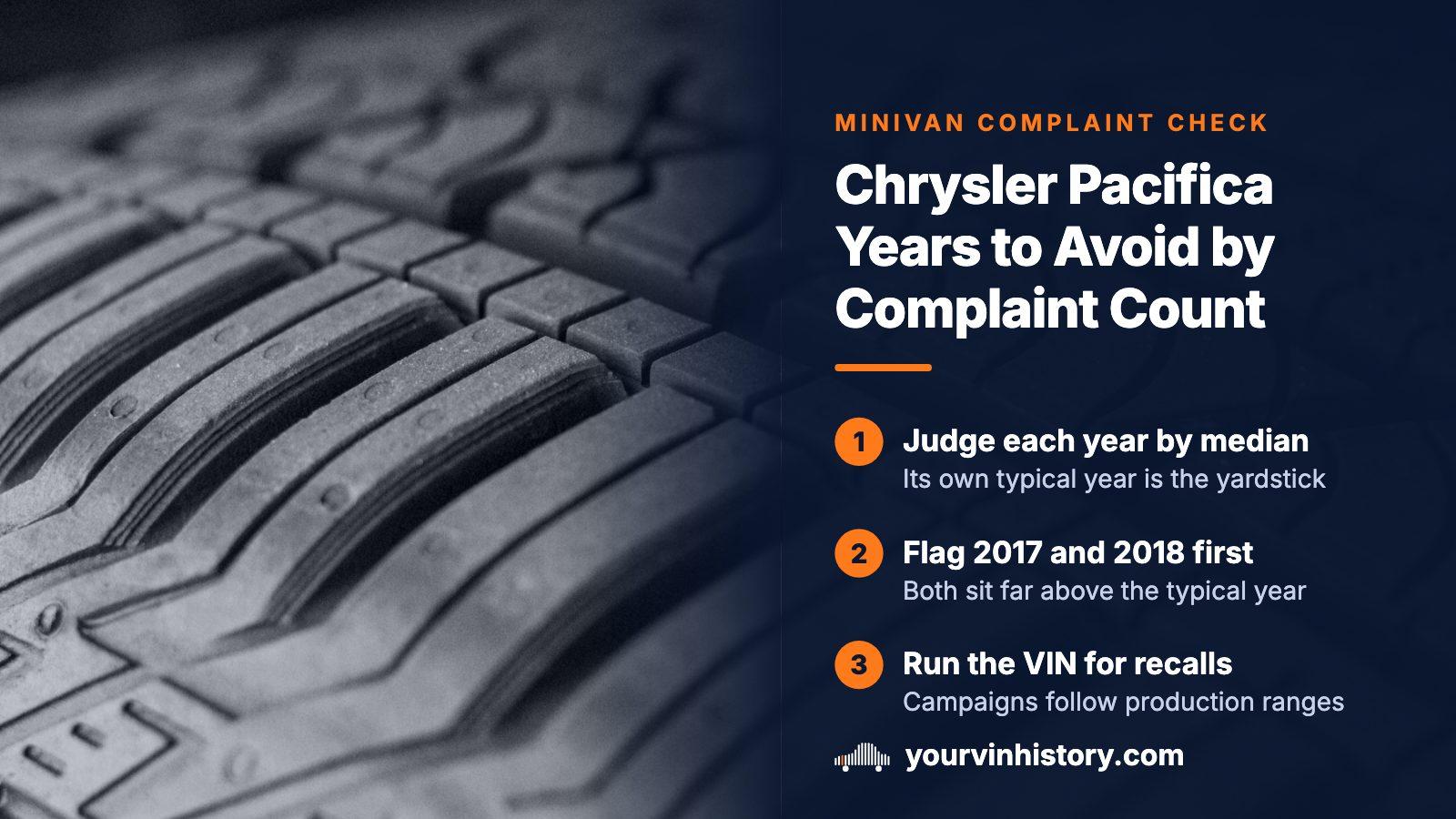
Two model years stand out: 2017 with 1,572 NHTSA complaints (4.31 times the Pacifica's own median of 365) and 2018 with 1,061 (2.91 times). The 2019 through 2022 years land near the median, and no year is clearly the cleanest. Engine is the biggest complaint area at 1,398 reports. A complaint count is not a failure rate, so a flagged year means inspect harder and negotiate, not rule the van out.
- Complaints on record
- 3,900 for model years 2017 to 2022
- Yearly median
- 365 complaints
- Peak year
- 2017, with 1,572 complaints
- Largest area
- Engine, 1,398 reports
How each Pacifica year was scored
Raw complaint totals mislead for two reasons. A popular year piles up more reports than a rare one of identical quality, and an older year has had longer to collect them. This page softens both effects by holding each model year up against the Pacifica's own typical year instead of against other vehicles. That typical year, the median across 2017 to 2022, is 365 complaints.
The counts come from NHTSA's complaint and recall filings for the six model years. Duplicate filings were removed using NHTSA's own ODI complaint number, and the data was pulled on 2026-08-16. A multiple above 1 means a year drew more complaints than the Pacifica's typical year, and a multiple below 1 means fewer.
All six Pacifica years in one table
Each row shows how many owners complained, how that count compares with the 365 median, how many recall campaigns NHTSA lists for the year, and a plain-word reading.
| Model year | Owner complaints | Times the median | Recalls | Plain reading |
|---|---|---|---|---|
| 2017 | 1,572 | 4.31× | 11 | Far above the typical year |
| 2018 | 1,061 | 2.91× | 12 | Far above the typical year |
| 2019 | 344 | 0.94× | 7 | Ordinary |
| 2020 | 222 | 0.61× | 5 | Ordinary, lowest count |
| 2021 | 385 | 1.05× | 7 | Ordinary |
| 2022 | 316 | 0.87× | 10 | Ordinary |
Only the first two rows sit far from the median. The remaining four run from 222 to 385 complaints, a narrow band beside the 1,572 in the peak year.
Why 2017 and 2018 draw the flags
The 2017 Pacifica is the peak: 1,572 complaints, 4.31 times the median, with engine and power train both prominent in that year's reports. The 2018 model follows at 1,061 complaints, 2.91 times the median, and engine again heads its list. These two years also hold the heaviest recall counts of the six, 11 for 2017 and 12 for 2018.
Read the pair as a pointer to where a mechanic should spend extra time, not as a ban. Plenty of sound vans exist in both years, and service history outweighs any model-year statistic. A 2017 with a thick folder of dated shop invoices can be a safer purchase than a 2021 with no paper trail at all. This site also keeps a separate record page for the 2017 model year, covering its recall campaigns and complaint breakdown.
The 2019 to 2022 vans: ordinary, with no clear winner
Four years land in the ordinary band: 2019 at 344 complaints (0.94 times the median), 2020 at 222 (0.61), 2021 at 385 (1.05) and 2022 at 316 (0.87). The 2020 van posts the lowest count, yet it sits close enough to its neighbors that the ranking does not crown it. With years this evenly matched, a single van's upkeep and condition count for far more than the year on its title.
Age is the second caution. Younger vans have had less time on the road to collect reports, so a modest count for 2021 or 2022 describes a record that is still being written. All six years in this data count as settled, and none is marked provisional, but a low number on a newer van is an early reading rather than a promise.
Recall counts measure something else
A recall is a defect the manufacturer has acknowledged and owes a repair for. A complaint is a single owner's unverified account. Since the two measure different things, a high recall count beside a low complaint count often means trouble surfaced early and was repaired while the van was under warranty. The 2022 Pacifica shows that pairing: 10 recalls against 316 complaints, or 0.87 times the median. The 2018 model shows the other pairing, with the highest recall count and a heavy complaint count too.
The repair is done at no charge by dealers, but only inside the federal rule's limits. Under 49 U.S.C. §30120(g), the maker's duty to remedy lapses 15 years after first sale. Campaigns also follow production ranges rather than whole model years, so one van from a listed year may be covered while its neighbor on the lot is not. Only the VIN settles it.
Where Pacifica complaints concentrate
NHTSA files every report under a broad component category. Across 2017 to 2022, the Pacifica's tallies run as follows:
- Engine: 1,398 reports, the largest area
- Electrical system: 1,236 reports
- Power train: 1,057 reports
- Unknown or other: 557 reports
- Steering: 457 reports
- Fuel or propulsion system: 120 reports
Read each line on its own and do not stack them into a total. The buckets are wide: they show which system the owner pointed at, not which part failed or why. Engine leads the whole run, and in the peak year of 2017 power train joins it as a prominent area. The counts alone cannot tell you what owners experienced, so the individual narratives on NHTSA's site are worth reading for a van you are considering.
How these counts can mislead you
- Sales volume skews the picture: a van that sells in huge numbers gathers more reports than a scarce one built just as well, so each year here is scored against the Pacifica's own median.
- Time on the road inflates counts too: older years have had longer to gather reports.
- Each complaint is one owner's belief about what happened. That adds up to a useful signal in bulk and says little about any single van.
- A complaint count is never a failure rate or a reliability score.
- No statistic describes the van in front of you: its history is a VIN question.
A bargaining chip, not a verdict
Every model year here contains carefully kept vans and neglected ones. Treat a flagged year as a reason to look longer and bargain harder, never as grounds to dismiss a van you have not seen.
What to inspect on a 2017 or 2018 Pacifica
The complaint areas point to a short inspection list. These steps suit any Pacifica, but the two flagged years deserve more time on each one.
- Ask for the service file before the keys. Dated invoices for engine and transmission work, oil changes and recall repairs say more than the model year.
- Start the van cold. Listen for unusual noises on start-up, watch the dash for warning lights, and have a mechanic scan for stored trouble codes.
- Drive until everything is warm. Gear changes should be smooth under light and hard throttle, since power train is a leading complaint area.
- Operate every electrical feature: lights, screens, windows, locks and any power doors or liftgate. The electrical system is the second-largest complaint area.
- Check the steering for looseness, noise or dash messages.
- Pay an independent shop for a pre-purchase inspection that includes a lift.
Checking the exact van before you pay
A model year describes a group of vans, while a VIN identifies one. Enter the 17-character VIN into NHTSA's recall lookup, which costs nothing, to see which campaigns are open on that van. Then check the title through the federal NMVTIS system, and run NICB's VINCheck, a no-cost screen for theft and total-loss records.
A yourvinhistory report brings title brands, accident records, odometer readings, liens and open recalls together after a free preview, with its NMVTIS title records supplied by ClearVin LLC, an approved NMVTIS data provider. If the van passes and sits in a flagged year, use the flag in the price conversation and ask the seller for proof that recall repairs were completed.
Where this information comes from
- NHTSA: Vehicle safety and complaints — Home of the consumer complaint database that supplies every owner-report count and model-year total used on this page.
- NHTSA: Recalls — Where open recall campaigns can be looked up by VIN, and the basis for the recall counts listed by model year.
- NMVTIS: Vehicle history record check — The federal title-record system for one van's title history, which no model-year statistic can show.
- NICB: VINCheck — A no-cost screen for theft and total-loss records on a specific VIN.
Sources and photos: Facts checked against the sources above in October 2026. Photo by Yvette S on Unsplash; diagrams by YourVINHistory.
Keep reading
- 2017 Chrysler Pacifica recalls: 11 campaigns and 1,572 complaintsThe peak year in detail: its recall campaigns and the components owners complained about.
- Dodge Grand Caravan years to avoid: 2008, 2016 and 2010 lead the complaintsA fellow minivan ranked by the same median method, handy for a like-for-like comparison.
- Recall check by VINStep-by-step recall lookup for the exact van, since campaigns follow production ranges.
- ChryslerWhat each position of a Chrysler VIN says about the van's build and model year.
Frequently asked questions
Which Chrysler Pacifica years should I avoid?
Treat 2017 and 2018 with the most caution, since they draw 1,572 and 1,061 complaints against a median of 365. Caution does not mean refusal. Plenty of vans from both years run well, so the sensible response is a longer inspection, the full service file and a price that reflects the extra uncertainty.
Are some Pacifica model years more reliable than others?
The data cannot rank reliability. Complaint counts are owner reports, not failure rates, and 2019 through 2022 all sit near the median without one clearly lowest. The 2020 model has the smallest count at 222, but that gap is too narrow to crown it. Judge a specific van by its records and a mechanic's report.
What do Pacifica owners complain about most?
By category, engine leads with 1,398 reports, followed by the electrical system at 1,236 and power train at 1,057. These are NHTSA's broad buckets, so they show which system owners pointed at rather than one failing part. On any year, a mechanic should look at the engine first, then gear changes and electrical features.
Does a high recall count make a Pacifica a bad buy?
Not by itself. A recall means the manufacturer acknowledged a defect and owes a repair, so a long list can reflect problems being found and fixed. What matters is whether the work was done on the van in front of you. The 2018 model lists 12 recalls and 2020 lists 5, but only the VIN lookup shows what is open.
How do I check whether a Pacifica has open recalls?
Enter the 17-character VIN in NHTSA's recall lookup, which lists campaigns still open on that exact van. Dealers repair them at no charge, within the limits of 49 U.S.C. §30120(g), which stop the free remedy once a van is 15 years past its first sale. Ask the seller for paperwork proving completed repairs instead of taking a verbal assurance.
Now check the car itself
The guide explains what to look for. The report shows what this VIN has on record.