THE SHORT ANSWER
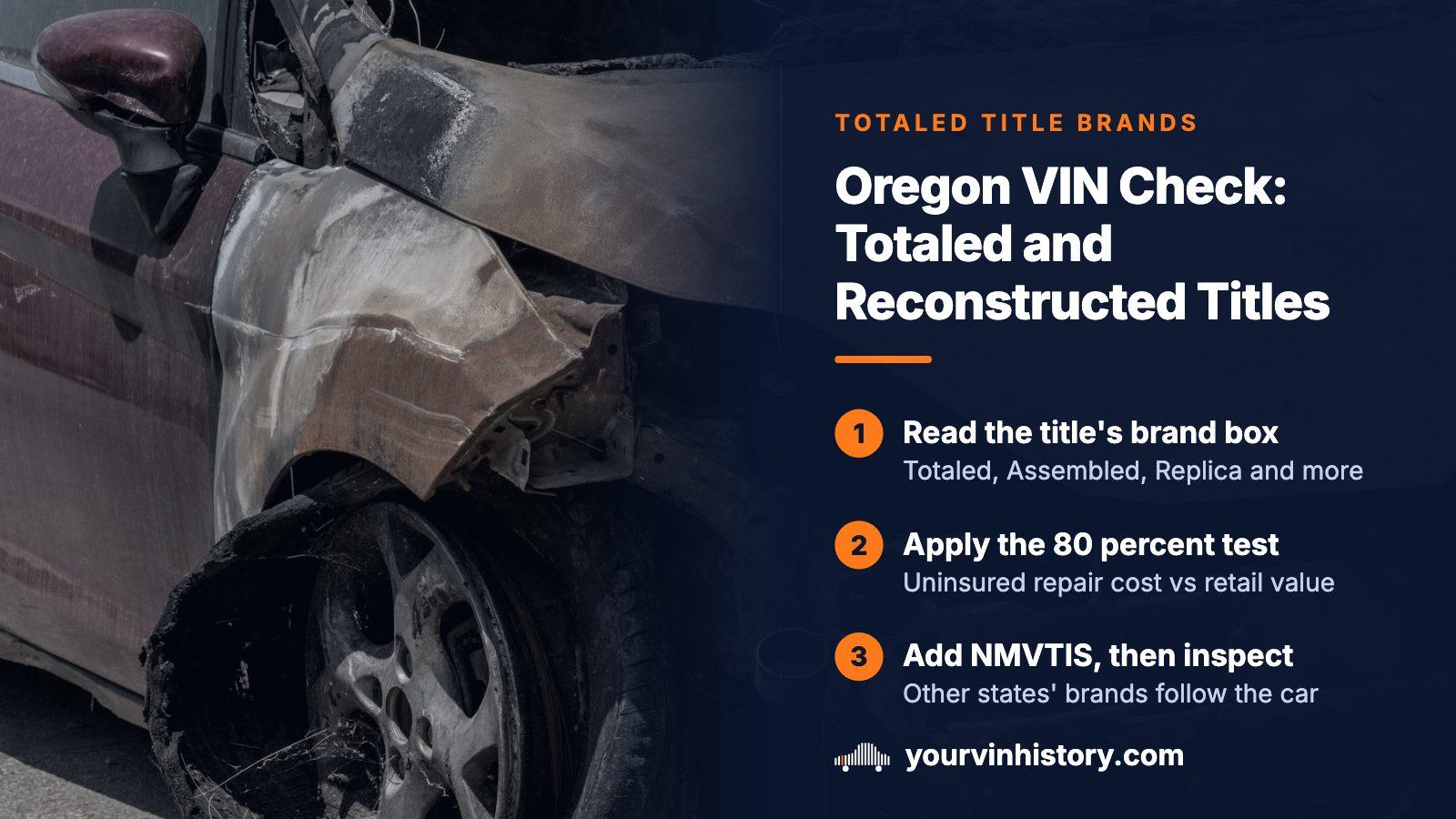
Decode the VIN, run NHTSA's recall lookup and the NICB VINCheck, then read the Oregon title's brand box for Totaled, Assembled, Reconstructed, Replica, or Branded followed by a state name. Oregon counts a vehicle as totaled when an insurer writes it off, or when uninsured damage would cost at least 80 percent of its pre-damage retail value to repair. Finish with the national NMVTIS title record and a hands-on inspection.
- Uninsured damage test
- Repair estimate of at least 80 percent of pre-damage retail value
- Title surrender
- 30 days from the declared loss
- Repaired wrecks
- Titled assembled, reconstructed or replica, with Totaled added
- Salvage title
- Cancels the existing registration when issued
Why an Oregon title needs a different kind of reading
Most buyers train themselves to hunt for three words on a title: salvage, rebuilt, junk. Oregon's DMV works from another list. Its brands include Totaled, Reconstructed, Replica and entries that carry a state name, and Assembled is one more designation for vehicles that fit certain definitions. Someone who scans only for rebuilt can read an Oregon title top to bottom and call it clean.
So the check has two jobs: reading the paperwork in the state's own words, and looking past it. A title speaks only for records that reached the DMV, and a car's earlier life elsewhere, or damage nobody reported, may live in other places.
Three ways a vehicle becomes Totaled in Oregon
DMV's handbook defines the term through three situations. Two of them work without any insurance payout, which is what sets Oregon apart from states that wait for a claim.
- An insurer that owes the loss declares the vehicle a total loss, or takes possession of it or title to it. Damaged and stolen vehicles both count.
- A stolen vehicle stays unrecovered for 30 days after the theft and no insurer covers the loss.
- A vehicle suffers damage that no insurer covers, and the estimated repair cost is at least 80 percent of its retail market value before the damage.
After a total loss is declared, the owner has 30 days to hand the title over, either to DMV or to the insurer. An owner who will not drive the vehicle can ask for a salvage title, unless the vehicle was declared junk or scrap. Even if nobody repairs it, the vehicle must be retitled because of its totaled status.
The 80 percent test for damage nobody paid out on
In many places, serious damage reaches a record only when an insurer processes a claim. Oregon adds a route that does not wait for one. The damage must be uninsured, and the repair estimate must reach at least 80 percent of the vehicle's retail market value just before the damage.
The yardstick is the value before the crash, not the value of the wreck. That keeps the test proportional to the car: a modest hatchback and a luxury sedan face the same ratio, not one fixed dollar line. Four-fifths of a car's worth is close to replacement cost, so a Totaled brand points to something serious, not a dented door.
A definition is not a database, though. A privately repaired wreck meets the test on paper, but a brand lands on a title only when the car passes through a DMV transaction or the loss is reported. Treat the rule as a reason to read titles closely, not proof that every uninsured wreck was branded.
Decoding the words in an Oregon title's brand box
Keep this table beside you when an Oregon title lands in your hands. It follows DMV's published brands and vehicle categories.
| On the Oregon title | What DMV says it means |
|---|---|
| Totaled | The vehicle met the state's totaled definition, insured or not. It is added on top of any other designation. |
| Assembled | A body resembling no particular year, model or make, on a vehicle neither factory built nor rebuilt by a manufacturer. |
| Reconstructed | A body that mostly is one particular year, model and make, on a vehicle that is neither factory built nor a replica. |
| Replica | A body built to reproduce another vehicle of a given year and manufacturer. The title shows the year and make it resembles. |
| Branded plus a state name | Oregon received a title from another state that listed a damage brand. |
| NONE | An out-of-state title with no previous brands. |
Assembled, reconstructed and replica are legal vehicle categories, so kit builds and reproductions that never saw a collision carry them too. DMV titles vehicles that way when they meet the totaled definition or are sold under certain laws. On a late-model production car, ask which reason applies.
How a wrecked Oregon car gets back to a regular title
The route from wreck to road has defined stops, and each leaves paper you can ask to see.
- The vehicle is declared totaled and the title goes to DMV or the insurer.
- DMV issues a salvage title. It names the owner but lists no lienholders or lessors, and it follows the frame or unibody if those parts change hands.
- Repairs are completed.
- The owner applies for a regular title as an assembled, reconstructed or replica vehicle, handing back the salvage title.
- A vehicle titled for the first time in one of those categories needs a VIN inspection by DMV or a designated law enforcement agency.
- The new title carries the word Totaled in addition to the designation.
Step four asks for title documents, a certification form and original bills of sale or equivalent proof for each major part. Those establish identity and ownership. None is a workmanship exam, so repair quality remains a question for your own mechanic.
Registration, trip permits and the bill of sale to insist on
Issuing a salvage title cancels the vehicle's existing registration. DMV cannot register it, and it may not run on Oregon highways until its owner applies for a new title in one of the three rebuilt categories, unless it carries a valid trip permit. Without that permit, a salvage-titled car should leave on a trailer.
Any business or individual who declares a vehicle totaled must also give the buyer the salvage title.
When the title went in and no salvage title came out
In that case the seller owes you a bill of sale. DMV's handbook says it must state that the vehicle is totaled, that the title was surrendered, that the plates and registration are no longer valid, and that the vehicle must be retitled as assembled, reconstructed or replica (or is a recovered stolen vehicle that is not totaled because of damage). If those statements are missing, stop and ask questions.
Stolen cars and the 30-day line
Theft can produce a Totaled brand even when no crash happened. If an insurer declares a stolen vehicle a total loss, salvage title rules apply. If nobody covers the loss, a vehicle missing for 30 days counts as totaled under Oregon law, and the owner should report the theft to law enforcement right away.
Recovery does not automatically undo that. An undamaged recovered car can avoid the totaled title, but only with evidence. For an insured theft, that means a written insurer statement, including the VIN, that the vehicle was not totaled under Oregon law. Without it, the car can only be retitled as totaled.
If a seller calls a car a recovered theft with no damage, ask which paper backs that up. Retitling involves a VIN inspection, which only DMV or a law enforcement agency may perform.
Cars that arrive in Oregon with another state's history
DMV does not read only its own files. If documents for an out-of-state vehicle show damage, DMV places a notation on the Oregon title. It may also brand from the vehicle's NMVTIS history, which the handbook says carries fuller brand history than other providers.
Two details help a buyer. A title with several brands, or none with an Oregon equivalent, becomes Branded plus the previous state's name. And if an ownership document names an insurer as owner, or as an interim owner anywhere in the reassignment area, DMV adds a Totaled brand. Insurers titling their own fleet vehicles are the exception.
Some words stop a title outright. Crushed, destroyed, dismantled, hulk, junk, non-rebuildable, non-repairable, parts only, scrap and wrecker-only all mean DMV will not issue an Oregon title. A parts, crushed or scrap disposition in the national record blocks one unless the same reporting party later records a sale.
What an Oregon brand still cannot tell you
Oregon's wide definition describes cars; it does not inspect them. A collision fixed for cash by someone who never visited a DMV counter leaves no brand. A car arriving from a state whose rules reach only insurer payouts can carry uninsured damage that no jurisdiction recorded.
That is why a national title record belongs beside the state paperwork. A yourvinhistory report begins with a free preview by VIN, and the paid report adds title brands, accident and damage records, salvage and auction history, odometer readings and open recalls. Its title data comes from ClearVin LLC, an approved NMVTIS data provider.
Then put hands on the car. Salvage titles follow the frame or unibody, so have an independent mechanic examine the structure, welds and fasteners.
A five-step Oregon check before any money changes hands
- Compare the 17-character VIN on the car with the title and any bill of sale. Oregon requires the VIN on a title application to match the vehicle, so a mismatch is a stop sign.
- Run NHTSA's recall lookup by VIN and the NICB VINCheck for theft and salvage flags. Both are free tools run by others.
- Read the brand box for Totaled, Assembled, Reconstructed, Replica, and Branded with a state name. Ask what each word refers to.
- Pull the national NMVTIS-based title record, which holds the brands other states recorded.
- Have a mechanic inspect the structure, then settle the price with the brand in view.
Run the first two steps before you drive across town. They cost nothing.
Where this information comes from
- Oregon DMV: abandoned, stolen, totaled vehicles and title brands — Backs the 30-day title surrender, the salvage title option, the assembled, reconstructed and replica wording, and the note that Oregon uses no flood brand of its own.
- Oregon DMV: Chapter J, damaged and totaled vehicles — Supports the full totaled definition with the 80 percent test, the registration and trip permit rule, the bill of sale wording, and how out-of-state brands are treated.
- NHTSA: recalls — The federal VIN lookup for open recalls, which works separately from any state title brand.
- NMVTIS: vehicle history — The federal national title information system, built to deter title fraud, where brands recorded by other states can be found.
Sources and photos: Facts checked against the sources above in October 2026. Photo by engin akyurt on Unsplash; diagrams by YourVINHistory.
Keep reading
- Total loss threshold by stateSee how Oregon's uninsured-damage test compares with the thresholds other states use.
- What is a branded title?A wider look at title brand types beyond Oregon's own wording.
- Oregon platesWhat happens to the plates when an Oregon car is sold, and what a plate search can return.
- Buying a car out of stateWhich records follow a car across state lines, useful when a car reaches Oregon with a past.
Frequently asked questions
What does Totaled mean on an Oregon title?
It is the DMV's word for a vehicle that met the state's totaled definition. On later titles it appears alongside any assembled, reconstructed or replica designation, and a salvage title can show it alone. A kit build or reproduction titled in those categories for other reasons does not carry it.
Is a Lemon Law Buyback the same as a Totaled brand?
No. Lemon Law Buyback is a separate notation that Oregon's consumer warranty law requires when a manufacturer repurchases a vehicle because of a defect and titles it in its own name. The notation is permanently inscribed on the title, and later sellers must give the buyer a signed notice. It points to a defect history, not a crash.
Can I register an Oregon car that has a salvage title?
Not while it holds a salvage title. Registration can be applied for after the vehicle is rebuilt and an Oregon title is applied for, in the same transaction or later. DMV then assigns a new plate with a new expiration date, so a seller who says the old plates and registration will carry over is mistaken.
Does Oregon put a flood brand on titles?
Not of its own. The DMV says Oregon does not use a flood brand, and a flooded Oregon vehicle that meets the Totaled definition receives Totaled. Titles from other states are different: one can arrive carrying Flood plus that state's name. Check the national record for water damage.
What if a seller never turned in the title on a totaled car?
Anyone who acquires a totaled vehicle whose title was never surrendered must surrender it to DMV, with releases from every person or company named on it, and apply for a salvage title if the car will be rebuilt or sold. Failing to surrender the title is a Class A misdemeanor, so a seller who skipped the step deserves doubt.
Now check the car itself
The guide explains what to look for. The report shows what this VIN has on record.