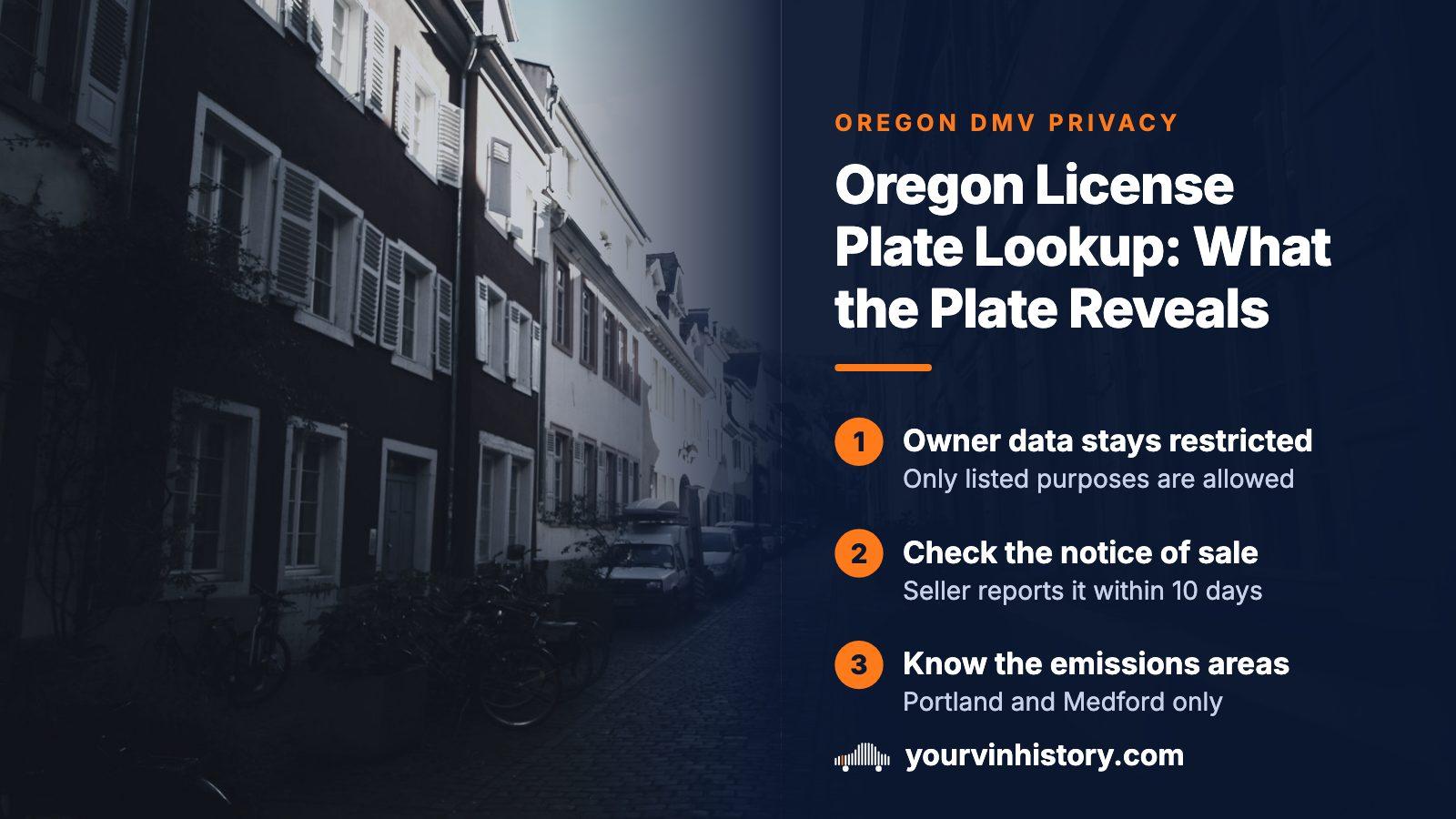
THE SHORT ANSWER
Not out of curiosity. The federal Driver's Privacy Protection Act lets Oregon DMV release owner details only for listed purposes, such as insurance claims, court cases and law enforcement, and a used-car buyer is not on that list. Plates also come off at sale, so they identify a car poorly. Use the 17-character VIN to check recalls, theft, salvage and title brands.
- Plates issued
- Two for most vehicles, one for motorcycles and trailers
- Notice of sale
- Seller reports it to DMV within 10 days
- Emissions testing
- Portland and Medford areas only
- Owner lookups
- Limited to uses the federal privacy law lists
What a plate search can return for an ordinary buyer
Type an Oregon plate into a search box and the best outcome is a vehicle description: a make, a model year, perhaps a VIN that was linked to the plate at some point. The registered owner's name and home address are a different matter. Those details sit in DMV records protected by a federal privacy law, and a website that sells them to any visitor is working from old scraped data or ignoring the rules.
Treat whatever a plate search shows as a lead to verify, never as a finding. Plates move. A match between a plate and a sedan tells you what the plate was attached to when the data was gathered, and the vehicle in front of you may have received it last week.
Who the Driver's Privacy Protection Act lets in
The Driver's Privacy Protection Act, found at 18 U.S.C. § 2721, tells state motor vehicle agencies not to hand out personal information from their files, then lists exceptions. Oregon DMV operates inside that frame. The exceptions that matter most:
- Government agencies, courts and police doing their jobs
- Insurers working claims, fraud cases, rating and underwriting
- Parties to court, administrative or arbitration cases, including serving legal papers
- Employers, and their agents and insurers, verifying a commercial driver's license holder
- Licensed investigators and security services acting for one of the listed purposes
- Notices to the owners of towed or impounded vehicles
- Requesters who can show the individual's written consent
Curiosity, a near miss in traffic and doubts about a seller's story are all absent from that list. If a plate matters because of a crash or a hit-and-run, give the number to the police and your insurer and let them request the record.
Plates at the sale: the seller makes the call
The DMV's page on buying and selling a vehicle tells sellers they may remove their license plates before the sale. That wording leaves the decision with the seller, which is why two Oregon cars sold in the same week can leave their driveways differently: one stripped bare, the other still wearing the old plates.
Some sellers leave plates on so the buyer can drive the car home. The DMV pages reviewed for this guide do not spell out whether a buyer may do that or for how long, so confirm it with the DMV instead of assuming. A seller who takes plates off may be able to reuse them on a different vehicle in the same category, but that errand belongs to the seller.
Either way, the plates are not your protection. A signed title, a filed notice of sale and your own prompt registration are. Ask what the seller intends to do with the plates before you pay, so the answer is not a surprise in the driveway.
The notice of sale and the seller who stays on record
According to the DMV, the seller remains the listed owner until the buyer completes the title transfer. Sellers are expected to report the sale through the DMV2U online service within 10 days, including the buyer's name and address. That duty belongs to the seller, yet it touches you twice.
First, your name and address go into a state record, so give accurate ones and write down the seller's phone number and full name. Second, a seller who has not filed is still on record as the owner of a car you are driving, which gives them every reason to press you to finish quickly. Meet that urgency halfway: start your title application right away, and ask the seller to tell you once the notice is in.
One plate or two: what the DMV issues
Oregon issues a pair of plates to most vehicles. Certain categories get a single plate that goes on the back.
| Vehicle | Plates issued |
|---|---|
| Cars, trucks and other standard vehicles | Two: one front, one rear |
| Motorcycles and mopeds | One, on the back |
| Trailers and campers | One, on the back |
| Antique and special interest vehicles | One, on the back |
In practice, a bare front bracket on an ordinary car is worth a question. The owner may have skipped the plate, but the car may also have had a bumper replaced or repainted, so check paint match and panel gaps before you accept the explanation. Mounting holes alone prove nothing in a state that issues two plates.
Emissions testing happens in two metro areas
Oregon's DEQ runs its vehicle inspection program around Portland and around Medford. A covered vehicle registered inside either boundary must be tested, while one legally registered anywhere else in the state does not need an emissions test at all.
Coverage depends on type and age. In the Medford area the rule reaches vehicles 20 years old or less, and the Portland area applies a model-year cutoff instead. DEQ exempts newer model years, motorcycles, low-speed vehicles, fully electric vehicles and heavy-duty diesels.
For a buyer, that means location changes what you should ask. With a Portland or Medford seller, request the latest passing test and be wary of a registration that lapsed, which can point to a failed test or a check-engine light nobody fixed. A car from the coast or the east side might have gone its whole life without a test, so if you plan to register it at a covered address, learn what it will need before you buy.
No routine safety inspection, so nobody has vouched for the car
Beyond the emissions program, Oregon does not put passenger cars through a routine safety inspection. Brakes, tires, steering and rust get no state review at sale or renewal. A DEQ test does not fill the gap: it looks at emissions, and DEQ says it will not test a vehicle that poses a safety hazard.
That leaves the examination to you and an independent mechanic. Oregon's weather deserves a place on the checklist:
- Door drains and sunroof channels, where wet winters and damp storage leave moss, silt or stains
- Carpet and trunk floor, where a mildew smell is hard to hide
- Tailgates, fasteners and subframes on cars that lived near the coast, since salt air corrodes from the seams outward
The paperwork the DMV expects in a private sale
The DMV's buying and selling page describes what a clean private transfer looks like. Walk through it with the title in your hand:
- Compare the VIN on the title with the VIN on the car. They must match.
- Confirm every owner named on the title has released their interest, and that any lienholder has signed the front of the title or provided a separate signed release.
- Check that the seller has signed and dated the back of the title or a bill of sale.
- For newer vehicles, watch the seller write the odometer reading on the back of the title, then sign it together.
- If the seller's name is not on the title, require a bill of sale showing the VIN, a statement releasing interest, the seller's printed name, signature and the date of sale.
The DMV also states that a vehicle with an unpaid loan cannot be sold, donated or gifted, so an open lien is a stop sign rather than a detail to settle later. The page sets a deadline for the buyer's title application. Read it on the day you buy and put the date in your phone.
Buying in Oregon to register somewhere else
Oregon has no general sales tax, which pulls shoppers from neighboring states toward Oregon listings. The catch is that the price on the windshield is Oregon's price. Once the car lives at your address, your own state's tax, emissions and VIN-verification rules apply, and they can add cost and steps that the Oregon seller never mentions.
Washington and California residents are the common case, and each state has its own counter and its own rules for cars arriving from out of state. Read those rules before you hand over money, not after the car is parked at home.
Check the car by VIN, because the plate cannot vouch for it
The VIN stays with the car while plates come and go, so every useful history search starts with it. Three lookups from others cost nothing and take minutes: the NHTSA recall search for open safety recalls, the NICB VINCheck for theft and salvage flags, and a VIN decode to confirm the car matches its listing.
Those tools have gaps. A vehicle history report fills in title brands, accidents, odometer readings and auction records. This site offers a preview before you buy, then a one-time purchase, with title records from an approved NMVTIS data provider.
Read the VIN off the car itself
Take the number from the car, not only from the ad, and compare it with the title. A mismatch between the two is the one problem a plate search will never flag, and it is reason enough to walk away.
Where this information comes from
- Oregon DMV: Buying or selling a vehicle — Backs the seller's option to remove plates, the notice of sale, the title signatures, the odometer entry and the bill of sale contents.
- Oregon DMV: License plates — Backs which vehicles receive two plates and which receive one on the back, plus the options for replacing plates.
- Oregon DEQ: Vehicles tested and exempted — Backs the Portland and Medford testing areas, the Medford age rule and the list of exempt vehicles.
- GovInfo: 18 U.S.C. § 2721 (Driver's Privacy Protection Act) — Backs the ban on releasing owner information from motor vehicle records and the list of permitted uses.
- Bureau of Justice Assistance: NMVTIS — Explains the national title information system behind title history checks by VIN.
Sources and photos: Facts checked against the sources above in October 2026. Photo by Karwin Luo on Unsplash; diagrams by YourVINHistory.
Keep reading
- License plate lookupThe national rules on plate searches, permitted uses and the scams to avoid.
- Oregon VIN checkThe next step for an Oregon car: what its VIN record can show and what it can miss.
- Washington platesThe neighbor many Oregon cars cross into, with its own plate-and-sale rules.
- Buying a car out of stateWhich records follow a car over a state line and which stop at the border.
Frequently asked questions
Is it possible to find out who owns an Oregon plate?
Not as a private buyer. Oregon DMV releases personal details from vehicle records only for uses the federal privacy law allows, such as insurance claims, court cases and law enforcement. If a driver caused a crash and left, report the plate number to the police and your insurer, because they have a lawful route to the record that you do not.
Do Oregon plates stay on the car when it is sold?
That depends on the seller. Oregon DMV says sellers may remove their plates before the sale, so a car can change hands bare or still wearing them. If the plates stay on, ask the DMV how that affects your drive home, and begin your own title application as soon as you hold the signed title.
Does Oregon require a front license plate?
Most vehicles receive two plates, front and rear. Motorcycles, mopeds, trailers, campers, antique and special interest vehicles get one plate for the back. If plates are lost on a vehicle titled in your name, DMV2U is usually the quickest way to replace them, and a paper application by mail is the fallback.
Does Oregon require a smog test or a safety inspection?
Emissions testing applies only to covered vehicles registered in the Portland and Medford areas, and Oregon has no routine safety inspection for passenger cars. A car registered elsewhere in the state can sit for years without any official check, so a buyer there should budget for an independent mechanic.
What is the best way to research a used car's history in Oregon?
Start with the 17-character VIN. Compare the number on the car with the title and the listing, run the NHTSA recall search and the NICB VINCheck, then pull a title history to see brands from any reporting state. Because no safety inspection stands behind the car, records and a mechanic's exam have to do that job.
Now check the car itself
The guide explains what to look for. The report shows what this VIN has on record.