THE SHORT ANSWER
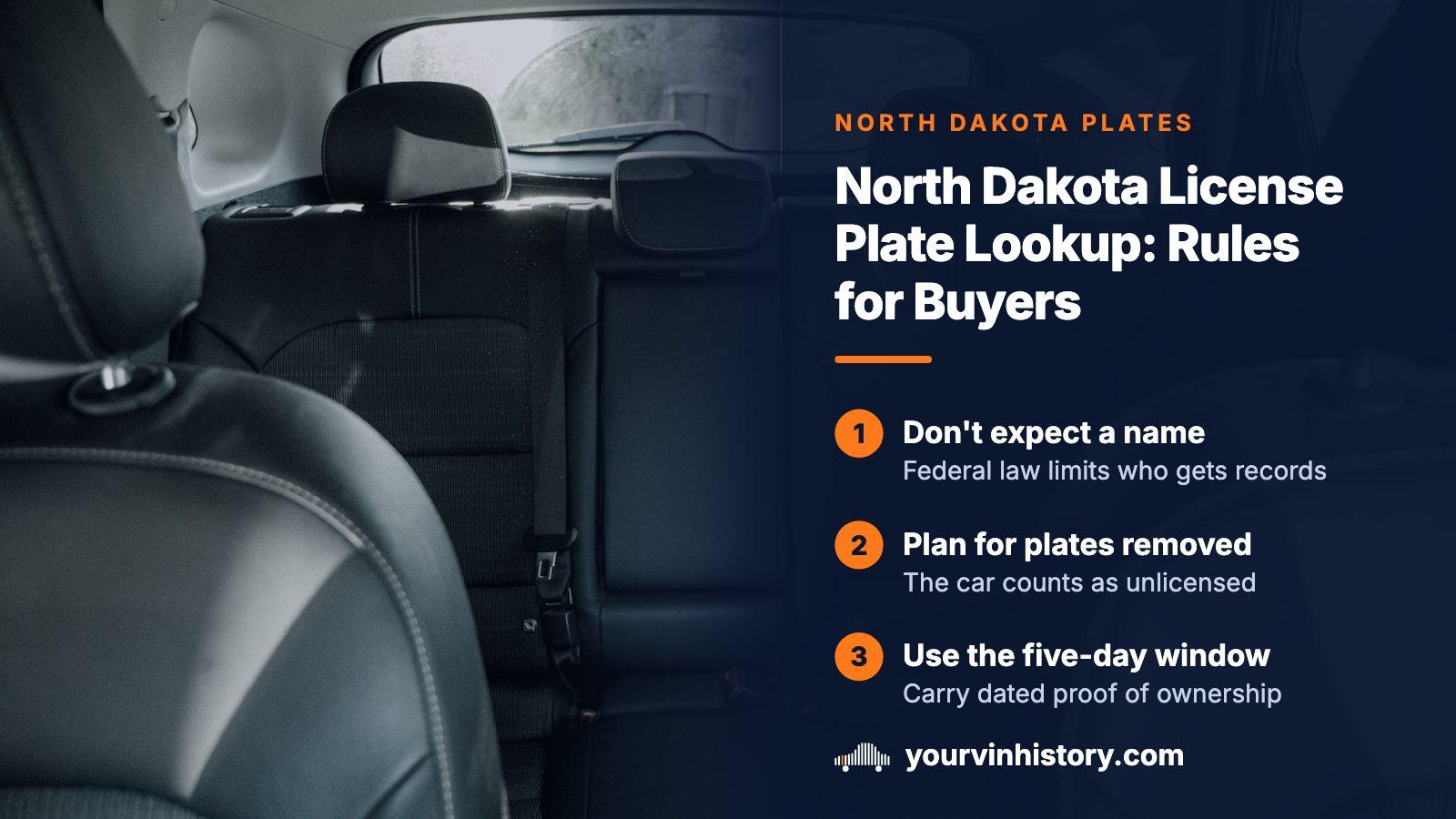
No public tool in North Dakota turns a plate number into an owner's name or address. The federal Driver's Privacy Protection Act limits that data to listed uses such as insurance claims and court cases. Plates belong to the registrant and come off when a vehicle is sold, which leaves the car unlicensed. A buyer may drive it for five days from acquisition while carrying dated proof of ownership, then pays a full year of registration.
- Owner records
- Released only for uses the federal privacy law permits
- At sale
- Seller removes the plates and the car counts as unlicensed
- Drive-home window
- Five days from acquisition, with dated proof of ownership in the car
- Buyer's fee
- A full year of license fee when the car is re-titled
What a North Dakota plate search can and cannot return
People search a plate for one of three reasons: they want to know who owns the car, what the car is, or whether it is legal to drive. North Dakota has no public tool that answers the first. State motor vehicle files carry names and addresses, and the Driver's Privacy Protection Act, codified at 18 U.S.C. § 2721, tells state agencies not to release that personal information except for the uses the statute spells out.
The second and third questions have better answers, though not from the plate. A plate number describes a registration: one person paid to run one vehicle for a period. It says nothing about title brands, accident history or odometer readings. Those records hang on the VIN, so most of this guide covers the paperwork around a plate.
The uses that do open an owner record
The federal law is a list of exceptions, not a blanket ban. A requester must fit one of them, and the state agency decides whether the request does. The ones most likely to touch an ordinary person:
- Courts, police and other government agencies doing their work
- Insurers handling a claim, checking for fraud or pricing a policy
- Parties to a civil, criminal or administrative case, including those serving court papers
- A tow operator or authority notifying the owner of a towed or impounded vehicle
- Employers confirming commercial driver's license details that federal rules require
- Licensed private investigators, but only for a purpose the statute already allows
- Anyone who can show the individual's written consent
Curiosity about a seller, a neighbor or a car parked outside a bar is not on that list. A buyer who wants to know whom the title was issued to should ask to see it and compare the names with the seller's photo ID.
Why the plate in a North Dakota listing photo proves little
North Dakota treats a plate as something the registrant owns, not something attached to the car. The state's transportation FAQ answers the seller's question bluntly: yes, the owner takes the plates off whenever the vehicle is sold, traded or otherwise transferred. From that moment the vehicle counts as unlicensed.
Two practical things follow. First, a plate in an advertisement, or on a car at a viewing, may belong to a seller about to move it to the next vehicle, so the number is a poor way to identify what you are buying. Second, a bare bumper at pickup is normal here and not evidence of anything hidden. Ask for the VIN, find it on the car and on the title, and make sure the two match.
Driving it home: the five-day allowance and its one condition
Collecting a car with no plates is not lawbreaking, as long as the timing and the paper line up. A new owner may drive within five days of the acquisition date with no registration showing on the vehicle. The condition is documentary: something dated that proves you own the car has to be inside it for the whole period. The state accepts any one of these:
- A dated bill of sale
- A dated copy of the certificate of title
- The back of the vehicle's current registration card
Without one of them in the glovebox the allowance does not cover you, and the date on the page shows an officer you are still inside the window.
Count from the acquisition date
The rule counts days from the date you acquired the car and says nothing about skipping weekends or closed offices. Plan the pickup so the title work can happen well before the allowance runs out.
When five days will not stretch far enough
The state expects some buyers to miss the window, so it offers a self-issuing temporary registration permit. It lasts longer than the allowance, and the buyer has to finish registration and titling before it ends. One copy is printed on the back of the seller's registration card, so leave that card with the car. The permit is also available from any Motor Vehicle office or online.
The online route asks for a North Dakota driver's license, so an out-of-state buyer should plan on the card or an office visit. Read the dates on the permit itself instead of trusting memory or a forum post.
Why registering a used car here costs a full year
Because the plates leave and the car is unlicensed, the Motor Vehicle Division charges a full year of license fee when the vehicle is re-titled. Whatever months the seller prepaid do not carry over to you, and nothing scales the fee down for a purchase made late in the cycle. Buyers from states where registration follows the car often budget for a part-year transfer and meet a bigger bill at the counter. Put the full amount in the budget next to the title fee.
| Situation | What it means for you |
|---|---|
| Buying a used car from a North Dakota owner | A full year of license fee at re-titling, with no prorated discount |
| Driving home inside the allowance | No registration on display, but dated proof of ownership stays in the car |
| Needing more time than the allowance gives | A self-issuing temporary permit, then registration and title before it ends |
| Selling your own car and buying another | Credit for unused months, if the plates move to the replacement |
What the seller does with the unused months
The system that charges you a full year also keeps the seller from losing what they paid. An owner who took the plates off at the sale can claim a credit toward the registration fee on a replacement vehicle, worked out from the unused months left when that replacement is acquired. The credit follows the person and the plates, not the car.
The state attaches conditions, which explains why sellers usually have a plan before they list:
- The plates must be transferred to the replacement vehicle, or there is no credit.
- The credit lapses with the plates, so it must be applied by their expiration date.
- It works on one replacement vehicle only. Any amount above the registration fee is lost and cannot pay title fees or taxes.
- The old vehicle has to be sold, traded or transferred before the replacement is acquired.
- Transferred plates stay off the road until the replacement is registered and a new registration card arrives.
For a buyer, a seller saying the plates are going on the next truck is the system working as designed, and the reason not to expect a plate to come with the car.
Paperwork to collect before you leave the driveway
Since the plate cannot vouch for the car, the documents have to. North Dakota's instructions to sellers are specific about what the title must carry, and a buyer can use them as a checklist.
- The seller's signature and date in the assignment section of the title, with your name, the price and the purchase date filled in.
- A current odometer reading on the title when the vehicle is less than ten years old.
- A damage disclosure statement from the seller when the vehicle is less than nine years old.
- A dated bill of sale, which doubles as your proof during the drive home.
- Every signature the title demands: where two owners are joined by "and," both sign, and where they are joined by "or," either may.
The law gives a seller fifteen days to deliver the endorsed title. Waiting for it in the mail is how people end up unable to register a car they have already paid for, so ask for it at the handover.
Use the VIN for what the plate cannot answer
The plate describes a registration that may already be heading to another vehicle. The 17-character VIN, stamped on the dash and printed on the door-jamb label and the title, is the identifier that stays with the car. NHTSA runs a free recall lookup by VIN, and NMVTIS, the national title system, is where brands reported by state agencies come together.
A yourvinhistory report is built on the VIN and shows title brands, accidents, odometer readings and open recalls, so a buyer sees the car's record instead of a plate's. The preview is free and quick enough to run before you meet the seller, not after the money has moved.
What you can still read from the plate itself
A plate is a small clue, not a dead end. The current standard North Dakota design shows a Badlands scene with a bison, three wheat stalks beside the state name, and the slogans Legendary and Peace Garden State. Its serial runs three numerals and then three letters. The state also lists personalized, blackout and patriotic plates, so a different look may mean an older issue or one of those programs.
Photograph the plate and the VIN together before the plate comes off, so your own notes tie the two. Then check that the registration card and the title show the seller's name. A mismatch is a reason to stop and ask before you pay.
Where this information comes from
- North Dakota: transportation FAQ — Backs the plate-removal rule, the dated-proof allowance, the temporary permit, the registration credit and the title-signing instructions for sellers.
- NDDOT: license plates — Describes the current standard plate and points to the personalized, blackout and patriotic plate programs.
- Driver's Privacy Protection Act, 18 U.S.C. § 2721 — The federal statute that sets which uses may receive personal information from state motor vehicle records.
- NMVTIS: National Motor Vehicle Title Information System — The national title database that consumers reach through approved data providers.
Sources and photos: Facts checked against the sources above in October 2026. Photo by NATHAN MULLET on Unsplash; diagrams by YourVINHistory.
Keep reading
- License plate lookupThe federal limits behind every state's plate search, and what paid lookup sites actually sell.
- North DakotaThe VIN side of a North Dakota purchase, including titling an older car that has no papers.
- Bill of sale for a carThe dated bill of sale is your proof on the drive home, and this shows what it should contain.
- Car title vs registrationWhy the registration behind a plate never shows a title brand.
Frequently asked questions
Can I find out who owns a North Dakota license plate?
Not through any public lookup. The federal Driver's Privacy Protection Act restricts owner details in state records to listed uses, and personal curiosity is not one of them. If a driver hit your car and left, give the plate number to the police and your insurer, who can use it lawfully. If you are buying, work from the VIN and the title.
Is it legal to drive a newly bought car in North Dakota without plates?
Yes, for a short time. The allowance runs five days from acquisition, and the car must carry dated evidence of ownership: a dated bill of sale, a dated copy of the title, or the back of the current registration card. Ask your insurer when coverage for the new car begins before you drive away.
What if I cannot title the car within five days?
Use the self-issuing temporary registration permit. It is printed on the back of the seller's registration card, available at any Motor Vehicle office, and offered online to holders of a North Dakota driver's license. It lasts longer than the allowance, but you must register and title the car before it ends, so note the printed date the day you get it.
Can a seller keep the plates and use them on another car?
Yes, and the rule is built for it. The seller transfers the plates to a replacement vehicle to claim credit for unused months. The credit covers one replacement only, lapses when the plates expire, and anything above the registration fee is forfeited. Those plates cannot be displayed until the new vehicle is registered and its registration card arrives.
Does a North Dakota plate show a salvage or rebuilt title?
No. A plate and registration show that fees were paid for a vehicle, not what has happened to it. Brands sit on the title record and in NMVTIS data from reporting states. Run the VIN, read the brand line on the paper title itself, and compare the two before you pay.
Now check the car itself
The guide explains what to look for. The report shows what this VIN has on record.