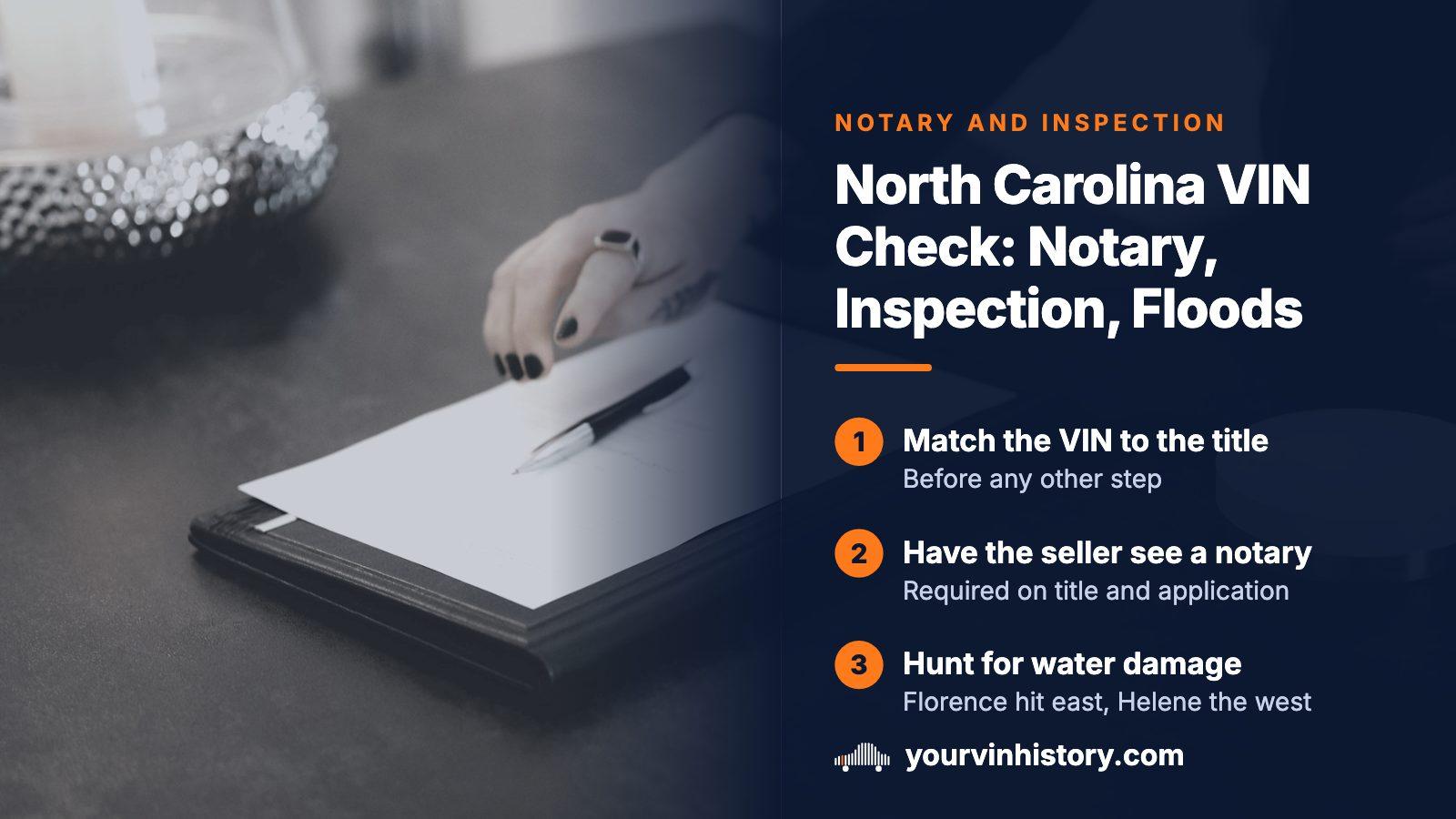
THE SHORT ANSWER
Decode the VIN and run the free federal lookups: NHTSA for open recalls and NICB VINCheck for insurer-reported theft, salvage and flood flags. Add a national NMVTIS title record from an approved provider to catch brands from other states. Then handle what is specific here: have the seller sign before a notary, find out the inspection status, and look hard for water damage, since storms have hit both the coast and the mountains.
- Notary
- Required on a North Carolina title and on the title application
- Inspection
- Annual safety check before registration; emissions only in certain counties
- Odometer statement
- Needed when the vehicle is under 10 years old
- Flood risk
- Florence hit the east in 2018; Helene later struck the western mountains
Match the VIN to the title before anything else
Start with the 17 characters, because every record you pull later hangs on them. Find the VIN at the base of the windshield and on the label inside the driver's door, then compare both against the number printed on the title, character by character. Any difference among the three is a reason to pause the deal until someone explains it.
Next, compare the name on the title with the person selling. A notary certifies who is signing; no stamp can repair a title that sits in someone else's name. Decode the VIN here too and confirm the year, make and engine against the listing.
The notary rule that trips up out-of-state buyers
NCDMV states that a North Carolina title must be notarized, and that both the original owner and the new owner fill in the information on its back. Its list of papers for buying from a private individual marks two documents as needing a notary: the title itself and the title application. Plenty of states dropped notarization long ago, so buyers from elsewhere, and some local sellers, sign in a driveway and consider the sale finished.
One wrinkle is worth knowing. For an out-of-state title, NCDMV says it recognizes that state's requirements. The notary rule therefore bites hardest when the car carries a North Carolina title. If the title came from another state, read what that state expects at signing, and call NCDMV when the paperwork looks half finished.
An unfinished transfer becomes your problem
A title signed in advance gives the notary nothing to witness. If the assignment was completed before you arrived, you may end up holding a document you cannot register, and the only fix is chasing the seller to redo it. Insist that the seller signs in the notary's presence.
Where and how to close the sale
Treat the notary as the fixed point and build the meeting around it. Banks and shipping stores commonly offer notary service, and a bank branch doubles as a safer place to move money than a parking lot.
- Compare the seller's photo ID with the name on the title before anyone signs.
- If a lienholder appears on the title, ask for the lien release. NCDMV lists it as required whenever liens are shown.
- Have the seller sign where the notary can watch, and complete your own portion at the same sitting.
- Bring the title application too, since it also needs a notary and a second trip is easy to avoid.
- Leave with the original title in hand, never a photo or a copy.
The other papers, and what registration asks for
A title and a notary are not the whole folder. For a private purchase, NCDMV's list adds an odometer disclosure statement, needed when the vehicle is under 10 years old, and a damage disclosure statement. The state's page lists a bill of sale only for dealer purchases, but write one for a private deal anyway. Include the VIN, price, date, and the full names and addresses of both parties, then keep a copy.
Highway-use tax is a separate item. NCDMV says it must be paid on a transfer, with an exemption certificate for transfers between spouses, between parent and child, and between stepparent and stepchild, when a North Carolina resident passes a North Carolina title to another resident. That certificate also requires a notary, so raise it before the signing appointment rather than during it.
Registration has prerequisites of its own. NCDMV requires continuous liability insurance from a North Carolina-licensed provider and says out-of-state policies are not accepted, so arrange coverage before your appointment. The car also has to have passed its safety inspection. Title applications take 10 to 15 business days to process according to the state's page, so do not expect the new title the same week.
Three lookups that cost nothing
Run these before you drive across town. A decode confirms what the factory built, which catches a seller describing a trim level the car never had. The NHTSA recall lookup, searched by VIN, lists open safety recalls. Recall repairs are normally done at no charge to the owner, but the federal free-repair rule has an age limit, so a very old car can fall outside it and a free repair is not guaranteed. Ask the manufacturer or a dealer if the model is that old.
The third is NICB VINCheck, which reports whether participating insurers have flagged a VIN as stolen and unrecovered, salvage or flood damaged. Read a clean result narrowly. It means no participating insurer reported the car, not that nothing happened to it. A mistyped VIN also returns nothing useful, another reason to read the number off the car itself.
Pulling the national title record
The lookups above are federal or insurer-fed, and North Carolina's DMV speaks for North Carolina titles. What none of them show reliably is a brand applied by another state before the car arrived. NMVTIS, the federal title database, fills that gap, and the Justice Department's NMVTIS site lists the approved providers that sell the records to the public. ClearVIN is on that list.
A yourvinhistory report takes its title records from ClearVin LLC, an approved NMVTIS data provider, and sets them beside accident records with a damage map, odometer readings, salvage and auction records with photos, liens, impounds and theft. A preview comes before any purchase. Even the best record holds only what someone reported, so damage that never reached an insurer or a reporting yard will not appear. Use the report to narrow the field, and a mechanic's hands to make the final call.
What the annual inspection tells you and what it hides
Few states still inspect every registered car each year, and this is one of them. NCDMV says a vehicle must pass an annual safety inspection, done by a licensed mechanic, before it can be registered or renewed. Certain counties add an emissions test at the same visit. That county list has shrunk over the years, so check the registration county on the NCDMV site rather than trusting an old article.
| A current inspection shows | It cannot show |
|---|---|
| The car recently passed a set safety checklist | Anything about the engine, transmission or title history |
| Someone kept it at inspection standard this year | Flood history, which the checklist is not built to detect |
| Where required, it met the emissions test | How the car will hold up next month |
A lapsed sticker deserves a question. NCDMV blocks registration until the car is inspected, and when the car cannot be driven to a station it may issue a temporary plate good for 10 days. The harmless answer is a car that sat in a garage. The costly one is a car that cannot pass, and that repair bill lands on you when you try to register it.
Water damage on both sides of the state
Hurricane Florence parked itself over the eastern part of the state in 2018, and floodwater reached vehicles across the coastal plain. Insured cars were declared total losses, branded and sent through the auction system. Cars whose owners never filed a claim left no insurance trail, and some were dried out and sold with clean titles. NICB warns about uninsured storm cars in general.
The old shorthand that the mountains are the dry half of the state no longer holds. Hurricane Helene later struck the western part of North Carolina, and the governor's office described the devastation there as unprecedented. A car that spent its life in the mountains deserves the same water inspection as one from Wilmington.
- Silt or grit in the spare-tire well and along the seat rails
- Corrosion on electrical connectors under the dashboard
- Water lines or fogging inside headlight and taillight housings
- Electrical faults that come and go without a pattern
- A heavy cleaner or air-freshener smell covering mildew
No single sign proves anything. Several together, on a car with a storm-zone past, justify walking away or paying a mechanic to look.
The order to do it in
Sequence matters. The cheap steps come first and the notary comes last, once you have decided the car is worth owning.
- Photograph the VIN on the car and match it to the title and the seller's name.
- Decode the VIN and look up open recalls with NHTSA.
- Search NICB VINCheck for theft, salvage and flood flags.
- Pull a national title record through an approved NMVTIS provider.
- Ask about the inspection status and the reason behind any lapse.
- Pay an independent mechanic to inspect it, using the water checklist for any car from a storm-hit area.
- Meet at a bank with the notary, the title, the title application, the odometer statement and a bill of sale.
- Insure the car and register it through NCDMV.
Where this information comes from
- NCDMV: Vehicle Titles — Backs the notarized North Carolina title, the rule for out-of-state titles, the liability insurance requirement and the title processing time.
- NCDMV: Vehicle Documents & Forms — Lists the papers for a purchase from an individual, which ones need a notary, the lien release and the odometer statement age rule.
- NCDMV: Safety Inspections — Explains the annual safety inspection, the emissions test in certain counties and the registration block when an inspection lapses.
- NMVTIS: Vehicle history reports — The Justice Department page naming the approved providers that sell national title records to the public.
- NICB: VINCheck — Free search of insurer-reported theft, salvage and flood flags, with the limits of what participating insurers report.
- NHTSA: Recalls — Open safety recalls by VIN, a lookup that does not depend on the title.
Sources and photos: Facts checked against the sources above in October 2026. Photo by Annika Wischnewsky on Unsplash; diagrams by YourVINHistory.
Keep reading
- North Carolina title checkThe state's title designations and the two routes to a salvage brand.
- Flood-damaged carsA fuller look at water damage, which a clean title often hides.
- North Carolina platesWhat North Carolina ties to a plate and what a lookup can return.
- NMVTIS reportWhat the federal title record contains and what it leaves out.
Frequently asked questions
How do I run a VIN check on a North Carolina car?
Read the VIN off the car, decode it, then search NHTSA for open recalls and NICB VINCheck for insurer-reported theft, salvage and flood. Add an NMVTIS record from an approved provider to catch brands from other states. NCDMV handles North Carolina titles and registration, but it does not replace those national sources, so use both.
Does a private car sale in North Carolina need a notary?
For a car with a North Carolina title, yes. NCDMV says the title must be notarized and marks the title application as a notarized document too. For another state's title, NCDMV says it recognizes that state's requirements. A seller who calls the notary optional is wrong about a North Carolina title, so book the signing before money moves.
What if the car I am buying is overdue for inspection?
NCDMV blocks the registration until the car is inspected, and it may issue a 10-day temporary plate if the car cannot be driven to a station. Because the car must pass before it can be registered in your name, get it inspected, or have a mechanic price what failing would cost, before you settle on a number.
Can I find out who owns a car from its license plate?
Not as a private buyer. The federal Driver's Privacy Protection Act restricts personal details in motor vehicle records to defined permitted uses, and shopping for a used car is not one of them. Photograph the plate and the VIN when you view the car, then run the VIN, since that is what the history records are keyed to.
Can a flooded car in North Carolina have a clean title?
Yes. Insured total losses get branded and show up in insurer-fed databases, but an owner who never filed a claim leaves nothing to trigger a brand. Run VINCheck and a national record, then check the car itself for silt, corroded connectors and moisture in the lamps. A mechanic who has seen flood cars will catch what a cleaning job missed.
Now check the car itself
The guide explains what to look for. The report shows what this VIN has on record.