THE SHORT ANSWER
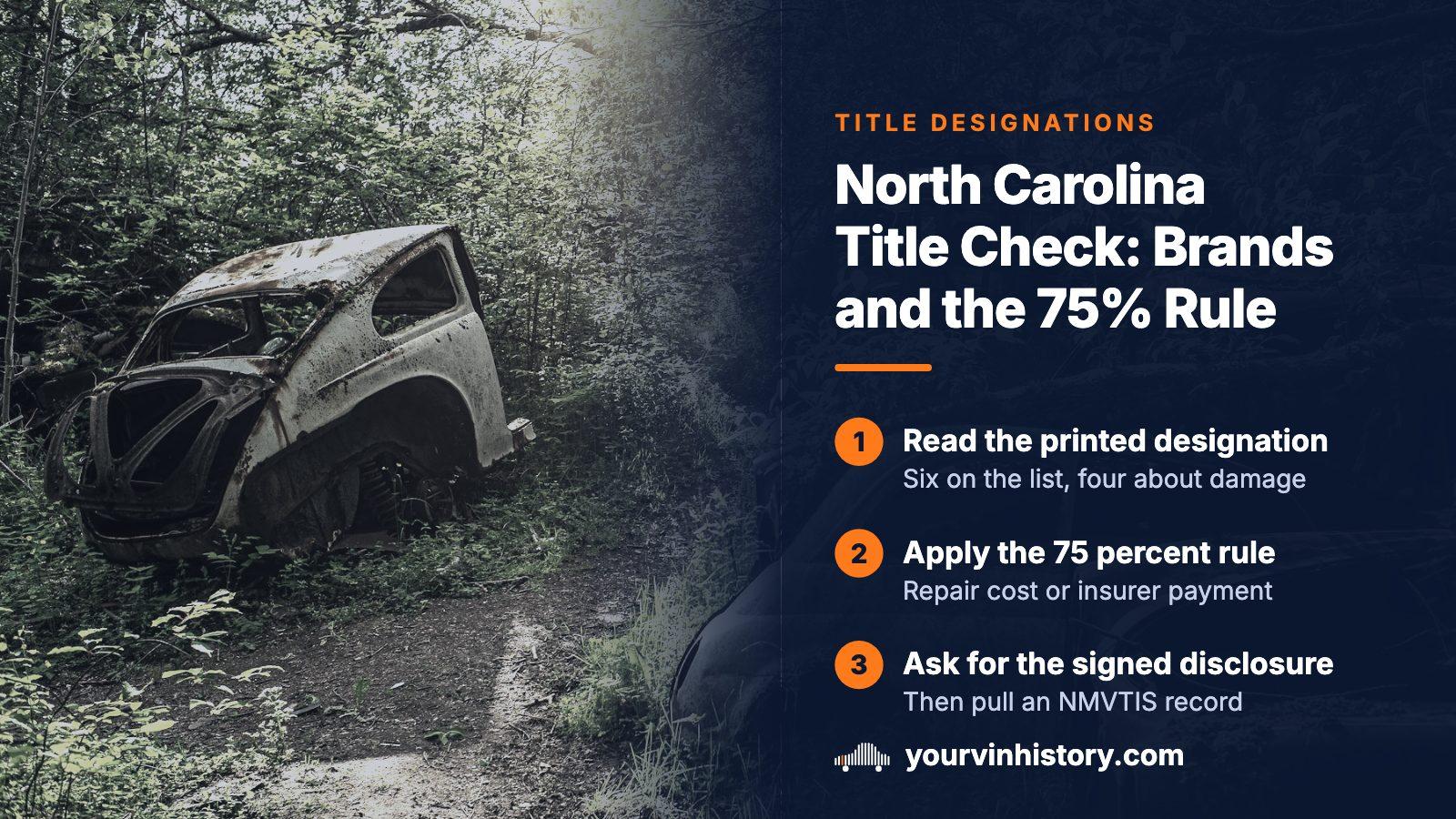
To check a North Carolina title, read the designation printed on it: salvage, salvage rebuilt, flood, reconstructed, junk or non-U.S.A. Salvage applies when repairs would cost more than 75 percent of fair retail market value, or when an insurer paid a claim above that share. Ask the seller for the signed damage disclosure form, then pull a national NMVTIS record to catch brands from other states.
- Salvage line
- 75 percent of fair retail market value, by repair cost or insurer payment
- Value source
- NADA Pricing Guidebook or a publication the Commissioner approves
- Designations
- Six on the DMV's list, four of them about damage or rebuilding
- Age split
- Six model years old or newer gets an anti-theft inspection
Six words the state can print on a title
North Carolina does not use one catch-all label for problem vehicles. The Division of Motor Vehicles defines six separate designations, and the word on your paper tells you which kind of history you are holding. Four describe damage or rebuilding: salvage, salvage rebuilt, flood and reconstructed. The other two concern identity and eligibility. A non-U.S.A. vehicle was built abroad for another market, and a junk vehicle cannot be titled at all.
| Designation | What the state means by it |
|---|---|
| Salvage motor vehicle | Damage past the 75 percent line, measured by repair cost or by an insurer's payment |
| Salvage rebuilt | A salvage vehicle that was repaired and then put through titling and registration |
| Flood vehicle | Water reached the vehicle and damaged the body, engine, transmission or differential |
| Reconstructed | Materially altered by adding, removing or swapping essential parts; glider kits and custom builds belong here |
| Junk vehicle | Cannot operate on public roads and is worth only parts or scrap |
| Non-U.S.A. vehicle | Built outside the United States and not meant by its maker for sale here |
Water damage and a parts swap point to very different inspections, so read the exact word before anything else.
Two separate ways to reach the salvage brand
The salvage definition has two triggers, and either one is enough. The first is an estimate-based test. If fixing the damage, counting parts, labor and whatever it takes to make the vehicle safe on public roads, would run past 75 percent of its fair retail market value, the vehicle is salvage. The second needs no estimate at all. If an insurance company has paid a claim larger than 75 percent of that retail value, the vehicle meets the definition on that basis alone.
It is easy to ask only about the first trigger. A seller can truthfully say the repair bill stayed modest while an insurer's payout told a different story. Put two questions on the table: what did the repairs come to, and did an insurer pay on this car, and how much? A clean answer to one leaves the other open.
The price list behind the percentage
A percentage means little without the figure it is applied to, and North Carolina names its source. Fair retail market values come from the NADA Pricing Guidebook or from another publication the Commissioner approves. That gives both sides a reference point instead of leaving the number to whoever argues loudest.
The word retail matters. Retail values run higher than trade-in or wholesale figures, so 75 percent of a retail number is a taller bar, and fewer damaged cars cross it than would if a wholesale value were used. A seller who says the damage fell well short of the threshold may be measuring against a lower figure than the state does. Ask which value they used.
A total loss decision is not the test
The repair-cost trigger applies regardless of any total loss ruling by an insurer. The state's threshold and the insurance company's business decision are separate things, and the gap runs in both directions.
- A car that no insurer ever handled can still meet the salvage definition on repair costs.
- An insurer calling a car a total loss does not by itself answer the repair-cost question, although a big enough payout can reach the brand through the second trigger.
- A seller who says the car was never totaled is describing an insurance outcome, not the legal category on the title.
The title records the category, so ask to see it.
Where the rules split at six model years
North Carolina handles newer damaged vehicles more strictly. NCDMV says a salvaged or damaged vehicle that is six model years old or newer needs an anti-theft inspection by the State Highway Patrol's Investigative Services Unit. The operative word is anti-theft. Treat the check as a look at identity and parts, not as an engineer's sign-off on the quality of the repairs.
Model years are counted inclusively: the year of manufacture is year one and the current calendar year is the last. The state also expects an insurer that pays a claim on a salvage vehicle to notify NCDMV within 10 days.
Older vehicles follow a different arithmetic. For a vehicle more than six model years old, G.S. 20-71.3 leaves the cost of replacing the air bag restraint system out of the repair total before the 75 percent comparison. A deployed air bag system can be a large line item, so on an older car a modest repair figure may not reflect everything that happened in the crash.
Salvage rebuilt, reconstructed and flood are different stories
Salvage rebuilt means the vehicle was salvage, got repaired, and went back through titling and registration. The damage happened and the car was fixed. Reconstructed describes something else: the vehicle was materially altered from its original construction by removing, adding or substituting essential parts, new or used. Glider kits and custom-assembled vehicles sit in this group, so a reconstructed brand is not always a crash story.
There is a wrinkle. NCDMV's branding rule says a salvage vehicle that was not inspected before being rebuilt is branded reconstructed, so that word can also stand in for an uninspected rebuild. Ask the seller which of the two applies.
A flood brand reads Water/Flood Damage Vehicle on the title. It is a different risk from collision damage and deserves its own inspection.
Junk and non-U.S.A.: the two that are not damage labels
Junk sits at the bottom of the ladder. The state describes a junk vehicle as one that cannot be operated on the highways and has no resale value beyond parts or scrap, and it says such a vehicle shall not be titled or registered. If a car is running in front of you while the paperwork calls it junk, one of the two is wrong, and only the paper carries legal weight.
Non-U.S.A. covers vehicles built outside the United States that the maker never intended for sale here, often called gray-market imports. The designation says nothing about crashes. It says the car began life under another market's rules. Match the VIN on the dash and the door-jamb label to the title.
The damage disclosure form a seller should hand over
NCDMV publishes the Damage Disclosure Statement, form MVR-181. State law requires a seller to disclose the listed items if he or she knows them, and the form warns that failing to do so can bring civil or criminal liability. The seller signs, the buyer acknowledges and keeps a copy, and the buyer takes on the same duty when reselling.
| Question on the form | Vehicles it applies to |
|---|---|
| Damage from a collision or other occurrence beyond a quarter of the vehicle's value, with parts listed | Five model years old or newer |
| Was it ever a salvage motor vehicle, and which state titled it | All model years |
| Is it a flood vehicle | All model years |
| Is it a recovered theft vehicle | Five model years old or newer |
| Has it been reconstructed | All model years |
The gap between a quarter and 75 percent
Damage can be large enough to disclose without being large enough to brand. A car repaired for more than a quarter of its value but less than 75 percent can carry a clean title and still belong on the form's first question. The form also depends on what the seller knows, so a repair done under a previous owner may never reach it.
Brands from other states and what the paper misses
North Carolina's branding rules bring a brand on an out-of-state title forward when the vehicle is retitled here, so a salvage brand picked up elsewhere should not evaporate at the state line. The trouble sits in the gaps. States define salvage with different thresholds, damage below a threshold produces no brand anywhere, and a seller's description rarely covers what other states recorded.
That is where a national record helps. NMVTIS, the federal title database, lists approved providers on its government site, and a yourvinhistory report includes title records supplied through ClearVin LLC, one of those providers, next to accident, salvage and auction data with photos. NHTSA's recall lookup is a separate check by VIN and costs nothing, because recall status does not depend on a title.
A sequence for checking a North Carolina car
Work through these in order. The early steps need only the paper in the seller's hand.
- Find the designation on the title and note its exact wording.
- Ask for the signed MVR-181 and read all five answers, including which state titled any salvage vehicle.
- Ask both salvage questions: what the repairs cost, and whether an insurer paid a claim and how much.
- On a vehicle older than six model years, ask whether air bag work was left out of the repair figure.
- Match the VIN on the title to the car, then decode it to confirm year, make and engine.
- Pull a national record built on NMVTIS data and look up open recalls on NHTSA's site.
- Pay an independent mechanic to inspect the structure and repairs before any money moves.
Where this information comes from
- NCDMV: Damage Disclosure Statement, form MVR-181 — Supplies the seller's five disclosure questions, the model-year cutoffs and the state's definitions of salvage, flood, reconstructed, junk and non-U.S.A. vehicles.
- NCDMV: Vehicle Title Special Cases — Backs the 75 percent salvage line, the six-model-year anti-theft inspection and the insurer's 10-day notice.
- North Carolina General Statutes: G.S. 20-71.3 — The statute behind the title and registration designations, including how air bag replacement is treated for older vehicles.
- NCDOT: 19A NCAC 03C .0202, branded vehicles — Shows the wording used on titles and registration cards and how out-of-state and uninspected rebuilt vehicles are branded.
- NMVTIS: official vehicle history record — The Justice Department's list of approved providers for the national title brand and total loss record.
- NHTSA: recalls — Open safety recalls by VIN, a lookup that is independent of title status.
Sources and photos: Facts checked against the sources above in October 2026. Photo by Patrick von der Wehd on Unsplash; diagrams by YourVINHistory.
Keep reading
- North CarolinaThe companion guide on North Carolina's own lookups and the paperwork around a sale.
- Total loss threshold by stateSee how a 75 percent line compares with the thresholds other states use.
- NMVTIS reportWhat the national title record contains and what it leaves out.
- Title washingHow a brand can disappear when a car crosses a state line.
Frequently asked questions
How can I tell if a North Carolina car has a salvage title?
Read the designation printed on the title itself and ask the seller for the signed MVR-181 damage form. Then run the VIN through a national record built on NMVTIS data, because a brand applied in another state may not come up in a seller's description. A brand on the paper settles the question; a clean-looking title still deserves the record check.
Can a North Carolina car with a clean title still have been badly wrecked?
Yes. The salvage brand needs repairs or an insurance payout above 75 percent of retail value, and damage short of that leaves the title unbranded. The seller's form asks about damage over a quarter of value on newer cars, but only what the seller knows. Accident records and a mechanic's look at the structure fill the gap.
Do air bag costs count toward North Carolina's 75 percent limit?
For a vehicle more than six model years old, G.S. 20-71.3 leaves the cost of replacing the air bag restraint system out of the repair total. The exclusion is written for the older group, so on newer vehicles the whole repair bill counts. If an older car deployed its air bags, the figure behind its title may understate the damage.
Does a salvage brand from another state carry over to North Carolina?
The state's branding rules carry an out-of-state brand forward when the vehicle is retitled in North Carolina. The wording may not match the original state's, since each state sets its own definitions and thresholds. Compare the record from the state that issued the first brand instead of assuming the two labels mean the same thing.
Does the state inspection of a rebuilt car prove the repairs are sound?
Not by its own description. NCDMV calls the check for salvaged or damaged vehicles six model years old or newer an anti-theft inspection by the State Highway Patrol. It is aimed at theft, so the quality of the work remains your question. Have an independent mechanic examine the frame, welds and air bag systems before you commit.
Now check the car itself
The guide explains what to look for. The report shows what this VIN has on record.