THE SHORT ANSWER
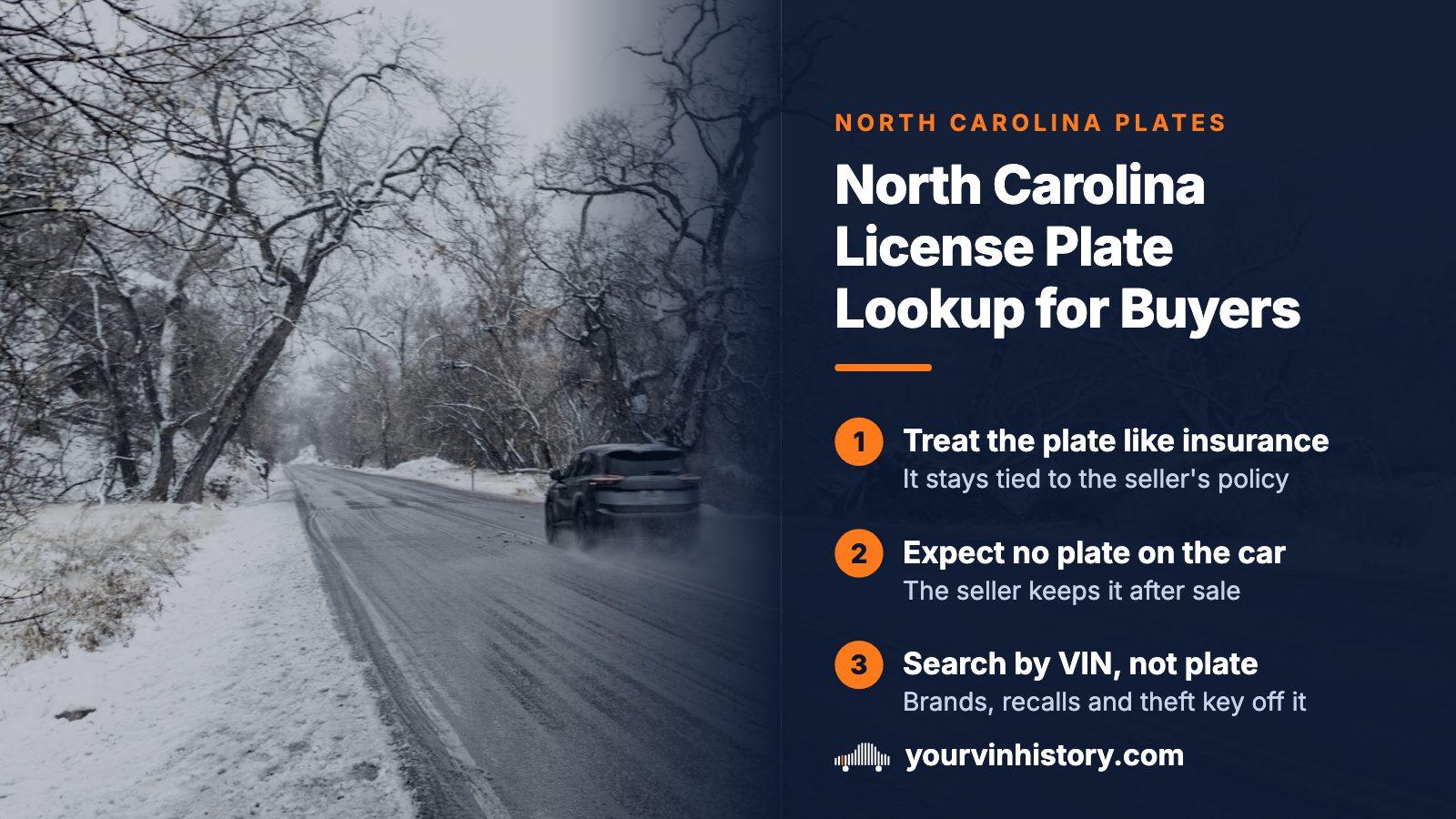
A private buyer cannot get an owner's name from a North Carolina plate, because the federal Driver's Privacy Protection Act limits NCDMV to releasing it for listed permitted uses. Plates stay with the seller and are tied to their insurance, so most cars change hands without one. For title brands, recalls and theft, search by VIN.
- Plates per car
- One, mounted at the rear
- Who keeps the plate
- The seller, not the buyer
- Owner details
- Released only for federal permitted uses
- Renewal
- Registration and county vehicle tax billed together
Why a North Carolina plate behaves like an insurance policy
In most states a plate says the car is registered. In North Carolina it also says the car carries liability coverage. Insurance companies send NCDMV an electronic notice when a policy ends, so the state learns about a gap without the owner saying a word.
A lapse on a registered plate brings civil penalties. If the owner still does not fix it, the state can demand the plate back. That is why people who sell a car or retire one from the road normally turn the plate in, rather than cancel the policy and let the metal sit in a garage.
For you as a buyer, the takeaway is simple. A plate on a North Carolina car is a record of somebody else's insurance obligation. It is not a feature of the car, and it will not stay with you after the sale.
Who is allowed to see the owner behind a plate
The Driver's Privacy Protection Act, found at 18 U.S.C. § 2721, bars state motor vehicle agencies from handing out personal information from their records except for uses the law spells out. NCDMV is bound by it like every other state agency. Its records channel expects a request to state which permitted use applies.
- Government agencies and courts doing their jobs, including police
- Insurers and their support organizations working claims, fraud cases or underwriting
- Parties to a legal proceeding, for service of papers and similar steps
- Employers checking commercial driver details that federal law requires
- Licensed private investigators, for purposes that fall within the same list
- Notices to owners of towed or impounded vehicles
Wanting to know who is selling a car, or who parked in front of your house, is not on that list.
Instant owner-name websites
A website that promises a North Carolina owner's name and address from a plate number is either selling old data or operating outside the rules above. Do not pay one, and do not trust what it returns.
What a plate search can answer, and what only the VIN can
A plate identifies a registration at one moment. The VIN identifies the vehicle itself, from the factory to the scrapyard. Most of what a careful buyer needs sits under the VIN.
| What you want to know | Plate number | VIN |
|---|---|---|
| Is this the same car after a sale? | Unreliable, since the plate leaves with the seller | Yes, it never changes |
| Has a state branded the title? | Not searchable by plate | Brands are reported by VIN to the national title system |
| Are safety recalls open? | The NHTSA lookup does not take plates | The NHTSA lookup takes the VIN |
| Who owns it? | Protected by federal privacy law | Not something a VIN check reveals |
If you only have a plate from a listing photo, ask the seller for the VIN. Then compare it with the number on the dashboard and the number printed on the title.
The plate goes home with the seller
The plate belongs to whoever registered it. When the car is sold, the seller either moves the plate to another vehicle they own or hands it back to NCDMV. Surrendering is the act that closes out their insurance obligation on that plate.
So a tidy private sale in this state often looks a little bare: a car with no tag on the back. You register the car in your own name, show your own insurance, and receive a plate issued to you.
Do not drive away on the seller's plate
The seller's insurance status and your driving become tangled the moment you pull out. If you need to move the car before registering it, ask NCDMV about temporary registration, which exists for exactly that gap.
Reading North Carolina plate designs
Standard passenger plates follow a pattern of three letters and four digits, as in ABC-1234. Two standard backgrounds share that pattern, and drivers pick whichever they prefer.
| Design | What it is | What it tells you |
|---|---|---|
| First in Flight | Shows the Wright Flyer and has been the usual default for years | Nothing about the car |
| First in Freedom | The other standard background, which refers to 1775 | Owner preference only |
| Specialty and collegiate | Cause and university plates, each with its own series and fees | A cause or school the owner supports |
| Antique or horseless carriage | Reserved for qualifying older vehicles, which are expected to see limited use | Ask how the car has been driven |
Because the design is a matter of taste, do not read age or condition into it. The useful signals are the tag date and whether a plate is present at all.
The tag sticker and the county tax bill
Registration and the county vehicle property tax renew together under the Tag & Tax arrangement, and you pay them on one bill. The agency behind it is the North Carolina Division of Motor Vehicles, part of the state transportation department, which out-of-state buyers often search for as NCDMV.
That has a practical side effect. A current sticker suggests the property tax was handled too. A sticker that expired long ago may mean tax went unpaid, and that debt can follow the car into your hands.
Ask the seller directly, and decide in writing who covers any back amount before you sign the title over.
Plate and tag clues worth a question
None of these proves anything alone. Each is a reason to slow down and ask.
- A plate still mounted on a private-sale car. Sellers who understand the insurance link usually pull it early, so ask why this one did not.
- A tag sticker long past its date, which may point to unpaid vehicle tax.
- Empty holes in the front bumper. North Carolina uses a rear plate only, so drilled holes often mean the car spent time in a two-plate state. The title chain should show it.
- Registration in a coastal county, where hurricanes and salt air raise the odds of flood or corrosion damage. Run the flood checks.
- A title whose notary section is blank or filled in wrong. NCDMV can bounce it.
Putting the car in your name
- Read the title before any money moves. Check the seller's signature, the odometer disclosure and the notary block, since North Carolina title transfers are notarized.
- Line up your own North Carolina insurance first. Coverage has to exist before a plate is issued, and the continuous obligation starts straight away.
- Go to NCDMV with the signed title and your proof of coverage. Pay the highway-use tax on the purchase, and leave with your own plate.
- From that point your Tag & Tax cycle runs under your name and your county.
Fees and forms change, so confirm the current list on the NCDMV site before you drive over.
If you are the seller: closing out the plate
Take your plate off before the buyer leaves, and do it even if the buyer asks you to leave it. Then either move it to another vehicle you own or surrender it to NCDMV.
Resist the urge to cancel the insurance first. Dropping coverage on a plate that is still registered is how lapse penalties reach people who thought they were finished with a car. Surrender the plate, keep your receipt or confirmation, and only then end the policy.
Complete the title carefully, including the notarization, so the buyer does not get turned away at the counter.
Where the history actually lives: the VIN
Start with checks run by others at no cost. The NHTSA recall lookup shows open safety recalls for a VIN, and the NICB VINCheck flags a theft or salvage record. Both take only the 17-character number.
Next comes the national title record. NMVTIS keeps brand information reported by participating states, so a salvage or flood brand applied in another state still shows up. A paid history report built on those title records, such as the one yourvinhistory sells after a preview, also pulls in accidents, odometer readings and auction photos.
Finish by matching names. The name on the title should match the seller's ID, and the VIN on the dashboard should match the VIN on every document.
Where this information comes from
- NCDMV: North Carolina Division of Motor Vehicles — The agency that issues plates and titles, and the place to confirm current registration steps and fees before you go.
- 18 U.S.C. § 2721: Driver's Privacy Protection Act — The federal rule that decides who may receive personal information from motor vehicle records.
- NMVTIS: National Motor Vehicle Title Information System — The national title database that carries brand information across state lines, keyed to the VIN.
- NHTSA: Recalls — The federal recall lookup that checks a VIN for open safety recalls.
Sources and photos: Facts checked against the sources above in October 2026. Photo by Zoshua Colah on Unsplash; diagrams by YourVINHistory.
Keep reading
- License plate lookupThe national picture of what plate searches can legally return and how scam sites work.
- North CarolinaState-specific steps for checking a car by VIN, including the notarized title.
- Temporary tagHow a temporary tag covers the drive home after you buy.
- Insurance lookup by VINWhether anyone outside the insurer can confirm a car is insured.
Frequently asked questions
Can I find out who owns a North Carolina license plate?
Not as an ordinary member of the public. Federal law restricts the owner's details to a short list of permitted uses, and a curious buyer is not on it. If a driver hit your car, give the plate number to the police or your insurer, who can make the request properly.
What happens if my North Carolina car insurance lapses?
NCDMV hears about it from the insurer, and civil penalties can follow. If the problem is not fixed, the state can require the plate to be returned. If you are about to stop driving a car, surrender the plate before the policy ends so no gap is recorded against you.
Can I keep the seller's plate after buying a car in North Carolina?
No. The plate was issued to the seller and is tied to their coverage. A seller who offers to leave it on is passing you a problem. Insist that it come off, then register the car and get a plate of your own, with temporary registration for any short trip in between.
Does North Carolina require a front license plate?
No, one plate at the rear is the rule. Bracket holes on a front bumper do not signal trouble on their own. They simply suggest the car may have been registered somewhere that asks for two plates, which the title history can confirm.
How can I research a used car's past before buying in North Carolina?
Work from the VIN. Use the NHTSA recall lookup and the NICB VINCheck first, then pull a title-based history report. On the paperwork side, make sure the name on the title matches the seller's ID and the notary section is completed, because a bad notation can stall your registration.
Now check the car itself
The guide explains what to look for. The report shows what this VIN has on record.