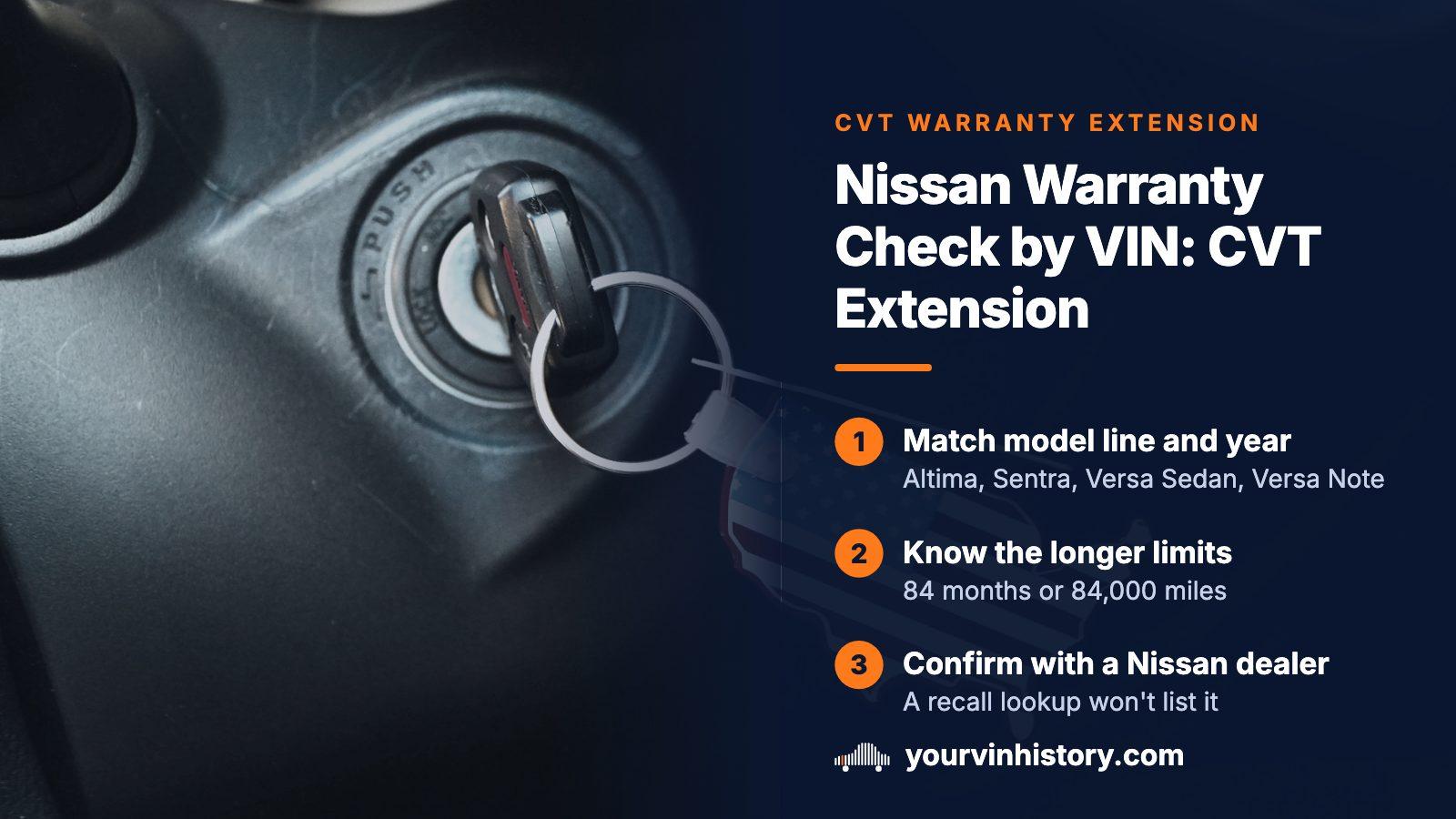
THE SHORT ANSWER
Nissan's CVT warranty extension applies to 2017-2018 Altima cars and to 2018-2019 Sentra, Versa Sedan and Versa Note cars. It stretches transmission coverage to 84 months and 84,000 miles, with the earlier limit ending it, and it passes to later owners. It is a warranty program, not a recall, so the federal recall lookup will not show it. Only Nissan's dealer systems can confirm a specific VIN, including whether a prior owner opted out of the class settlement behind it.
- Coverage
- Up to 84 months and 84,000 miles, earlier limit wins (was 60 and 60,000)
- Models
- 2017-2018 Altima; 2018-2019 Sentra, Versa Sedan, Versa Note
- Activated
- May 23, 2023
- Recall?
- No, Nissan calls it a warranty extension
Four model lines are on the list, and a matching badge is not enough
Nissan's bulletin names four lines and no others. Other Nissan models that also use a CVT are outside the program, and Nissan's own FAQ explains the narrow list only by saying that many factors go into decisions like this.
| Model | Model years | Generation code |
|---|---|---|
| Altima | 2017-2018 | L33 |
| Sentra | 2018-2019 | B17 |
| Versa Sedan | 2018-2019 | N17 |
| Versa Note | 2018-2019 | E12 |
The bulletin also gives a build-date range for each line. A car with the right badge but an odd production date should be run by VIN rather than assumed, and the model year in a listing deserves a check against the VIN itself.
From 60 to 84: what the longer limits add
Before the change, CVT coverage on these cars ended at 60 months or 60,000 miles. The new ceiling is 84 months or 84,000 miles, and the earlier limit ends it. That adds two years and 24,000 miles to one of the pricier parts of the car.
Nothing else about the warranty moved. Other components keep their old coverage, and the conditions and exclusions of Nissan's new vehicle warranty still apply to the CVT work, so the extension is not a blank check.
The program went live on May 23, 2023. A second version of the bulletin followed on November 2, 2023, mainly to update the voucher rules; the CVT terms stayed as they were.
Eighty-four months is seven years, so many cars on this list have run out on time alone, whatever the odometer says.
What the transmission coverage includes
Nissan listed the covered items instead of promising the transmission in general terms, which is handy when a repair estimate arrives with several lines on it:
- The CVT assembly, with its internal components, gaskets and seals
- Cooler kit, on cars that have one
- Torque converter
- Control valve body
- Reprogramming of the transmission control module
Because reprogramming is on the list, a software-only fix on a covered car is part of the program. Nissan also says a replacement may be a new or a remanufactured assembly depending on supply, and both arrive with new internal parts. Rental cars fall under separate goodwill guidelines, so ask about one before the car goes in.
Why a clean recall lookup says nothing about this program
The first FAQ in the bulletin asks if the program counts as a safety recall. Nissan says no and calls it a warranty extension.
That answer decides where you can look. NHTSA's recall lookup reports open safety recalls for a VIN. A warranty extension is the manufacturer's own promise, tracked in the manufacturer's own records. NHTSA does keep a copy of the bulletin as a document, but a copy of the notice is not a status report on your car.
The second difference is the end date. This program stops when the time or mileage limit is reached. Run the recall lookup on any used Nissan anyway, since open recalls are their own risk, and read each result as an answer to a different question.
A class action settlement sits behind the extension
Manufacturers usually call extensions goodwill. Nissan's bulletin is franker. It says the extension is meant to address customer concerns, including those raised through class actions, and it tells dealers to send settlement-term questions to the settlement administrator instead of answering them.
The settlement reached past the warranty. People who had already paid for CVT repairs that the longer limits would have covered could claim reimbursement, with a cap that depended on where the work was done and a main claim deadline in March 2023. A voucher toward a new Nissan went to certain owners with repeated repairs, and its redemption window has closed.
For a buyer, the useful point is that this settlement layer is the reason the extension has an opt-out at all.
The opt-out: how an earlier owner's choice reaches your VIN
Members of a class action can exclude themselves from the settlement, usually to keep their own right to sue. A note in the bulletin tells dealers that some owners may have done exactly that, which takes the extension off their car, and it instructs dealers to look up each VIN instead of assuming.
That is how two Versa Sedans from the same month, with similar mileage, can end up with different answers. One shows the longer coverage. The other is listed as excluded because an earlier owner filed an exclusion request.
If the VIN comes back excluded
Nissan's FAQ covers a car listed as excluded whose current owner says they never opted out. Dealers are told to send that person to Nissan's reinstatement process or to Nissan Consumer Affairs, which holds a list of owner names that did opt out and can say what documents are needed. The bulletin does not promise how this works for someone who bought the car after the opt-out, so ask Nissan directly and get the answer in writing before you settle on a price.
Why the seller's paperwork cannot settle it
Nothing that travels with the car records an opt-out: not the window sticker, not the owner's warranty booklet, not a folder of service receipts, and not the seller's sincere recollection of what they were told. The status lives in Nissan's warranty systems, filed under the VIN.
Nissan's instructions to its own dealers show how much weight it puts on the lookup. Dealers must check warranty status on every vehicle entering the service department, including cars bought from private sellers, cars driven in by visiting owners and cars sitting in the dealer's own inventory. Notices to eligible owners also went out by mail beginning in mid-2023, so a car that has changed hands since may never have come with a letter. The bulletin's answer for anyone without one is to supply the VIN and let Nissan check eligibility.
What a second or third owner inherits
- Transfer: the warranty applies to the vehicle and moves with ownership, and the new owner does not have to file anything to receive the extension.
- Dealer choice: any authorized Nissan dealer can diagnose and repair a covered car, not only the one that sold it. Nissan recommends booking ahead.
- Location: cars sold or registered in Canada or Mexico are outside the program, which matters for anyone importing a used one.
- Past replacements: a CVT that was already swapped keeps the extended limits, and Nissan adds a separate parts warranty covering 12 months or 12,000 miles counted from the replacement, when that outlasts the extension.
The last item is small good news: a transmission replaced late in the window may still have parts coverage after the extension ends. Ask for the replacement date and the invoice, since a past replacement is both a repair-history question and a coverage question.
Checking one specific Nissan before you pay
- Read the 17-character VIN from the car itself, at the base of the windshield or on the driver's door jamb, and match it to the title and the listing.
- Confirm the model and model year against the table above. A car outside those years is not in this program.
- Ask a Nissan dealer's service department to check that VIN. Nissan's dealers have two places to look, the warranty-extension listing inside their Service Comm system and DBS National Service History, so ask specifically whether the car is flagged as excluded.
- Ask the dealer to state the remaining months and miles, and whether a CVT replacement is on record.
- Run NHTSA's recall lookup separately for open safety recalls.
- Pull a title record from an NMVTIS approved data provider, because a warranty answer says nothing about title brands or total losses.
- Keep the dealer's answer as a printout or an email with the date on it.
The yourvinhistory report covers title brands, accidents, odometer readings and open recalls, with its title records supplied by ClearVin LLC, an approved NMVTIS data provider. It fits steps five and six, but it does not read Nissan's warranty systems, so it cannot replace step three.
Turning the dealer's answer into an offer
Only a few outcomes are possible, and each points to a different move. The bulletin also tells owners who notice a change in how the car drives to see an authorized dealer, so any odd behavior on a test drive is worth chasing before you commit.
| What Nissan's system shows | What to do with it |
|---|---|
| Covered, with plenty of time and miles left | The CVT risk has a known limit. Weigh the remaining coverage as a real benefit when you negotiate. |
| Covered, but nearly spent | Treat the extension as a short grace period. Plan for the CVT as if it will soon be your problem. |
| Expired, or listed as excluded | The transmission cost is yours. Dealers may quote a repair estimate and consider goodwill help on request, but approval is Nissan's call. Price the car with that risk in mind. |
| No clear answer | Assume no coverage until Nissan says otherwise in writing. |
In each case, a pre-purchase inspection by an independent shop is cheap compared with a transmission.
Where this information comes from
- NHTSA: Nissan campaign bulletin, CVT warranty extension (Revision 1) — Source for the models, the new limits, the covered parts, the opt-out note to dealers, transferability, the reinstatement route and the parts warranty after a replacement.
- NHTSA: Nissan campaign bulletin, CVT warranty extension (original) — The May 23, 2023 announcement that Revision 1 replaced, handy for seeing that the CVT terms did not change between versions.
- NHTSA: Recalls — The federal lookup for open safety recalls by VIN, which is a different record from a manufacturer warranty program.
- Bureau of Justice Assistance: NMVTIS vehicle history — Where to find approved data providers for a federal title record, the check a warranty lookup cannot replace.
Sources and photos: Facts checked against the sources above in October 2026. Photo by Jake Kling on Unsplash; diagrams by YourVINHistory.
Keep reading
- VIN warranty checkHow the in-service date works, and which part of a warranty passes to you.
- NissanThe CVT question from the maintenance side rather than the coverage side.
- Nissan recallsThe safety recall record for a Nissan, which is a separate lookup.
- Vehicle service contractWhat to read first if the factory coverage has expired or been excluded.
Frequently asked questions
Does a Nissan Rogue or another CVT model have this extension?
Not under this bulletin. It names only the Altima, Sentra, Versa Sedan and Versa Note in the model years shown in the table. Other Nissan models with a CVT are not listed. A different Nissan may carry other coverage, so check that VIN with a dealer instead of assuming either way.
Can I use any Nissan dealer for the CVT extension?
Yes. The bulletin says any authorized Nissan dealer can diagnose and repair a covered car, not just the selling dealer, and it recommends an appointment. Some deeper CVT repairs need a technician with extra certification, so ask whether the store you pick can do the work itself before you leave the car.
What if I paid for a CVT repair before the extension?
The settlement set up reimbursement for people who paid for CVT work that the longer limits would have covered. Claims needed documentation and went through the settlement administrator, and the amount could be capped depending on where the repair was done. The main deadline was in March 2023, so a buyer today should not count on it.
How long does the Nissan CVT extension last on my car?
Until the first of two limits is reached: 84 months or 84,000 miles. Because 84 months is seven years, a lightly driven car can still be out of coverage on age alone. Ask the dealer for the exact months and miles remaining on your VIN, which is more reliable than counting from the day you bought it.
Will Nissan buy back a car if the CVT keeps failing?
The bulletin says no. Nissan states that it will repair covered transmissions at no cost to the customer, so replacement or repurchase of the vehicle will not be necessary. This extension creates no buyback right. Any claim under a state lemon law is a separate question that depends on your state's rules and the car's history.
Now check the car itself
The guide explains what to look for. The report shows what this VIN has on record.