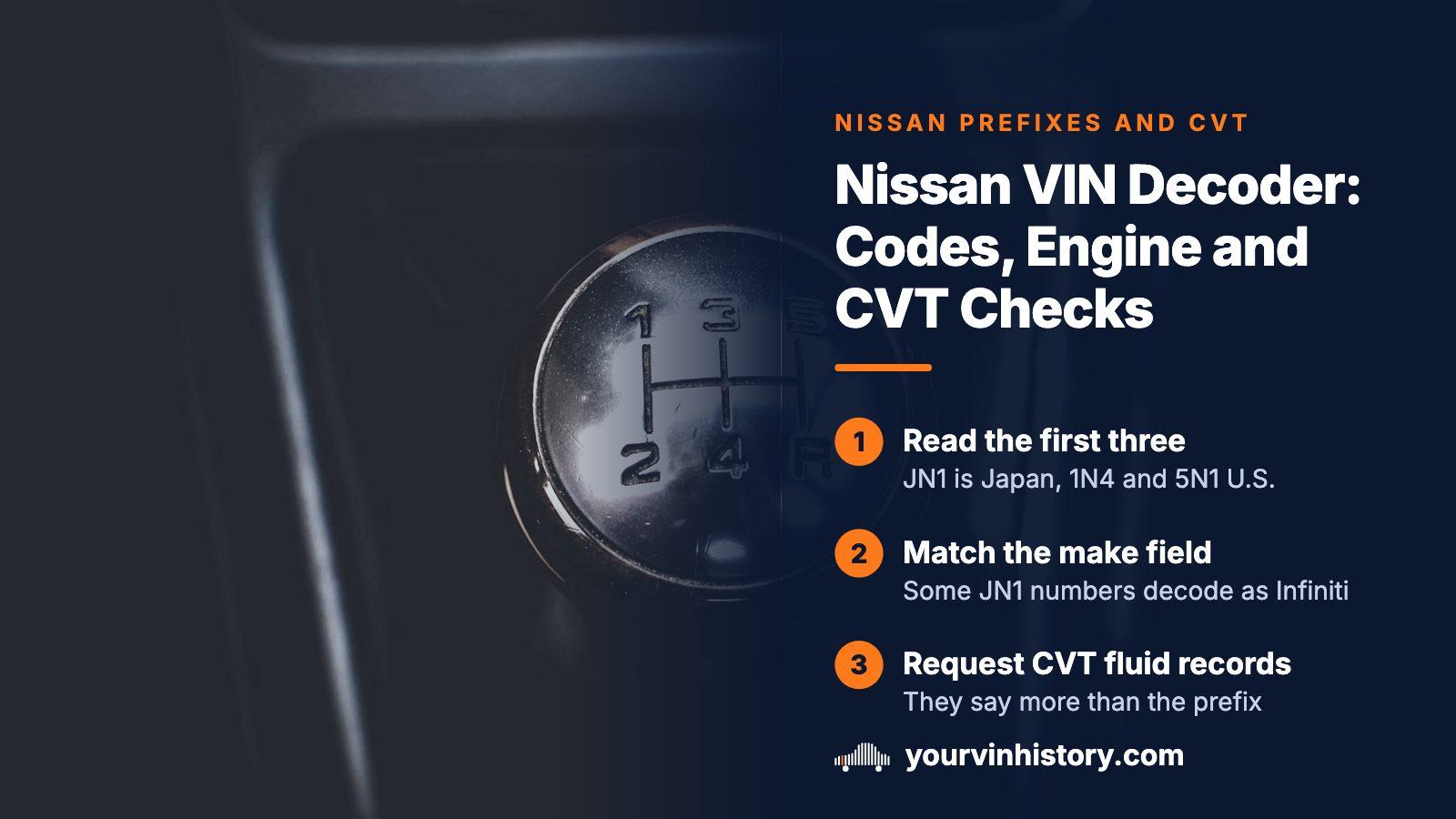
THE SHORT ANSWER
Read a Nissan VIN in blocks. The first three characters give the maker and the country of assembly, such as JN1 for a Japanese-built car or 1N4 and 5N1 for U.S.-built ones. Positions four to eight describe the model and engine, nine is a check digit, ten is the model year, eleven the plant, and the rest the serial. After decoding, ask for the CVT fluid service records, because they say more about a used Nissan than any prefix.
- Common prefixes
- JN1 and JN8 (Japan), 1N4 and 5N1 (U.S.), 3N1 (Mexico)
- Transmission
- Most of the range is CVT; confirm the type on the car
- Infiniti overlap
- Some JN1 numbers decode as Infiniti, so read the make field
- Imports
- Japanese chassis numbers will not decode in U.S. tools
What a Nissan decode returns, and where it comes from
Every maker selling in the United States files its VIN layout with the federal government, and NHTSA's vPIC database turns those filings into a lookup anyone can use without registering. Type in a Nissan VIN and the result typically lists model year, model, body class, engine displacement and cylinders, fuel type, drivetrain, transmission type, factory restraint system, plant and country of manufacture.
The output is only as complete as the filing behind it. NHTSA says vPIC's patterns come from specifications that manufacturers supply, so a blank row may mean nothing was filed rather than the car lacking the feature. Test each decoded claim against the listing, and confirm that trim, engine and drive layout match what the seller advertises.
Nissan prefixes: JN1, JN8, 1N4, 5N1 and 3N1
The first three characters, the world manufacturer identifier, tell you who built the car and in which country. NHTSA's register lists a good many Nissan identifiers, and these five cover most of the cars and crossovers you will meet.
| Prefix | Vehicle type | Built in |
|---|---|---|
| JN1 | Passenger car | Japan |
| JN8 | Multipurpose passenger vehicle | Japan |
| 1N4 | Passenger car | United States |
| 5N1 | Multipurpose passenger vehicle | United States |
| 3N1 | Passenger car | Mexico |
The register also carries truck prefixes such as 1N6 and 3N6. A U.S. or Mexican prefix is routine, not a warning sign: Nissan runs large plants in Tennessee and Mississippi, and a good share of the volume sold here is built in them. What a prefix cannot always do is name the badge, as the Infiniti section below explains.
Finding the number and matching it three ways
Look through the windshield at the base on the driver's side, then open the driver's door and read the sticker on the frame. Both should agree with each other and with the title, character for character.
- Windshield plate: the number visible from outside the car.
- Door-frame label: a second copy that should be identical.
- Title or registration: the legal record that must match both.
- Listing or bill of sale: typed by the seller, which is where slips creep in.
One transposed character is more often a typing error than a scam, but it breaks decoding and recall searches, so settle it first. If the two physical numbers disagree with each other, stop until the seller explains it with paperwork.
Engine data, and the swap question on performance models
The eighth character points to the engine the car was built with. Parts counters and specialists ask for the engine family designation, so write it down. The stamping on the block shows what sits under the hood today, and the two are not always the same engine.
On sport models in particular, swaps are common enough that you should simply ask. A swap done openly, with receipts and a shop's name, works like a maintenance record. A swap nobody mentions can affect insurance, emissions compliance and resale value, and it tends to surface at an awkward moment, such as an inspection or a claim.
For a second opinion on the decoded engine and drivetrain, fueleconomy.gov lists federal mileage ratings by vehicle. Advertised figures that clash with the rating for that configuration may point to a different car.
Why the CVT outweighs the prefix on a used Nissan
Most of Nissan's recent lineup is fitted with a continuously variable transmission, and a quick search turns up complaints about them within minutes. The worry has a real basis, but it is narrower than the loudest posts suggest.
A CVT is not fragile by design. It is sensitive to the condition of its fluid, and that fluid belongs on a service schedule rather than being a fill-for-life item. Owners who assume otherwise skip the service, and a skipped service is the usual first step toward a large repair bill. The decode tells you whether the car has this transmission. Only paperwork tells you how it was treated.
Records to request and what to notice on a test drive
Work through these in order, before you settle on a price.
- Confirm the transmission type in the decode and again on the car. Not every Nissan has a CVT, so verify instead of assuming.
- Ask for dated invoices showing CVT fluid changes. Nothing else in a used Nissan's file says as much about how it was cared for.
- Ask which fluid went in. A CVT needs the fluid its maker specifies, and the wrong one can cause damage that looks like a mechanical fault.
- Drive it with the radio off. Listen for a shudder when you ease away from a stop, a pause before the car moves, and a whine that climbs with road speed.
- Ask whether the transmission was ever replaced or rebuilt, and request the work order. A replacement can be a good sign when the paperwork is solid.
- Put the paperwork into the price. Of two otherwise matching cars, the one with a dated service trail is worth more.
Remaining warranty and the extended CVT coverage
Nissan extended its transmission coverage on certain model years, so a car that looks out of warranty on paper may still have protection. Which years qualify, and whether a particular car does, depends on its VIN.
That extension is a warranty program rather than a recall, so NHTSA's recall lookup will not mention it. Call a Nissan dealer with the VIN and ask what coverage remains, then request the answer in writing or on a service printout before it shapes your offer.
Paper beats memory
A seller's belief that the transmission is still covered is not evidence. Get the dealer's answer for this exact VIN, with a date on it, before you count on any coverage.
Infiniti and Nissan: one family, sometimes the same prefix
Infiniti is Nissan's luxury division, and its cars share platforms, engines and hardware with Nissans. They also share manufacturer filings: NHTSA's register lists the group's prefixes under Nissan company names, and a decode of a JN1 number can come back with Infiniti as the make. The prefix alone therefore cannot sort one brand from the other.
Use the make and model fields in the decode, and compare them with the badge on the trunk and the name on the title. When a car wearing one badge decodes as the other, resolve it before any money moves. A paperwork slip or a rebadged import explains most such cases better than fraud does, but the seller owes you a documented explanation either way.
Imported Nissans and Japanese chassis numbers
Enthusiasts prize Nissan models that were never sold new here, and many cross the border once they pass the twenty-five-year mark. A Japanese-market car has no 17-character VIN at all. Its chassis number is built from a model code and a serial, a format U.S. tools cannot parse. NHTSA's own page says vPIC holds only limited data on vehicles not intended for sale or import into this country.
- Expect the decoder to reject the number. That says nothing about the car itself.
- Ask for the entry paperwork showing the car came in legally, and compare it with what your state requires for a title.
- Call the state titling office before you pay, to confirm it will register this kind of car.
- Identify the chassis code with a marque specialist or Japanese-market references, since U.S. databases will not know it.
- Plan for parts: some will need special sourcing, which is a running cost.
- Still search a national title record, because brands and theft entries apply to imports like any other car.
Recalls: search the VIN, then ask what the repair costs
Recalls attach to ranges of VINs, not to a model name, so the reliable check is the full 17-character number in NHTSA's recall lookup. It costs nothing, takes a minute, and deserves a repeat on the day you sign, because new campaigns are added over time.
Federal law requires the manufacturer to fix a covered defect without charge, and a change of owner does not cancel that duty. There is an age limit, though. The no-charge requirement stops applying when the first buyer purchased the car more than 15 calendar years before the recall notice. A Nissan inside that window should be repaired at no cost to you. An older one may not qualify, so ask a dealer what the maker will do for that specific VIN and campaign before you assume the bill is Nissan's.
What the decode cannot tell you
A decode reads the factory record of the car and stops there. It has nothing on what happened afterward: collisions, flood or salvage branding, odometer tampering, liens or theft. Those live in title, insurance and auction records.
A yourvinhistory report by VIN pulls those records together, beginning with a preview, and shows open recalls beside title brands, accident entries with a damage map and odometer readings. Read it after the decode and the CVT questions, so you reach the seller with specific facts instead of general worries.
Where this information comes from
- NHTSA: vPIC VIN decoder — Where the decode fields and the manufacturer-prefix register come from, including its stated limits on cars not built for U.S. sale.
- NHTSA: Recalls — The place to enter a full VIN for open safety recalls, and to repeat the search before you sign.
- Fuel Economy: fueleconomy.gov — Federal mileage ratings for comparing a decoded engine and drivetrain with the car in an advertisement.
Sources and photos: Facts checked against the sources above in October 2026. Photo by Thakur Jaideep Singh on Unsplash; diagrams by YourVINHistory.
Keep reading
- Nissan warranty by VINHow the extended CVT coverage works and what can disqualify a VIN.
- Nissan recallsThe recall side of a Nissan purchase, covered in more depth.
- Transmission by VINWhat to do when the decode leaves the transmission field blank.
- Imported car VIN checkWhat the twenty-five-year rule does and does not clear on an import.
Frequently asked questions
Can I decode a Nissan VIN without paying?
Use NHTSA's vPIC decoder, which the federal government runs and which needs no account. Enter all 17 characters and read the make, model, year, engine, drivetrain and plant. The result reflects what Nissan filed, so compare it with the door-frame label, and remember it says nothing about accidents or title brands.
Does a JN1 prefix mean a Nissan was built in Japan?
Yes, for a passenger car: JN1 is registered to Nissan Motor Company for Japan. The same prefix also appears on Infiniti cars, so a JN1 number does not by itself tell you which badge belongs on the car. Read the make field in the decode. U.S.-built passenger cars start with 1N4 instead, and Mexican-built ones with 3N1.
Can the VIN tell me whether a Nissan has a CVT?
Often, because transmission type is one of the fields a decode can return, but only when Nissan filed it. If the field is blank, ask a Nissan dealer to confirm from the VIN and look through the service paperwork. Whatever the answer, a car with a CVT should come with proof that its fluid was changed on schedule.
Why does my imported Skyline's chassis number fail to decode?
Japanese-market cars use a chassis number in place of a 17-character VIN, and NHTSA's database mostly covers vehicles intended for sale here. The failed decode is expected. Take the chassis code to a specialist importer or a Japanese-market reference, and ask the seller for import paperwork that your state's titling office will accept.
Is a recall repair on an older Nissan always free?
No. The federal no-charge requirement ends when the first purchase was more than 15 calendar years before the recall notice. The number of previous owners does not matter; the age of the car at the time of the notice does. Whether Nissan offers anything on an older car is a question for a dealer, who needs the VIN and campaign number.
Now check the car itself
The guide explains what to look for. The report shows what this VIN has on record.