THE SHORT ANSWER
Decode the VIN, check NHTSA for unrepaired recalls and NICB VINCheck for theft and salvage, then buy a report built on NMVTIS, the federal title database, from an approved provider. After that, inspect for the New York the car lived in: water and silt on coastal cars, dents and chewed wiring on street-parked ones, rusted underbody parts upstate. Treat the sticker as a snapshot, because a new owner needs a fresh inspection anyway.
- Sandy benchmark
- About a quarter of a million insured vehicles damaged in 2012, by NICB's count
- Branding limit
- New York damage brands generally apply only to vehicles 8 model years old or newer
- Private-sale inspection
- The previous owner's inspection is not valid; 10 days from registration to get one
- Plate lookups
- Restricted by federal law, so ask the seller for the VIN
Three no-cost lookups to run before you call the seller
Begin with the 17-character VIN. Read it from the dashboard plate and the door-jamb label, compare both with the title, and only then start searching. If the numbers disagree, every result you pull describes some other car.
- VIN decode: confirms year, make, engine and body style against the listing, which catches a trim level that was upgraded on paper only.
- NHTSA recall lookup: lists unrepaired safety recalls on that VIN from roughly the last 15 years. Repaired recalls do not appear, and a recall announced last week may not have reached the database yet.
- NICB VINCheck: reports whether participating insurers logged the VIN as an unrecovered theft, a total loss, a salvage vehicle or flood damage. It skips police files and insurers that opted out, and NICB itself says it is not a full history.
All three cost nothing and take minutes. None of them is a title history, so a clean result is a reason to keep going, not a reason to stop.
The title record that follows a car across state lines
New York branding has a narrow reach. The DMV marks a title for a destroyed or damaged vehicle only when the car is 8 model years old or newer, and titles for older cars generally carry no brand at all. An older New York car can show a spotless certificate and still have a rough past.
NMVTIS, the National Motor Vehicle Title Information System, is the cross-check. It is a federal program meant to protect buyers from title fraud and unsafe vehicles, and brands recorded by other states land in it. Reports come from approved providers, and the federal roster separates the ones that sell to the public from the ones that serve dealers only, so read that page before you pay anyone.
A yourvinhistory report takes its NMVTIS title records from ClearVin LLC, an approved provider, and adds accident records with a damage map plus salvage and auction records with photos. The New York title check guide on this site covers the age rules in more detail.
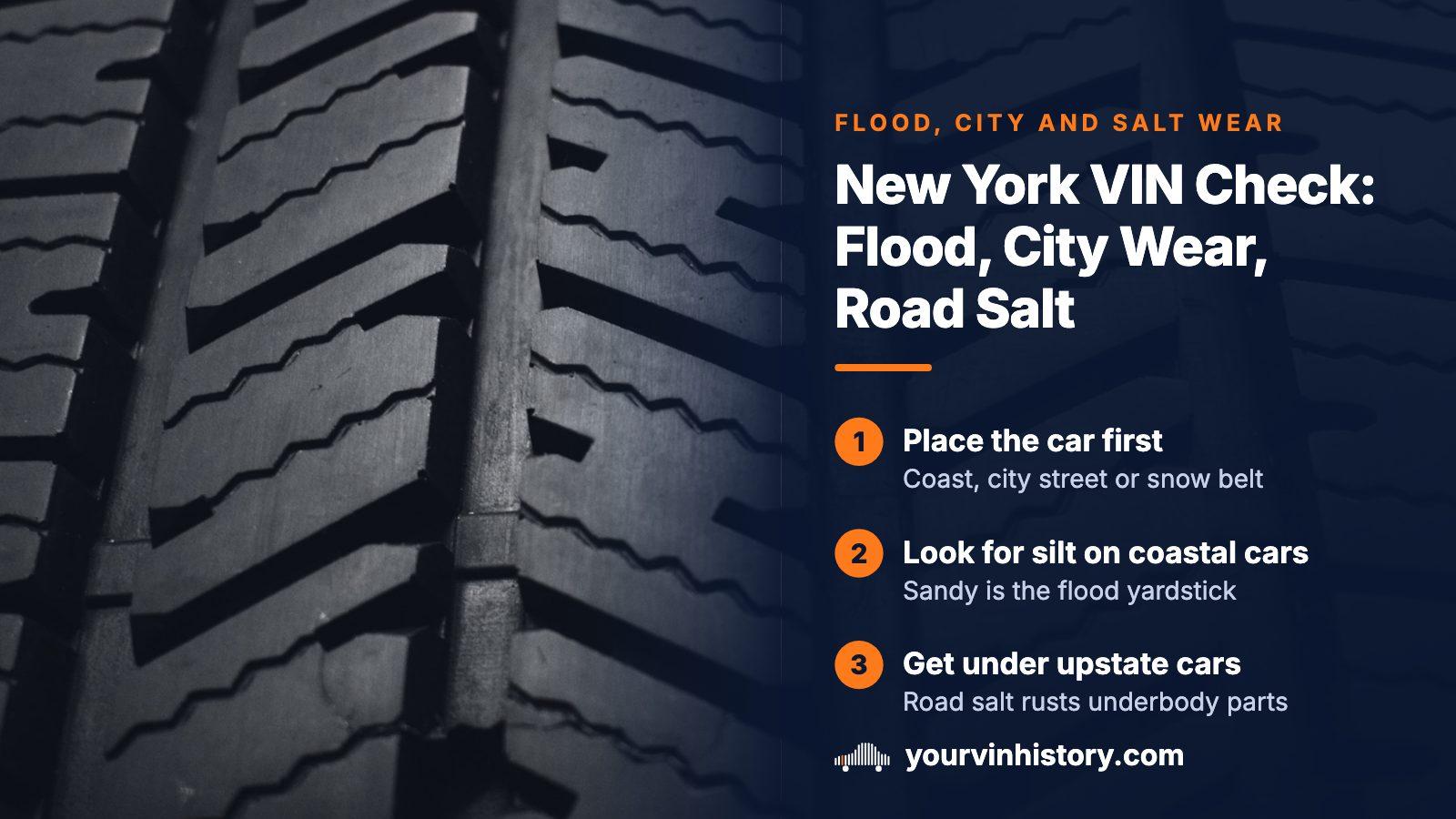
Place the car: coast, city street or snow belt
Two cars with New York plates can have lived opposite lives. Decide which kind you are looking at first, because it determines which physical checks deserve your time.
| Where it lived | What wears it out | Check first |
|---|---|---|
| Downstate coast and low-lying blocks | Storm surge or heavy-rain flooding | Water traces in carpet, seat hardware and wiring |
| City street | Tight parking, short trips, years outdoors | Body corners, wiring harness, battery and exhaust |
| Upstate snow belt | Winters on heavily salted pavement | Frame, brake lines and subframes, on a lift |
The records and the seller's story should agree on the placement. A long run of owners in one county, an old registration address or a seller who cannot say where the car was kept overnight all count as evidence.
Sandy as the yardstick for flood exposure
Hurricane Sandy struck the New York area in 2012. By NICB's count it damaged roughly a quarter of a million insured vehicles, and New York made up more than half of that total.
The tally has limits that matter to a buyer. It covers insured losses only, and not every claim in it was a flooded car. Owners without coverage filed nothing, so their cars appear in no count and could be dried out and offered without a word. NICB warned at the time that reconditioned storm cars might be sold to buyers anywhere in the country.
More than a decade on, a Sandy car is an old car, so the direct risk has faded. The pattern has not. A flood brand catches the cars an insurer wrote off, and only a physical inspection catches the rest.
A flood walk-around for any downstate or coastal car
Salt water does the most lasting harm to metal and wiring, so a coastal car gets the closer look. Work through the checks NICB recommends before a mechanic ever sees it:
- Pull up the carpet and look for dampness, stains or silt, then ask whether the carpet has been replaced.
- Check screws and other bare metal under the dash and seats for rust.
- Inspect the seat belts for water stains and the retractors for mildew or grime.
- Lift the spare tire and examine the well beneath it.
- Smell the cabin. A musty odor is a warning.
- Look in the engine bay for silt, grass or rust.
- Peel back the rubber boots around electrical connectors and see what is underneath.
- Run the door speakers, since door-mounted ones tend to fail first in a flood.
Then pay a trusted mechanic to look for hidden damage and run diagnostics. Flooded cars are often cleaned up and priced under retail, so a downstate coastal car with a price well below market needs a reason.
Reading a low-mileage city car
Mileage understates how hard a parallel-parked car lived. Years at the curb leave a pattern you can read by walking around it:
- Scuffed bumper corners and wheel faces from parking by feel.
- Dings along door edges and quarter panels from the cars on both sides.
- Chewed or patched wiring, because rodents settle into engine bays and the faults they cause can look random.
- Battery and oil wear from short trips that never fully warm the engine, plus exhaust corrosion from condensation.
- Tired suspension and bent wheels from potholes.
Garage or curb
Two cars with the same odometer reading can be worth different amounts depending on where they spent their nights. Ask, then compare the answer with what you see.
Commercial use wears a car in ways mileage does not capture. A report's ownership and use type records can show whether the vehicle led a working life before you met it.
Upstate salt: look underneath, on a lift
Upstate winters mean heavy road salt, and salt eats the parts you cannot see from a parking lot. A walk-around is not enough here. Put the car on a lift, or pay a shop to.
- Frame rails and crossmembers: flaking, swelling or patched holes.
- Brake and fuel lines: corroded or recently replaced sections.
- Subframes and suspension mounts, where rust loosens the grip of the hardware.
- Rocker panels along the sills.
- Exhaust parts and fasteners that look eaten away.
Fresh undercoating on a used car is a question, not an answer. It may be routine care, or it may cover corrosion the buyer was never meant to see. Ask for dated receipts for any rustproofing work.
What the inspection sticker proves, and what it skips
New York requires every registered vehicle to pass a safety inspection once a year at a DMV-licensed station, and most vehicles get an emissions test in the same visit. For cars that are neither brand new nor very old, that test is an OBD-II check of the onboard computer, so an illuminated check-engine light is a problem you will inherit.
A sticker expires on the last day of the month punched into it. It shows that the car passed on one day, which is useful, and nothing beyond that. It says nothing about flood history, hidden accident repair or the title.
On a sale, the old sticker also stops mattering to you. A dealer must have the car inspected before delivery. A private buyer gets an extension of 10 days from the registration date, and the DMV states that an inspection issued to the previous registrant is not valid. Budget for a fresh inspection, and learn what is likely to fail before you pay.
Why a plate number will not name an owner
The sheer number of plates on New York streets makes the urge to type one into a search box constant. The federal Driver's Privacy Protection Act restricts personal information in motor vehicle records to defined permitted uses, and vetting a seller is not among them.
Ask for the VIN instead. It sits on the dashboard where anyone can read it through the windshield, so a seller who hesitates to share it before you visit has told you something. The seller's name belongs on the title and matches a photo ID, not a plate search.
The order of work before any money moves
- Match the VIN on the car, the title and the listing, and match the seller's ID to the owner named on the title.
- Run the decode, the NHTSA recall search and NICB VINCheck.
- Pull a history report built on the NMVTIS title record and read the brand history across every state the car has lived in.
- Decide where the car lived, then do the matching inspection: water checks, curb-wear checks or the underbody lift.
- Have a mechanic or licensed station look over brakes, tires, lights and the check-engine light, since a passing inspection comes due soon after you register.
- Complete the transfer with both parties present, and read the owner line on the title against the seller's ID once more before paying.
Each step can end the deal cheaply, which is the reason for the order.
Where this information comes from
- NY DMV: About New York State inspections — Backs the annual safety and emissions rules, the sticker expiry, and the handling of inspections on dealer and private sales.
- NY DMV: Buying a salvage vehicle — Explains why damage brands generally stop applying once a vehicle is older than a set number of model years.
- NMVTIS: National Motor Vehicle Title Information System — The federal title database and its list of approved report providers.
- NICB: VINCheck — Source for what the theft and salvage lookup covers and where it stops.
- NHTSA: Recalls — The VIN-based search for unrepaired safety recalls.
Sources and photos: Facts checked against the sources above in October 2026. Photo by fr0ggy5 on Unsplash; diagrams by YourVINHistory.
Keep reading
- New York title checkThe age rules that decide how much a New York title can tell you.
- Flood-damaged carsMore flood signs, since the title often reads clean on a wet car.
- MichiganA fuller underbody routine for cars from salt country.
- New York platesThe plate steps at a New York sale, which a buyer should know about too.
Frequently asked questions
How do I check a VIN on a used car in New York?
Copy the VIN from the dashboard plate rather than the listing, and confirm it matches the title. Run a decode, the NHTSA recall search and NICB VINCheck, then buy a history report built on NMVTIS records from an approved provider. Finish with an inspection suited to where the car lived, because a report cannot see silt, rust or chewed wiring.
Is there a free VIN check for New York cars?
Several free tools exist, all run by other organizations. NHTSA's recall search covers unrepaired recalls, and the New York DMV points drivers to it. NICB VINCheck covers insurer-reported theft, salvage and flood records. Neither is a title history, and neither sees damage that never reached an insurer, so treat both as a first filter before paying for a report.
Does a clean New York title mean the car never flooded?
No. A damage brand depends on an owner reporting the damage, and the DMV applies it generally only to vehicles 8 model years old or newer. An uninsured owner who dries out a flooded car reports nothing. Pair the title with an NMVTIS-based report and a hands-on check for silt, rust and musty carpet.
Can I find a New York car owner from a license plate?
Not as a private buyer. The Driver's Privacy Protection Act limits who can receive personal details from motor vehicle records, and checking on a seller is not a permitted use. Get the seller's name from the title and a photo ID instead, and use the VIN for every real check. The plate guide covers what happens to the plates at sale time.
What if the car fails inspection right after I buy it?
In a private sale the previous owner's inspection does not count for you, so the repair bill is yours. The DMV gives a private buyer 10 days from registration to get inspected. That is why a look at brakes, tires, lights and the check-engine light belongs before the deposit, with any known fix priced into your offer.
Now check the car itself
The guide explains what to look for. The report shows what this VIN has on record.