THE SHORT ANSWER
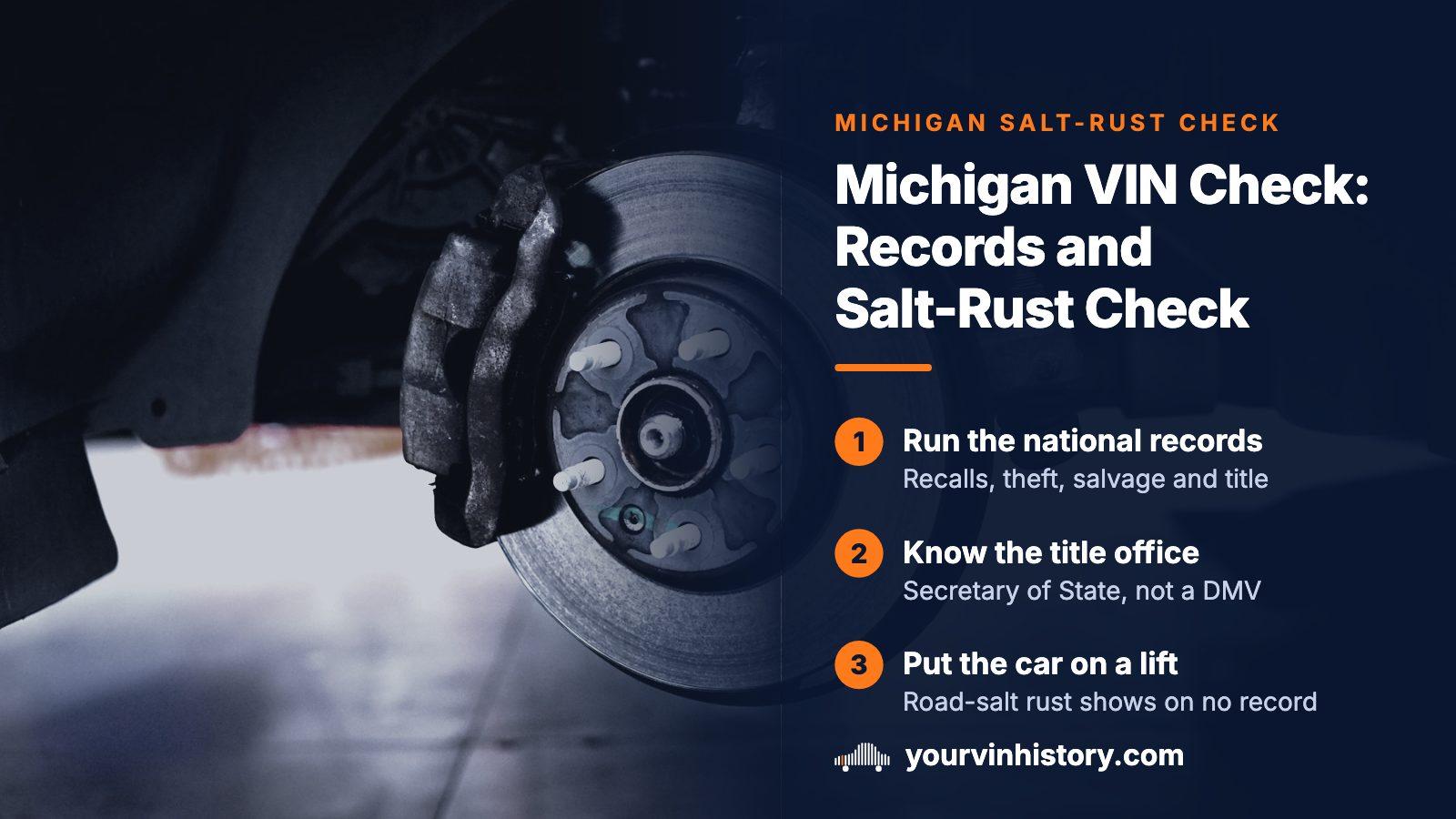
Decode the VIN, search NHTSA for open recalls, run NICB's theft and salvage search, then pull an NMVTIS-approved title record to catch brands from any state. Michigan's own title paperwork goes through the Secretary of State, the office people mean when they ask about a Michigan DMV. Finish with a lift inspection, because road-salt corrosion appears on no record.
- State agency
- Secretary of State, not a DMV
- Biggest gap
- Road-salt corrosion, which no record captures
- No-cost national checks
- NHTSA recall search and NICB theft and salvage search
- Plate lookups
- Owner details restricted by federal privacy law
A clean report can still hide a rotten frame
Most used-car risk lives in a database somewhere: a branded title, an odometer rollback, a lien nobody cleared. Michigan has all of those, but its signature problem is physical. Years of winter road treatment eat steel from the underside, and nothing about that process creates paperwork.
Nobody files an insurance claim for a perforated rocker panel. No agency stamps a title because a subframe is flaking. A Michigan car with soft metal underneath and a spotless history report is therefore not unusual, and a buyer who stops at the report has checked the wrong thing. Treat the records as the first filter, which removes cars with title or theft trouble, and the lift as the second, which removes cars with structural trouble.
Michigan has no DMV; the Secretary of State keeps the file
If you are shopping from another state, a search for the Michigan DMV leads nowhere. Titles, registration and plates here come from the Secretary of State, which residents shorten to SOS. Title transfers are completed at SOS branch offices, and official questions about a vehicle's state record go to the same agency.
The naming quirk matters less than it sounds, because the national tools behave identically everywhere. A VIN decode, the NHTSA recall search, NICB's theft and salvage lookup and an NMVTIS title record work on a Michigan car exactly as they would on a Texas one. The SOS adds the state-level paperwork, mostly at the moment ownership changes hands.
The order that wastes the least time
Fast and cheap checks go first, so a bad car gets rejected before it costs you money or a Saturday.
- Decode the VIN and confirm that the year, make, trim and engine match the listing.
- Search the NHTSA recall tool for open recalls on that exact VIN.
- Run NICB VINCheck for theft and total-loss records. It caps you at five searches in a day, and it only sees insurers that take part.
- Pull an NMVTIS-approved title record, which carries brands recorded by any reporting state, including the ones that border Michigan.
- Book the underbody inspection on a lift, before any deposit changes hands.
- Sit down with the seller at an SOS branch to complete the transfer, with the paper title in front of you both.
Stop at the first red flag. A theft hit or a scrap brand ends the search, and there is no reason to pay a shop to look under that car.
Open recalls and the age limit on repairs
NHTSA's recall search takes a VIN and reports whether that specific car has a safety recall waiting for its repair. The lookup costs nothing, and it is worth running before you negotiate, since an open recall can mean a safety defect or a wait for parts.
On the repair side, federal rules generally make the manufacturer fix a safety recall at no charge to the owner, but that duty has an age limit counted from the first retail sale, generally 15 years. A very old vehicle can fall outside it, and the maker may or may not agree to cover the work anyway. Call a franchised dealer for the make with the VIN and ask what will be covered before you count on a no-cost repair.
Where salt does its work, and why it hides
Salty slush is thrown upward and packs into every pocket under a car, where it stays damp against bare steel. Corrosion starts in seams and hidden cavities, so by the time paint bubbles on a fender, the structure behind it has been losing metal for years.
- Frame rails and subframes, which carry the engine, suspension and steering
- Crossmembers and body mounts that tie the cabin to the frame
- Steel brake lines and fuel lines, which corrode from the outside in and can fail with little warning
- Spring perches, strut towers and control arm mounts, where a failure is structural
- Bolts, nuts and fittings that seize or snap, turning a routine repair into a long one
Light surface rust on a Michigan car is ordinary and no reason to walk away. Flaking layers, holes, and metal that crumbles under a thumb are another matter.
What to ask for when the car goes on the lift
A flashlight in a parking lot does not count. Any independent repair shop can raise a car and look underneath for a modest fee, and the exam costs far less than the first major repair it might save you from.
- Have the shop examine the frame rails and subframes for flaking, scaling or holes, probing suspect spots with a pick or screwdriver.
- Trace each steel brake and fuel line end to end. Heavy corrosion means replacement soon.
- Check the suspension mounting points, including strut towers and rear spring perches, because repairs there are structural.
- Ask whether fasteners turn or snap. A seized caliper bolt or exhaust hanger previews every future repair.
- Treat fresh undercoating on an older car as a reason to look harder. Thick new spray can cover exactly what you came to see.
Turn the findings into a price discussion
A shop's written list of corroded lines, mounts and fasteners works as a negotiating document. Either the seller adjusts the price to cover the work, or you learn the car should go to someone else.
Four Michigan title words and what each tells you
A Michigan title can carry a brand that changes what the car is worth and how it may be used.
| Brand | Meaning in Michigan | What it means for a buyer |
|---|---|---|
| Salvage | A total loss whose damage passed the state's threshold. It cannot be driven on public roads until it is repaired and recertified. | A project car, not a commuter, until the process is finished. |
| Rebuilt | A former salvage vehicle that has been repaired and passed recertification. It is legal to drive. | The brand is permanent, so it follows the car through every later sale. |
| Scrap | The terminal designation, for a vehicle too damaged to go back on the road. | Parts and scrap metal only. It is never retitled. |
| Flood | Water damage recorded on the title. | Less often a local cause than on the coasts, but water-damaged cars can arrive from elsewhere. |
The recertification that moves a salvage car to rebuilt is performed by an authorized inspector, and it centers on identification: the VIN, part numbers and proof of where replacement parts came from. Passing it does not guarantee the repair itself is sound, so a rebuilt car still deserves its own lift inspection.
Why the Michigan title is not the whole story
A brand follows a vehicle through the national system, so a salvage event in Ohio or Illinois can be on record even though Michigan never issued anything for it. That cross-state view comes from NMVTIS, the federal title database, which approved providers sell in report form. It is the reason to check the national record instead of trusting the paper title alone.
One option is a yourvinhistory report, whose title records come from ClearVin LLC, an approved NMVTIS data provider. Beyond brands, it shows accidents on a damage map, salvage and auction records with photos, odometer readings and open recalls. A preview comes first, and the report is a one-time purchase.
Private-sale habits that hold up at the branch office
- Complete the transfer with the seller at a Secretary of State branch, so the paperwork is checked by the agency that issues the new title.
- Match the seller's name to the name printed on the title before any money moves.
- Compare the VIN on the title with the number on the car, in both places it appears, character by character.
- Write up a bill of sale that records the VIN, the price, the date and who stands on each side of the deal.
- Expect the seller to keep the plate. It does not transfer with the car.
- Be wary of a title that was reissued very recently on an older car.
- On a car that has seen winters, find out how recently the brake lines were swapped out. A vague answer is information too.
A plate number will not give you an owner. The federal Driver's Privacy Protection Act limits who may obtain personal details from motor vehicle records, and curiosity about a seller is not on the list. Ask for the VIN instead.
A rust-free car from the South swaps one risk for another
Some Michigan buyers shop warmer states for older vehicles that never met road salt, and the logic holds: a frame that never took a winter is worth real money on a car with many years behind it. The trade is that southern cars face their own hazards. A vehicle from a hurricane coast may have lived through flooding, and water leaves damage that a salt-focused lift inspection is not built to find.
Match the exam to the car's actual history instead of to what your home state taught you to fear. For a Gulf or Atlantic coast car, look for water. For a car that spent its life here, look for corrosion. Either way, the title and registration finish at a Michigan SOS branch.
Where this information comes from
- Michigan Secretary of State — The agency that issues Michigan titles and plates and completes ownership transfers at its branch offices.
- Bureau of Justice Assistance: NMVTIS Vehicle History — The federal page behind the national title database, and the route to approved providers that sell its reports.
- NHTSA: Recalls — The federal search that reports open safety recalls for a specific VIN, at no cost.
- NICB: VINCheck — A theft and total-loss lookup built on records from participating insurers.
Sources and photos: Facts checked against the sources above in October 2026. Photo by ün LIU on Unsplash; diagrams by YourVINHistory.
Keep reading
- Michigan title checkThe damage cutoffs behind Michigan's salvage and scrap certificates, and how to read them.
- Pre-purchase inspectionWhat a shop inspection covers and which systems it can miss.
- VermontAnother cold-weather state, with advice on telling surface rust from the structural kind.
- Michigan platesWhat a Michigan plate can and cannot tell you in a private sale.
Frequently asked questions
How do I run a VIN check on a Michigan car?
Copy the 17-character VIN from the car itself, usually at the base of the windshield or on the driver's door jamb label, and compare it with the title. Then decode it, search NHTSA for recalls, run NICB's theft and salvage search, and order an NMVTIS-approved title record. The state-level paperwork goes through the Secretary of State.
Is there a Michigan DMV I can contact about a car?
There is no office by that name. The Secretary of State handles titles, registration and plates, and out-of-state buyers who search for a DMV often land on the wrong office. Its branch offices complete title transfers, and its website is the place to confirm current fees and forms before you sign or pay anything.
Can I look up who owns a Michigan license plate?
Not as a private buyer. The Driver's Privacy Protection Act limits personal information from motor vehicle records to listed permitted uses, and curiosity about a seller is not one of them. If a deal is underway, ask for the VIN and the title, then confirm the name on the title matches the person selling.
Will a vehicle history report show rust?
No. Rust triggers no insurance claim and no title brand, and no state office logs it, so reports stay silent about it. A history report can show an accident, a brand, an odometer reading or a recall, but only someone looking at the underside can say whether the frame is sound. Use both before you pay.
Is a car with a Michigan rebuilt title safe to buy?
The brand means the car was once totaled, then repaired and recertified, and that review focuses on identification and parts sourcing. Passing is not a promise of good workmanship. Check the national title record for the original loss, ask for repair paperwork and photos, and pay for an independent lift inspection. The brand also never comes off, which hurts resale.
Now check the car itself
The guide explains what to look for. The report shows what this VIN has on record.