THE SHORT ANSWER
In Vermont, rust matters to an inspector when it weakens the vehicle's structure or endangers people on the road. Cosmetic corrosion is not supposed to fail a car, and a film of rust on brake rotors is acceptable under the DMV's own bulletin. Before you buy, find the last inspection date, get the underbody looked at on a lift, run the free NHTSA recall lookup, and add a national NMVTIS title record.
- Inspection cadence
- Every vehicle, once a year
- The rust that matters
- Corrosion that weakens the structure or endangers road users
- Rotor surface rust
- Not grounds for rejection under Bulletin 24-2
- Rotor rust that fails
- Swelling, delamination, pitting, half an inch cumulative
The only rust question that counts: does the part carry load
Every used car in Vermont has some rust on it, so counting orange spots tells you nothing. The state's inspection standard asks something sharper. It separates corrosion or torn metal that weakens the vehicle's structure, or puts occupants and other road users at real risk, from corrosion that merely spoils the look of the car.
Take that distinction as your own buying rule. A rusty fender lip, a blistered door bottom or a scabby wheel arch costs you appearance and maybe a body-shop bill. Rust in something that holds the car together, steers it or stops it costs you safety, and repairing it can run into real money.
The state has revised its Periodic Inspection Manual to spell the standard out for inspection stations, rather than leaving the call to individual taste. That makes the line a published test, not a shrug.
Why Vermont cars rot from the bottom up
Winters here are long, the land is hilly, and keeping secondary roads open takes salt and treated sand by the truckload. That mixture climbs into the underbody, sits in seams and pockets, and keeps the metal damp for weeks. Paint on the visible surfaces can look fine for years while the structure below it quietly deteriorates.
A short test drive on a dry afternoon shows none of this, and neither do listing photos, which favor the top and sides of the car. The damage that counts sits behind plastic shields and fresh undercoating. Bring a flashlight, ask to see the car in daylight, and expect to get your knees dirty.
What the annual inspection does and does not prove
The DMV runs a yearly program: safety items are judged against the Periodic Inspection Manual, and emissions testing includes an on-board diagnostics check. The state licenses the stations and certifies the inspection mechanics, and its website has a locator that searches by town, ZIP code or station name.
The emissions half fails a car for a short list of reasons you can spot yourself. The diagnostic connector may have been removed or may not work. The dashboard warning light may never glow when the key is turned on, which often means a dead bulb. Or the light may stay lit while the engine runs. A car that fails has to be diagnosed, repaired and retested before it earns a pass sticker.
Both halves are floor tests. A pass says the car met defined criteria on the day someone looked at it. It says nothing about a tired engine, a slipping transmission, or what happened to the car before it reached Vermont.
Orange brake rotors and what Bulletin 24-2 says about them
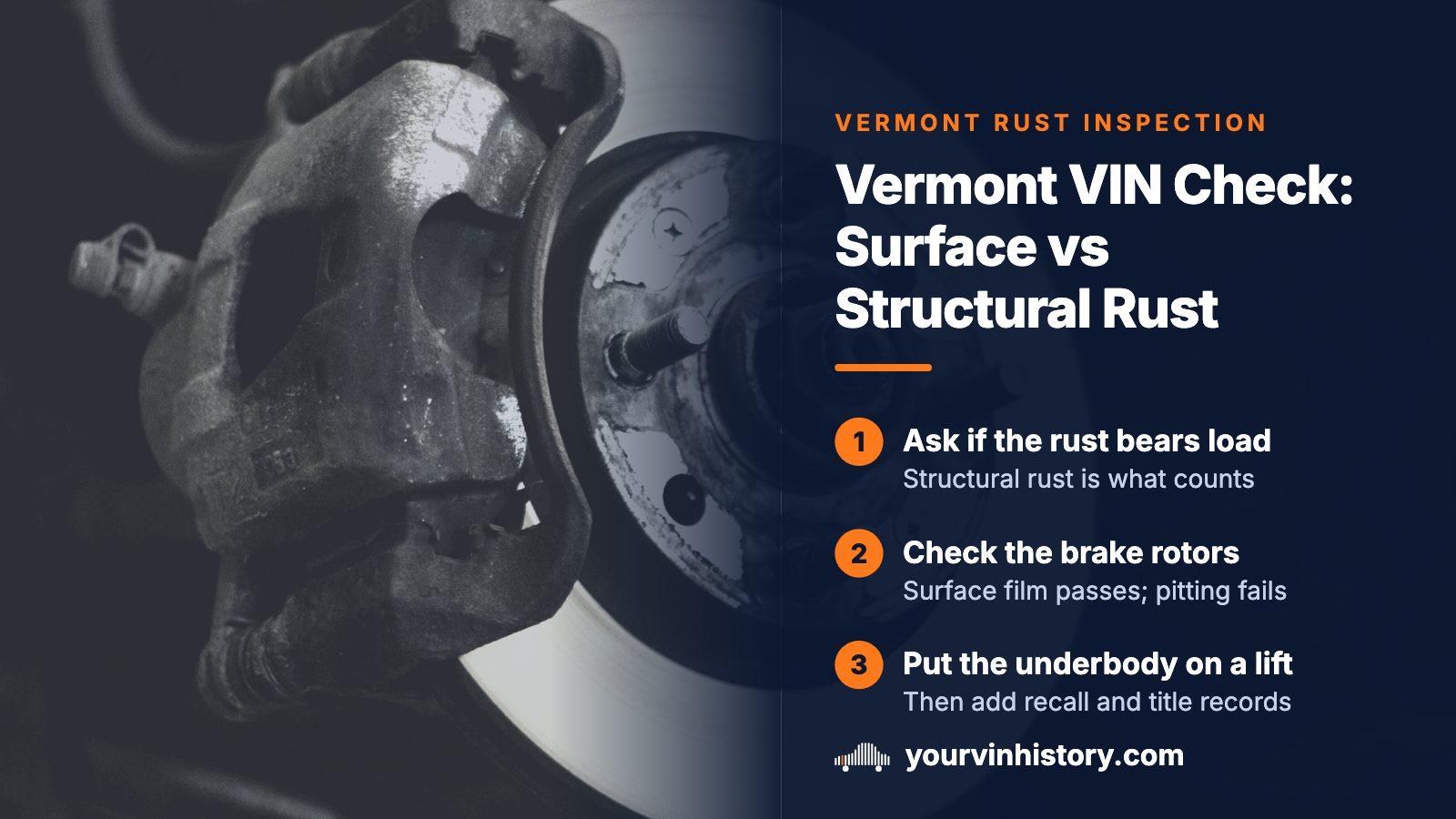
Rotors are bare cast iron, so any car parked outside for a few days grows a brown film on the braking surfaces. Inspection Station Bulletin 24-2 speaks to exactly this. Surface rust on a rotor is not a reason to reject a vehicle. Deterioration of a different order is: swelling, delamination, pitting, and rust adding up to half an inch.
| What you see on the rotor | How the bulletin treats it |
|---|---|
| A thin orange film across the face | Surface rust, not grounds for rejection |
| Swelling, or layers starting to separate | Deterioration that justifies rejection |
| Pitting in the braking surface | Deterioration that justifies rejection |
| Cumulative rust reaching half an inch | Grounds for rejection |
The lesson for a buyer is about reading what you see. On a car that has been standing, orange rotors say very little, and a few firm stops usually brush the film away. Craters, ridges or a rotor that looks puffy are different, and worth a quote from a brake shop before you settle on a price.
A flashlight walk-around for the places rust costs money
Do this in daylight, ideally with the car raised. Spend your time on parts that hold the car together or move it, not on paint.
- Rocker panels, the long sills under the doors: press along the lower edge and look for soft spots, bubbling or patched sections.
- Frame rails or unibody rails: flaking on bare steel is common, but swollen layers or daylight through the metal are not.
- Subframe and suspension mounting points, where control arms, struts and springs bolt to the body.
- Brake and fuel lines, which rot where nobody looks and can fail in ways that are dangerous and expensive.
- Fresh undercoating sprayed over only part of the underbody, which can be there to hide what lies beneath.
If the underside is buried in thick new coating, ask why. Tell the seller up front that a mechanic of your choosing will look before any money moves.
Read the sticker's expiry date as a pricing clue
Most buyers ask whether the car has a current sticker. Ask when it was inspected instead. A car with eleven months left cleared the standard recently. One with three weeks left was last tested almost a year ago, and a full winter of salt has happened since.
That gap is where the negotiation lives. A fresh sticker supports the seller's asking price. A sticker about to lapse means the next test is yours to face, along with any repair it demands, so price that in. Neither case replaces your own inspection: the station checked the car against the manual, and nobody checked it for your benefit.
The import that meets Vermont's standard for the first time
Vermont borders New York, New Hampshire and Massachusetts, and Quebec is a short drive north, so plenty of used cars for sale here were registered somewhere else first. A car from a state without a yearly inspection may have collected years of salt without anyone measuring it against a written standard.
Budget for a failed first test
A car that spent its life on salted roads elsewhere can fail its first Vermont inspection outright. Have the underbody checked before you agree on a price, not after the registration is done.
A car that has lived here all along has at least been examined each year it stayed, which an import cannot claim. Ask the seller where the car spent its earlier winters, and ask for the earlier owner's state if the answer sounds vague.
What records can tell you, and what they leave out
No database records rust. A history report cannot grade a rocker panel, so the underbody check stays your job. What records do cover is the paper trail. Vermont's files describe Vermont, while a brand applied in another state sits in the national NMVTIS record. A yourvinhistory report draws on NMVTIS title data from ClearVin LLC, an approved provider, alongside accident, odometer and salvage records. The preview comes first, and the full report is a one-time purchase.
Titling rules deserve a look too. Act 165 changed how Vermont treats vehicles that once needed no title, so confirm what documents this specific car really has instead of guessing from its age.
Skip plate lookups for identifying a seller. Under the federal Driver's Privacy Protection Act, states may release the personal details in their vehicle files only for listed purposes, and idle curiosity is not on the list. Work from the VIN, which opens the vehicle-side records legitimately.
Five steps, in this order, before paying for a Vermont car
The order matters because the cheap, remote checks can rule a car out before you spend a Saturday on it.
- Decode the VIN to confirm the model year, drivetrain and build match the listing.
- Run the NHTSA recall lookup and the NICB VINCheck. Both are free.
- Order the national title record, since it carries brands from every reporting state.
- Ask for the date of the last inspection and read the sticker yourself.
- Put the car on a lift, or pay an independent shop to, before any deposit changes hands.
The first three steps need only the VIN and can be done from a couch. The last two require you at the car, so save them for a vehicle that survived the screening, and treat any surprise along the way as a reason to lower the offer or walk.
Where this information comes from
- Vermont DMV: Inspection Station Bulletin 24-2 — The bulletin telling stations which brake rotor rust is acceptable and which kinds justify rejection.
- Vermont DMV: Periodic Inspection Manual (VN-113) — The written criteria that stations apply to every vehicle they inspect.
- Vermont DMV: Vehicle inspections — Explains the safety and emissions inspection, the diagnostic check, common reasons for failing it, and the station locator.
- NHTSA: Recalls — Search open safety recalls by VIN, separate from any state inspection.
Sources and photos: Facts checked against the sources above in October 2026. Photo by Benjamin Brunner on Unsplash; diagrams by YourVINHistory.
Keep reading
- MichiganAnother salt state, where the underbody question comes up without an annual inspection behind it.
- NMVTIS reportHow the national title record works and why it catches brands applied in other states.
- Pre-purchase inspectionWhat to ask a mechanic to look at once the paperwork checks out.
- Vermont platesWhat a Vermont plate does and does not reveal, plus the Act 165 titling change.
Frequently asked questions
Will a Vermont inspector fail a car for rust on the fenders or body panels?
Not for looks alone. The state's test is functional: corrosion that weakens the structure or endangers occupants or other road users is the problem, while corrosion that is purely cosmetic should not sink a car on its own. The gray area is rust that has eaten through metal near something important, so a hole close to a mount deserves a mechanic's opinion, not a shrug.
What makes a car fail the emissions part of a Vermont inspection?
The test includes a check of the on-board diagnostic system. Reasons for failing include a connector that is missing or dead, a dashboard warning light that never glows when the key is turned on, and a warning light that stays lit with the engine running. After a fail, the car is diagnosed, repaired and retested. Low-income drivers may qualify for the state's emissions repair assistance program.
Is orange rust on brake rotors a reason to walk away?
Usually not. A film of surface rust forms on bare rotors after a few days outside, and the DMV bulletin does not treat it as grounds for rejection. Walk away, or at least renegotiate, when you see swelling, separating layers, pitting, or a grooved surface a brake shop would replace. Ask for a short drive first, since light rust often wears off with a few firm stops.
Does a VIN check show rust damage?
No. Corrosion is a physical condition, and no title or insurance database grades it. A VIN check shows the paper side: title brands, accident and salvage records, odometer readings and open recalls. Use those results to decide whether a car deserves a lift inspection, then let the underbody settle the question. A clean record on a car with rotten rocker panels is entirely possible.
Does passing a Vermont inspection mean the car has no open recalls?
No. Recalls are tracked by the manufacturer and NHTSA against the VIN, while the state inspection works from its own manual, so the two do not overlap. NHTSA's lookup is free and takes the 17-character VIN. Run it on the exact car you are buying, and ask the seller how any open item will be handled before you sign.
Now check the car itself
The guide explains what to look for. The report shows what this VIN has on record.