THE SHORT ANSWER
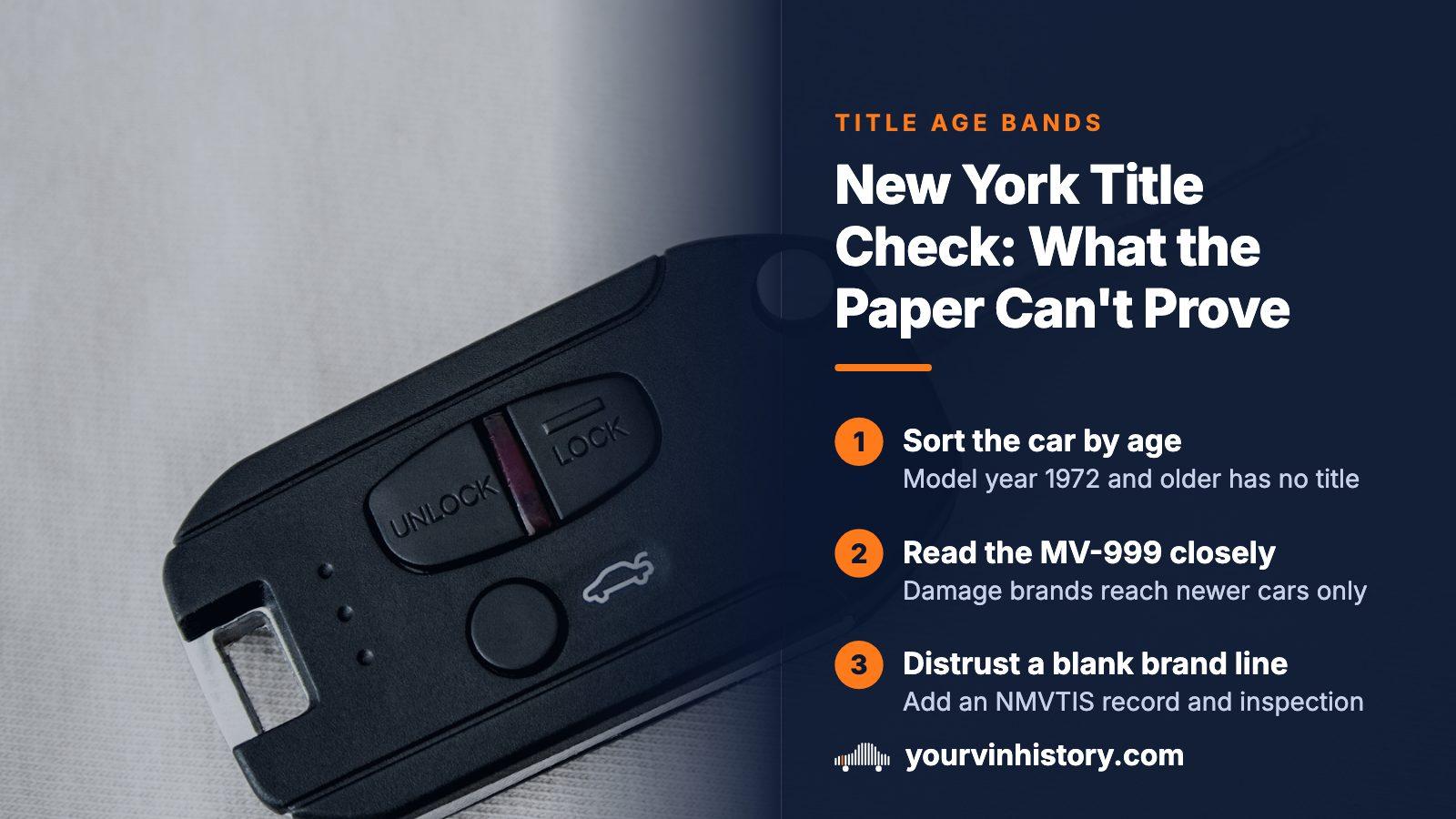
New York does not title vehicles of model year 1972 or older. They come with a transferable registration, and a bill of sale never replaces it. Newer vehicles get a certificate of title, form MV-999, but a damage brand is generally required only up to 8 model years of age, and only for damage equal to 75 percent or more of the car's retail value. On an older car, a blank brand line is weak evidence, so add a national NMVTIS record and an inspection.
- Titled from
- Model year 1973 and newer
- Older cars
- Transferable registration, original or certified copy
- Branding limit
- Generally vehicles 8 model years old or newer
- Damage trigger
- 75 percent or more of retail value
Sort the car into an age band before you read anything
Look at the model year first. It tells you which document should exist and how much that document can know about the car's past. Two cutoffs matter, and they sit at opposite ends of a vehicle's life, so every New York car lands in one of three bands.
| Band | Ownership paper | How to read a blank brand line |
|---|---|---|
| Model year 1972 or older | Transferable registration | Nothing to read, because no title certificate exists |
| Model year 1973 or newer, within 8 model years | Certificate of title, form MV-999 | Meaningful, since the damage-brand rule was running |
| Older than 8 model years | Certificate of title, form MV-999 | Weak, since severe damage generally goes unrecorded |
The first band calls for different paperwork. The third calls for a different kind of evidence.
Model year 1972 or older: the transferable registration
Vehicles of model year 1972 or older are not given a title in New York. The state hands out a transferable registration instead, a single document with two jobs. One portion proves who owns the vehicle and is what changes hands in a sale. The other portion is the registration that lets the vehicle run on public roads.
To pass the vehicle on, the owner named on the document signs the back. A seller holding a 1968 coupe and no title is therefore describing the normal state of affairs, not hiding a problem. What deserves your attention is whether the paper is genuine, whether it is the transferable kind, and whether the name on it belongs to the person standing across from you.
Identity does the heavy lifting here
With thin paperwork, confirming that the car is what the document says becomes the main job. Compare the VIN plate on the car with the number on the document before you discuss price.
A bill of sale supports the transfer but cannot carry it
In a private sale, New York wants two pieces of paper, and one cannot stand in for the other. The bill of sale records the deal. The title certificate or transferable registration, carrying the signature of whoever is named on it, shows the seller had the right to make the deal.
- The ownership document itself, either the original or a certified copy, signed by the named owner
- A bill of sale carrying the same names, the same VIN and the agreed price
- The seller's photo ID, compared line by line with the name on the ownership document
A seller who offers a bill of sale and a promise to deliver the rest later is offering you something the state does not accept as proof of ownership. Without the signed document, you may be left with a car you cannot register.
The eight-model-year limit on damage brands
The DMV's regulations call for a brand on the certificate in one situation: the vehicle is still within 8 model years of age, and the owner reports it destroyed or damaged to the extent of 75 percent or more of the vehicle's retail value at that time. After that age, the title generally goes unbranded.
The consequence is easy to miss. Picture a car in its tenth model year that is hit hard enough to meet the damage threshold. It can be repaired and retitled, and the certificate need not say a word about it. The title is not lying. The regulation simply stopped asking.
Clean means different things at different ages
On a car in its third model year, no brand is useful evidence. On one in its twelfth, no brand may only mean the rule no longer applied. At that age the national record and a physical inspection are the real check.
Reading the MV-999 before you sign anything
The DMV's own advice to buyers is to study the current owner's certificate closely before committing. Treat it as a matching exercise: every field on the paper should line up with something you can see or confirm.
| Field | Check it against |
|---|---|
| Owner name | The photo ID of the person handing the car over |
| Year, make and VIN | The car itself and the VIN plate attached to it |
| Lienholder | A written release, if any lender is named |
| Brand wording | Any marking such as REBUILT SALVAGE: NY, weighed against the car's age |
| Odometer statement | The dashboard reading, and whether the seller completed it |
| Damage statement | The seller's answer, since it shapes the wording on your new certificate |
Any mismatch is a reason to stop and ask. It is not a reason to hope the DMV will sort it out afterward.
The two disclosures that gate your new title
On a vehicle no more than 8 model years old, the DMV will not put you on the road until two statements on the MV-999 are done: the odometer disclosure and the damage disclosure. Without them, there is no registration and no new title certificate in your name. The seller completes both statements and you sign.
The damage statement matters beyond paperwork. It decides whether your new certificate carries the Rebuilt Salvage wording.
The usual failure is a relaxed private sale. The seller signs the transfer, leaves a disclosure half filled in, and takes the cash. Later the DMV counter refuses the application, and the seller no longer returns calls. Finish both statements where the payment happens, with both parties present, and read them before you sign.
What the DMV salvage vehicle examination covers
Once a salvage vehicle has been put back together for road use, the DMV must examine it before New York will issue a new title certificate or registration. The rule covers cars given a New York salvage certificate, and it reaches rebuilt salvage vehicles from most other states too, so a rebuild finished elsewhere does not bypass the step.
The examination belongs to the state's auto theft prevention program. Examiners look at where the parts came from. Passing shows that the car got through a theft screen.
It does not certify that the frame is straight, that the welds are sound or that the airbags were fitted correctly. Those are questions for an independent inspector. A title reading REBUILT SALVAGE: NY tells you a rebuild happened and was screened for stolen parts. The quality of the work remains yours to find out.
Lienholders: the printed name and the live record
New York shows a lienholder on the title certificate and also keeps it in the DMV's computer records. The two do not age the same way. The paper is a snapshot from the day it was printed, while the DMV record is the current one.
When an owner pays off a loan, the owner receives a release, and that release has to reach the buyer together with the title certificate at transfer. The useful question is whether a release exists for each lien on the paper, not merely whether a lender is named.
If a balance is still owed, the payoff should go to the lender directly instead of to the seller. A seller's word that the loan is settled leaves the sale unfinished until the release is in your hand.
What the certificate cannot show, and where to look
Because New York stops recording damage brands as a car ages, the evidence has to come from outside the New York certificate. Brands applied in other states travel into the national title record, and that record does not apply New York's eight-model-year cutoff.
NMVTIS is the usual route. A history report built on it lists the brands, odometer readings, accidents and salvage or auction records tied to the VIN. The report on this site draws its NMVTIS title records from ClearVin LLC, an approved NMVTIS data provider.
No database replaces a mechanic. For a New York car in the older band, an independent inspection is how you learn what the records missed, such as a repaired frame or a disguised flood history.
The order to work in before money moves
- Read the model year off the document and decide which age band the car belongs to.
- Ask to see the original ownership paper, then match the owner's name to their ID and the VIN to the car.
- Pull the NMVTIS-based record, with the closest attention if the car is past 8 model years.
- Have an independent inspector look at the car, especially if a brand appears or the car is older.
- At the table, get any lien release or route the payoff to the lender, and sign both disclosures with the seller.
A seller who resists any of these steps has told you something useful.
Where this information comes from
- NY DMV: Certificate of Title — Which vehicles receive a title certificate and which receive a transferable registration instead.
- NY DMV: Acceptable proofs of ownership for vehicles — Handling rules for older vehicles, and why a bill of sale cannot stand alone.
- NY DMV: The salvage vehicle examination — The theft-prevention inspection that sits behind a REBUILT SALVAGE: NY brand.
- NY DMV: Buying a salvage vehicle — The age limit and damage threshold behind New York's salvage branding.
- NMVTIS: Vehicle history reports — Federal page listing the approved providers that sell NMVTIS-based history reports.
Sources and photos: Facts checked against the sources above in October 2026. Photo by Shadow Photography on Unsplash; diagrams by YourVINHistory.
Keep reading
- NMVTIS reportRead what the national title record holds, since it is the check that outlasts New York's branding limit.
- Rebuilt title inspectionSee what a post-rebuild inspection judges and what it leaves to you.
- Vehicle lien checkFollow a lien from the printed certificate to the lender's release.
- Classic car VIN decoderLearn how to confirm a classic car's identity when its ownership paper offers little to go on.
Frequently asked questions
Does a clean New York title mean the car was never wrecked?
Not necessarily. The brand rule is tied to the 75 percent damage line and to vehicles within 8 model years, so serious damage short of the line, or any damage after the age cutoff, can sit under a clean certificate. Treat a blank brand line as one clue, then confirm it against the national NMVTIS record.
Can I buy a 1968 car in New York with only a bill of sale?
No. You need the transferable registration, signed on the back by the owner named on it, plus the bill of sale. The state accepts the original or a certified copy but not a photocopy. If the seller cannot produce the signed original, the sale is not ready to close.
Do older boats follow the same rule as classic cars?
The cutoff differs by type. For cars and other motor vehicles, the transferable registration applies to model year 1972 or older. For motorboats, New York applies it to 1986 or older. Check the vehicle type and its year before assuming that a title should exist.
The seller says the loan is paid off. Is that enough?
Ask for the release. The DMV record is current while the printed certificate may not be, so a lender's name on the paper proves little either way. If the release is missing and money is still owed, send the payoff straight to the lienholder and keep proof of the payment.
Does a car rebuilt in another state skip the salvage examination?
Generally not. The requirement reaches rebuilt salvage vehicles from most other states as well as New York salvage certificates. Keep in mind that the examination is a theft screen on parts, so it will not tell you whether the structural repair was done well.
Now check the car itself
The guide explains what to look for. The report shows what this VIN has on record.