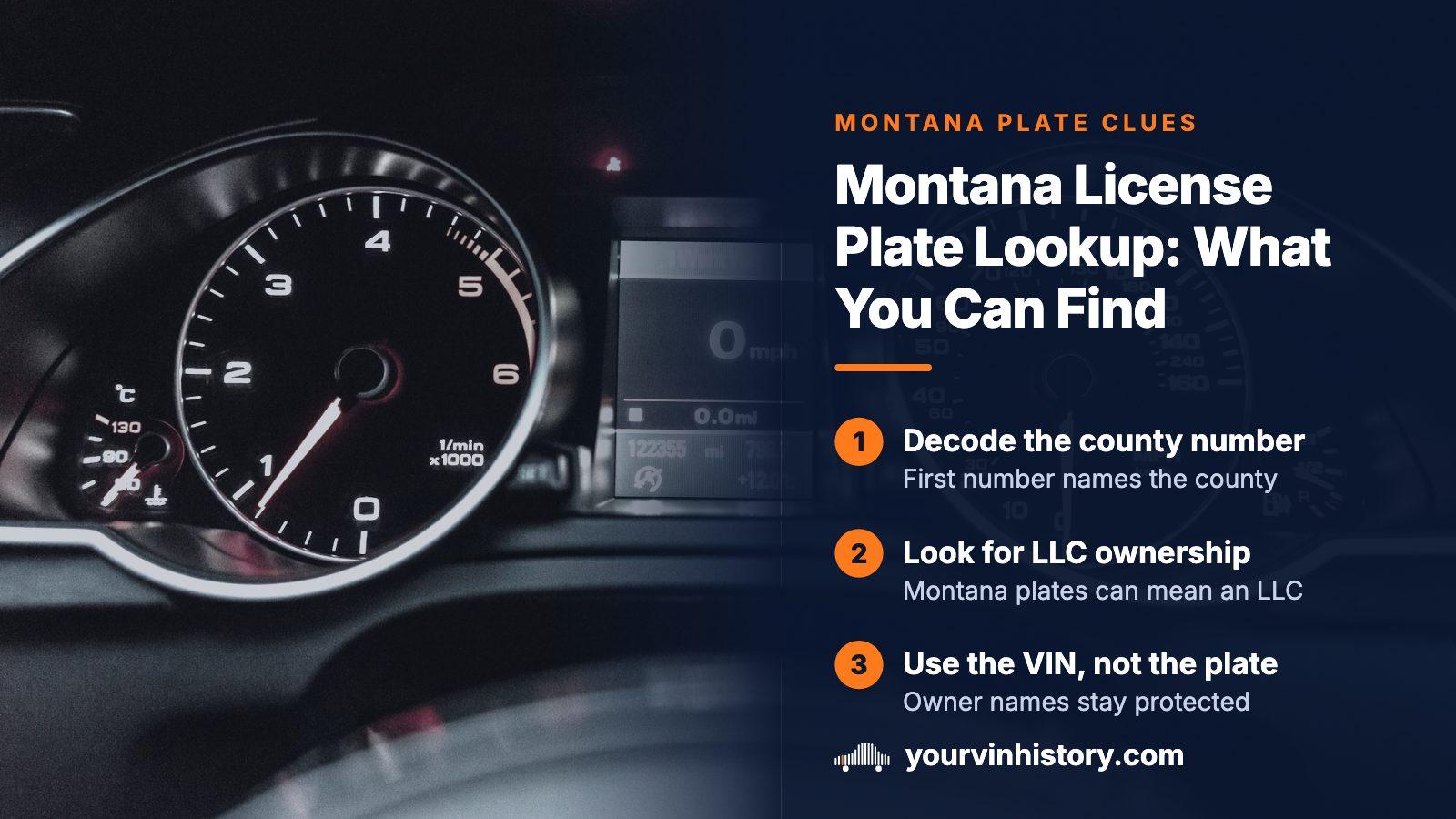
THE SHORT ANSWER
No, a private buyer cannot get an owner's name from a Montana plate. The Driver's Privacy Protection Act limits motor vehicle records to fourteen permitted uses, and shopping for a car is not one of them. The plate still carries clues: its first number names the registration county, and a Montana plate on a car far from Montana can mean an LLC holds the title. For everything else, work from the VIN.
- County numbers
- 1 to 56 on standard plates, with Silver Bow as 1 and Cascade as 2
- General sales tax
- None in Montana
- Permanent registration
- Open to owners of vehicles 11 years old or older
- Who runs the MVD
- The Montana Department of Justice
What a Montana plate search can and cannot return
Typing a Montana plate into a search box feels like it should open a file on the car. For a private person shopping for a car, it does not. Behind every plate sits a state motor vehicle file, and federal law controls who may open it.
Montana's Motor Vehicle Division sits inside the Department of Justice and releases records only within those limits. The lawful routes to a name are narrow: police working a real case, an insurer handling a claim, a court proceeding. A buyer's route is the VIN, whose records show titles and brands, the history that bears on the purchase. Be wary of any site that sells Montana owner names by plate, since on an LLC car the name on file may be a company's.
The county number at the front of the plate
A standard Montana plate opens with a number from 1 to 56, one for each county. Silver Bow is 1, Cascade is 2 and Yellowstone is 3, and the list continues down through the smaller counties. Locals read it without thinking: a 4 is Missoula, a 6 is Gallatin.
For a buyer, the number is a quick test of the seller's story. It records the current registration county, which can differ from where the car spent its life, since owners move and registrations follow. A mountain county hints at winters, gravel roads and salted passes; a county with big towns leans toward short trips.
Use the number as a question, never a ruling. If a seller swears the truck never left Billings and the plate carries Missoula's number, ask why. The title history settles it.
Why out-of-state supercars carry Montana plates
The state collects no general sales tax, requires no periodic vehicle inspection, and lets a Montana LLC register vehicles it owns. Together, those three facts explain many Montana plates on supercars and big motorhomes thousands of miles from the state.
Someone living in a heavily taxed state sets up a Montana LLC, titles the vehicle to the company and registers it in a Montana county. The owner's home state sees a sales-tax bill that never arrived.
The scheme is lawful on the Montana side and a different story elsewhere. Several states now audit, fine and even prosecute residents who use it, calling it tax evasion. A buyer feels none of that until the car is theirs and their own registration office starts asking questions.
When a company, not a person, is on the title
If the title names an LLC, the person showing you the car is not the owner. They say they speak for the company, and that shifts what you must confirm before any money moves.
- Search Montana's business records and confirm the LLC exists.
- Ask for written proof that the seller may sign for the company, and compare the signature on the title to it.
- Pull a national title record by VIN to look for liens, brands and odd ownership gaps.
- Ask your own state's motor vehicle agency what it requires to register a car with this history.
A company title is a reason to ask more
Many Montana LLC cars are babied and garaged. The exposure sits elsewhere: whether the seller can legally sell, and what your home state asks about tax history at registration.
Permanent registration after 11 years
Once a vehicle is 11 years old or older, Montana lets its owner register it one time, pay one fee and stop renewing. For a ranch truck or winter beater, that is a sensible convenience.
For a buyer it quietly removes a clue. Where registration renews every year, an expired sticker or a lapse says something about how a car was kept. Under permanent registration no sticker ever expires, so the evidence is missing rather than bad. Treat that as a gap and fill it from other paper: odometer statements, service receipts and the title record.
The arrangement also belongs to the owner who chose it. A buyer registers fresh through a county treasurer and, if the vehicle qualifies, can pick the permanent option for as long as they keep it.
Two plates, county treasurers and a Justice Department office
Montana expects plates on both the front and rear of a passenger vehicle. A bare front bumper is harmless on its own, but it can be a sign the car came from a one-plate state, so ask where it was last registered.
Many states put titling under a transportation or revenue agency. Montana's Motor Vehicle Division belongs to the Department of Justice, and county treasurers process registrations locally and issue the plate carrying your county's number. Before you drive off, ask the seller and the treasurer's office what happens to the old plates at sale, because states differ on that point.
What the federal privacy law counts as protected
The Driver's Privacy Protection Act, at 18 U.S.C. 2721 through 2725, is the reason a plate search stops short. Its definitions are narrower than most people assume.
- A motor vehicle record is any record tied to a permit, title, registration or ID card from a motor vehicle department.
- Personal information covers a name, address, phone number, photograph, Social Security number and driver identification number, but the five-digit zip code is carved out.
- Highly restricted information, meaning a photograph, Social Security number or medical details, can be released without the person's consent for only four of the fourteen uses.
- Data about accidents, driving violations and a driver's status sits outside the definition altogether.
That last item corrects a common belief. This law is not what keeps a car's crash history out of your hands. Whether you can get that history depends on state law and on whoever holds the record.
The fourteen permitted uses and where a buyer fits
Section 2721(a) sets the default: a state motor vehicle department may not release personal information. Section 2721(b) then lists fourteen exceptions. They describe institutions with a job to do, not people with a question.
| Who is asking | What the exception covers |
|---|---|
| Agencies, courts and their contractors | Official functions, plus civil, criminal, administrative and arbitral proceedings, including serving papers |
| Insurers | Claims investigation, fraud prevention, rating and underwriting |
| Safety and the auto industry | Theft, emissions, recalls, product changes, performance monitoring and market research |
| Businesses checking their own data | Confirming what a person submitted, and correcting it only to stop fraud, pursue legal remedies or collect a debt |
| Employers and investigators | Commercial driver's license checks, and licensed investigators acting within the list |
| Tow yards and toll operators | Notices to owners of impounded vehicles and private toll operations |
| Consent and state-law routes | Express or written consent, bulk surveys, and uses a state authorizes for vehicle operation or public safety |
No line on the list covers a private shopper who wants to know who owns a car before buying it. That is the statute working as written, not an oversight.
Penalties, and why lookup sites ask for a purpose
Section 2722 makes two acts unlawful for anyone: knowingly obtaining or sharing personal information for a use outside the permitted list, and making a false representation to get a record. The second matters on lookup pages. Claiming a purpose that is not yours is the exact conduct the law names, and picking the closest-sounding option does not make it honest.
Consequences run on three tracks. A knowing violation draws a criminal fine under title 18. A state department with a standing practice of substantial noncompliance can be fined by the Attorney General up to $5,000 a day. And the person whose data was misused can bring a federal lawsuit, where a court may award actual damages with $2,500 in liquidated damages as the minimum, and may add punitive damages for willful or reckless conduct and attorney's fees.
The limits travel with the data. Under section 2721(c), a lawful recipient may resell or share personal information only for a permitted use, and one who passes it on must keep records of who received it. A service that cannot name the permitted use behind its data deserves distrust.
What a Montana plate suggests and what it cannot prove
| What you see | What it suggests | What it does not prove |
|---|---|---|
| A county number up front | Where the car is registered now | Where it has been driven or stored |
| Montana plates on an exotic or motorhome far from Montana | A company probably holds the title | Who stands behind the company, or that the seller can sign for it |
| An older car with no renewal history | It may be on permanent registration | That anyone has serviced or inspected it lately |
| One plate on a passenger car | Possible history in a state that needs only one | Anything about condition |
Beyond the registration, work from the vehicle itself, in this order:
- Compare the VIN on the car with the VIN on the title.
- Look up open recalls for that VIN with the free NHTSA recall tool.
- Pull a national title record. A yourvinhistory report starts with a free preview, then a one-time purchase, and its NMVTIS title records come from ClearVin LLC, an approved NMVTIS data provider.
- If an LLC holds the title, confirm the company exists and that the seller can sign for it before paying.
- Register through the county treasurer, mount both plates and ask about the permanent option if the vehicle qualifies.
Where this information comes from
- GovInfo: 18 U.S.C. 2721-2725, Driver's Privacy Protection Act — Backs the default ban on release, the fourteen permitted uses, the two unlawful acts, the penalties, the damages floor and the definitions.
- Montana MVD: standard license plates — Where the state describes standard plate design, county numbering and how plates are issued.
- Montana Department of Justice: driving and the Motor Vehicle Division — Shows that titles, registration and vehicle records are handled by an office inside the Department of Justice.
- Bureau of Justice Assistance: NMVTIS — The federal system behind national title and brand history keyed to a VIN, useful when the title names a company.
Sources and photos: Facts checked against the sources above in October 2026. Photo by Benjamin Brunner on Unsplash; diagrams by YourVINHistory.
Keep reading
- License plate lookupThe national rules on what a plate search can return, and how to spot the scam sites.
- MontanaHow permanent registration and Montana conditions shape what a VIN check should cover.
- Buying a car out of stateWhich records cross the state line with an LLC-titled car and which stop at the border.
- Register a car in another stateWhat your home state asks for once the Montana-plated car is yours.
Frequently asked questions
Can a buyer find the owner behind a Montana plate?
Not as a private buyer. Montana releases owner details only for uses federal law permits, such as police work, insurance claims and court cases. If a car hit yours and drove off, give the plate number to the police and let them request the record. In a sale, the seller's ID should match the name on the title.
Is it illegal to buy a car with Montana LLC plates?
Buying one is not a crime. The tax question belongs to the owner who lives elsewhere and registered through the LLC. Your exposure comes later, when your own state reviews the car's tax history at registration. Ask that office what it needs before you commit, and get the seller's signing authority in writing.
What does the first number on a Montana plate mean?
It names the county of registration. Silver Bow is 1 and Cascade is 2, and the numbers run up to 56. Use it to test a seller's account of where the car lived, then confirm with the title record, because a plate shows where a vehicle is registered and says little about its past.
What is permanent registration in Montana?
It is a one-time registration for vehicles 11 years old or older, with no renewals after that. The owner chooses it, and a buyer starts over at the county treasurer's office. With no sticker to expire, an older Montana car leaves no renewal trail, so odometer statements and the title record carry more weight.
Do Montana passenger cars need a front plate?
Yes, passenger vehicles carry plates on the front and rear. A car with no bracket holes up front is not a problem by itself, but ask where it was registered before Montana, since not every state asks for two plates.
Now check the car itself
The guide explains what to look for. The report shows what this VIN has on record.