THE SHORT ANSWER
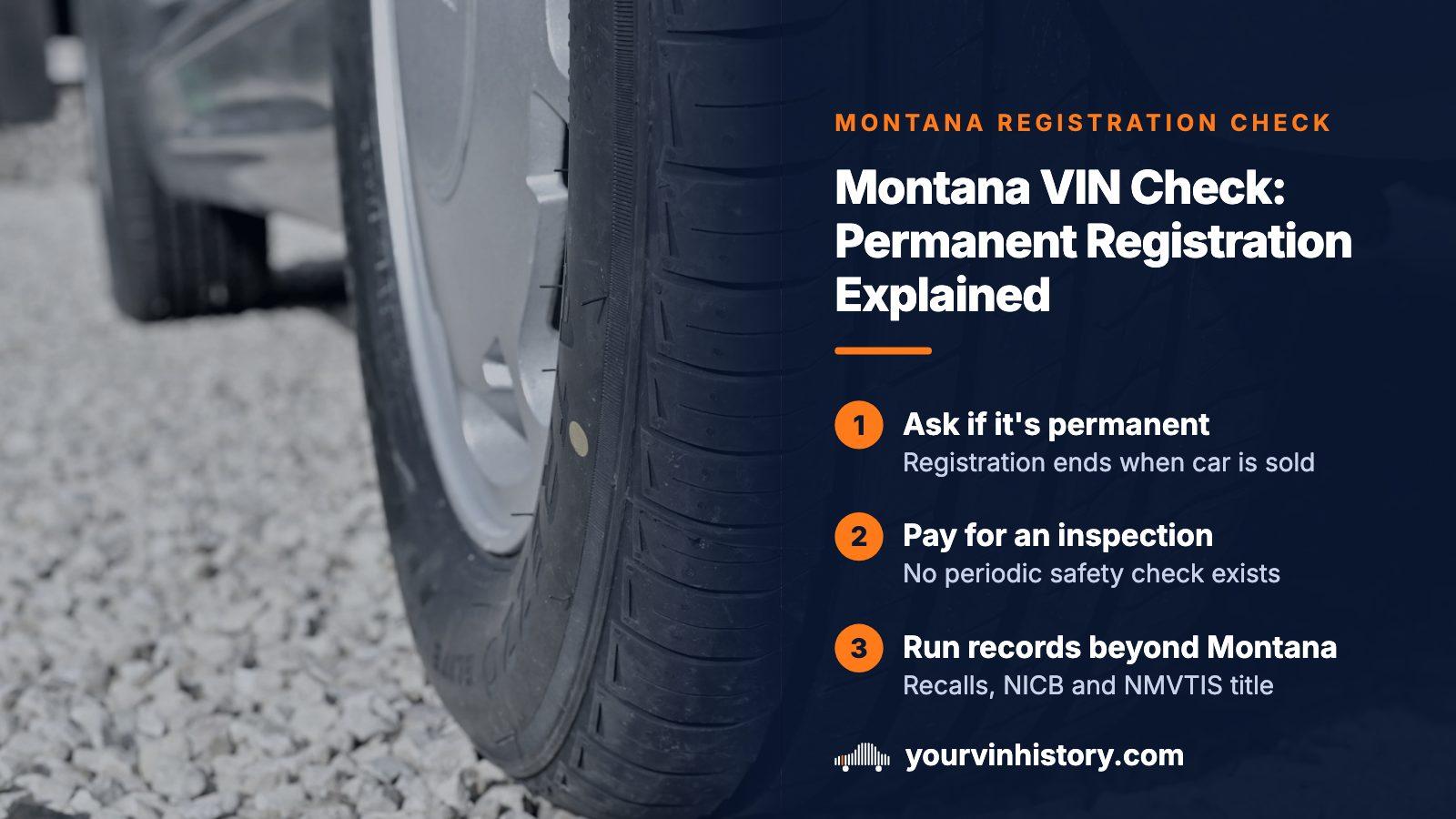
Decode the VIN, search the NHTSA recall lookup, check NICB for theft and salvage reports, then pull the national NMVTIS title record from an approved provider. In Montana, add two steps the state will not do for you: find out whether the registration is permanent, since it ends when the car is sold, and pay for an independent inspection, because no periodic safety inspection exists to lean on.
- Permanent registration
- Optional for vehicles 11 years old or older
- After a sale
- It ends at the change of ownership
- Periodic inspection
- None for ordinary passenger vehicles
- Emissions testing
- No statewide requirement
How Montana's permanent registration works
Most states pull every owner back to the counter on a schedule. Montana offers a way out of that cycle. The owner of a light vehicle, a motorhome or a collector vehicle with qualifying plates may choose permanent registration once the vehicle is 11 years old or older, and after that there is nothing left to renew.
The request goes through a county treasurer's office, which is where the Montana Motor Vehicle Division describes titling and registration being handled. It is the owner's option, not an automatic status. Vehicles ten model years old and newer do not qualify, so you will mostly meet permanent registration on older cars, trucks and campers.
The appeal for an owner is easy to see. Some people live a long way from the county seat, and skipping the yearly trip saves real time.
What happens to a permanent registration when the car is sold
It stops. The arrangement belongs to the owner who asked for it, not to the vehicle. Once the car changes hands, the registration is over, and the buyer starts from scratch: a title in your name, a fresh registration and the fees that come with both.
So when an ad says 'permanently registered,' read it as a remark about the seller's own paperwork. It says nothing about what you will owe or what the vehicle has been through. If the asking price quietly includes a bonus for it, you are being charged for something you cannot receive.
Price the car, not the seller's status
Nothing about a seller's permanent registration passes to you. Raise it before you leave a deposit, and set aside money and time for registering the car yourself.
A thin paper trail on older Montana cars
Renewals leave tracks. In many states each one is a checkpoint where insurance gets confirmed, an emissions test comes due, an overdue registration comes to light and a dated entry lands in the state's files.
Remove the renewal and an older Montana car can sit in one owner's hands for years without adding a single new state record. That is not a reason to pass on it. It does mean that records kept outside Montana's own system, plus what you can see with your own eyes, must do more of the work than they would on a car from a renewal state.
A yourvinhistory report lists accident records with a damage map, along with salvage and auction records with photos. A quiet state file tells you little, but a photo of the car taken after a crash can contradict a seller's story.
No periodic inspection and no statewide emissions test
For ordinary passenger vehicles, Montana has no periodic safety inspection program, and no statewide emissions testing requirement either. Put that beside permanent registration and the result is a vehicle that may have gone a very long time without any official body examining it.
Vermont takes the opposite approach, inspecting every vehicle every year against published criteria. Neither system is wrong, but they produce different used markets. A buyer there inherits a record that somebody looked at the car. A buyer in Montana has to create that record by hiring a mechanic, which makes the pre-purchase inspection the first real examination the car may have had in ages.
What Montana winters, gravel and distance do to a vehicle
Vehicles in this state tend to work for a living. Use the table as a walk-around guide.
| Condition | What it wears | What to check |
|---|---|---|
| Severe winters | Batteries, cooling systems, seals and plastics | Battery age, coolant condition, cracked door and window seals, brittle trim |
| Gravel and chip seal | Paint, windshields and suspension | Stone chips on the nose and rocker panels, glass cracks, clunks over bumps |
| Winter road treatment | Underbody metal | Frame rails, brake lines and the floor pan, looking for scale or flaking |
| Long distances | Everything, through high annual mileage | Odometer against model year, then service records for the big wear items |
Crews do treat roads in winter, so underbody corrosion deserves a look, though it is milder than in the salt-heavy eastern states. The profile to read carefully is heavy highway mileage on a car with chipped paint and tired suspension. A buyer from elsewhere may see neglect where there is just an honest working vehicle.
Why a Montana plate is a weak clue about the car
Montana is known for plates that sit on vehicles owned by out-of-state residents through companies set up in Montana. That is a tax and registration matter, not a condition one, and the site's separate Montana plate guide covers it. The point that belongs here is narrower: a Montana plate does not prove the car has ever spent a winter in Montana.
Do not guess the climate from the plate. Ask where the car was driven day to day, and let the title and registration events in the VIN history show where it has been.
Plates have a second limit. Under the federal Driver's Privacy Protection Act, personal details held in state motor vehicle files can be released only for a short list of permitted uses, so a plate will not hand you an owner's name. A VIN opens the vehicle-side records without that restriction.
The records that do not depend on Montana
Start by decoding the VIN, so a mismatch between the build and the listing shows up before you spend a day on the road. Then use checks that never relied on Montana's renewal system.
- NHTSA recall lookup: search by VIN for open safety recalls. The search itself costs nothing, but ask the manufacturer or a dealer what repair terms apply, because very old vehicles fall outside the federal free-repair rule.
- NICB VINCheck: a no-cost screen for theft and salvage reports.
- NMVTIS title record: brands from every reporting state, bought from an approved provider.
The yourvinhistory report is built on NMVTIS title records supplied by ClearVin LLC, an approved NMVTIS data provider. That national record carries more weight on a Montana car than Montana's own registration status does.
Questions to put to a Montana seller
These questions cost nothing to ask and are hard to dodge. The answers also tell your mechanic where to look first.
- Is the registration permanent, and is that reflected in the asking price?
- Has the car lived in Montana all along, or did it arrive from somewhere else?
- When did someone other than you last look the car over?
- What gravel-road damage has been repaired, such as glass, paint or suspension work?
- Can I see receipts for cooling, battery and seal replacements after hard winters?
Write the answers down and compare them with the records. A seller who knows the car well usually has dates and receipts to match, and a story that shifts between the phone call and the viewing is a reason to read the title record more closely.
A five-step Montana check, in order
Run these in order, because the cheap steps can end a deal before the expensive ones begin.
- Decode the VIN and compare engine, body style and model year with the ad.
- Ask whether the registration is permanent, and confirm the seller understands it ends at the sale.
- Buy the NMVTIS title record, which matters more here because Montana's paperwork may reveal little about the car's life.
- Run the NHTSA recall lookup and the NICB VINCheck, since neither needs the state to have looked at the vehicle.
- Hire an independent mechanic to inspect the car before you pay, because no periodic state inspection has done it for you.
Complete the title transfer only after the inspection is done and the records agree with what the seller told you. Once the car is registered in your name, most of your bargaining room on price is gone.
Where this information comes from
- Montana Motor Vehicle Division: vehicle title and registration — Confirms that county treasurer offices handle titling and registration in Montana.
- Yellowstone County Treasurer: registration schedules — Supports the permanent registration option for older vehicles and its end at a change of ownership.
- NHTSA: recalls — Lets you search a VIN for open safety recalls, whatever state the car was registered in.
- NMVTIS: vehicle history — The Justice Department page listing approved providers of national title history reports.
Sources and photos: Facts checked against the sources above in October 2026. Photo by Andres Siimon on Unsplash; diagrams by YourVINHistory.
Keep reading
- Montana platesWhat a Montana plate can reveal, and the entity-registration practice that makes it a poor clue.
- VermontThe opposite approach, with every vehicle inspected each year.
- NMVTIS reportThe federal title record that does not depend on any one state's renewal activity.
- Pre-purchase inspectionWhat a mechanic's inspection covers, useful where no state inspection exists.
Frequently asked questions
Can I keep a seller's permanent registration when I buy a Montana car?
No. It is cancelled as soon as ownership changes, so you apply for a title in your own name and register the vehicle yourself. Ask the county treasurer's office what the paperwork will cost before you agree on a price, and do not let a seller present permanence as part of what you are buying.
How old must a vehicle be for permanent registration in Montana?
It must be 11 years old or older, and it must be a light vehicle, a motorhome or a collector vehicle with qualifying plates. Newer vehicles are excluded. The practical consequence for a buyer is that any car carrying this status is already well into its life, so wear items deserve extra attention.
Does Montana require a safety inspection on a used car?
Not a periodic one for ordinary passenger vehicles, and there is no statewide emissions test. Because no scheduled program looks at a car's mechanical condition, the only examination you can count on is the one you pay a mechanic to perform. Book it before you hand over money.
Does a permanent registration mean the car has a clean history?
No. It records an owner's choice about renewals and nothing else. Title brands, accidents, odometer readings, liens and theft are all separate questions. A permanent registration is also not a clue to whether the car was damaged in another state, which only a national title record can show.
Is a Montana plate proof the car lived in Montana?
It is not. Owners who live elsewhere can hold vehicles through Montana companies, so a plate may reflect a paperwork address rather than the roads the car drove. To learn what it has endured, ask about its daily use and read the title events in its VIN history.
Now check the car itself
The guide explains what to look for. The report shows what this VIN has on record.