THE SHORT ANSWER
Decode the VIN, search NHTSA for open recalls, run NICB's theft and salvage lookup, then pull an NMVTIS title record from an approved provider to see brands applied by any state. In Missouri, also work out whether the car is exempt from safety inspection (ten model years old or newer, under 150,000 miles), read the title designations, and remember the 30-day deadline to apply for a title after you buy.
- Safety inspection exemption
- Ten model years old or newer and under 150,000 miles
- Title application window
- 30 days from the day you acquire the vehicle
- Late title penalty
- $25 per 30 days late, capped at $200
- Plate owner lookups
- Restricted by the federal DPPA
Start with the lookups that cost nothing
Pull the records that exist for every car in the country first. Three of them cost nothing.
- A VIN decode confirms that the make, model, year and engine in the listing match what the number says the factory built.
- NHTSA's recall lookup shows any open safety recall attached to that VIN.
- NICB's VINCheck searches theft and salvage records reported by participating insurers.
The fourth lookup matters most before money changes hands. NMVTIS is the federal title system meant to protect buyers from fraud and unsafe vehicles, and approved providers sell its record to the public. A Missouri title shows one state's view, while an NMVTIS record can show a brand applied anywhere that reports. A yourvinhistory.com preview at no charge shows what exists for a VIN, and the paid report adds NMVTIS title records supplied by ClearVin LLC, an approved NMVTIS data provider.
The ten-year line that decides whether anyone inspected the car
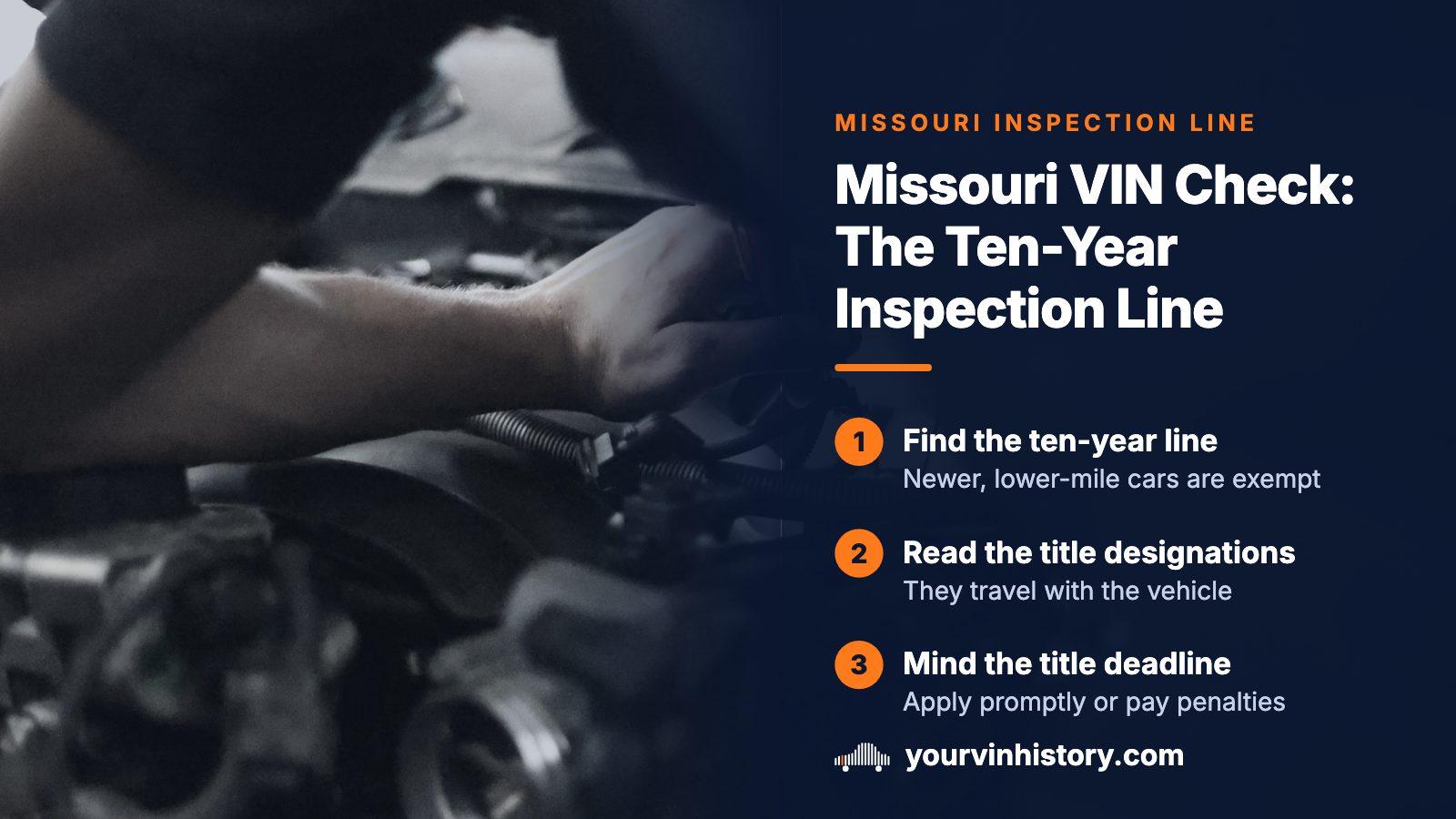
In 2019 Missouri changed its law so that newer, lower-mileage vehicles stopped needing a periodic safety inspection. The exemption covers a vehicle up to ten model years old with fewer than 150,000 miles. Cross either threshold, by age or by odometer, and a safety inspection is required when the car is sold and when it is registered.
For a buyer, that makes two used markets under one set of plates. Inside the line, no inspector has necessarily looked at the brakes, tires, steering or underbody. Outside it, the car had to clear a checklist to change hands, which speaks only to the items on that list.
Confirm the rule in force
The line above is the one set by the 2019 law. Inspection requirements are a favorite subject for new legislation, so confirm what applies today with the Missouri Department of Revenue before relying on it for a specific purchase.
What a car's position on the line tells you
Model year and odometer reading place any Missouri car in one of four positions.
| Where the car sits | What to conclude |
|---|---|
| Comfortably inside the exemption | No safety inspection was required of it. Your own mechanic is probably the first independent look at brakes, tires and underside. |
| Close to the line | Ask what it would need to pass an inspection today. How the seller answers is information in itself. |
| Just past the line, recently sold or registered | An inspection was required, so the checklist items were acceptable that day. Everything off the checklist is unknown. |
| Far past the line | Each sale and registration should have produced an inspection, so ask for the latest result and read what it flagged. |
A listing that sits right at the edge
Some sellers list a car just before it ages out of the exemption, or a few thousand miles shy of the mileage cap. The timing can be innocent, because people sell when life says so. It can also mean the owner would rather pass the first inspection problem to the next person than pay for it.
You do not need to accuse anyone. Ask what the car would need to pass, and notice whether the answer is specific. Then price any gap into your offer, or have a mechanic put it on a lift. Age and mileage both count, so read the odometer as closely as the model year.
Two examinations that people mix up
Missouri has a second examination that has nothing to do with the safety exemption. Before a title is issued for certain vehicles, the owner must present a vehicle examination certificate. The list covers salvage vehicles, reconstructed vehicles, motor change vehicles, non-USA-standard imports and anything else the Director of Revenue adds. The Missouri State Highway Patrol performs the exam, as can another law enforcement agency the director authorizes.
Non-USA-standard means an import built to a specification other than the American one. A motor change vehicle has had its engine swapped. Either label is easy to overlook on a title.
Roadworthy is not the same as genuine
A safety inspection asks if the car is fit to drive now. The certificate checks that the vehicle matches its paperwork. A car can pass the first without facing the second, and neither judges the structure.
Prior salvage on an older car says less than you would expect
Missouri prints the words prior salvage on titles for vehicles that went through the salvage process and then passed examination. For a salvage-titled vehicle that is ten years old or older, the statute relaxes one demand: the owner need not restore the car's original appearance to complete the exam.
- On an older car, the designation records that an examination happened, not that the work was done well.
- The appearance relief starts at ten years of age, the same number as the safety exemption, yet the two rules are unrelated.
- Nothing in the examination grades structural repairs, so only an inspection by someone you hired can answer that.
The leniency is sensible, since demanding cosmetic restoration on an old car would push usable vehicles toward the crusher. When anyone in a Missouri car conversation says ten years, ask which rule they mean.
Designations that travel with the vehicle
The title statute takes a firm position on branded vehicles that cross a state line. A car brought into Missouri wrecked or damaged, or towed in under another state's abandoned vehicle process, goes to the Highway Patrol. If the inspector finds a salvage or junk condition, the director records it on any Missouri title issued, and the designation is carried onto every title after it.
Vehicles that arrive already branded get similar treatment. When an out-of-state title was marked reconstructed, motor change, specially constructed or prior salvage, Missouri places both the earlier designation and the name of the issuing state on its current title and on later ones. A Missouri title can therefore tell you which state applied the brand, which is more detail than many states keep.
Safeguards aimed at washed titles
Another provision targets title washing: a vehicle holds a current title from another state, and Missouri has already issued a salvage certificate for it. Before an original Missouri title is issued, the Highway Patrol inspects the vehicle and verifies its identification numbers, unless an officer elsewhere already did a comparable inspection.
The statute also puts a duty on the person selling. A title showing no earlier designation does not excuse the transferor from using due diligence about that title before the transfer. When a seller says the paperwork looked fine to them, the law does not treat that as a full answer, and neither should you. Compare the title, the car and the NMVTIS record.
The 30-day title clock and what lateness costs
An application for a Missouri certificate of ownership is due within 30 days of acquiring the vehicle. After that, the statute adds a penalty in fixed amounts.
| Timing | Penalty |
|---|---|
| Within the first 30 days | None |
| The first 30 days late | $25 |
| Every further 30 days late | Another $25 |
| Ceiling | $200 in total |
The application must list the VIN and the mileage shown on the odometer at transfer, so the number on the car and the number on the paperwork must agree before you sign. The director may waive the penalty for good cause, which gives a buyer whose seller never produced a signed title grounds to ask. Separately, driving a vehicle that must be registered is unlawful before you have filed for a certificate of ownership. The test is whether you filed, not whether the title has arrived.
River floods and road salt leave no entry
Missouri's water damage is mostly river water. The Missouri and Mississippi valleys flood in many wet springs, and the water reaches cars in driveways and on dealer lots far from any coast. An uninsured vehicle that dries out can reappear for sale with a clean title, so the record may stay silent. A car from a river town, or one with a Gulf Coast past, deserves a water inspection: silt in odd places, corroded connectors, damp light housings and electrical faults that come and go.
Winter is the other source of hidden damage. Missouri salts its roads and has freeze-thaw cycles, so brake lines and underbody steel corrode out of sight. That matters most inside the inspection exemption, where no inspector may ever have lifted the car.
A Missouri purchase in the order that saves money
- Match the VIN on the car to the VIN on the title.
- Run the no-cost lookups, then the NMVTIS record, before any money moves.
- Read every title designation, including the name of any other state attached to it.
- Place the car against the ten-year, 150,000-mile line and, if it is past it, ask for the last inspection result.
- If the car is salvage, reconstructed, motor change or non-USA-standard, ask to see the vehicle examination certificate.
- Hire a mechanic to check structure, brakes and corrosion, since neither Missouri examination judges repair quality.
- Start the 30-day title clock the day you buy.
A Missouri plate will not get you an owner. Federal privacy law restricts that information to permitted uses, so ask the seller for the VIN instead.
Where this information comes from
- Missouri Revisor of Statutes: Section 301.190 — The statute behind the 30-day application window, the late-penalty schedule, the Highway Patrol examination and the rules that carry designations forward.
- Missouri Department of Revenue: Motor Vehicle — The agency that handles Missouri titles and registration, and the place to confirm the inspection rules in force today.
- NMVTIS: National Motor Vehicle Title Information System — The federal system meant to protect consumers from title fraud and unsafe vehicles and to keep stolen vehicles from being resold.
- NICB: VINCheck — A no-cost search of theft and salvage records reported by participating insurers.
- NHTSA: Recalls — Where to search a VIN for open safety recalls.
Sources and photos: Facts checked against the sources above in October 2026. Photo by Martin Fennema on Unsplash; diagrams by YourVINHistory.
Keep reading
- Missouri title checkGoes deeper on salvage and prior salvage wording and on the damage test that decides which cars get branded.
- Pre-purchase inspectionPicks up where this guide ends, for the cars that no state inspector has ever examined.
- Flood-damaged carsShows how to spot a river-flooded car whose title still reads clean.
- Title washingExplains how a brand can vanish across a state line, the pattern Missouri's carry-forward rules are written against.
Frequently asked questions
How do I run a VIN check on a car in Missouri?
Start with NHTSA's recall lookup and NICB's VINCheck, both offered at no cost, then add an NMVTIS title record from an approved provider so brands applied by other states show up. Before paying anyone, compare the VIN on the dashboard, the door-jamb label and the title. All three should agree character for character.
Does a used car need a safety inspection to be sold in Missouri?
It depends on age and mileage. Under the 2019 change, a vehicle up to ten model years old with fewer than 150,000 miles is exempt, while an older or higher-mileage one needs an inspection at sale and registration. Ask for the latest result, and confirm the current rule with the Department of Revenue.
What if I miss Missouri's 30-day deadline to title a car?
The statute adds $25 for the first 30 days of delinquency and $25 for each 30 days after that, up to $200 in total. The director can waive it for good cause. Keep proof of the delay, such as messages chasing a seller for a signed title, and make the request in writing.
Can I find a Missouri car's owner from its license plate?
No. A private buyer cannot do this, because the federal Driver's Privacy Protection Act lets owner details out only for permitted purposes, and curiosity about a car you hope to buy is not one. The VIN answers purchase questions, so ask the seller for it and check it against the title and the car.
Do flood-damaged cars turn up in Missouri?
Yes, because river flooding in the Missouri and Mississippi valleys can put water into vehicles in towns far from the coast. A flooded car that was never insured may be dried out and sold with a clean title. Run the records, then look for silt, a musty smell, damp carpet padding, corroded connectors and flickering electrical systems before committing.
Now check the car itself
The guide explains what to look for. The report shows what this VIN has on record.