THE SHORT ANSWER
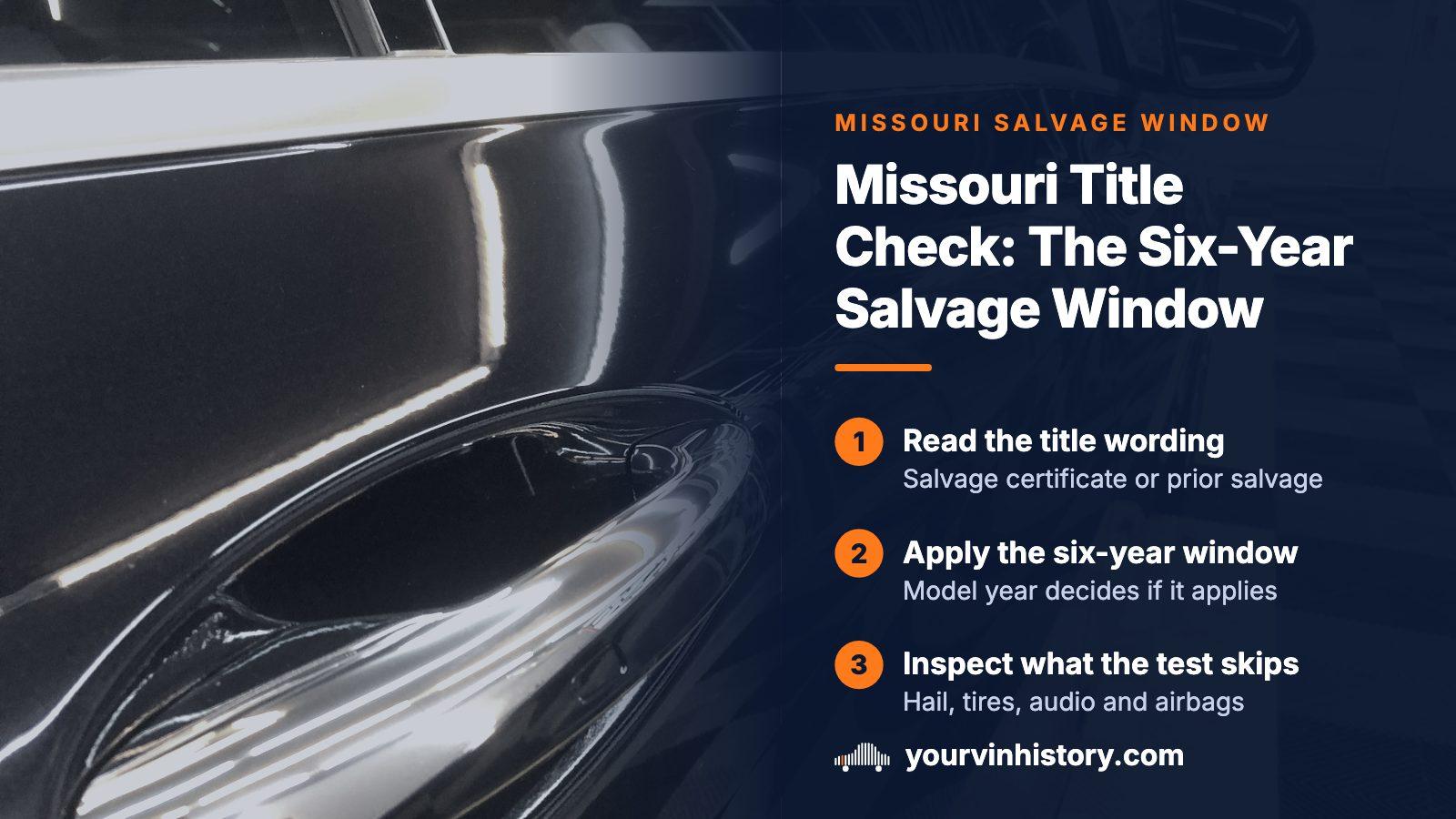
Read the title for salvage certificate or prior salvage wording, then compare the car's model year with the years it has been on the road. Missouri's damage test applies when repairs top 80 percent of fair market value, but only within six years of the model year, and it drops hail damage, airbags, tires, audio equipment and sales tax from the repair figure. Add a national NMVTIS record and inspect the car for what the test leaves out.
- Damage test
- Repairs above 80 percent of fair market value
- Window
- Damage within six years of the model year
- Left out of the repair figure
- Hail, safety restraints, tires, sound systems, sales tax
- Salvage certificate
- Proof of ownership only, not valid for registration
Two wordings to look for on a Missouri title
Missouri uses two phrases to mark a damaged vehicle on its paperwork. A salvage certificate of title is issued for a vehicle declared salvage, and it serves as proof of ownership for that vehicle. A prior salvage designation goes onto an original certificate of title once the vehicle examination certificate shows the vehicle was salvaged or rebuilt at some point.
A title with neither phrase is only as reassuring as the rule that would have produced one. For a late-model car that rule is fairly tight. For an older car it leaves a sizable gap, and the sections below show exactly where it opens.
Five routes into the salvage system
Plenty of articles boil Missouri down to one percentage. The state's definition of a salvage vehicle is wider, and the damage calculation is only one of five ways in.
- The damage test: repair costs above 80 percent of fair market value, for damage inside the six-year window
- A declaration of salvage by the owner
- A declaration of salvage by a lienholder
- A declaration of salvage by an insurance company
- Abandoned property, when it is titled as salvage or as abandoned property
The four non-test routes do not hinge on the 80 percent figure or the model-year window. An insurer paying out on a wreck can declare an older car salvage by itself, and that is why some old Missouri cars carry brands. A wreck repaired out of pocket, with no insurer and no declaration, leaves little for the system to catch.
The six-year window, worked through
Count from the model year the manufacturer assigned, not from the day you bought the car. Damage counts toward the test only if it occurs within six years of that model year. After that, the 80 percent calculation is no longer a way to earn a salvage designation.
| When the damage happened | Inside the window? | What the 80 percent test does |
|---|---|---|
| Two years after the model year | Yes | Applies, so repairs above 80 percent of value can lead to a brand |
| Six years after the model year | Yes, at the edge | Still applies |
| Seven years after the model year | No | Not available as a route to salvage, though a declaration still can be |
Value widens the gap. An older car is worth little, so even a moderate repair bill eats a large share of it. Those cars are the likeliest to cross 80 percent, and the window releases exactly them from the test.
Why old and clean proves less
On a Missouri vehicle more than six model years old, a title with no salvage wording means the damage test did not apply or nobody declared the car salvage. It does not mean the car was never wrecked. Treat the title as the place to begin asking questions.
Costs the 80 percent test ignores
When the test applies, repair cost is weighed against 80 percent of fair market value, and the repair side gets trimmed first. Five categories come out, and each one points at damage a buyer can still find on a car with a spotless title.
| Left out of the repair figure | What a buyer can look for |
|---|---|
| Hail damage | Dimples across the roof, hood and trunk lid, or fresh paint on those surfaces |
| Safety restraint systems | New airbags, replaced seat belts, a steering wheel hub or dash cover newer than the rest of the interior |
| Tires | Mismatched brands or uneven wear hinting at a bent suspension |
| Sound systems | A non-factory head unit, loose dash trim, or wiring that does not match the car |
| Sales tax | Nothing visible on the car; it only keeps the repair total below the invoice amount |
The restraint exclusion deserves the most attention. Airbags rank among the pricier parts to replace after a hard impact, and Missouri does not count that bill toward 80 percent. A car can take a serious hit, get new airbags, and still finish under the line.
A salvage certificate proves ownership and nothing else
Missouri hands out a salvage certificate of title so the owner of a salvaged vehicle can show who owns it. The statute does not accept it for registering a vehicle, so the car cannot be plated and driven on that paper.
Handling is restricted as well. The rules let the certificate change hands through one reassignment on its back, and only registered dealers or insurance companies may do it. The aim is to stop a branded vehicle drifting through a string of private sellers without anyone applying for a new title.
A salvage certificate that looks like it has traveled further than that deserves a hard stop. Ask how the car got from the last named owner to the person selling it.
A prior-salvage brand and the inspection that earns it
Prior salvage is how Missouri flags a vehicle that has been rebuilt, the rough equivalent of the rebuilt brand used elsewhere. The wording lands on the original title only after a vehicle examination certificate reports that the vehicle used to be salvage or was reconstructed.
The examination certificate is the useful part. Without one, a repair is only the seller's story; with one, the state has looked at the vehicle and recorded what it found. If an insurer pays out on a vehicle already declared salvage and the owner keeps the car as prior salvage, the statute still puts it under the examination requirements.
So when a visibly repaired car turns up with a plain title, ask why. It may simply be a car that never reached salvage. Even so, a repaired car with no designation and no examination paperwork is a question the seller owes you an answer to. Related guides below cover value and insurance for rebuilt cars.
Paperwork for a prior salvage title, and the 60-day clock
If a seller says a rebuilt car is still being retitled, know what the state wants to see. The list is short but specific.
| Item | Needed when |
|---|---|
| Missouri Title and License application, marked Prior Salvage | Every time |
| Original title for the damaged vehicle | Every time |
| Safety inspection no more than 60 days old | The vehicle will be registered |
| Identification or odometer inspection | Registration is being put off |
The 60-day limit catches people. A safety inspection done early in a long rebuild can age out before the application is filed, and the finished car then waits for a fresh one. If a seller hands you inspection paperwork, read the date and count forward.
Damage from other states needs a national record
A Missouri title reflects what Missouri's rules caught. A car wrecked and branded elsewhere can reach a Missouri owner with paperwork that says nothing about it. NMVTIS, the federal database of title brands and total losses, exists to close that gap.
Not every history product draws on it. The NMVTIS site lists approved data providers and separates those that sell to the public from those that serve commercial customers only, so check that list first. A yourvinhistory report includes NMVTIS title records supplied by ClearVin LLC, an approved NMVTIS data provider, next to accident and odometer records, a cross-check that helps when a Missouri title looks too clean.
A Missouri title check in six steps
- Work out the age gap. If the car is more than six model years old, a clean title leaves room for later damage that no 80 percent test would have branded.
- Match the VIN on the car to the VIN printed on the title, character by character.
- Read the title for a salvage certificate or prior salvage designation. If it says prior salvage, ask to see the examination paperwork behind it.
- Look up open recalls on the NHTSA site by VIN, and screen the number with the NICB VINCheck tool for theft and salvage flags. Both searches cost nothing, and neither depends on how the title reads.
- Pull a national NMVTIS record to catch brands and total losses recorded in other states.
- Inspect the car with the excluded damage in mind: hail, airbags, tires and audio equipment.
Inspecting a car the title calls clean
The damage most likely to hide behind a clean title is the damage the state does not count. Go over the car in daylight, ideally after a wash, and take your time.
- Hail: sight along the roof, hood and trunk lid at a low angle so small dents cast shadows, and look for paint that does not match between panels
- Airbags: with the key on, the warning lamp should light briefly and go out; a lamp that stays lit, or never lights, needs a scan before you buy
- Dash, steering wheel and belts: look for seams that do not line up and trim newer than its surroundings
- Tires: the set should be consistent, with even wear across each one
- Audio and wiring: the head unit and speakers should look original, with nothing spliced or taped under the dash
Ask the seller whether an insurance claim was ever paid, and ask for repair invoices. Then have a mechanic you chose, not one the seller suggests, put the car on a lift.
Where this information comes from
- Missouri Revisor of Statutes: Section 301.010 — Where the state defines a salvage vehicle, including the damage test, the six-year window and the costs held out of the repair figure.
- Missouri Revisor of Statutes: Section 301.227 — Covers the salvage certificate of title, the limit on reassigning it, and the prior salvage designation.
- Missouri Revisor of Statutes: Section 301.190 — Describes the examination certificate that backs up a prior salvage designation.
- NMVTIS: official vehicle history record — The federal page for the national title record, with its list of approved data providers and which ones sell to the public.
- NHTSA: recalls lookup — Search open safety recalls by VIN, whatever the title says.
Sources and photos: Facts checked against the sources above in October 2026. Photo by Clarence Tioh on Unsplash; diagrams by YourVINHistory.
Keep reading
- Total loss threshold by stateSee how Missouri's 80 percent line compares with the thresholds other states use.
- What is a rebuilt title?Prior salvage is Missouri's version of a rebuilt brand; this covers what it does to value and insurance.
- NMVTIS reportThe national record that catches brands applied outside Missouri.
- MissouriThe rest of the Missouri picture: inspections, registration and the state's own lookups.
Frequently asked questions
Can an old car with a wreck history still have a clean Missouri title?
Yes. Damage that occurs more than six years past the model year falls outside the test, so a heavy wreck on an older car may never trigger the 80 percent calculation. Unless an owner, lienholder or insurer declared the car salvage, nothing else forces a brand. Ask for repair invoices and run a national record.
Does hail damage count toward Missouri's 80 percent salvage rule?
No, hail is one of the costs removed from the repair figure. A hail-battered car can look wrecked and still sit well under the line. An insurance company can still declare it salvage on its own, so hail history may show up as a brand, but you cannot count on the title to say so.
Who can declare a vehicle salvage in Missouri?
Apart from the damage test, three parties can do it: the owner, a lienholder, or an insurer. Abandoned property can also end up titled with a salvage designation. For a buyer, the practical lesson is that an insurer's decision on a claim, not an age rule, often decides whether an older car gets branded.
How long is a safety inspection good for when retitling a prior salvage car?
For a vehicle that will be registered, the safety inspection must be no more than 60 days old when the application is filed. If registration is being put off, an identification or odometer inspection is what the state asks for instead. Check current requirements with the Department of Revenue.
Does a clean title mean the car has no open recalls?
No. Recalls are tied to the VIN at NHTSA and have nothing to do with title status, so a spotless Missouri title can sit on a car with an unfixed recall. The lookup costs nothing, but do not assume the repair will too: very old vehicles fall outside the federal free-repair rule, so ask a dealer first.
Now check the car itself
The guide explains what to look for. The report shows what this VIN has on record.