THE SHORT ANSWER
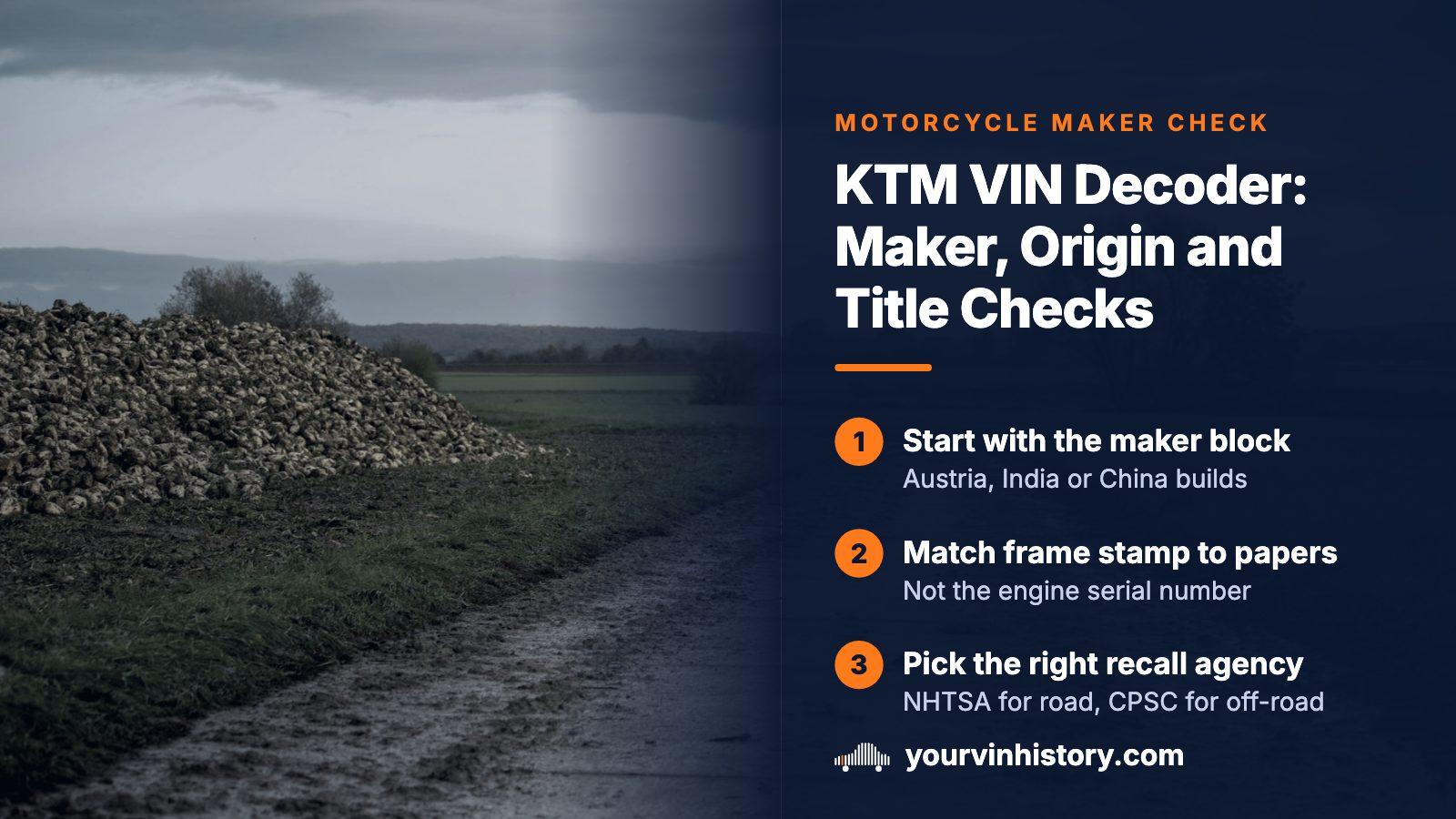
Read characters 1 to 3 of the VIN first. They name the manufacturer and point to the country of build, which for a KTM can be Austria, India or China. Then find out whether the bike is street-legal or can be registered in your state, match the frame stamping to the paperwork, and check recalls with NHTSA for road bikes or the CPSC for off-road machines.
- Read first
- Characters 1 to 3, the maker block
- Shared hardware
- KTM, Husqvarna and GasGas
- Build countries
- Austria, India and China
- Recalls
- NHTSA for road bikes, CPSC for off-road
What a KTM VIN holds and what it leaves out
A VIN decoder reads a fixed layout that federal regulation sets out in 49 CFR Part 565. For a motorcycle, the descriptive middle of the number is meant to cover the make, the type of motorcycle, the model line, the engine type and the net brake horsepower. The table shows where each piece sits.
| Characters | What they carry |
|---|---|
| 1 to 3 | Manufacturer identifier: who built the machine, and the first clue to where |
| 4 to 8 | Descriptive block: make, type, line, engine type and horsepower on a motorcycle |
| 9 | Check digit, a built-in test for a mistyped VIN |
| 10 | Model year |
| 11 | Plant of manufacture |
| 12 to 17 | Serial number of that one machine |
Anything outside that layout is beyond a decoder's reach. It will not say whether the bike was crashed, whether a previous owner modified the engine, how many hours the motor has run or whether the title is clean. Those answers live in records and in the machine itself.
Characters 1 to 3 settle who built it and where
For most makers the opening block is the least interesting part of a VIN, because everyone knows where their bikes come from. KTM breaks that pattern. The same badge appears on bikes put together by different companies in different countries, so the block carries real information.
Mattighofen, Austria, is the home plant and the source of a large share of the range. Partner manufacturers also assemble KTM-badged motorcycles, notably in India and China, and the split of models between plants has shifted as the group grew. A listing that says Austrian built may be right or wrong for the specific bike in front of you, and the same goes for the opposite assumption.
So let the number decide. Run the VIN through a decoder, note the maker and country it reports, and compare that with what the seller, the ad and the paperwork claim. A match is reassuring but proves little. A mismatch is a question to put to the seller before you drive anywhere.
KTM, Husqvarna and GasGas draw on the same hardware
All three names belong to one group, and their lineups rest on common engines and common frames, not on three independent engineering efforts. The differences that remain are real, but they sit higher up on the bike.
- Mostly shared: the engines and frames underneath the range.
- Mostly different: bodywork and graphics, which is the first thing a buyer sees.
- Different by design: suspension specification and settings.
- Different by model: trim, equipment levels and the market position each name aims for.
Motorcycle groups work this way routinely, much as a car maker sells related models on one platform. Most shoppers never think about it, and they compare a Husqvarna with a KTM as though the two had nothing in common.
Turn the shared platform into a shopping advantage
If the KTM you want is scarce or priced high where you live, the matching Husqvarna or GasGas may be sitting unsold a short drive away, and underneath it is substantially the same motorcycle. Searching under all three names widens a thin used market.
The family tie also helps after the purchase. A shop that knows one badge usually knows the others, so finding a mechanic gets easier. Because major components are shared, parts supply tends to beat what the sales of any single name would predict. Bodywork and graphics are the exception: that is where the brands diverge, so panels from one badge rarely swap onto another.
Search the siblings too
When you hunt for one model, enter all three names in the listing search. The sibling with the least name recognition may carry a lower asking price for nearly the same bike.
Frame number versus engine serial
The frame number is the legal identity of the bike. Titles and registrations are issued against it, and it has to agree with the paperwork exactly, character for character. The engine carries its own serial, which follows the motor and not the machine.
On an off-road KTM the two can drift apart for ordinary reasons. Competition engines get rebuilt, replaced and swapped as routine upkeep, so an engine serial that does not line up with the frame often says more about how hard the bike was campaigned than about any wrongdoing. Ask what was replaced and ask for receipts.
A frame stamping is a different matter. Metal that has been ground, filled, repainted or restamped is a reason to walk away, whatever explanation comes with it.
- Read the frame stamping yourself, in daylight or with a light held at a low angle.
- Compare it with the title or registration one character at a time.
- Ask whether the engine is the original and, if not, what became of it.
- Look for grinding, filler or fresh paint around the stamped area.
Closed-course KTMs and the registration trap
A good share of KTM's lineup is made for closed-course competition, not road use. Such bikes are neither engineered nor documented to be registered, and the papers that arrive with them are not the kind that produce a street title.
Buyers lose real money here. Someone who buys a race bike expecting to make it road-legal may never manage it, and a motorcycle that cannot be registered is worth roughly what a track toy fetches, often far below the asking price. Get the registration answer for your state before any money changes hands.
Get the answer from the DMV
Ask your state motor vehicle agency whether this kind of machine can be titled or registered, and keep the reply. A seller who wants the bike gone is not a neutral source on that question.
The dirt bike guide on this site goes deeper on bikes sold without titles, and its advice holds for this brand too.
Road bike or dirt bike: two agencies, two recall searches
Recalls follow the type of machine. A street-legal KTM falls under NHTSA, whose recall lookup works by VIN at no cost. A closed-course machine is regulated as a consumer product, so its campaigns are published by the Consumer Product Safety Commission.
| Machine | Where recalls appear | How to search |
|---|---|---|
| Street-legal motorcycle | NHTSA | Enter the VIN in the recall lookup |
| Off-road competition machine | CPSC | Search the recall database by product category, such as two-wheeled powered off-road vehicles |
The split matters more with KTM than with a brand that builds only road bikes, because one garage often holds both kinds. A search of NHTSA alone on a dirt bike returns a clean result that tells you very little. Use the agency that matches the machine you are buying.
When the country of build is not what you expected
A plant in India or China is no defect, and it says nothing bad about a bike on its own. The point is to know. If the decoded origin differs from the listing, ask direct questions and let the answers decide.
- Ask where the bike was first sold and how it reached the seller.
- Check that the title or registration names the same maker and model year the VIN decodes to.
- If the bike came from abroad, ask for the import paperwork.
- Be cautious with any story that cannot be backed by a document.
Federal standards decide whether a machine brought in from overseas can be registered for the road, and NHTSA's page on importing a vehicle is the place to start reading about them. For an off-road machine, the registration question comes back to your state's rules.
A short routine for checking a used KTM
- Decode the VIN and read characters 1 to 3 for the maker and country, then compare them with the listing.
- Work out whether the bike is street-legal or closed-course, and settle with your DMV whether it can be registered.
- Price the matching Husqvarna and GasGas models beside the KTM.
- Inspect the frame stamping in person and match it to the title or registration.
- Ask about the engine: original, rebuilt or swapped, with receipts.
- Search recalls at NHTSA or the CPSC, whichever fits, and run a theft screen before you send money.
For a street-legal bike with a full VIN, a vehicle history report adds title brands, salvage and auction records, liens and open recalls to that list. Competition bikes may leave little to find in any database, which is one more reason the in-person checks carry the weight.
Where this information comes from
- eCFR: 49 CFR Part 565, VIN content and layout — Sets the VIN layout, including the manufacturer block in the first three characters and what the descriptive block covers on a motorcycle.
- NHTSA: recall lookup — Where open recalls on a street-legal motorcycle are searched by VIN.
- CPSC: recalls and product safety warnings — The searchable recall database that covers off-road machines, with product categories such as two-wheeled powered off-road vehicles.
- NHTSA: importing a vehicle — Background on the federal standards that bear on registering a machine brought in from abroad.
Sources and photos: Facts checked against the sources above in October 2026. Photo by Andrew Dawes on Unsplash; diagrams by YourVINHistory.
Keep reading
- Dirt bikesHour counts, short frame numbers and what to do when a competition bike has no title.
- Motorcycle VIN lookupTelling a frame number from an engine serial on any make.
- How to read a VINThe full seventeen-character layout, the year chart and the check digit.
- Motorcycle value by VINWhat the bike is worth once the VIN checks out, and why low mileage can mislead.
Frequently asked questions
How do I know if my KTM was built in Austria?
Read characters 1 to 3 of the VIN, look up the maker and country a decoder reports for them, and compare that with the title and the ad. The tank graphics and the seller's pitch do not settle it. If the decode and the paperwork disagree, ask the seller or an authorized dealer to explain the gap before you buy.
Does a KTM dirt bike have a VIN?
Machines built purely for racing are not designed with road registration in mind, so how they are identified and papered differs from a street-legal motorcycle. Look for a stamping on the frame, but do not assume it follows the layout above or that a title exists. Ask your state motor vehicle agency whether the bike can be titled at all.
What does the check digit in a KTM VIN do?
On a bike that follows the federal layout, character 9 is a check digit. The regulation describes it as a way to verify that a VIN was transcribed accurately, so one mistyped character will usually break the match. If a decoder rejects a number, recopy it from the frame stamping before drawing any conclusion about the bike.
Are KTM, Husqvarna and GasGas parts interchangeable?
Mechanical parts are often related, because the three ranges share engines and frames, which is why parts supply runs better than one name's sales would suggest. Bodywork and graphics are where the brands differ, so cosmetic parts are the least likely to fit across badges. Match any part by number with a dealer or parts catalog rather than trusting the shared lineage.
Will a NHTSA search cover my off-road KTM?
Not reliably. NHTSA covers street-legal motorcycles, while closed-course machines are treated as consumer products and their recalls are published by the CPSC. A clean NHTSA result on a dirt bike therefore proves little. Search the CPSC database by product category, and if the bike is plated for the road, run the NHTSA lookup as well.
Now check the car itself
The guide explains what to look for. The report shows what this VIN has on record.