THE SHORT ANSWER
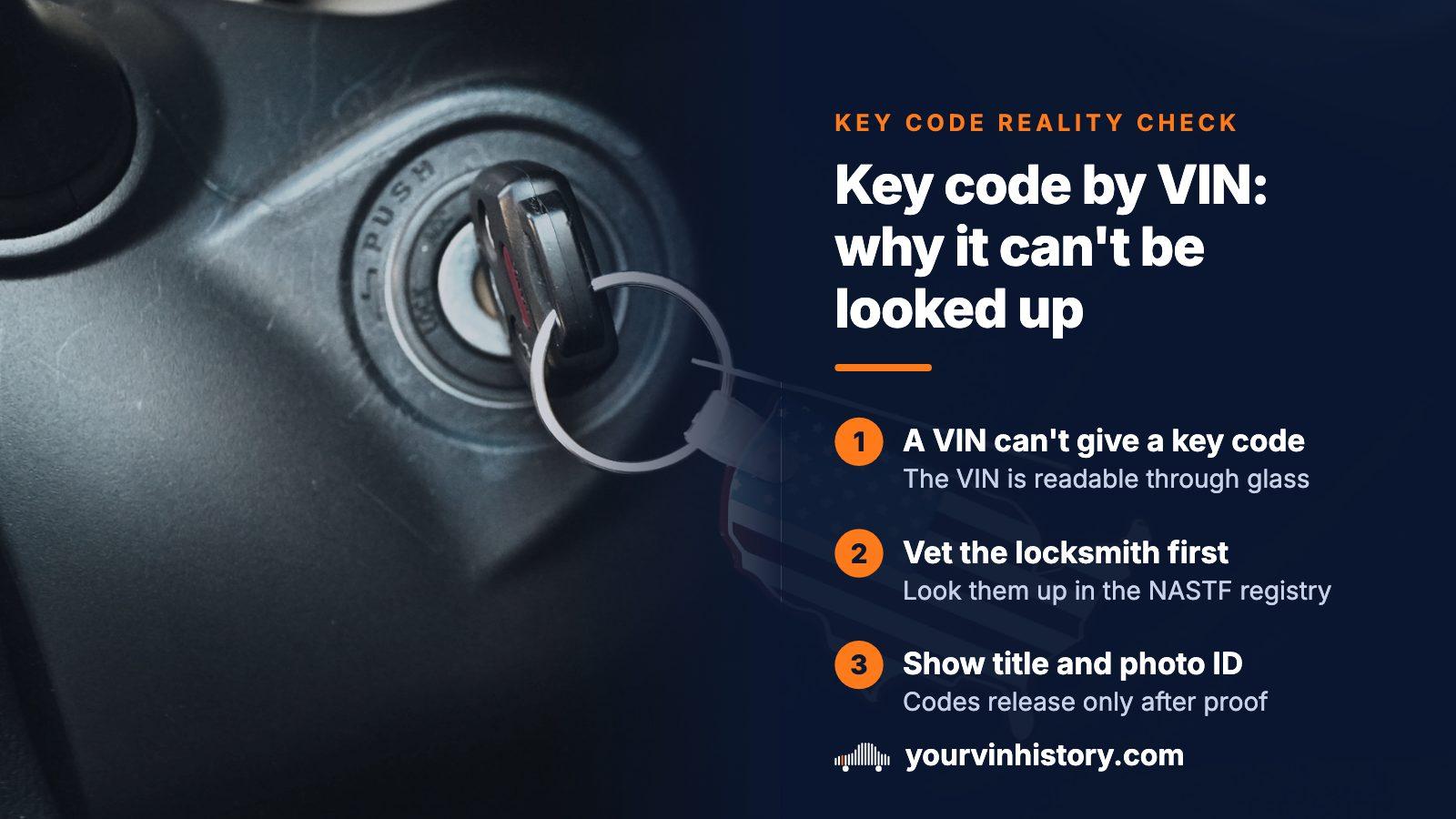
You cannot look up a key code by VIN. Federal rules put the VIN where anyone can read it from outside the car, so codes are released only to dealers and to locksmiths registered through NASTF, and only after they check your ownership papers and photo ID. Before you hire a locksmith, look the business up in the NASTF registry. Treat any site that sells a key code from a VIN alone as a warning sign.
- VIN visibility
- Readable through the glass from outside the car
- Who releases codes
- Dealers and NASTF-registered locksmiths
- Jobs behind one new key
- Up to three: cut, program, immobilizer
- Proof you provide
- Title or registration, plus photo ID
Why a VIN cannot hand you a key code
A VIN decodes into facts about how the car was assembled: the maker, the plant, the model year, the engine. Those are harmless to publish. A key code describes the cuts that let a blade turn the locks, which makes it a credential, not a description.
The federal VIN standard says that on most passenger vehicles the number must sit inside the cabin where an observer standing outside, beside the left windshield pillar, can read it through the glass. Suppose the code followed from that number. The same stroll through a parking lot would then produce keys for a whole row of cars.
A warning sign, not a shortcut
A site that sells key codes against a bare VIN, with no proof you own the car, is not offering convenience. It is offering to open cars it has never verified belong to you.
Cut, chip, immobilizer: the three jobs behind a new key
People say they need a new key and mean different things, so two quotes for one car can sit far apart. The code speaks to one piece of the work only: the mechanical cuts. If the key head holds a transponder chip, or the car uses a proximity fob, a blade with perfect cuts may open the door and still be useless for starting the engine.
| Job | What happens | Where the code fits |
|---|---|---|
| Cutting the blade | Metal is shaped, copied from a key you hold or originated from the code | The only step the code serves |
| Programming the transponder | The chip is introduced to the car so the immobilizer accepts it | Not touched by the code; needs equipment and, on many makes, manufacturer security data |
| Updating the immobilizer | A key is added to the car's memory, and lost ones are removed | Separate security access, and the step most people forget |
Copying a key you still hold usually means cutting plus programming. With every key gone, the cutting starts from the code, and the other two jobs need security access on top.
Who can get a key code released
Two doors lead to the code. One is a franchised dealer for your make, which deals with the manufacturer as routine business. The other is a technician or locksmith on the vehicle-security registry run by the National Automotive Service Task Force, known as NASTF, which approves them for jobs such as key programming, code ordering and immobilizer resets. On either path, the release follows a check that you are the owner.
The locksmith route exists because a car with no working key often cannot get to a dealership under its own power. A registered professional can come to the car, and registration acts as the gatekeeper that keeps manufacturer security data from reaching just anyone.
Vetting a locksmith before you share your VIN and title
The business needs a federal taxpayer ID or, in Canada, a business number. It must hold the licenses and registrations required in each municipality where it works, and stay in good standing there. Its main work must be repair or replacement done directly for vehicle owners. Approved registrants receive an ID number and a passcode for the secure data.
That secure database is limited to qualified professionals, but the NASTF registry page lets you look up a business by name or registry ID. Search before you send anything sensitive. A match proves registration, a floor and not a guarantee; it says nothing about whether the quote is fair.
One question that sorts things quickly
Ask the locksmith for a registry ID before anyone drives out. Someone who does this work for a living can answer in seconds. A pause or a refusal is useful information.
What you will have to show
Expect to prove two separate things: that the car is yours, and that you are the person named on the paperwork. Documents carry that proof, not a confident voice on the phone.
- A title in your name, or your current registration
- Government photo ID that matches the name on that document
- The car, or a verified location, since the work usually happens where it sits
- Written permission plus the owner's documents, if the registered owner is not the person standing there
- Patience if the dealer or manufacturer channel repeats the check
If you bought the car recently and the title has not reached you yet, say so at the start. That gap is common, and it goes far better when raised on the phone than at the car door.
Why losing every key costs more than adding a spare
The jump in price between a spare and an all-keys-lost call has reasons you can name.
- No pattern to copy. If you hold a key, a locksmith can reproduce it mechanically. If you hold none, the cuts must be originated from the code, which is the gated step.
- The car stays put. A vehicle that will not start usually cannot reach a shop, so the work happens at the curb or the car gets towed.
- Programming gets harder. Many procedures expect a key the car already accepts. Without one, the process runs longer, and some makes require manufacturer authorization.
- The old keys still exist somewhere. A key that went missing may be in someone's pocket, so the job should erase it from the car's memory, not only add a new one.
Dealer or mobile locksmith: which one fits
Both routes are legitimate, and the right pick depends on the circumstances.
| Situation | Usually points to |
|---|---|
| The car will not start and cannot be driven | A locksmith, who travels to the vehicle; a dealer may add a tow to the bill |
| A very recent or unusual model | The dealer, which works from the maker's own procedures and parts |
| Evening, weekend or urgent need | A locksmith, once you have checked the registry instead of calling the first listing |
| You want every old key to stop working | Either one, but ask for it by name; the answer should be yes, not an assumption |
Breaking a quote into its parts
Prices shift by region and by year, so this guide prints none. The structure of the bill holds steady, and asking for it in pieces is the best protection you have.
- The key itself: blade, transponder key and proximity fob are three separate parts, each priced differently
- Originating the cuts from the code, if nothing exists to copy
- Programming time, which is what covers the tools and the security access
- A travel or tow charge, depending on the route you picked
- Immobilizer work beyond adding one key, including erasing the old ones
Itemized, a quote can be compared against a second opinion line by line.
Normal requests and warning signs
Legitimate key work involves handing over sensitive documents, so learn which requests are normal.
| Normal | Warning sign |
|---|---|
| Wants to see your photo ID and the title or registration before work starts | Offers a code from the VIN alone, no ownership check at all |
| Asks for the VIN, which anyone can read off the car | Wants a photo of your title and ID sent to an address you cannot verify, before any real contact |
| Turns the job down when your papers do not prove ownership | Agrees to go ahead anyway for extra money |
| Appears in the registry under the name they gave you | Dodges when you ask who they are or for a registry ID |
A real professional asks for more proof than you expected, and a scammer asks for less. Federal parts-marking rules defend vehicle identity from another angle, by stamping the number on major parts of certain passenger cars. Key release rules guard a different weak point.
Buying a used car that comes with one key
One key is no defect and no reason to walk away. It is a known future cost that the seller is passing to you, and on a car with a proximity fob it can be sizable. Raise it before the price is settled, not afterward.
There is a security side too. Nothing on the car tells you how many keys exist or who holds them: a prior owner, a household member, a valet. Ask the seller how many were made and where each one is. Not knowing is an honest answer, and a reason to have the immobilizer reset so that only the keys you hold will start the car.
Keys are one line on a longer checklist. NHTSA's recall lookup by VIN costs nothing, and NICB's VINCheck screens for theft and total-loss records that participating insurers have reported. A yourvinhistory report gathers title brands, theft records, liens and odometer readings for the VIN. Start with the free preview; the full report is a one-time purchase.
What to do while you still have a working key
Everything above gets cheaper and calmer when you act before the last key disappears.
- Have a spare made now, while the job is copying rather than originating
- Store the spare away from the first key: a different bag, building or vehicle
- Photograph your title and registration, and keep the images where you can reach them from a phone
- On a used car that came with one key, decide early: add a spare, or have the car re-keyed
- Check how involved your make's keys are; some need far more work than others
Where this information comes from
- NASTF: Vehicle Security Professional registry — The registry page to visit when you want to check a locksmith's registration by business name or ID.
- NASTF: What is a NASTF Vehicle Security Professional — Backs the entry conditions for registrants and the kinds of security work the credential covers.
- eCFR: 49 CFR Part 541, Federal Motor Vehicle Theft Prevention Standard — Source for the rule that marks the VIN on major parts of certain passenger cars.
- NHTSA: Recalls — Where to search a VIN for open safety recalls before you buy.
- NICB: VINCheck — A screen for theft and total-loss entries that insurers report.
Sources and photos: Facts checked against the sources above in October 2026. Photo by Jake Kling on Unsplash; diagrams by YourVINHistory.
Keep reading
- VIN cloningAnother way vehicle identity gets abused, and why lookups alone can miss it.
- Theft recovery vehicleWhy old keys matter on a car that was stolen and later recovered.
- Used car red flagsWhat a single key belongs next to on a buyer's checklist.
- Report a stolen carThe first steps to take if a lost key turns out to be a stolen car.
Frequently asked questions
Is there any way to get a key code using only a VIN?
Not as a private person. A VIN identifies how the car was built, and what decoders return, such as engine and plant, never includes the cuts. Codes go to dealers and registered locksmiths after they verify ownership and identity. The free NHTSA and NICB tools cover recalls and theft, not keys.
What should I do if I have lost all my car keys?
Call a dealer for your make or a registered locksmith, with the title or registration and photo ID ready. Ask whether the quote includes removing the lost keys from the car's memory, and request it in itemized parts. If the car cannot be driven, a mobile locksmith may spare you a tow.
How can I check that a locksmith is registered for vehicle security work?
Search the NASTF registry by business name or registry ID, and ask for the ID before you book. NASTF expects a taxpayer ID, local licensing and good standing, so a legitimate shop has paperwork behind it. Registration does not set the price, so still compare quotes.
Can a VIN check tell me how many keys a used car has?
No. Vehicle history records are built from titles, damage, mileage and theft reports, not from keys. The only way to learn the count is to ask the seller and see what gets handed over. A history report can still show theft or title events that make the question more urgent.
Should I re-key a used car I just bought?
Consider it whenever you cannot account for every key ever programmed. Clearing the immobilizer so only the keys in your hand work is a reasonable step if you plan to keep the car, and a fair cost to raise when negotiating the price.
Now check the car itself
The guide explains what to look for. The report shows what this VIN has on record.