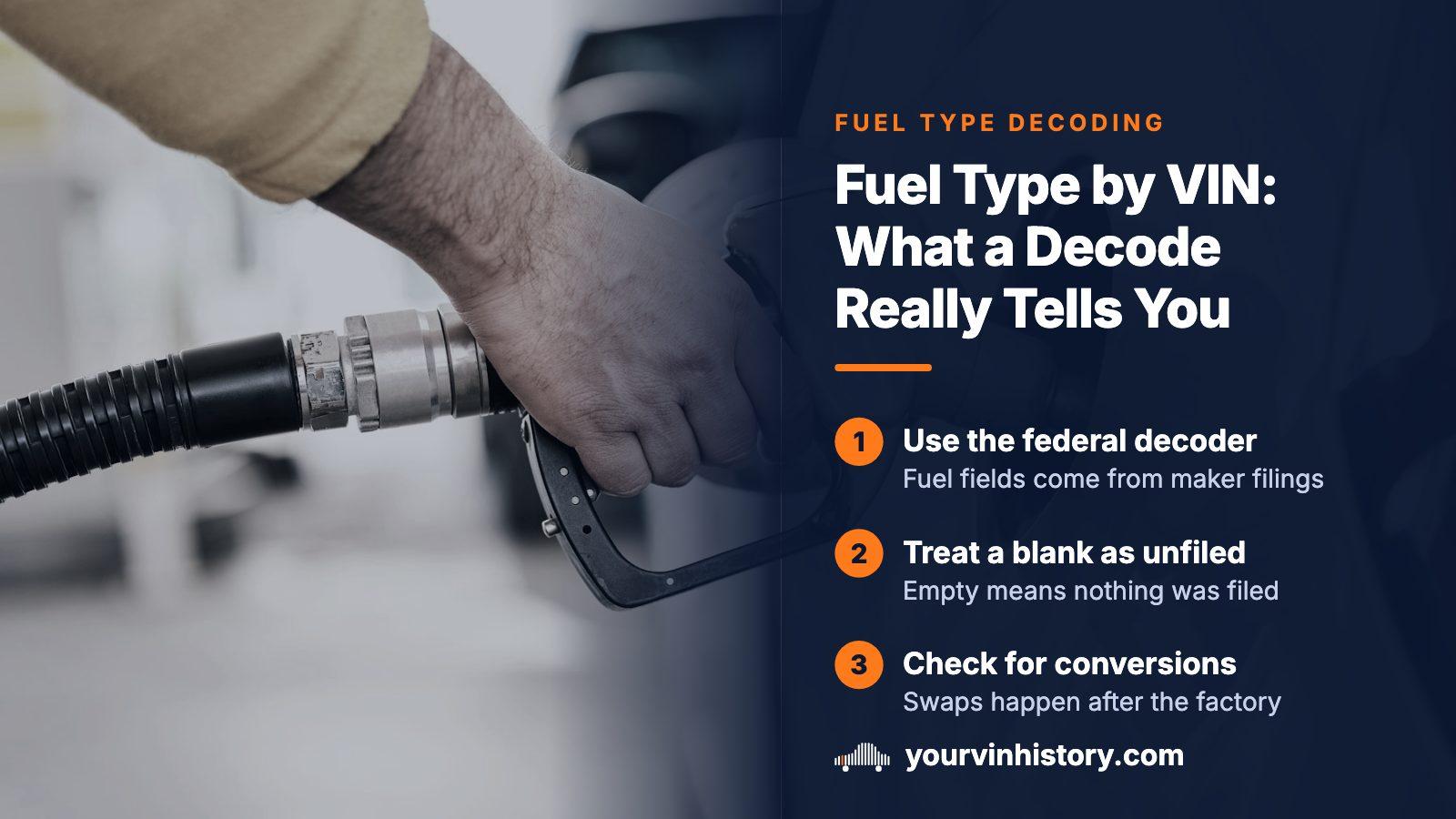
THE SHORT ANSWER
No position in a VIN is assigned to fuel, and the federal content table lists engine type, not fuel, as what a maker must make decipherable. The regulation defines engine type to include the fuel utilized, and NHTSA's public decoder carries dedicated fuel fields built from manufacturer submissions. A decoded fuel type is therefore dependable for the car as built, but it cannot see conversions or engine swaps, and a blank field means nothing was filed.
- Fuel in the federal table
- Not listed as its own item
- Engine type is defined to include
- The fuel utilized
- Decoder data comes from
- Manufacturer-reported filings
- Blind spots
- Conversions and engine swaps
What the fuel line in a decode really is
Run a VIN through a decoder and a line reading gasoline or diesel appears, which suggests that somewhere in the seventeen characters a letter or digit stands for fuel. None does. The middle stretch of a VIN points to a model, a body and an engine, and the decoder then looks that pattern up in a table of what the manufacturer said it means.
So the fuel line is a looked-up value, attached to a pattern the maker registered rather than spelled out by any single position. That distinction decides how much weight the answer deserves. A looked-up value is only as good as the record behind it. Where the maker registered the pattern carefully, the fuel line is accurate. Where the record is thin, the line can be wrong or empty. Most of the time the record is sound, which is why decoded fuel types are usually right.
Where the federal rule stops and fuel sneaks back in
The VIN content regulation, 49 CFR 565.15, sets out in Table I what each class of vehicle must make decipherable. Fuel is not a row, a column or a named item for any class. What the table does name for nearly every class is engine type.
| Vehicle class | Engine type required? | What else the row asks for |
|---|---|---|
| Passenger car | Yes | Body type, line, series and the restraint devices |
| Truck | Yes | Chassis, cab type, brake system and a gross weight rating |
| Motorcycle | Yes | Type of motorcycle and net brake horsepower |
| Trailer | No | Type of trailer, body type, length and axle configuration |
The trailer row has no engine entry, which makes sense for something that burns nothing. The useful detail sits in the definitions of the same regulation: engine type means a power source with defined characteristics such as fuel utilized, number of cylinders, displacement and net brake horsepower. Fuel is not missing from the rule's logic. It is folded inside engine type instead of being listed alone.
How the federal decoder fills its fuel fields
Under 49 CFR 565.16, manufacturers must send NHTSA the information needed to decipher the characters of their VINs, and send amendments whenever their coding changes. NHTSA's vPIC decoder is built on that kind of manufacturer-reported data. Its variable list includes Fuel Type - Primary, Fuel Type - Secondary, Fuel Delivery/Fuel Injection Type and Electrification Level, so fuel is a regular output of the tool even though it is not a regular input in Table I.
Two consequences follow. The quality of the fuel field depends on what each manufacturer chose to file for each model. And a field that was never required can sit empty across an entire model line without anything being wrong with your lookup. A decoder that does not use the federal data may behave differently, so ask where its fuel line comes from.
Reading the values a decoder can return
The primary fuel field draws from a fixed list. Gasoline, diesel and electric are the everyday entries. The list also holds compressed and liquefied natural gas, propane, hydrogen, fuel cell, methanol, ethanol blends and a separate flexible fuel vehicle value. Here is how much to lean on each kind of answer.
- Gasoline or diesel: the firmest readings, because a diesel engine and a gasoline engine are different engine types, which is exactly where the rule wants clarity.
- Electric: expected on battery-powered cars; read it alongside the electrification field before trusting it.
- Natural gas, propane or hydrogen: rare, so the seller should be able to explain the setup without hesitation.
- Flexible fuel vehicle: a capability flag that deserves a physical check, covered below.
A diesel result earns an extra look on used trucks and vans. Buyers should settle gasoline versus diesel before the viewing, since the two versions of one model sell at different prices, cost different amounts to run and call for different service questions. A listing that gets this wrong wastes a trip.
Hybrids and plug-ins report two power sources
A vehicle with two power sources can carry two fuel entries. The decoder documents a primary and a secondary fuel type for cases such as a plug-in hybrid. A separate electrification field sorts vehicles into mild hybrid, strong hybrid, plug-in hybrid, battery electric and fuel cell electric.
Those labels mean different things at the pump and the outlet. A mild system uses a small electric motor to assist a combustion engine, so the car still refuels like a gasoline one. A strong hybrid charges its battery from the engine and from braking. A plug-in carries a larger pack that can also charge from an external source. A battery electric car has no combustion engine at all.
On any of these cars, battery condition and the terms of the high-voltage warranty matter more than the fuel label, yet neither is a VIN attribute. Look to service records and a hands-on inspection for those answers.
Flex fuel: the decode points, the car confirms
Because the value list includes a flexible fuel vehicle entry, a decode can flag the capability. Treat that as a pointer, not a verdict. A flex-fuel car is built like a gasoline car and often looks identical, and filling a tank with a fuel it cannot take is an expensive error.
The physical evidence is cheap to collect. Many flex-fuel vehicles have a yellow fuel cap, or a yellow ring around the opening on a capless filler. Some carry a label on the fuel door, and some wear a badge on the body. The owner's manual normally lists which fuels the engine may use. A flex-fuel claim that appears in an ad but not on the car, in the manual or in the decode is the one to doubt, since listings are often copied from a different trim.
When the fuel field comes back empty
A blank fuel line is the most common disappointment, and the likeliest cause is that the manufacturer filed nothing for that field on that vehicle. The lookup did not fail and the VIN is not bad. Gaps tend to cluster around older vehicles and thin filings.
A blank is a gap, not an error
Do not stop at the empty line. Read the neighboring fields instead: engine model, cylinder count, displacement and configuration. A decode that names an engine family sold only as a diesel answers the fuel question even when the fuel line itself is empty.
If the neighbors are blank too, run a second decoder and compare. Disagreement between tools is itself useful, because it tells you which attribute to confirm on the car before any money moves.
What a VIN cannot know after the car leaves the factory
A VIN is assigned at manufacture, and every attribute behind it describes the vehicle as it was built. Nothing updates when an owner later fits a propane kit, drops in a different engine or converts a gas car to battery power. The seventeen characters stay put, and the decode keeps reporting the original answer.
That makes conversions a question for the seller, mainly on older or high-mileage vehicles. These steps help:
- Ask whether the engine is the one the car left the factory with.
- Look for aftermarket tanks, extra fuel fillers or unexplained switches in the cabin.
- Request invoices for any fuel system or powertrain conversion.
- Compare the decoded engine with the identification on the engine fitted.
A short routine to run before you hand over money
Putting the wrong fuel in a tank takes seconds and can cost far more than the check that prevents it. This routine fits inside the first viewing.
- Decode the VIN with the federal tool and note the fuel, electrification and engine fields.
- If the fuel line is blank, use the engine model and cylinder count to work out the answer.
- Open the fuel door and read the label and cap.
- Match the engine identification, where you can reach it, to the decode.
- Ask in writing whether anything was converted or swapped.
- Confirm that the listing's fuel claim agrees with all of the above.
Where a history report and the recall lookup fit
Fuel is a specification question, and a decode answers specification questions. A yourvinhistory report puts factory specs read from the VIN next to title brands, accident and odometer records and open recalls, so engine and fuel data sit beside the history items. It shares the decode's blind spot: a fuel system change made after the car was built will not appear.
NHTSA's recall lookup is a free federal tool that takes a VIN and returns open campaigns, including ones that touch the fuel system. Run it alongside the decode. A recall on a fuel component is worth knowing about before you buy, and the seller's description may not mention it.
Where this information comes from
- 49 CFR 565.15: VIN content requirements — Table I lists the attributes each vehicle class must make decipherable, with engine type in place of a separate fuel item.
- 49 CFR 565.16: reporting requirements — Explains the decoding information manufacturers must submit to NHTSA, which is the raw material for decoder fields.
- NHTSA: vPIC VIN decoder — The federal decoder, built on manufacturer-reported data, with its own fuel type and electrification fields.
- NHTSA: recalls lookup by VIN — Checks a specific VIN for open safety recalls, including campaigns on fuel system parts.
Sources and photos: Facts checked against the sources above in October 2026. Photo by engin akyurt on Unsplash; diagrams by YourVINHistory.
Keep reading
- Engine size by VINEngine type is the required attribute that fuel follows from.
- NHTSA VIN decoderSee what the federal decoder returns and where its data runs out.
- Window sticker by VINThe factory build sheet is a second way to confirm what the car was sold with.
- Used electric car checkBattery and high-voltage questions that a fuel field cannot answer.
Frequently asked questions
Is there a digit in the VIN that shows fuel type?
No. The characters that describe the vehicle point to a model, body and engine pattern the maker registered, and fuel is derived from that engine entry or held in a separate decoder field. The check digit and the model year character carry no fuel information either, so counting positions will not help you.
Can a VIN tell me if a truck is a diesel?
Usually. Diesel and gasoline versions of a model use different engine entries, so the engine model, cylinder count and fuel fields should agree with each other. If they disagree, or the fuel line is empty, look at the engine bay and the fuel door label before you drive anywhere with the vehicle.
Does a plug-in hybrid show as electric or gasoline?
Typically both. The primary entry covers one power source, the secondary entry covers the other, and the electrification level names the system type. Read which is which, since a plug-in still takes gasoline and needs a charge cable. Battery health is a separate matter that no decode reports.
Will a VIN decode reveal a fuel conversion?
No. A decode reflects the manufacturer's filing for that VIN, so a later propane kit, engine swap or electric conversion is invisible to it. Look for aftermarket tanks and extra switches, ask for installer paperwork, and compare the decoded engine with the one actually fitted to the car.
Where can I check fuel type by VIN at no cost?
NHTSA's vPIC decoder is a free federal tool and returns fuel fields when the manufacturer supplied them. Pair it with the free NHTSA recall lookup, which also takes a VIN. Then confirm on the vehicle itself, because both tools describe the car as it was built, not as it is today.
Now check the car itself
The guide explains what to look for. The report shows what this VIN has on record.