THE SHORT ANSWER
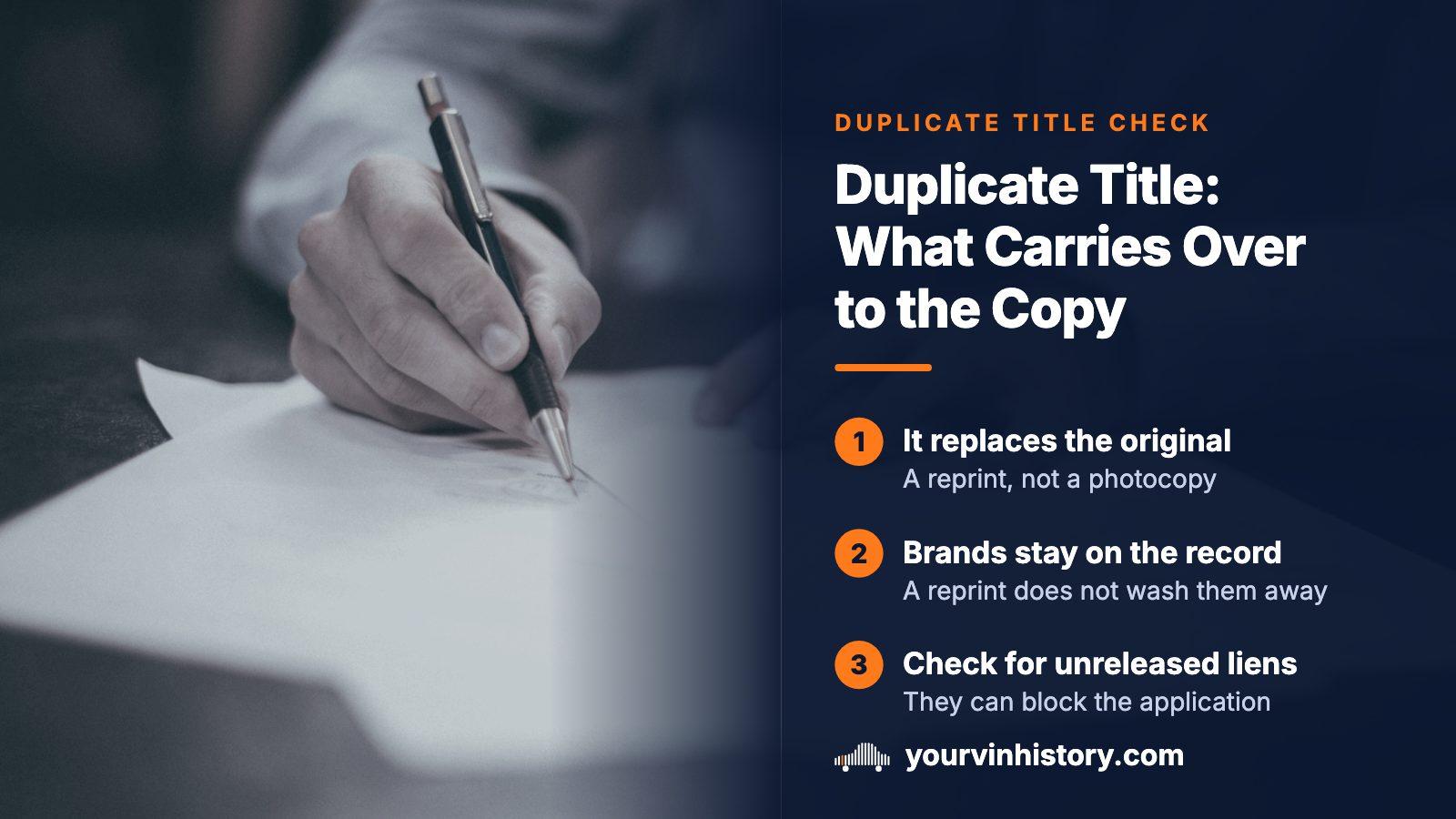
A duplicate title replaces the original rather than sitting beside it. It is printed from the state's record, so a brand on file stays on the car and a lien nobody released can block the application. Florida marks the duplicate and every later title in its chain. Fees run from $2 to $20 across the three states that publish them, and waits run from the same day to at least 15 days.
- What it does
- Replaces the original and any earlier copy
- Brands
- Stay on the vehicle record; a reprint does not remove them
- Florida
- The words duplicate copy pass to every later title in the chain
- Published fees
- $2 to $20 across three states
A duplicate is a reprint, not a photocopy
The word suggests a second, equal certificate. No state issues one. Texas says on Form VTR-34 that its certified copy takes the place of the original title and of any earlier copy, which makes the newest printing the only one that counts. Florida reaches the same outcome from another direction: an owner who recovers the original must hand it to the department to be cancelled.
Federal law explains the caution. Under 49 CFR 580.4, a physical title has to be produced by a secure printing process, so only the state can make one. Two convincing instruments for one car would invite a double sale, and a clerk cannot reach into a glovebox to collect the old one. That gap between the state's books and the paper in circulation explains most of the risk here.
What travels onto the replacement and what does not
Because the replacement is produced from the state's file on the vehicle, it reflects that file. The table sorts the pieces.
| Item | On the replacement |
|---|---|
| Brand such as salvage or rebuilt | Stays with the vehicle record. Nevada's DMV states that a brand cannot be removed and that later titles carry it. |
| Lien still on file | Holds up the application until the lienholder releases it or applies for itself. |
| Florida's duplicate copy wording | Printed on the duplicate and on every later title in its chain. |
| Odometer figure | The reading disclosed at the last transfer, not a fresh one. |
| The superseded original | Cancelled on the state's books, though it may still exist as paper. |
A reprint adds no history and erases none.
A reprint does not wash a brand away
A seller with a branded car might hope a fresh certificate resets the paperwork. The state pages reviewed for this guide give that hope no support. Nevada's DMV says a brand cannot be removed, that every future title is branded, and that hiding or washing a brand off a title is illegal. Texas says the title of a rebuilt vehicle shows the Rebuilt Salvage brand.
A brand changes through a state procedure, such as an inspection after repairs, and a duplicate application is not one of those procedures. The duplicate-title pages from Florida, New York and Pennsylvania do not mention brands at all, so silence is not permission. The more realistic worry is a retitle in another state, which the title washing guide covers.
Treat the paper as a summary
A clean-looking duplicate proves only that the state printed one. Read the record behind it before you pay.
Florida's inherited mark and what it costs a buyer
Florida Statutes section 319.29 requires the words duplicate copy across the face of a duplicate and of every certificate later issued in the chain that began with it. The mark is inherited, so it survives each sale.
The wording has legal weight. A later purchaser in that chain acquires only the rights the first duplicate holder had, so a buyer who paid fair value in good faith stands no higher than the person who asked for the duplicate. The statute lets a purchaser require the seller to indemnify against claims presented on the original certificate, which hints that such claims do surface.
The mark is not an accusation, and it may date from an owner several sales back. It does mean the check on the seller matters more than usual.
Who the state accepts as the applicant
The owner of record is not always the person the state wants to hear from. Four rules decide it.
- Lien on record: Florida's manual lets only the lienholder apply, and California's section 4459 ranks the legal owner, meaning the lienholder, ahead of the registered owner.
- Address changed: California and Florida both treat a mismatch with the file as a fraud signal, covered below.
- Several owners: Texas requires each recorded owner's signature, or a separate power of attorney.
- Applicant role: Pennsylvania publishes separate forms for the owner, the lienholder and the dealer (MV-38O, MV-38L and MV-38D), because the role changes the handling.
The paid-off loan that still shows on file
A lien can outlive the loan. Texas warns that financing history may leave a lien in the department's records after payoff, and it asks for an original release signed by the lienholder, on company letterhead or on Form VTR-266. Photocopies, scans, faxes and emails are refused.
So the lender comes before the counter. Lenders merge, move and close, so a wet-ink release can be hard to track down. Photograph it first, because Texas states that documents left at a regional service center are not returned. The release has to come first, since the application will not move forward without it.
Address changes and repeat requests draw extra scrutiny
California Vehicle Code section 4466 stops the department from issuing a duplicate when the application lists an address other than the one on file, unless the registered owner appears in person with proof of ownership and a photo license or ID card. Florida's statute directs the department to verify the signer when the address differs, and its manual accepts proofs such as a photo ID with the new address, a utility receipt, a lease, a homestead exemption or a current registration.
Both rules target one scheme: ordering a title mailed to an address the thief controls. California relaxes the in-person step for dealers, insurers and similar institutions.
Repetition draws scrutiny too. California can require a Highway Patrol report verifying the VIN when a duplicate was already issued for the vehicle in the previous 90 days, although the section carves out exceptions. A seller who mentions two replacements in a short span has handed you a reason to slow down.
Electronic titles and titles lost in the mail
Some vehicles have no paper at all. While a lender holds an electronic lien, California keeps the record electronically under Vehicle Code section 4450.5 and prints no certificate. Florida's manual says a duplicate cannot be processed when the record shows electronic status. The owner needs a paper certificate printed from the electronic record, which is a different transaction.
A title that was issued but never arrived is separate as well. Florida allows reissuance within 180 days of the issue date with no additional fee, and its manual treats a title as missing only after 20 days have passed since processing. Wait past 180 days and the request becomes an ordinary duplicate with an ordinary fee.
Fees and waits in the states that publish them
| Application route | Fee | Timing or limit |
|---|---|---|
| Texas, mailed application | $2 | Allow 15 days or more; the department offers no status tracking |
| Texas, regional service center | $5.45 | Applied for in person at a regional office |
| Michigan, mailed application | $15 | Roughly 14 days to arrive |
| Michigan, instant title | $20 | Printed the same day at an office; each listed owner attends, no agents |
| New York, mail or DMV office | $20 | Needs Form MV-902 |
| New York, online order | Not stated | Printed the next business day if ordered before 8 pm, then mailed the day after |
Texas by mail and New York sit about ten times apart for the same job, a spread set by state fee policy, not by your car. Pennsylvania lists no amount and points to the schedule on Form MV-70S, so it is left out rather than guessed. Confirm your own fee before paying.
With a buyer waiting, ask about a counter that prints on the spot rather than about the fee. Michigan's instant option costs five dollars more than mail and saves about two weeks.
Buying a car whose title is a duplicate
- Match the seller's photo ID to the name printed on the title.
- Ask when the duplicate was issued and why, and note a date close to the listing.
- Pause the sale if the title was replaced more than once in a short span.
- On a Florida title, read duplicate copy as normal, then lean harder on the identity check, since your rights are capped.
- Run a lien check before paying, because a settled loan can still sit in the record.
- Do not read the title's mileage as current; it dates from the last transfer, and the seller must disclose mileage again to you.
The pattern behind these items is the double sale. A seller sells the car, then reports the title lost and collects a replacement, which leaves two documents for a car the seller no longer owns. Texas prints a felony warning above the signature line because the state cannot test the claim that the original was lost.
What a title history can and cannot confirm
State agencies report title events, so a replacement issued in one state can appear for someone reading the record from another. That gives a timeline, and a duplicate issued the month before a listing reads differently from one issued years ago. A yourvinhistory report starts with a preview and, once purchased, lists title brands, liens and odometer readings alongside those events.
The record cannot show intent, whether the original was truly lost or who holds it now, and a very recent event may not have been reported yet. Weigh it against the paper and the person in front of you.
Where this information comes from
- FLHSMV: Procedure TL-05, duplicate and lost in transit titles — Florida's staff manual on lienholder-only applications, electronic titles, lost-in-transit reissue and accepted proofs of a new address.
- TxDMV: Form VTR-34, certified copy of title — Texas wording on supersession, mail and in-person fees, lien releases and the felony warning.
- California Legislature: Vehicle Code 4466 — The address-mismatch bar, the in-person route and the Highway Patrol VIN report after a recent duplicate.
- New York DMV: Replace a title certificate — Form MV-902, the $20 fee, the printing schedule and cases where online ordering is closed.
- Michigan Department of State: Title replacement or duplicate — Mail and instant title fees, timing and the rule against using an agent for an instant title.
- eCFR: 49 CFR 580.5, odometer disclosure on titles — Why the mileage on a newly printed title is the reading from the last transfer.
Sources and photos: Facts checked against the sources above in October 2026. Photo by Scott Graham on Unsplash; diagrams by YourVINHistory.
Keep reading
- What is a branded title?The labels that follow a car onto every replacement certificate.
- Title washingHow a brand can drop off when a car is retitled in another state.
- Vehicle lien checkHow to find a lienholder, who may rank ahead of you as applicant.
- Title jumpingA related fraud where the title is never transferred at all.
Frequently asked questions
Does a duplicate title remove a salvage or rebuilt brand?
No page reviewed for this guide treats a reprint as a way to shed a brand. Nevada's DMV says a brand cannot be removed and that washing one off a title is illegal. A replacement comes from the same record, so the brand remains part of what the state holds. If a seller says the duplicate fixed the title, read the record.
Can I sell a car with a duplicate title?
Yes. Once issued, the replacement is the operative title, so the owner signs it over like any other. Its printed mileage dates from the last transfer, so the seller gives a fresh disclosure. If the original turns up later, Florida requires its surrender for cancellation rather than any use.
How long does a duplicate title take to arrive?
It depends on the route. Michigan mails in about 14 days or prints an instant title the same day for $20. New York prints an online order the next business day when placed before 8 pm, then mails it the day after. Texas asks for at least 15 days by mail and offers no tracking. Add time if a lien release is needed.
What if my title never arrived in the mail?
Hold off on an ordinary duplicate. In Florida, an undelivered title can be reissued at no additional fee if you ask within 180 days of the issue date, and the manual expects 20 days to pass first. After 180 days it is a normal duplicate with the usual fee. Check the address on file too, since returned mail may already be flagged.
Does a co-owner have to sign for a duplicate title?
It depends on the state. Texas expects each recorded owner's signature, or a power of attorney covering that owner. Michigan's instant title requires every listed owner to appear in person, and no agent may stand in. New York closes online ordering when a power of attorney is involved. Check your state's form before assuming one signature is enough.
Now check the car itself
The guide explains what to look for. The report shows what this VIN has on record.