THE SHORT ANSWER
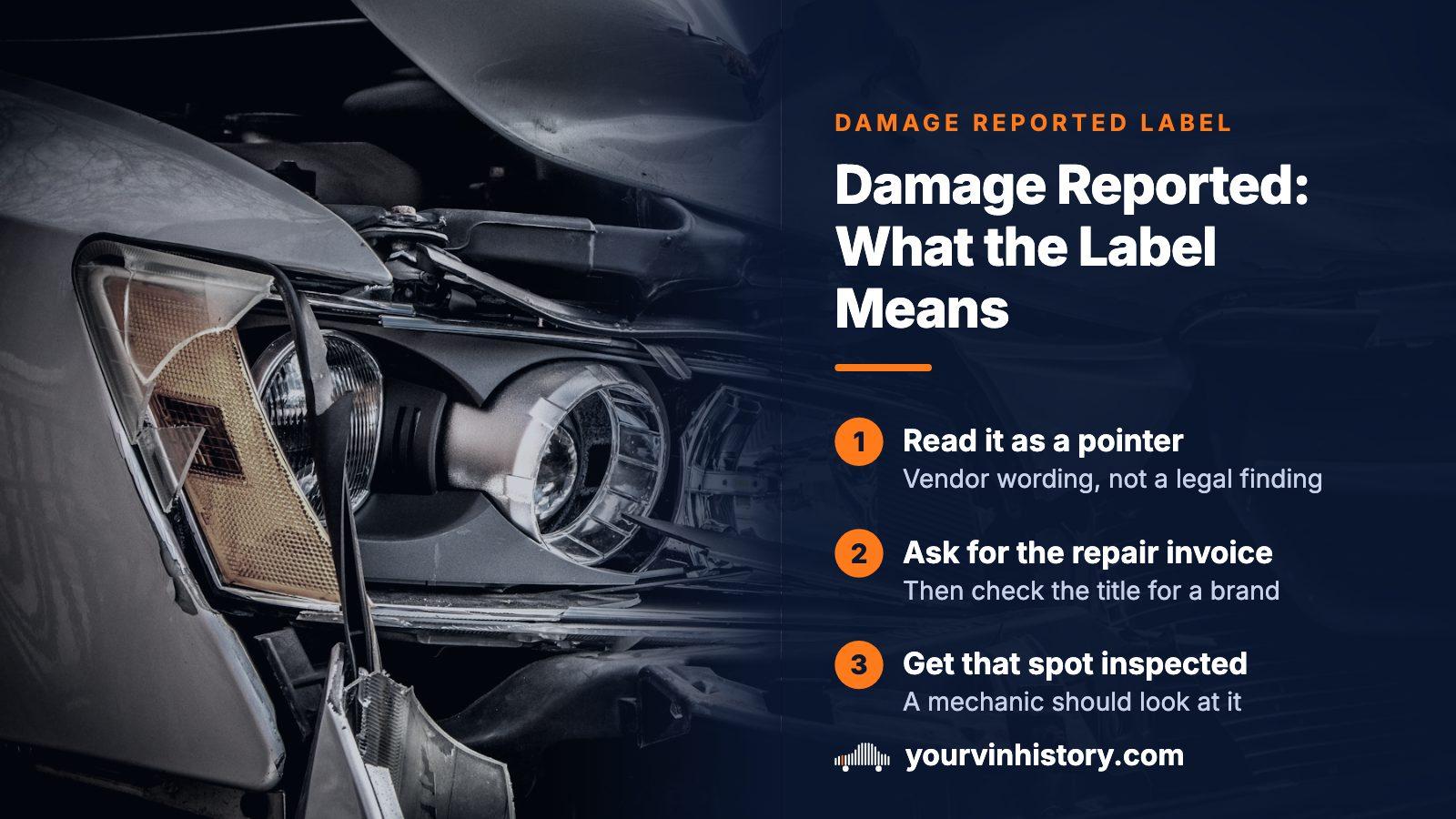
A damage reported line is a vendor's label, not a legal finding. A source linked to the VIN, such as a body shop, an auction or an inspector, told a database that damage existed, with no set threshold or proof standard. It does not mean salvage or total loss. Treat it as a pointer: ask for the repair invoice, check the title for a brand, and have a mechanic inspect that spot.
- Legal definition of the phrase
- None; it is vendor wording
- Insurer reports to the federal system
- Monthly, current model year plus four prior
- Salvage yard reports
- Monthly, 5 fields per vehicle
- Who sets title brand rules
- Each state, by its own test
A label chosen by a company, not a ruling by an agency
The line reads like the result of a review, but it is not one. A history company chose the wording, decides when to print it, and explains it only in its own help text. No statute mentions the phrase, no regulation attaches a dollar threshold to it, and no agency audits whether your car deserved it.
Commercial databases are still useful, because they collect facts no rule makes anyone collect, such as small repairs and auction notes. Just read the line as a tip from some source, not a verified finding.
Very different events behind the same two words
One wording covers a wide spread because the label measures nothing. Each of these can print as the identical line:
- A scuffed bumper cover logged during a cosmetic repair at a body shop
- A dent an auction inspector spotted when the car arrived
- A scrape noted by a rental fleet on a car it owned
- A repaired front-end hit that reached the structure behind the panels
- An inspection note recorded with no repair attached
Only the date, the spot on the car and the reporting source give the line meaning. Without them, you do not know yet.
Who feeds the line, and who stays silent
A history database holds what its data partners chose to send, and nobody publishes the full partner list. Typical contributors:
- Repair shops connected to a data network
- Insurers, on claims they process
- Auctions, describing the car as it arrived
- Fleet and rental operators
- State agencies and some police departments
Whether an event gets recorded turns less on severity than on whether the party handling the car sends a report. An independent shop outside any data network can fix a badly bent corner and leave no trace, and in the finished report you often cannot see who sent an entry at all.
Damage, accident, structural: reading the neighboring lines
Big vendors list accident and damage separately, yet buyers read them as one. They tend to come from different feeds.
| Line on the report | What usually sits behind it |
|---|---|
| Accident reported | A crash record, typically from police or an insurance claim |
| Damage reported | Any party describing harm to the car, such as a shop invoice, an auction note or an inspection |
| Structural damage reported | Harm said to reach the frame or load-bearing structure; the wording that moves price most |
| Airbag deployment | A restraint that fired, which hints at impact force but measures no damage |
| Minor, moderate or severe | The sender's own characterization, with no inspection behind it |
Damage without an accident is ordinary: someone documented harm during a repair and no crash record was ever filed. Severity words describe what was reported, not the quality of the repair, and each vendor's glossary differs and can change.
What the federal rule defines instead
The Justice Department's rules for the national title system, NMVTIS, give salvage a cost-based definition. A car qualifies when an event such as a collision, fire or flood pushes repair costs plus the car's salvage value above its market value just before the event. Total losses under state law, or under an insurer's own policy terms, count too, whether or not the insurer takes title. Junk is stricter: the car cannot run on public roads and is worth only parts or scrap.
A calculation versus a note
Salvage status rests on a calculation, or on an insurer's decision to call the car a total loss. A damage entry rests on whatever a sender typed. If a seller waves at the damage line to brush off a title brand, those are different kinds of record. The federal wording also governs reporting only; each state decides what actually gets branded.
Who must report, and where the model-year limit bites
Damage notes to a commercial database are optional. Two groups must report salvage vehicles to the national title system, and both file monthly.
- Insurers file on vehicles they took possession of and judged junk or salvage, plus total losses under state law or their own policies, naming the VIN, a date and the party the car came from.
- Junk and salvage yards file on what they acquired the month before, in five fields: contact details, VIN, date obtained, seller, and what became of the car, such as crushing, resale or export. Yards whose state already passes the same data along may skip it.
One limit rarely gets mentioned: the insurer duty covers the current model year and the four before it, so an older car totaled by its insurer falls outside that rule. State titles and yards still create records for older cars, but the older the car, the more your own inspection and the title history must carry.
Why the state decides whether damage becomes a brand
Branding is a state decision, and states disagree. One wrecked car might be branded on one side of a border and not the other.
The tests differ in kind. Some states compare repair cost with a percentage of value, with cutoffs spread over a wide band. Some look at what the insurer actually paid, not an estimate. At least one asks whether repair is uneconomical, with no percentage at all, and others set a dollar figure.
The damage line says nothing about which test applied. That entry beside a clean title in a strict state means more than in a lenient one, and only the title record and the state rule show which you have.
When the line says damage and nothing else
A bare line looks evasive, but it is usually just thin. A vendor prints what the feed supplied, and a feed with only a VIN, a date and a flag cannot produce more. Since the entry cannot say where to look, these steps do the work:
- Ask the seller to say what the entry covers, ahead of any inspection
- Ask for the repair invoice, the document the entry is a thin echo of
- Check the title record for a brand, which has a legal test behind it
- Inspect the area whatever the seller says
- Compare a second commercial report built from different sources
An invoice converts a vague entry into a documented repair. That can beat a car with no entry and nothing on file.
Why a clean report proves less than it seems
No damage line means only that nothing about the car reached that database from a reporting source. Cash repairs made to dodge a claim, work at shops with no data link, and harm nobody wrote down all leave a clean line, and none of this is rare. Because networks differ, two reports on one car can disagree without either being wrong. Neither can show a repair that was never reported to anyone, so a clean report is a reason to inspect, not to skip the inspection.
Disputing an entry that is wrong
Some owners find entries for events that never touched their car. Vendors investigate against the supplying source, but will not remove accurate records on request, and a report the seller could edit would be useless to a buyer. If the entry began in a state title or a required insurer or yard filing, correct it there; a company holding a copy cannot rewrite the original.
- Obtain the report itself, not a screenshot, with the entry's exact date and source detail.
- Identify the origin: a state for a brand, an insurer for a total loss, a shop or network for a repair entry.
- Gather documents that contradict it, such as invoices, a police report naming a different vehicle, or the title.
- File with the vendor's published dispute process and with the originating source.
- Keep all correspondence to show the next buyer.
What the entry should do to your offer
Any damage line also costs you at resale, since the next buyer will see it and ask for a discount. Keep that apart from the mechanical question.
| Situation | Typical effect on price |
|---|---|
| Minor entry, and an invoice that matches it | Small and negotiable; the paperwork carries the weight |
| Minor entry, and nobody can explain it | Larger, because you are pricing the unknown, not the harm |
| Frame or structural harm on the report | Large and lasting; it follows the car through every later sale |
| Entry alongside a branded title | A different market, so weigh the brand first |
A small, documented repair can be discounted beyond its true harm, which is sometimes a chance to buy well. A vague entry the seller cannot explain asks you to carry a risk nobody measured; price it hard or leave.
A workable order for the checks
- Decode the VIN and confirm the car matches the listing.
- Run NHTSA's recall lookup by VIN; it costs nothing and answers a different question from damage.
- Obtain the federal title record from a provider on the Justice Department's approved list.
- Have the seller account for the entry and hand over the invoice; the reaction is information too.
- Inspect the area the entry points to: paint depth readings, panel gaps, the underside.
- Discount whatever uncertainty is left.
On this site, a VIN search opens with a preview, and the paid report adds title brands, accidents with a damage map, and salvage and auction records with photos. It is one purchase, not a subscription, and a mechanic's inspection still covers what no report can.
Where this information comes from
- U.S. Department of Justice: 28 CFR 25.52, NMVTIS definitions — Supplies the federal wording for salvage automobile, junk automobile and total loss.
- U.S. Department of Justice: 28 CFR 25.55, insurance carriers — Backs the monthly insurer report and its limit to recent model years.
- U.S. Department of Justice: 28 CFR 25.56, junk and salvage yards — Lists the fields a yard reports each month and the exemption when a state forwards the data.
- Bureau of Justice Assistance: approved NMVTIS data providers — Shows which companies may sell the federal title record to the public.
- NHTSA: file or search vehicle safety complaints — Where owner complaints can be searched by make, model and year.
Sources and photos: Facts checked against the sources above in October 2026. Photo by Clark Van Der Beken on Unsplash; diagrams by YourVINHistory.
Keep reading
- VIN accident checkWhich accident facts reach the files and which never do.
- What is a branded title?The brands that do have a legal test behind them, one by one.
- NMVTIS reportWhat the federal title record holds and how to read it.
- Frame damage checkWhen records say nothing about structure, measuring the frame does.
Frequently asked questions
Is minor damage reported on Carfax a dealbreaker?
Rarely on its own. Minor can mean a parking-lot scuff a shop logged, or the only trace of a larger repair paid for privately. Ask what the entry refers to, request the invoice, and have that corner inspected. If the explanation holds up, treat it as a bargaining point.
What does structural damage reported mean?
A source said the damage reached load-bearing structure, meaning the frame or unibody, not just bolt-on body panels. It affects price more than any other damage wording and follows the car through later sales. If you still want it, pay an independent shop to measure the frame before agreeing to anything.
Does damage reported mean the car has a salvage title?
No. A salvage brand is a title status set under state law, often after an insurer declares a total loss. A damage line is a commercial entry that can sit beside a clean title or a brand. Only the title record shows which applies; the damage line cannot answer that in either direction.
Can I see whether a model has a pattern of crash or fire problems?
Yes. NHTSA's complaint search filters by make, model and year, and owner complaints record whether a crash, fire or injury was involved. The reports are owner-submitted and unverified, and a high count can trace to one defect. They show a model year's pattern, not this car's history.
Does no damage reported mean the car was never damaged?
No. It means nothing reached that database from a source that reports to it, so cash repairs and unreported shop work leave no trace. Look for what records cannot show: mismatched paint, overspray on trim, uneven panel gaps, fresh undercoating in odd places. A pre-purchase inspection by a mechanic you choose answers what the line cannot.
Now check the car itself
The guide explains what to look for. The report shows what this VIN has on record.