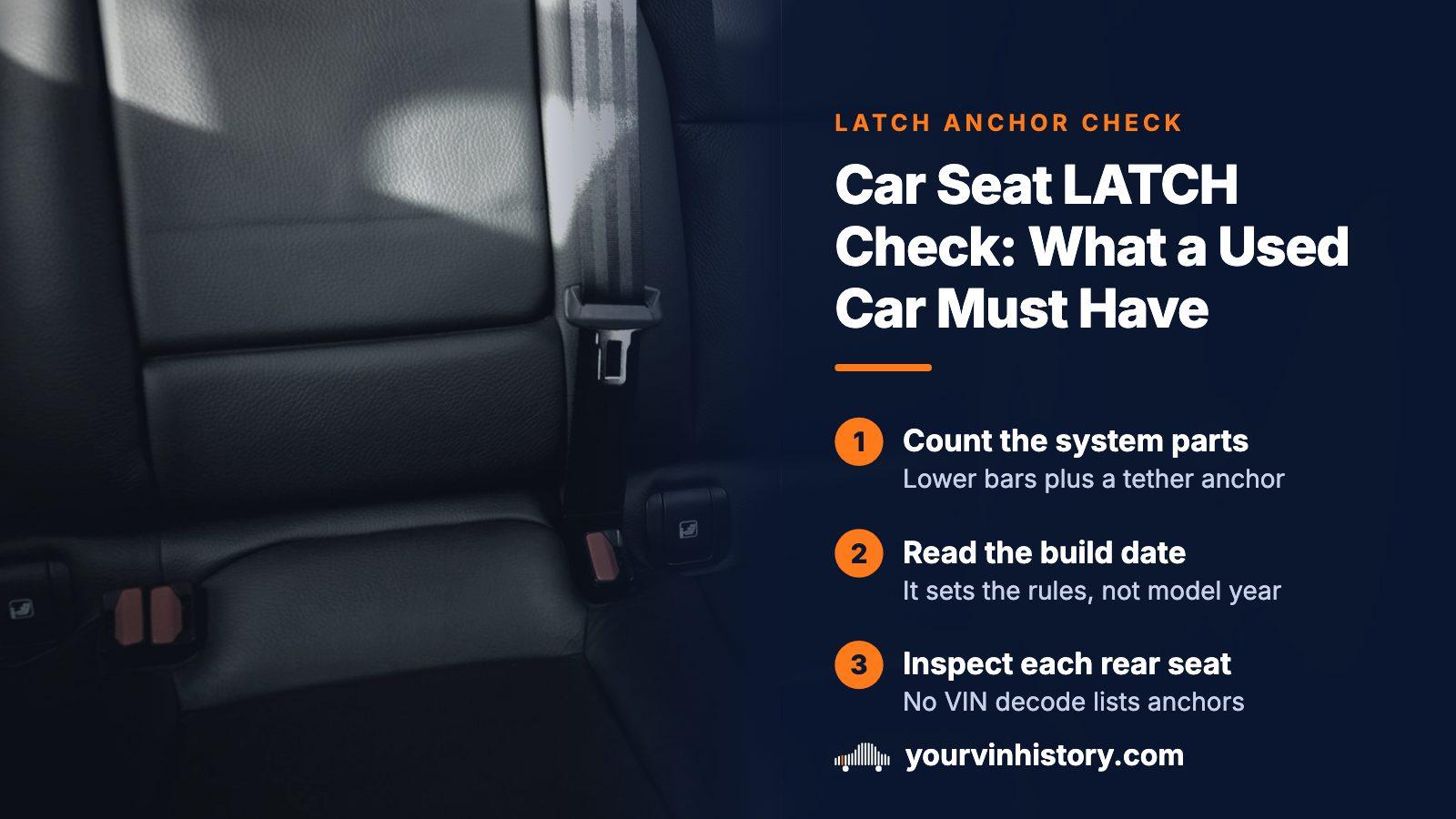
THE SHORT ANSWER
Federal Motor Vehicle Safety Standard 225 asks for two complete anchorage systems, each with two lower bars and a tether anchor, in a vehicle built on or after September 1, 2002 that has three or more forward-facing rear seats. A third seat needs only a tether anchor. Older cars follow two earlier sets of dates. No VIN decode lists anchors, so check the build date and inspect the seats.
- Federal minimum
- Two complete systems plus one extra tether
- Full rules apply
- Cars built on or after Sep 1, 2002
- Date that counts
- Build date, not model year
- In the VIN?
- No anchorage field to read
Three parts make one LATCH system, and a tether alone is not one
The rule behind every child seat anchor in a car is Federal Motor Vehicle Safety Standard 225, printed at 49 CFR 571.225. It exists to put anchors in the right place, make them strong enough to hold in a crash, and help child seats get installed correctly.
| Part | Where it sits | Its job |
|---|---|---|
| Two lower anchorages | Low in the crease where the seat back meets the cushion | Two bars that the lower connectors on a child seat clip onto |
| One tether anchorage | Behind or above the seat back, depending on body style | Holds the hook on the top strap of a forward-facing seat |
The standard treats the pair of bars and the tether together as one child restraint anchorage system. A seat with a tether point but no bars has an anchor, yet no system. The word LATCH gets used loosely, so count the parts at each seat.
The federal floor is two full systems plus one extra tether
Many families expect every rear seat to carry a full set. The requirement is smaller. In a vehicle built on or after September 1, 2002 with three or more forward-facing seats in the rear, the standard calls for complete systems at two of those seats and a tether anchorage at a third. A car with only two such seats must have a complete system at both.
That is why the common layout, lower bars at the two outer seats and a tether-only middle, shows a maker meeting the rule exactly. Some models go further and put bars in the middle too, but that is a fact about one model, and only a look at that car will confirm it.
A family that needs three child seats shoulder to shoulder should not count on the hardware being there. The standard does not promise it.
SUVs and minivans: the second row is where to look
A vehicle with three or more rows carries one more placement rule. At least one of the required complete systems has to sit at a forward-facing position in the second row, provided the second row has such a position.
The effect is to stop a maker from meeting the whole requirement in the farthest row, where anchors would exist on paper and be of little use with a small child. Nothing more is promised: not anchors in each row, nor a second-row center seat.
- Which second-row seats have both lower bars and a tether anchor
- Whether the third row has any anchors at all, and of which kind
Three build-date cutoffs, and one that precedes them all
Articles on this topic tend to quote September 1, 2002 and nothing else. The standard has earlier steps that matter when you shop older or cheaper cars.
| Built | What the standard asks | In plain terms |
|---|---|---|
| Before September 1, 1999 | Nothing, the standard does not reach these cars | No anchor rules apply, so inspect the seat rather than assume |
| September 1, 1999 to before September 1, 2000 (S4.2) | Tether anchors at three rear forward-facing seats on at least 80 percent of a maker's output, convertibles excluded | Tether points, with no promise of lower bars |
| September 1, 2000 to before September 1, 2002 (S4.3) | Complete systems on a share of output set in S14; tether anchors on every vehicle, with limited exceptions | Some cars have full systems and some do not |
| September 1, 2002 and later (S4.4) | The full requirement | The two-plus-one layout |
The earliest line is easy to miss and useful. From September 1, 1999, any anchorage a maker installed had to meet the standard's rules for configuration, location, marking and strength, even when the maker fitted it voluntarily. An anchor in a car from that stretch was built to a specification.
Why two similar cars from 2000 to 2002 can differ
During the phase-in, a maker met its obligation across total output, not on every car. Two vehicles that look identical in a listing can differ: one left the line with complete systems and the other did not. No model year or trim name settles which.
The standard's dates also run on the date of manufacture. The certification label on the door jamb shows the month and year the car was built, and vehicles sold as one model year can fall on either side of a cutoff. Trust that label and the seat over the listing.
Hardware details that changed between 1999 and 2005
| Built | What changed |
|---|---|
| September 1, 1999 to before September 1, 2004 | A maker could choose, irrevocably, an alternative bar design described in S15 instead of the main design in S9. From September 1, 2004 the S9 design is required. |
| Same window, tether placement | Makers chose between two placement methods until September 1, 2004. Later cars follow one. |
| March 1, 2005 and later | The lower bars must not be capable of being stowed, whether by folding or any other means. |
The last row gives you something to look for. On a car built before March 1, 2005, anchors that fold out of sight are permitted and mean nothing. On a later car, a bar that seems designed to tuck away deserves a question to the seller, because the standard no longer allows it.
The first six years of this standard were a moving target, which is a reason to inspect the specific car.
What a real lower anchor looks like
Section S9.1.1 describes the bars closely enough to tell a true anchorage from a trim bracket or a piece of seat frame. You are recognizing, not measuring.
- Two straight bars, horizontal, running across the car rather than front to back
- A diameter of 6 mm, give or take 0.1 mm, which is why connectors from every child seat brand fit
- At least 25 mm of length, with no more than 60 mm between the parts that stop a connector sliding sideways
- Permanently part of the vehicle, not a clip-on accessory
- On a car built from March 1, 2005, not designed to fold away
Do not pull on anchors to test them
The standard sets a rigidity limit of 5 mm of movement under a force of 100 N. That belongs to a certification test run before the car was sold. Tugging on anchors in a used car cannot reveal what the car has been through.
Tether anchors, symbols and the missing manual
The tether anchorage is the harder one to find. Its position varies: the parcel shelf, the rear of the seat back, or the cargo floor. The standard describes it as a permanently installed point that must accept the hook defined for child seats in FMVSS 213, and it may sit under a cover that opens with a screwdriver or a coin.
Installed anchors must carry markings too, so look for the symbols on the seat back or beside the seat crease before feeling around. Each new vehicle also has to ship with English-language instructions for using them. After a few owners, that booklet is often gone.
- Ask whether the owner's manual is still with the car, and count its absence as a minor cost
- Find the anchor symbols first, then feel for the bars behind them
- Replace a missing manual with one for the exact model year; it names the seating positions approved for child seats
What a VIN decode can and cannot tell you
NHTSA's vPIC decoder returns what a manufacturer has reported for a VIN, such as the build plant and country. It has no anchorage field, so no VIN lookup will tell you how many LATCH positions a car has.
A decode is still worth running before you drive over. It confirms model year and build details, which the cutoffs above depend on, and the NHTSA recall lookup accepts a VIN at no charge and shows open safety recalls. Dealers generally repair open recalls at no charge, however many owners the car has had, but vehicles old enough fall outside the federal free-repair rule, so ask the manufacturer about an older car.
A history report from this site adds accident records with a damage map. A rear impact on the record is a reason to look hard at the rear seats.
A five-minute check at the car
- Read the build month and year on the door jamb label and compare it with the September 2002 cutoff, not the model year in the listing.
- At every rear seat you would use, find the symbols, then the two bars. Note which seats have bars and which do not.
- Locate a tether anchor for each forward-facing seat. If you cannot find one, ask the seller.
- On a three-row vehicle, check the second row before the third.
- Bring your own child seat. Fit depends on anchor spacing, the shape of the cushion and where the buckle falls, and no regulation speaks to your particular seat.
Two questions for the seller are worth asking. Have the rear seats ever been replaced or retrimmed, since the anchor hardware lives in the seat structure, and was the car ever hit from behind? The standard has been fully in effect for over two decades, so the gap to find is between what the car must have and what your family needs.
Where this information comes from
- U.S. GPO: 49 CFR 571.225, child restraint anchorage systems — The system definition, the compliance dates, the second-row rule, and the bar and tether specifications.
- U.S. GPO: 49 CFR 571.213, child restraint systems — The companion standard for the child seats themselves, which ties into the tether hook the vehicle anchor must accept.
- NHTSA: vPIC VIN decoder — The federal VIN decoder, which reports manufacturer-supplied build details and shows no anchorage data.
- NHTSA: recalls lookup — Where to check a VIN for open safety recalls on a family car.
Sources and photos: Facts checked against the sources above in October 2026. Photo by Maxim Hopman on Unsplash; diagrams by YourVINHistory.
Keep reading
- Safety features by VINExplains why the build date, not the model year, sets which equipment rules applied.
- Seating capacity by VINShows how seating positions are counted, which decides how many anchor positions a car needs.
- Recall check by VINThe next check to run on a family car, using the VIN.
- How to buy a used carPuts the anchor check in order with the other steps before you pay.
Frequently asked questions
How many LATCH positions does a car need?
In a vehicle built on or after September 1, 2002 with three or more forward-facing rear seats, complete systems at two of them and a tether anchorage at a third. A rear row with only two such seats needs a complete system at each. A vehicle with no forward-facing rear seats needs a tether anchorage at each forward-facing front passenger seat.
Do all used cars have LATCH?
No. A car built before September 1, 1999 falls outside the standard. From then until September 2002 the requirements phased in, so some cars carry tether anchors only. Full coverage applies to cars built on or after September 1, 2002. For one car, the door jamb date and a look at the rear seat settle it.
Will three car seats fit across the back seat on LATCH?
Not on the strength of the federal minimum, which leaves the middle seat with a tether anchor and no lower bars. Some models add bars there. The owner's manual lists the seating positions approved for child seats, so read the one for that model year, then try your own seats in the car.
Can a VIN tell me whether a car has LATCH?
No. The federal decoder has no field for child seat anchors, and the 17 characters of a VIN do not record them. A decode gives you model year, build details and recall status through NHTSA. For the anchors you need the door jamb date, the symbols in the rear seat and a test fit.
Should I run a recall check before buying a family car?
Yes, and it takes seconds. NHTSA's lookup takes a VIN and lists open safety recalls, including seat-related ones, with no fee. Dealers generally repair open recalls at no charge, but very old vehicles fall outside the federal free-repair rule, so confirm with the manufacturer for an older car.
Now check the car itself
The guide explains what to look for. The report shows what this VIN has on record.