THE SHORT ANSWER
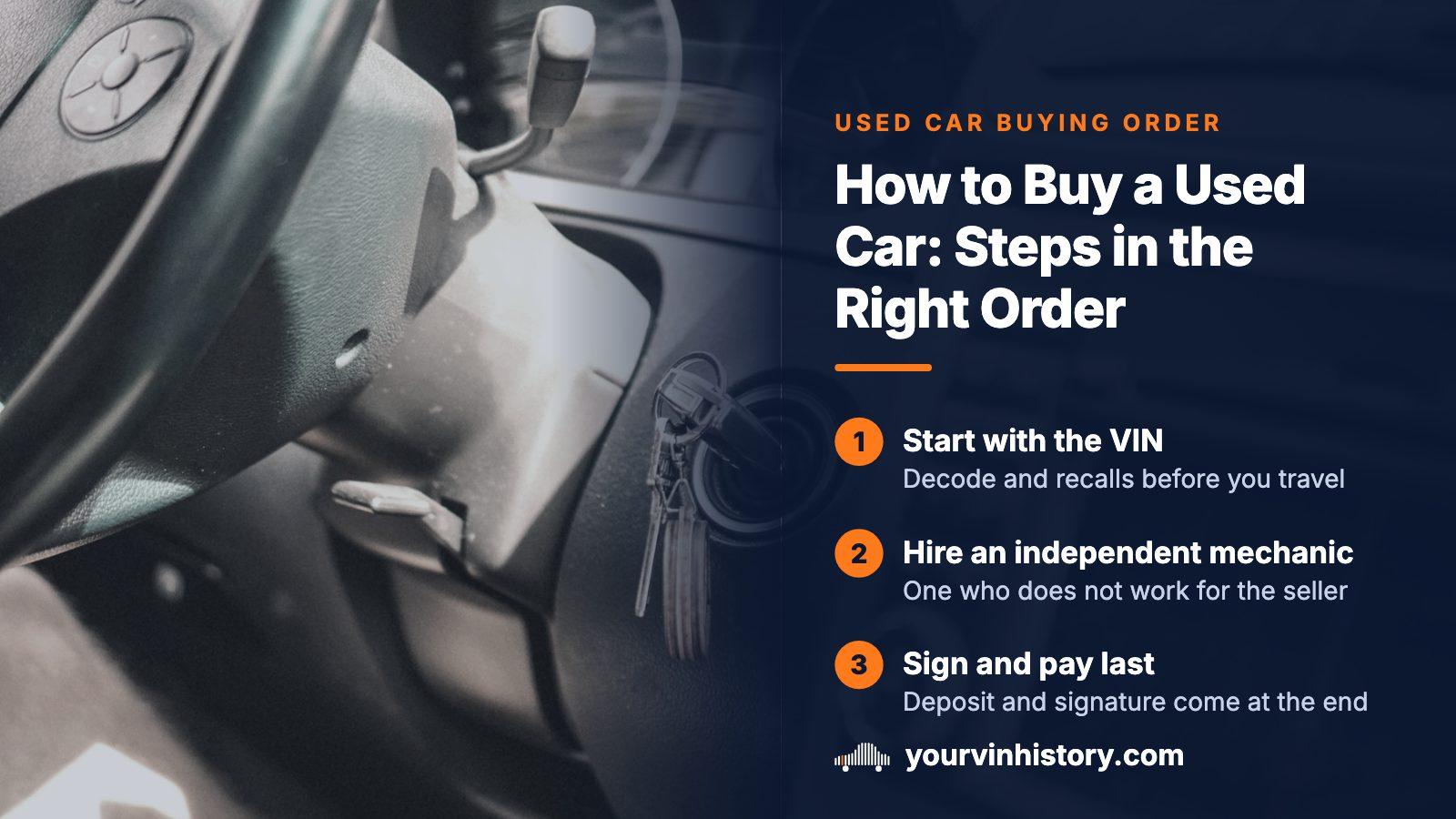
Start with the VIN, because a decode and a recall lookup cost nothing and can drop a car before you leave the house. Then pull title, lien and odometer records, inspect the car yourself, and hire an independent mechanic for the finalists. Keep the deposit, the payment method and the signature for last. Federal law gives no automatic three-day right to cancel a dealership sale, so the contract in front of you is your only safety net.
- Start with
- The VIN, before any travel
- Cash reporting
- Dealers file a federal return naming you on cash above $10,000
- Online delivery window
- 30 days, or 50 when the seller arranges your financing
- Dealership cooling-off
- No federal three-day right to cancel
Budget for the whole car, not just the price tag
A used car comes with a purchase price and then a second bill that arrives over the following year. The FTC tells buyers to count registration, insurance, gas and maintenance next to the sale price, and to read up on a model's repair records, safety test results and typical mileage before settling on it. That homework turns a long search into a short list.
Before you visit anyone, ask for an out-the-door price in writing. A number that includes every fee lets you confirm that the advertised discount applies and that the car is actually on the lot. Add-ons such as gap insurance or rustproofing get the same treatment: ask what each costs and covers, and remember you can often buy them elsewhere.
Hold the listing up against the VIN
Ask the seller for the full 17-character VIN and run it through NHTSA's vPIC decoder. The decoder shows what the manufacturer recorded for that number; the listing shows what somebody typed. Comparing the two takes a minute, costs nothing and does not alert the seller that you are checking.
| Field | What a mismatch usually means |
|---|---|
| Trim or series | The most inflated line in any ad. Often a pricing issue rather than dishonesty, but settle it before you drive anywhere. |
| Engine and drivetrain | If the ad is vague and the decode is specific, believe the decode. |
| Body class and doors | Rarely wrong, so a miss suggests the ad was copied from a different vehicle. |
| Model year | Model year and build date are separate things, and some federal rules follow the build date. |
| Plant and country | Can settle whether the car is the market variant the seller describes. |
Two cautions. A blank field is not evidence against the seller, since manufacturers leave many items unreported. And when a field returns two options, the number alone cannot choose between them. NHTSA's page says the data is manufacturer-reported and sends detailed questions to the maker.
Pull the records the seller cannot influence
Each record answers a separate question, and none substitutes for another. Work through them before you agree to a viewing.
| Check | What it settles |
|---|---|
| Open recalls | NHTSA's lookup takes the VIN and lists unrepaired safety recalls. The maker generally owes the repair on newer vehicles, but very old vehicles fall outside the federal free-repair rule, so confirm coverage first. An open recall belongs in the price talk, not automatically in the reject pile. |
| Title brands | Any salvage, flood, lemon or similar brand a state put on the title. NMVTIS is the federal title database, and approved providers sell access to it. |
| Liens | Whether a lender still holds a claim on the car. This one survives a surprising number of other problems. |
| Odometer history | Whether the mileage story stays consistent across every document that recorded it. |
A yourvinhistory report gathers title brands, accidents, odometer readings, liens and open recalls for a single VIN. The preview comes first, and the full report is a one-time purchase.
A clean record describes filings, not the car
Databases hold what somebody reported. A collision that never produced an insurance claim leaves no entry. Flood damage on a car with no coverage frequently never earns a brand. A spotless report lowers the risk without closing the question, which is why the physical steps below are not optional.
The FTC makes the same point about mechanical condition: history reports may show accidents and flood damage, but they typically do not reveal mechanical problems.
Think of each step as a filter
Records remove the cars that left a paper trail. The viewing and the mechanic remove the ones that did not. Run both filters, records first, because they are cheaper.
What to carry to the viewing
None of this is specialist gear, and the whole kit costs less than an hour of a mechanic's time.
- Your phone with the decode open, so you compare the car against facts instead of memory.
- A basic OBD scan tool, or a Bluetooth dongle that talks to your phone. Around twenty dollars buys one that reads readiness monitors as well as fault codes.
- A flashlight, which turns a glance under the carpet or chassis into an actual inspection.
- Something to write with, because first impressions fade by the time you are home.
- A friend, or at least the seller's name and the address sent to someone who is not coming along.
Ten minutes at the car that no database replaces
Here the vehicle is the thing under test, not its paperwork, so this is the only stage that can expose events nobody documented.
- Lift a corner of the carpet and feel the padding underneath. Dampness, silt or a tide line is the flood sign that detailing seldom reaches. Pull a seat belt fully out and inspect the webbing near the spool too.
- Keep every window shut for fifteen minutes while you go through the rest, then climb in and sniff the footwell before the cabin airs out.
- Plug in the scanner and read the readiness monitors. They show whether codes were wiped recently, a more useful fact than whether a dashboard lamp is lit.
- Run every electrical item: windows, mirrors, seats, wipers at each speed, every light. Treat an intermittent fault as a finding.
- Match the VIN on the dash and the door jamb to the paperwork. They nearly always agree, and the one time they do not is why you look.
Pay a mechanic who does not work for the seller
On a serious candidate, a paid inspection is the best-spent money in the process because it examines the machine. Run the cheap checks first so you only pay to inspect cars that survived them. The FTC advises using an independent mechanic even when a dealer calls the car certified, and it separates a mechanical inspection from a safety inspection, which usually asks only whether the car is unsafe to drive.
Ask for the findings in writing, with the make, model and VIN on the page and a cost estimate for each repair. That estimate doubles as bargaining power on the price. If a dealer will not allow an outside inspection, the FTC suggests considering another dealer, and a private seller who refuses has given you the same answer.
Read the window sticker and get promises on paper
Dealers must post a Buyers Guide on the used cars they offer and give it to you after the sale. It states whether the car is sold as is or with a warranty and, if there is a warranty, what share of repair costs the dealer will cover. Maine and Wisconsin dealers use their own versions. The Guide overrides the sales contract, so any change you negotiate belongs on it.
As is means the dealer pays for no repairs after the sale and the risk of later trouble is yours. When a used car has no written warranty and is not sold as is, unwritten implied warranties generally apply, and how long they last depends on your state. Spoken promises are hard to enforce. If someone says the dealer will fix something, ask for it to be written on the Guide.
Pick the payment route before you reach the desk
How you pay and where you sign change which rules apply, and deciding early removes the pressure of choosing quickly between options you never compared.
| Route | Effect on the deal |
|---|---|
| Cash above $10,000 | A federal return naming you has to be filed by the dealer, and what counts as cash can include some instruments worth less than that. |
| Online order with seller-arranged financing | The federal mail-order rule gives the seller 30 days to deliver, stretching to 50 days when the seller arranges your financing. |
| Visit to a dealership | The three-day cooling-off rule does not cover it, and the FTC states that federal law requires no three-day cancellation right. |
| Off-site sales event | The cooling-off rule can apply here, since it depends on where you agreed to buy, not on what you bought. |
If you finance, compare the annual percentage rate, the term and the total cost. The FTC warns that a low monthly payment often means a longer loan and more interest, and suggests comparing offers from dealers, banks, credit unions and finance companies.
Deposit, signature and payment come last
Handing over money and signing a contract are the two moves you cannot casually undo, and the protections many buyers imagine around them mostly do not exist. A dealership sale has no general cooling-off period and no automatic return window. What you have is the contract, plus whatever you verified beforehand.
- Run the lien check before any money moves. A lender's claim stays on the car after you own it.
- Read the contract's terms on cancellation, deposits and financing conditions before you sign.
- Find out whether the sale depends on your loan being finalized, and what happens to the deposit if it is not.
- Before signing, confirm the exact price, the total with financing, the finance charge, the rate and the number and size of payments.
- Keep any deposit small so that walking away remains a real option, and treat pressure to finish today as a reason to leave.
Where this information comes from
- FTC: Buying a Used Car From a Dealer — Backs the Buyers Guide, as-is and implied warranty points, independent inspection advice and financing comparisons.
- NHTSA: Recalls — The federal lookup for unrepaired safety recalls by VIN, used at the start of the sequence.
- NHTSA: vPIC VIN decoder — Source of the manufacturer-reported build details you compare against the listing.
- NMVTIS: Vehicle history for consumers — The federal title database behind brand and history checks.
Sources and photos: Facts checked against the sources above in October 2026. Photo by tim on Unsplash; diagrams by YourVINHistory.
Keep reading
- Vehicle lien checkThe one record that should be cleared before any money moves.
- Pre-purchase inspectionWhat a mechanic's inspection covers and which systems fail first.
- Used car red flagsWarning signs that live in records instead of the metal.
- After buying a used carThe steps that start once the seller has left.
Frequently asked questions
What should I do first when I want to buy a used car?
Get the full VIN from the seller and decode it before you travel. Compare the build with the listing and look up open recalls. A seller who will not hand over the VIN has already told you something, and walking away costs you nothing at that point. Every later step costs more and is harder to undo.
Do I get three days to return a used car?
Usually not. The FTC says federal law does not require a three-day cancellation right for dealer sales, and state rules vary. The federal cooling-off rule can reach sales agreed away from the seller's regular place of business. Ask for the return policy in writing before you sign, not after.
Is a vehicle history report enough without an inspection?
No. A report reflects what was filed with agencies, insurers and auctions, and it typically says little about mechanical condition. Use it to decide which cars deserve a mechanic's time, then let the mechanic examine the one you want. The two answer different questions, and each covers a gap the other leaves.
Should I buy a used car with an open recall?
It does not have to end the deal. The maker generally owes the repair on newer vehicles, though very old vehicles fall outside the federal free-repair rule. Ask the manufacturer or a franchised dealer, using the VIN, whether this car is covered, and let any uncertainty shape your offer.
What mistake costs used-car buyers the most?
Doing sound checks in the wrong sequence: traveling before decoding the VIN, paying before looking for a lien, or signing on the belief that you can undo it. Each turns a problem that cost nothing to find into one that costs money to fix. Write your sequence down before you contact the seller.
Now check the car itself
The guide explains what to look for. The report shows what this VIN has on record.