THE SHORT ANSWER
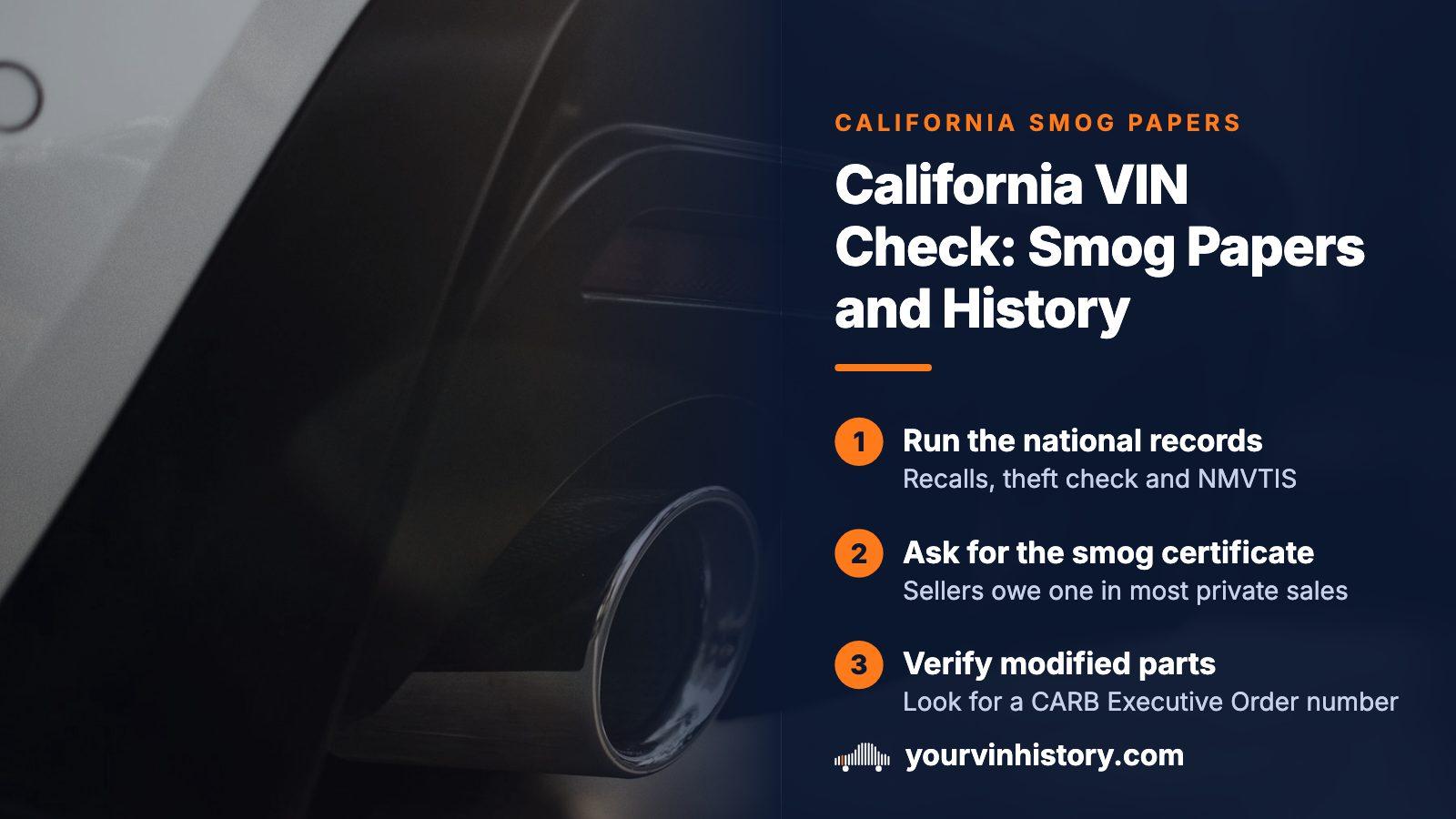
Decode the VIN, check it against NHTSA's open recalls and NICB's theft and salvage search, then pull an NMVTIS title record from an approved provider. California adds one more step: in most private sales the seller owes you a current smog certificate, and a modified or out-of-state car should be proven smog-legal before a deposit changes hands. A plate will not identify an owner for a private buyer, so ask the seller for the VIN.
- Smog certificate
- Supplied by the seller in most private sales
- Certificate window
- Valid for 90 days from the inspection
- Modified parts
- Need a CARB Executive Order number
- Plate lookups
- Limited by the federal DPPA
Two layers: national records and the California gate
Most of a California VIN check is the same work you would do in any state. A car's identity, open recalls, theft and salvage flags and title history sit in national systems that do not care where the car is parked. California adds a second layer, and that layer is smog. For most vehicles past their first few model years, a transfer needs a passing emissions inspection, so the question is never only whether the history is clean. It is also whether this particular car can be put in your name.
The order matters. Record checks cost little and can end a deal in ten minutes. The smog questions take a conversation with the seller, so they come second, but both need answers before any deposit.
Records to pull before you drive over
All of these work from the VIN alone, so you can finish them from the listing page.
- VIN decode: confirms the body, engine and model year match what the seller advertised. A mismatch is the first thing to raise.
- NHTSA recall lookup: the federal search lists open safety recalls for that exact VIN, at no charge.
- NICB VINCheck: a no-cost search that flags theft and salvage reports on the VIN.
- NMVTIS title record: title brands from every state that reports, sold through approved providers.
A report from this site pulls NMVTIS title records through ClearVin LLC, an approved NMVTIS data provider, and sets accident, odometer, salvage and auction entries beside them when those exist.
Who owes the smog certificate
California builds the emissions inspection into the sale itself. When an affected vehicle changes hands, the DMV says the seller has to give the new owner a valid smog certification, and the Bureau of Automotive Repair adds that a vehicle bought from a private seller must have passed a Smog Check within the last 90 days. The date printed on the certificate matters as much as the word PASS.
| Situation | How the smog rule treats it |
|---|---|
| Ordinary private sale of an affected car | Seller provides a valid certificate |
| Gasoline car in its newest four model years | No inspection at transfer; the buyer pays a smog transfer fee instead |
| Certified at registration renewal, then sold inside 90 days | Listed by BAR as an exception to a fresh inspection |
| Transfer between close relatives such as spouse, parent, child or sibling | Generally exempt, with limits covered below |
| Electric vehicle | Not subject to the inspection |
Treat the table as a map of where to ask questions, not a ruling on one car. The DMV's smog inspection page carries the current cutoffs.
Reading the certificate you are handed
A certificate is a record about one car on one date. Check that the VIN printed on it matches the dash and the title, that the date falls inside the 90 days, and that the result is a pass. One from last year only proves what the car did last year. A printout with a different VIN, or none at all, is not worth keeping.
California also keeps a public log of smog inspections, searchable by VIN, which lets you set the seller's paper beside the car's testing history. Failures followed by a quick pass, repeated retests, or odometer readings that do not climb in order are worth a question.
When the seller says smog is your problem
Some sellers offer a small discount if you handle the smog yourself, or insist the car will pass with no paper to prove it. Hear that for what it is: a known risk moving from the person who has driven the car to the person who has not. A seller with a current certificate hands it over, and one without it usually has a reason.
Three things commonly stand between a car and a pass:
- A check engine light that is on. On newer cars the inspection reads the onboard computer, and a lit warning lamp is a failure whatever the seller says caused it.
- Self-tests that never finished. A recent battery disconnect or a freshly cleared fault code can leave the computer unready, which can hold up the inspection.
- Missing or altered emission parts, which BAR treats as tampering.
Checking an exemption claim
Sometimes the seller is right that no certificate is needed. Age, fuel type, weight and the relationship between buyer and seller can each take a car out of the transfer inspection. Do not argue it at the curb. Look the claim up on the DMV's smog inspection page, which lists the cutoffs, and ask the seller to note the basis in writing.
Family transfers deserve extra care. The exemption names specific relatives, and the DMV warns that it does not apply when a relative buys a car for you without first titling it in their own name. A gift from a parent is simple. A purchase routed through a third person is not.
Military service changes nothing here: the DMV states there is no military exemption.
Out-of-state cars and the label under the hood
A bargain from another state is the classic California trap. A car built to federal rather than California emissions specifications, or fitted with modifications California does not accept, can be fully legal where it was sold and still fail here. BAR's guide also requires a smog check on out-of-state cars from all but the oldest model years when they first register in California.
- Read the emissions label in the engine bay, because California-certified vehicles say so on it.
- Treat a car that was moved to the state just before the sale with caution.
- On a diesel, check that the emissions hardware is intact and unaltered.
- Ask the seller why this car is for sale in California; the explanation tells you something.
Registering a car that moves in has its own deadlines. Settle eligibility before you settle price.
Modified cars and the Executive Order number
California takes emissions anti-tampering law seriously, and it shows up in aftermarket parts. According to the Air Resources Board, an add-on or modified part that affects emissions generally needs an exemption issued as an Executive Order. Each exempted part has an assigned number that Smog Check stations, BAR Referee stations or CARB can verify.
The inspection includes visual and functional checks, so an unexempted part can sink a car whose exhaust readings are clean. BAR's guidance adds a consequence buyers rarely hear: a repair cost waiver, which limits what some owners must spend on a failing car, cannot be issued for a vehicle with tampered emission controls. If you buy a car with an illegal exhaust or deleted parts, restoring it is on you in full.
Ask for the paperwork on every modification
An owner who bought exempted parts can usually name the Executive Order number for each one. If the seller cannot, assume every one of those parts has to be removed before the car passes, and verify any number you are given with CARB rather than trusting a sticker.
Wildfire, flood and salt air
California weather produces its own kinds of damage. Heat, smoke and ash from wildfire can ruin trim, plastics and cabin filters, and a car an insurer declares a total loss may be branded and sold at auction. Winter rain on burn scars sends debris and water into neighborhoods buyers think of as dry. Coastal cars age quietly, since salt air works on wiring, fasteners and underbody metal.
- Heat-crazed or discolored trim and plastics on a car from a burn area.
- Smoke residue in the cabin air filter and inside the door cavities.
- Resprayed or replaced panels with a vague story, which calls for a full title record check.
- Silt, damp carpet or a musty smell on any car from a county that flooded.
- Corroded connectors and fasteners on a car that lived near the ocean.
Plates, owners and the DMV's role
Many buyers start with the plate, and the law stops them. The Driver's Privacy Protection Act, a federal statute, restricts what motor vehicle agencies may release about a driver, and its permitted purposes do not include a private buyer sizing up a seller. Ask the seller for the VIN instead, read the same number off the dash, and check both against the title.
The DMV remains the reference for what a transaction requires. Every title, registration and transfer goes through that agency, and its published pages on smog exemptions, transfers and cars arriving from elsewhere are the place to settle a claim made at the curb. Before money moves, match the seller's ID to the name printed on the title. A mismatch there is a problem no smog certificate can fix.
A sequence for the day you meet the seller
Work through these in order, and stop at the first one that goes wrong.
- Compare the VIN on the dash with the one on the title and the listing.
- Request the smog certificate ahead of any price talk, and check its VIN and date.
- Look for a lit check engine light, then start the car and let it idle.
- On any modification, ask for the Executive Order number of each part and verify it with CARB.
- On an out-of-state car, read the emissions label and confirm eligibility with the DMV.
- Confirm the seller's name matches the title, then complete the transfer through the DMV.
Where this information comes from
- California DMV: Smog Inspections — Backs the seller's duty to supply a certificate, the newest-cars fee, family transfers and the lack of a military exemption.
- California Bureau of Automotive Repair: Smog Check — Source for the 90-day certificate window and the rule for cars bought from private sellers.
- California Bureau of Automotive Repair: Smog Check Reference Guide — Lists the transfer exceptions, the first-registration check for out-of-state cars and the bar on repair cost waivers for tampering.
- California Air Resources Board: Aftermarket, Performance, and Add-on Parts — Explains Executive Order exemptions and who can verify an EO number.
- NMVTIS: National Motor Vehicle Title Information System — The federal title database behind approved providers' title and brand records.
- NHTSA: Recalls — Where to search a VIN for open safety recalls.
Sources and photos: Facts checked against the sources above in October 2026. Photo by Farhan Abid on Unsplash; diagrams by YourVINHistory.
Keep reading
- Smog check historyRead the public emissions test log for the car you are considering.
- Register an out-of-state car in CaliforniaWhat the DMV requires if the car you want comes from another state.
- California title checkHow California brands a damaged title and how to read the result.
- California platesPlates stay with the car here, and privacy law limits what a lookup returns.
Frequently asked questions
How long is a smog certificate good for in California?
The Bureau of Automotive Repair says a certificate is valid for 90 days, and a car from a private seller should have passed within that window. The clock starts on the inspection date, so a seller who tested the car months ago may need a new test.
Who pays for smog when you buy a used car in California?
In an ordinary private sale the seller supplies the certificate. On the newest gasoline cars no inspection happens at transfer, and the buyer pays a smog transfer fee to the DMV instead. If a seller of an older car wants you to handle smog afterward, get the car tested before you commit.
Can I register a car I bought in another state?
Often yes, if it meets California requirements, but a smog check is part of first registration for most model years. The risk is a car never built to California emissions specifications, or one with modifications California does not allow. Check the emissions label and the DMV's out-of-state pages before you buy.
Are modified cars legal in California?
Only when parts that affect emissions carry a CARB exemption, shown by an Executive Order number. You can verify a number with CARB's aftermarket parts tools. A part lacking one can fail the visual inspection even when emissions readings are clean, and BAR will not grant a repair cost waiver for tampered equipment.
Can I look up the owner of a California license plate?
Not as a private individual. The Driver's Privacy Protection Act is a federal law that confines access to personal details in motor vehicle records to certain permitted uses, and vetting a seller is not among them. Ask for the VIN and the title instead, and run the records on the VIN, which describes the car without naming a person.
Now check the car itself
The guide explains what to look for. The report shows what this VIN has on record.