THE SHORT ANSWER
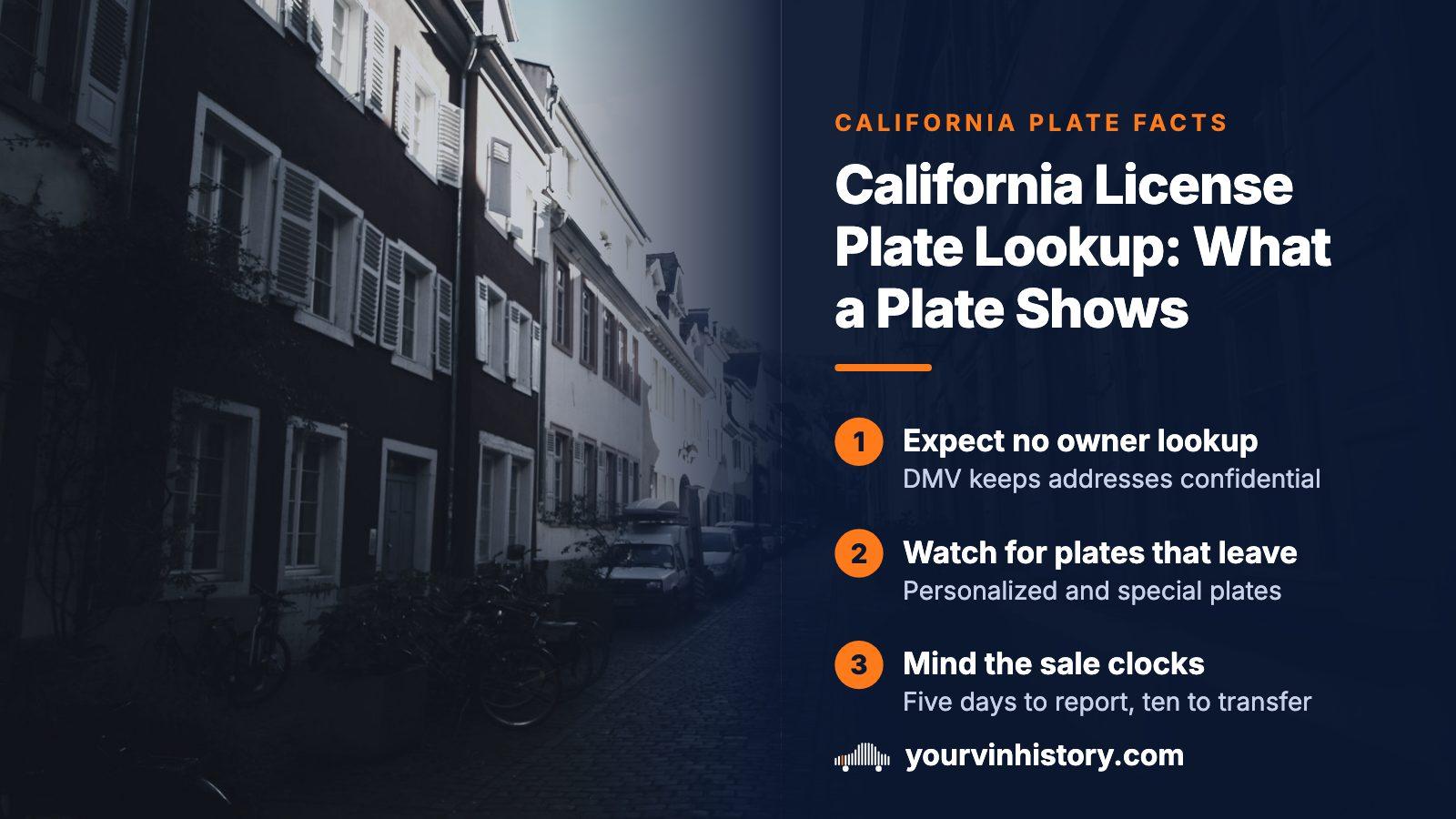
No public tool in California turns a plate into an owner. DMV does not share confidential details such as an address, and federal law limits other releases to a list of permitted purposes. Buyers should work from the VIN instead. Standard plates stay with the vehicle at sale, while personalized and special interest plates usually leave with the seller, so the plate can still hint at the car's past.
- Owner details
- Addresses and similar data are confidential, not public record
- Standard plates
- Stay with the vehicle when it is sold
- Seller's clock
- Five days to report the sale to DMV
- Buyer's clock
- Ten days to transfer ownership
What DMV releases about a plate, and what stays closed
DMV does keep records that people can request, but it states that confidential information, such as an address or Social Security number, is not public record and is not shared. A plate number does not change that. Typing one into a request form does not entitle you to the name behind it.
Federal law sets the outer limit. The Driver's Privacy Protection Act bars a state motor vehicle agency from knowingly disclosing personal information from its records, then lists exceptions. They include:
- government agencies, courts and law enforcement doing their work
- matters of vehicle safety, theft and recalls
- insurers investigating claims and fraud
- civil, criminal and administrative proceedings
- notifying owners of towed or impounded vehicles
- licensed investigators, but only for one of the permitted purposes
Curiosity about a seller, or about a car you saw parked, is not on the list. California added its own layer in 1989, making residence addresses in DMV files confidential after the murder of the actress Rebecca Schaeffer, a case widely credited with prompting the federal law too.
Owners can request their own vehicle record online. A record for someone else goes through a paper request, and DMV releases accident and insurance information only to the people involved in a crash or their attorney.
Plates stay with the car in California
Many states have the seller unscrew the plates and leave. DMV's wording for California is that plates generally remain with the vehicle they were issued to. Standard plates are issued when someone buys a new vehicle, replaces lost, stolen or damaged plates, or gives up special interest plates.
DMV's own manual describes a plate's job as identifying the type of registration and giving DMV a way to find the owner in its files. The owner lookup is real, but it belongs to DMV, not to you. What a buyer gets from the arrangement is continuity: a set of plates that has ridden on the car for years is a thread through its history.
Fresh plates, missing plates and bumper holes
A brand-new set on an older car deserves an explanation. DMV replaces lost or stolen plates with a new configuration, and any plate currently assigned to a vehicle must be surrendered when new ones are issued. If the plates were stolen, DMV asks for a police report.
So fresh plates can be innocent, or they can mean the car arrived from another state. Ask the seller which it is, then confirm it against the title history.
Count them too. DMV issues two plates to most vehicles, while trailers, motorcycles, special equipment and tow dollies get one. When two are issued, state law calls for one at the front and one at the rear. Bumper holes are ordinary in a two-plate state, so they say little about where a car lived before.
Reading the plate number and the plate type
Standard passenger plates use a digit, three letters and three more digits, like 1ABC234. DMV's plate history shows that layout arriving with the 1980 model year, after an earlier run of three digits followed by three letters. The sequence has kept climbing since, so the leading digit is a rough age band. It cannot date a plate precisely, but a plate from a late series on a very old car invites a question about when it was replaced.
| Plate type | What DMV says | What a buyer can ask |
|---|---|---|
| Standard passenger | Verifies registration and identifies passenger vehicles | Does the series fit the car's age? |
| Commercial, motorcycle, trailer | Separate standard plate types for those vehicles | Does the type match what is being sold? |
| Personalized or special interest | Supports a cause or recognizes service; some are personalized | Will it leave with the seller? |
| Legacy | A retro special interest design; DMV's manual says these plates stay with the owner at transfer | Is the seller keeping it? |
| Digital | Allowed under a 2022 state law that created a permanent program for approved devices | Nothing special; the record behind the number is unchanged |
Registration stickers and the smog question
After each renewal DMV mails new registration stickers, which it calls tabs, and the owner affixes them to the plates. An expired tab on a car for sale means registration has lapsed. For many cars it also raises the smog question, because DMV says a vehicle that needs a smog certification will not be renewed until that is done, even when the fees are paid.
The rules are not uniform. DMV lists the counties where renewal needs a smog check, and gasoline vehicles less than eight model years old are excluded. A lapsed tab on a newer car therefore usually has a different explanation than an older one in a smog county.
Do not accept "smog it after"
A seller must give the buyer a valid smog certification, subject to DMV's listed exemptions. The best known is a car less than four years old, where the new owner pays a smog transfer fee instead. DMV also lists a smog certification among the items needed to finish registering a private-party purchase. A seller who offers to let you handle it is handing you the risk of a failed test.
Personalized, special interest and legacy plates
These plates belong to the plate owner, not the vehicle. DMV tells sellers to remove them before the buyer takes possession. Keeping them may mean paying an annual retention fee, and the buyer receives regular plates free when ownership transfers.
So a listing photo showing a vanity plate, followed by a viewing where the car wears standard ones, has an ordinary explanation. The reverse needs a closer look. A personalized plate can stay on a sold car only if the owner releases priority on the DMV form, and the buyer then applies for it and pays the original fee. Without that, the plates must be surrendered, except for transfers between spouses, parents, children or grandparents.
Out-of-state plates on a car for sale here
A car wearing another state's plates has not been through California registration. DMV's driver handbook gives people who move here 20 days to register, and says every vehicle registered in California must meet the state's requirements, including emission controls. DMV cannot register one that does not qualify.
Before paying, confirm the car can actually be registered here. Expect to need a smog certification, and budget for the extra time.
Plates from another state also mean the title history may sit in that state's system. A brand applied there follows the VIN rather than the plate, which is why the VIN-based title record counts for more than anything stamped on the metal.
Closing the sale: the five-day and ten-day clocks
DMV's list for a private-party purchase is short. Run through it before money changes hands.
- The title, which DMV calls the pink slip, signed by the seller on line 1.
- A bill of sale signed by the seller and by the person named on the title, if those are different people.
- An odometer record when the vehicle is less than 10 years old. If the title has no mileage line, a separate transfer form signed by both parties covers it.
- A smog certification.
- Fees and use tax, which DMV's fee calculator estimates.
- Within five days, the seller reports the sale to DMV with a Notice of Transfer and Release of Liability.
- Within ten days, the buyer transfers ownership into their own name.
Reporting the sale does not move ownership. The buyer's transfer is what changes the record, so ask the seller to show the confirmation and set a reminder for your own deadline. For the seller, the report matters for another reason: once DMV has it, responsibility for later parking and traffic violations and civil claims passes to the new owner, and DMV stops sending renewal notices for the car.
Turning a plate in a photo into something checkable
A plate in a listing photo is a reason to ask questions, not a way to investigate. What works is the VIN. Read it off the car, match it to the title and registration, and then run it. NHTSA's recall lookup and NICB VINCheck cost nothing, and the title record comes from NMVTIS, the federal database.
A report built on the VIN, such as the one yourvinhistory sells, shows title brands, accidents, odometer readings, salvage and auction records and open recalls. A plate on its own reveals none of that.
Sites that promise an owner's name from a plate cannot be drawing it from DMV files, since DMV says confidential details are not shared. Treat whatever they offer with suspicion.
Where this information comes from
- California DMV: Records Requests — Says confidential details are not public record, and explains how records are requested and who gets accident and insurance data.
- 18 U.S.C. 2721: Prohibition on release of motor vehicle records — The federal rule behind the permitted-use list.
- California DMV: License Plates — Source for standard plate types, plates staying with the vehicle, and registration tabs.
- California DMV: Personalized and special interest plates — Covers what happens to these plates when the vehicle changes hands.
- California DMV: Registering a vehicle bought in a private sale — Lists the buyer and seller deadlines and the paperwork for a private-party purchase.
- California DMV: Smog Inspections — Explains when smog is needed and that the seller supplies the certification.
Sources and photos: Facts checked against the sources above in October 2026. Photo by Karwin Luo on Unsplash; diagrams by YourVINHistory.
Keep reading
- CaliforniaSmog paperwork and the other California buying rules that start from the VIN.
- License plate lookupThe national privacy law and what a plate search can return in any state.
- Register an out-of-state car in CaliforniaWhat happens next when the car in front of you carries another state's plates.
- Vanity plate availabilityHow to check whether a personalized plate configuration is available.
Frequently asked questions
Can I look up a California license plate for free?
There is no public plate-to-owner lookup. DMV lets you pull your own vehicle record online, and renewal needs a plate number plus the last five digits of the VIN. For a car you want to buy, the useful free checks start with the VIN: the NHTSA recall lookup and the NICB theft and salvage search.
Do license plates go with the car in California?
Generally yes. DMV says plates remain with the vehicle they were issued to. Only certain kinds, personalized environmental, special recognition and special interest plates, can be reassigned to another vehicle when the owner asks and pays the fees. If a seller removes standard plates, ask why before you pay.
What does the first number on a California plate mean?
It is a loose clue to when that plate series was issued. DMV's history shows the digit-and-three-letters layout beginning with the 1980 model year, and the sequence has advanced since. Do not use it to date a car. Use it only to notice when the plate looks far newer than the car.
Can I use a digital license plate on a California car?
Yes, for approved devices. A 2022 state law created a permanent program that lets an approved digital plate replace a conventional one. It is hardware only: DMV still issues the number, and the confidentiality rules behind the record stay the same. If you buy a car that has one, ask for the registration paperwork as usual.
A driver hit my parked car and I have their plate number. Can I find the owner?
Report it to police and your insurer rather than searching yourself. DMV releases accident and insurance information only to the people involved in a crash or their attorney, and federal law allows insurers and litigants to use motor vehicle records for claims and lawsuits. A plate number is the evidence they will work from.
Now check the car itself
The guide explains what to look for. The report shows what this VIN has on record.