THE SHORT ANSWER
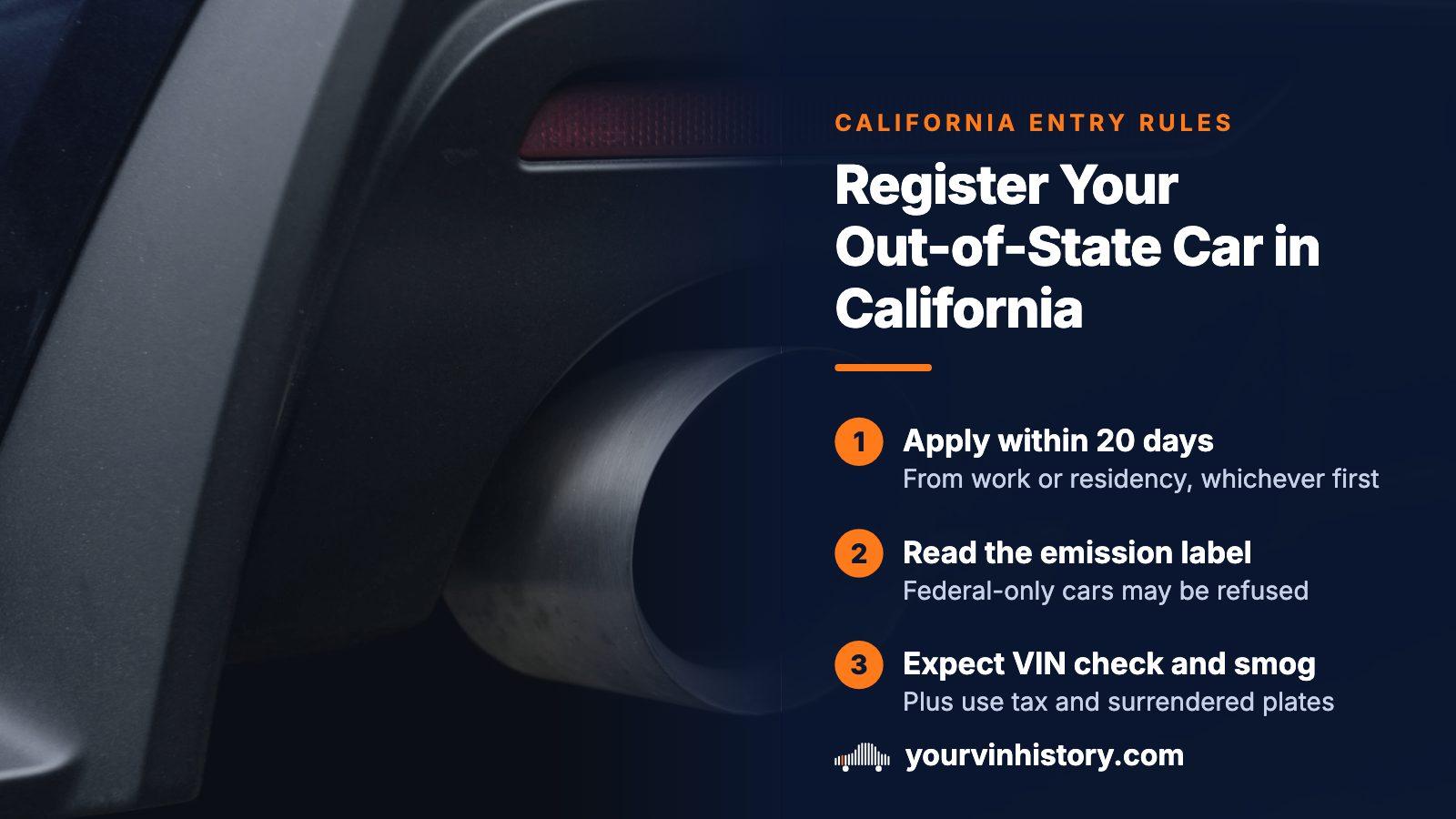
Apply within 20 days of accepting California work or establishing residency, whichever happened first. Before that, read the emission label: a car with under 7,500 miles at purchase must be California-certified, and a federal-only 49-state car is refused unless an exemption applies, such as having first registered it yourself in your home state. Expect a VIN verification, a smog certificate, use tax and surrendered plates.
- Deadline
- 20 days from accepting California work or establishing residency, whichever is first
- Mileage gate
- Under 7,500 miles at purchase counts as a new vehicle
- Who inspects
- A DMV representative, licensed verifier, auto club employee or trained peace officer
- Top late penalty
- 160 percent of the vehicle license fee, after two years
The mileage gate comes before any paperwork
California has its own definition of a new car. Under DMV Fast Facts sheet FFVR 29, a vehicle showing fewer than 7,500 miles when a California resident or business buys or trades for it is treated as new, whether or not another state has titled and registered it.
Smog rules require a new car to be certified for California, and not every one is. Many manufacturers build versions for the other 49 states only, with emission equipment that meets federal rules but not California's. The DMV is unable to take a registration application for a car that does not qualify.
So a barely driven crossover from an out-of-state dealer can have a spotless title and still be unregistrable here. No fee fixes that, which is why this question comes first.
Read the emission label yourself
The test lives on the car, not in a database. Look at the emission label under the hood. On a motorcycle, check the frame or the owner's manual. A California-certified vehicle says that it conforms to California regulations or is legal for sale in California. Photograph the label before you pay.
| What the label says | What it means for registration |
|---|---|
| Conforms to California regulations, or legal for sale in California | California-certified. The mileage rule is no obstacle. |
| Meets US EPA (federal) standards only | A 49-state car. Under 7,500 miles at purchase, it needs an exemption. |
| Meets US EPA and California standards | Built to both sets of rules, so it can be registered here. |
Exemptions for a nearly new 49-state car
Most people rely on the mover exemption. If you are relocating to California, a new 49-state car is allowed when you were its first registered owner in your home state; for military personnel, that means the last state where they served. You must show evidence of that registration.
- A vehicle obtained in a divorce, inheritance or legal separation settlement
- A replacement for a vehicle registered in California that was stolen while you were driving it out of state
- A replacement for a vehicle registered in California that was wrecked or disabled past reasonable repair while you were out of state
- A vehicle you registered where you last served on active duty outside California
- Certain small street motorcycles, model year 2005 and older, with engines under 50 cubic centimeters
- An emergency vehicle covered by Vehicle Code sections 27156.2 and 27156.3
The mover exemption rests on evidence, not on the move. A car bought the month before relocating and never registered anywhere leaves you nothing to show.
Cars imported from outside the United States
Gray-market vehicles, meaning cars bought abroad (Canada and Mexico included), are harder. The DMV warns that bringing them up to California emission requirements and federal safety standards can be very costly or impossible. A direct import under two years old cannot be converted, and motorcycles and diesel-powered vehicles cannot be converted at all.
Even where a conversion is possible, inspection can stall the car. A licensed verifier may not examine a vehicle whose federal safety label was never issued, as with a gray-market import. Those cars go to the DMV or the California Highway Patrol.
When the 20 days start counting
Once the car qualifies, the deadline is 20 days, and it does not run from the day you cross the state line. Vehicle Code section 6700(a) lets an owner keep driving on out-of-state registration until the owner accepts work in California or establishes residency, whichever happens first. The application is due within 20 days of that event.
So the count can begin before the move: accept a California job on the 1st, start driving here on the 15th, and the clock has run since the 1st.
Two related rules close gaps. Section 6700(c) requires a California resident who regularly drives a car registered elsewhere to register it within 20 days of first operating it here. Section 4152.5 treats a vehicle last registered in another jurisdiction as a fresh filing, deemed an original application.
One line carries the deadline
The out-of-state section of the application asks for the date the car entered California, the date it was first driven here, the date you took a job, got a California license or became a resident (whichever came first), and the date you bought it. The third answer is the one that lines up with the 20-day deadline.
The VIN verification and who may sign it
The form is REG 31, Verification of Vehicle, and it is marked not to be completed by the applicant. The inspector fills in every section while physically examining the assembled vehicle.
Four kinds of people may sign: DMV staff who are authorized, verifiers licensed by California, employees of an authorized auto club, and trained peace officers. Nonresident vehicles lead the list of what a licensed verifier may handle, but a verifier may not inspect:
- A car with a federal safety label that does not match its VIN, or one that is unreadable, damaged, altered, missing or never issued
- A revived salvage or revived junk vehicle
- A specially constructed vehicle
- A vehicle with documents from a foreign country
- A used motorcycle with an unavailable California record, or a motorcycle with an engine change
Missing sections, cross-outs and erasures void the form even when initialed, and a new verification is required. Look it over before you leave.
The smog certificate for a car from out of state
Section 4000.2 of the Vehicle Code tells the DMV to require a smog certificate, showing compliance, or noncompliance where that is the result, when a vehicle previously registered outside California is registered here. Model years that Health and Safety Code section 44011 exempts from the two-year smog inspection are left out, so the newest cars are treated differently.
Keep two questions apart. Certification concerns the model, meaning whether this design was ever approved for sale in California. The smog certificate concerns this car today, meaning whether its emission equipment works. A car with the right label can still fail at the station because a part has given out, so learn that before you buy.
Documents to bring and the old plates
- The application for title or registration, REG 343, signed by each owner
- The out-of-state certificate of title, with any lender named in the legal owner section (write None if there is no lien)
- The signed REG 31 verification and a smog certificate
- Your old license plates and records of any sales tax paid to another state
- A REG 4008 weight declaration for a commercial vehicle at 10,001 pounds or more, or a pickup over 8,001 pounds unladen or 11,499 pounds GVWR
Section 4301 requires an applicant to surrender every unexpired plate, seal and certificate that serves as evidence of foreign registration, and the application asks what became of them.
Use tax, fees and what the total depends on
Section 4300.5 says the application for a previously out-of-state vehicle must arrive with the use tax owed, so budget for it on the day.
| Cost | What sets it |
|---|---|
| Base registration fee | Vehicle Code section 9250; take today's amount from the DMV fee page |
| Vehicle license fee | The car's value, so it differs widely from one car to the next |
| County and district fees | Your county of residence |
| Use tax | Price paid, minus credit for sales tax shown to be paid in another state |
| Smog certificate | The test station's own price |
| VIN verification | Whoever performs it; the REG 31 form sets none |
| Weight fees | Applies to commercial vehicles and heavier pickups |
Fee amounts get revised, so use the DMV's current fee page or calculator, not a figure from an old article.
What a late filing adds to the bill
Vehicle Code section 9554 stacks two charges. One is a flat penalty added to the registration fee. The other is a percentage of the vehicle license fee and weight fees. The flat amount gets quoted because it looks harmless, but the percentage lands on the bigger fee.
| How late | Flat penalty | Percentage penalty |
|---|---|---|
| 10 days or less | $10 | 10 percent |
| Over 10 days, up to thirty | $15 | 20 percent |
| Over thirty days, up to a year | $30 | 60 percent |
| Over a year, up to two years | $50 | 80 percent |
| Over two years | $100 | 160 percent |
In the last band the percentage penalty exceeds the fee it is charged on. If you have already missed the 20 days, file now, because every band you cross costs more than the one before.
If you are still shopping, settle these first
- Photograph the emission label before agreeing on a price.
- Compare the odometer with the 7,500-mile line, since a low-mileage, federal-only car is what the DMV turns away.
- Confirm the seller holds the title in the seller's name, and note any lender shown on it.
- Ask whether the car was ever salvage or revived salvage, since a licensed verifier cannot inspect those.
- Get the paperwork showing sales tax paid, which backs up your use tax credit.
Decode the VIN to see that it matches the car in the photos, and check the title history, because a brand recorded in another state follows the vehicle. A yourvinhistory report covers title brands, odometer readings and salvage records for a VIN, and the preview shows what exists before you pay.
Where this information comes from
- California DMV: Fast Facts FFVR 29 — Where the 7,500-mile new-vehicle test, the emission label check, the exemptions and the import limits come from.
- California DMV: Verification of Vehicle (REG 31) — Shows who may sign, what a licensed verifier cannot inspect, and why altered forms are voided.
- California DMV: Application for Title or Registration (REG 343) — The out-of-state dates, the sales tax credit question and the plate disposition choices.
- California Vehicle Code section 6700 — Sets the point where driving on out-of-state registration ends and the 20 days begin.
- California Vehicle Code section 9554 — The flat and percentage late penalties and the delay bands they apply to.
- California Vehicle Code section 4000.2 — Requires a smog certificate for a vehicle previously registered outside the state, with model-year exceptions.
Sources and photos: Facts checked against the sources above in October 2026. Photo by Dain Lindo on Unsplash; diagrams by YourVINHistory.
Keep reading
- VIN inspectionApproved inspectors, fees and what a failed inspection triggers, state by state.
- Smog check historyWhere the emissions test log for a car is kept and what it can tell you.
- Buying a car out of stateThe purchase side: which records follow a car over a state line and which stop there.
- Register a car in another stateHow other states set their deadlines and checks, for comparison with California.
Frequently asked questions
Can I register my out-of-state car with California online?
Not from start to finish. The VIN verification must be done by an authorized person who physically inspects the car, and the application asks what you did with your old plates. Plan on at least one in-person step with the car and its paperwork.
Do I need a California driver license before I register the car?
Not under the statute. Vehicle Code section 4150 asks for the owner's license or ID card number, if any, and the application has a field for the number and the issuing state, so an out-of-state license goes in as it is. Do not let a later license appointment push the vehicle filing past 20 days.
Do I get credit for sales tax I paid in another state?
Possibly. The application asks whether you paid sales tax elsewhere on a vehicle that entered California within a year of purchase, and the amount you list is credited toward use tax here. It also says a car last registered elsewhere may qualify for a use tax exemption and refers those questions to the Department of Tax and Fee Administration, known as CDTFA.
What should I do with my old license plates?
Hand them in or account for them. The application lets you say that the plates expired, went to the DMV, were destroyed or kept, or went back to the issuing state's motor vehicle department. They may not go on any vehicle again unless the car is dual registered. If you cannot surrender them, the DMV may ask the earlier state to certify the registration.
Can a private verifier inspect a salvage or imported car?
Usually not. The REG 31 bars licensed verifiers from revived salvage vehicles, gray-market imports, cars with a missing or mismatched safety label and cars with foreign documents. Those go to the DMV or the CHP. Paying a private verifier for one of them buys a form the DMV will not accept, so ask the DMV where to go first.
Now check the car itself
The guide explains what to look for. The report shows what this VIN has on record.