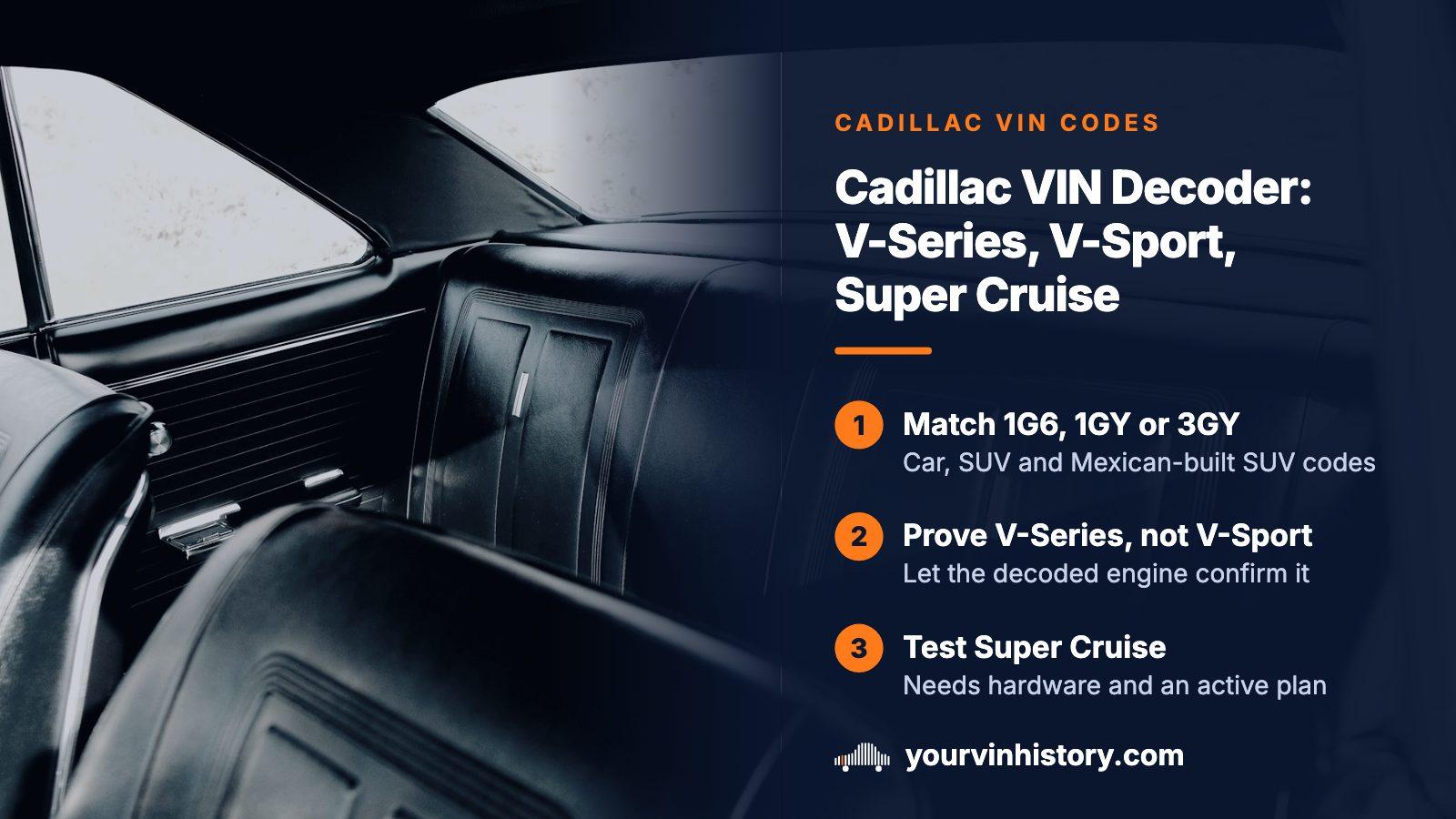
THE SHORT ANSWER
A Cadillac VIN starts with a maker code: 1G6 on U.S.-built cars, 1GY or 3GY on SUVs. The next five characters describe the build, the ninth is a check digit, and the final eight carry model year, plant and serial in that order. On a used example, let the engine in the decode confirm a V-Series, use the RPO label for options, and test Super Cruise on a drive.
- Car prefix
- 1G6, a Cadillac passenger car
- SUV prefixes
- 1GY, plus 3GY for Mexican builds
- Trim to verify
- V-Series, not V-Sport
- Super Cruise
- Needs factory hardware and an active plan
Three prefixes that mean Cadillac
Every VIN opens with a world manufacturer identifier, three characters saying who built the vehicle and what kind it is. NHTSA's vPIC database lists 1G6 as a Cadillac passenger car, and both 1GY and 3GY as Cadillac multipurpose passenger vehicles, the category that holds SUVs. A leading 1 points to a U.S. build and a leading 3 to Mexico.
| Prefix | Vehicle type | Built in |
|---|---|---|
| 1G6 | Passenger car | United States |
| 1GY | Multipurpose vehicle (SUV) | United States |
| 3GY | Multipurpose vehicle (SUV) | Mexico |
General Motors builds several brands under one manufacturer, so the third character is where the division shows. A trunk badge can be ordered online and stuck on in a minute. A division code stamped into the number cannot be swapped. If the lid says Cadillac and the VIN decodes as another division, the car was rebadged or the number was altered, and the seller owes you an explanation.
What the other fourteen characters hold
After the prefix, a Cadillac number follows the same layout as any other 17-character VIN, with a few General Motors habits layered on top.
- Positions four to eight: the vehicle descriptor, covering model, body and drivetrain, with the engine at position eight.
- Position nine: a check digit, the result of a calculation on the other characters, which catches typing slips and clumsy forgeries.
- Position ten: the model year.
- Position eleven: the assembly plant.
- Positions twelve to seventeen: the production sequence that tells one car from the next on the line.
Look through the windshield from outside at the driver's corner of the dash, then open the driver's door and find the jamb sticker. Compare both with the title. Three matches is the baseline; any mismatch pauses the deal until someone explains it.
What a decode returns and what it cannot see
NHTSA's vPIC tool decodes a VIN against patterns that manufacturers file under federal reporting rules, so the answer is only as detailed as the filing. For a Cadillac that usually means:
- Model year, model name and body class
- Engine size, number of cylinders and fuel
- Whether the car sends power to the rear wheels or all four
- Airbags and belts as the factory first installed them
- Where the car was built, down to the plant
A decode describes the car as it left the factory. It cannot see an engine swap, a respray or a repaired front end, and it covers vehicles meant for sale in the U.S., while cars from before the modern VIN format decode poorly or not at all. Once you know the engine and drivetrain, the EPA's fueleconomy.gov can match them to official mileage figures. For what happened after delivery, a vehicle history report adds title brands, accident records and odometer readings.
V-Series and V-Sport: similar names, different cars
V-Series marks the true high-performance Cadillacs, built with their own powertrain, suspension tuning and brake hardware. V-Sport is a lower rung: an option package layered onto an ordinary model, positioned between a standard car and a V-Series. The pattern will be familiar from BMW's M against M Sport, and from Lexus's F against F Sport.
The overlap in naming does real work for sellers. Listings blur the two without any malice at all, and a buyer who skims the headline can end up paying V-Series money for a car that is not one. The wide price gap between the tiers is exactly why it deserves a check before you pick up the phone.
Proving the trim before you talk money
Lettering can be added to either car. Engine records and option codes cannot be faked with an afternoon and a tube of adhesive, so lean on those.
- Decode the VIN and read the engine line before the first call.
- Photograph the RPO label and look for the performance equipment codes.
- Check the brakes against what the variant should carry; the hardware differs sharply between the two tiers.
- Have a dealer pull the as-built record for that VIN and compare it with the listing.
- Price the car on what the decode says, not on the badge across the trunk.
Super Cruise needs hardware and a plan
Super Cruise is the hands-free highway driving feature, and used-car listings get it wrong more often than almost anything else, usually out of ignorance rather than intent. It rests on two pillars. First, the car needs the factory hardware, which many models offered only as an option. Second, the connected service that runs it needs a live plan. That plan is a recurring charge, and the feature goes dark once payments stop.
| What you find | What it means for you |
|---|---|
| Hardware and an active plan | Expected to work on supported highways. Verify it on a test drive. |
| Hardware but an expired plan | Switched off for now. You could restart it, but you would be signing up for a recurring bill, not receiving something already paid for. |
| No hardware | Impossible to add afterward, so a listing that advertises it is mistaken. |
Ask for a live demonstration
Request a Super Cruise demonstration during your test drive, on a road the system supports. A seller who cannot make it work should be treated as selling a car without it. Tesla buyers face the same issue with software-gated features.
The RPO label settles equipment arguments
GM tags every factory option with a Regular Production Option code, and Cadillac runs the very same scheme as Chevrolet, GMC and Buick. The codes are three characters long and appear on a Service Parts Identification sticker, most often in the glove box, occasionally in the trunk or on the console.
That sticker records paint, axle ratio and the equipment packages, which includes the performance and driver-assistance content driving the price. Photograph it early. If it is missing, painted over, or cleaner than the rest of the car, ask why. The Chevrolet guide on this site explains the code system in more depth, and a GM build sheet is another way to recover the original order.
Recalls follow the VIN, not the model name
Recalls attach to ranges of VINs, and a General Motors campaign often spans several divisions when a part is shared, so a Chevrolet notice can reach a Cadillac. NHTSA's lookup answers at the level of a single VIN, which is the only level that matters when you are about to buy.
A recall repair is normally done by a dealer at no charge to the owner, with one catch tied to the age of the car. The federal rule requiring a no-cost remedy stops applying when the vehicle was first sold more than 15 calendar years before the recall notice. A manufacturer may still choose to cover an older car, but it does not have to, so on a long-lived Cadillac ask the dealer what the repair will cost before you assume it is nothing.
The order of checks before you make an offer
- Decode the VIN and confirm the engine, particularly on anything sold as a V-Series.
- Get a clear photo of the RPO label.
- Test Super Cruise on the drive, with both the hardware and an active plan shown.
- Run NHTSA's recall lookup on the full 17 characters.
- Look at the brakes, suspension and air springs for the cost they imply.
- Check what factory warranty remains against the VIN, and ask what passes to a later owner.
Most of this takes minutes and costs nothing. The cost of skipping it shows up later, as a price paid for equipment the car does not have.
Where this information comes from
- NHTSA: vPIC VIN decoder — The federal catalog of manufacturer-filed VIN patterns, used here to confirm the Cadillac prefixes and what a basic decode returns.
- NHTSA: recalls lookup — The place to search open recalls by full VIN before agreeing to a purchase.
- EPA: fueleconomy.gov — Official mileage estimates by model year, handy for comparing the engine and drivetrain a decode reports.
Sources and photos: Facts checked against the sources above in October 2026. Photo by CHUTTERSNAP on Unsplash; diagrams by YourVINHistory.
Keep reading
- GM build sheetHow to pull the original factory order for a General Motors car from its VIN.
- ChevroletThe RPO label explained at length, since Cadillac shares the system.
- TeslaAnother brand where features depend on more than the hardware.
- VIN warranty checkWhat coverage remains on a used car and what passes to you.
Frequently asked questions
Is there a no-cost way to decode a Cadillac VIN?
Type the 17 characters into NHTSA's vPIC tool. It needs no account and returns whatever Cadillac filed for that number: model, year, body class, engine, drivetrain and plant. It will not show accidents, title history or add-on equipment, so treat it as the first step and not the whole check.
Is V-Series the same as V-Sport?
No. V-Series is the top-tier performance model, with a distinct engine, suspension and brakes. V-Sport is a step-up package beneath it. Similar lettering shows up on both, so rely on the engine code in the decode and the options on the RPO label, not the trunk badge.
Will Super Cruise still work on a used Cadillac?
Only if the car left the factory with the hardware and the service plan is active. Ask the seller to show it working on a supported road. If the plan has lapsed, ask Cadillac or a dealer what reactivation would cost you, because the previous owner's arrangement does not settle that.
Where is the RPO label on a Cadillac?
Look inside the glove box first. On some models it sits in the trunk or the center console instead. It lists each factory option as a three-character code. If you cannot find one, say so to the seller, and consider requesting the build record tied to the VIN as a second source.
Does a clean recall lookup mean the car is fine?
It means no open recall is attached to that VIN today. New campaigns get added over time, and the lookup says nothing about crashes, flood damage or title brands. Run it again on the day you pay and once more after the purchase, and pair it with a full history report.
Now check the car itself
The guide explains what to look for. The report shows what this VIN has on record.