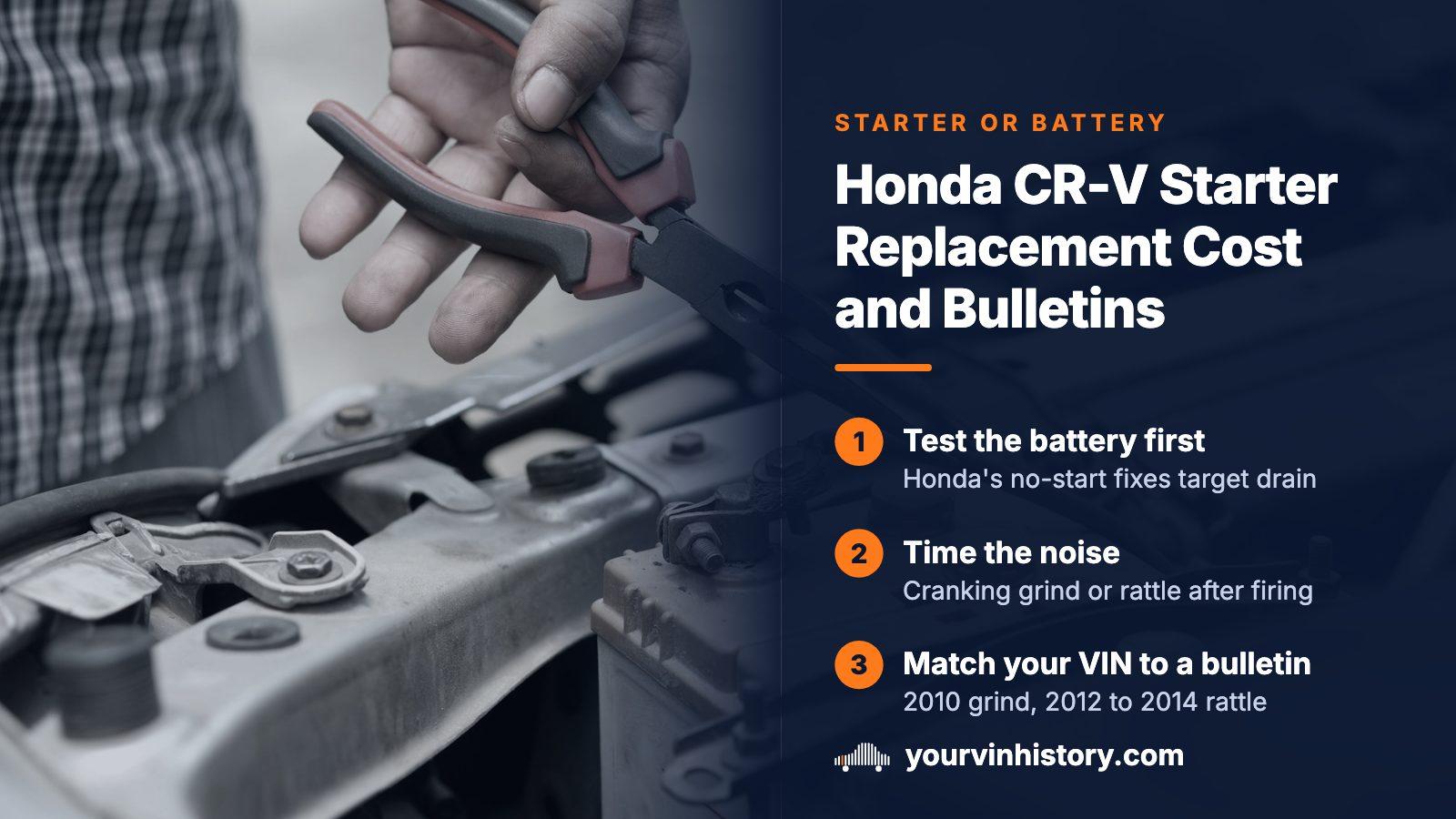
THE SHORT ANSWER
RepairPal publishes an average of $804 to $1,130 for a CR-V starter, tax excluded, with parts the bigger piece. Honda filed just one CR-V starter bulletin, for 2010 models in certain VIN ranges. A two-second rattle at cold start on a 2012 to 2014 car points to the valve-timing actuator, and the 2012, 2017 and 2019 no-start fixes are battery-drain software. Test the battery and time the noise before approving the part.
- RepairPal average
- $804 to $1,130, before tax
- Honda starter swap time
- 0.7 hour, 2010 CR-V
- Honda starter bulletins
- One, for 2010 models by VIN
- Electrical complaints
- 1,663 of 10,899, 2008 to 2022
The price on record and who published it
The dollar figures on this page are not our measurements; they belong to RepairPal. Its CR-V starter estimator shows an average of $804 to $1,130, excluding tax and not adjusted for your area, on a page marked updated September 3, 2026. RepairPal refused automated requests, so the numbers come from its search listing as read in October 2026.
| Piece of the job | RepairPal's average |
|---|---|
| Parts | $643 to $893 |
| Labor | $161 to $237 |
| Whole job, before tax | $804 to $1,130 |
Labor is the small part because the job is quick. Honda's single CR-V starter bulletin allows 0.7 hour for a 2010 model, a warranty allowance rather than a retail shop time. Ask whether the quote is for a new, Honda remanufactured or aftermarket remanufactured starter, and whether a core charge applies.
What the federal electrical complaints can and cannot show
NHTSA's complaint form gives starters no category of their own. The nearest bucket, ELECTRICAL SYSTEM, also takes battery, wiring, lighting and module complaints, so its totals cap starter trouble rather than count it. The CR-V extract used here holds 10,899 complaints for 2008 through 2022; 1,663 of them (about 15%) are electrical, and the category made every year's top five.
| Model year | Electrical reports | Standing |
|---|---|---|
| 2010 | 43 | Fifth among its components; about 9% of the year |
| 2012 | 67 | Second among its components |
| 2017 | 396 | The peak; about 23% of the year |
| 2019 | 157 | Another year with a Honda battery-drain fix |
These are unverified owner reports, not failure rates. The 2017 and 2018 model years together hold 40% of the electrical total. NHTSA's live counts for 2020 to 2022 ran lower in October 2026, since some reports now sit under the CR-V Hybrid.
2010: the one bulletin that names the starter
Of the manufacturer communications NHTSA holds for 2008 through 2024 CR-Vs, only one concerns the starter. Honda Service Bulletin 12-018 dates from March 2012, with an April 2014 revision, and applies to 2010 CR-Vs in listed VIN ranges (2WD and 4WD). The symptom is an intermittent grind on cold starts, typically at 45°F or below. Honda's explanation is a clutch housing outside specification, which loads the roller and pinion unevenly. The repair is a new Honda remanufactured starter, allowed 0.7 hour under normal warranty.
On a 2010, name the bulletin
A dealer can check whether a grinding 2010's VIN falls in the 12-018 ranges. Citing the number points the technician at the known suspect.
A rattle that starts as the engine catches is not the starter
Among 2012 to 2014 CR-Vs, owner complaints repeat one story: a cold-start noise, a starter swapped in, no change. A 2014 owner reports an $863 quote for a starter meant to silence a rattle of one to three seconds.
Honda's bulletins blame something else. Bulletin 09-010 covers the 2012 model year and the earliest 2013 cars by VIN; 16-012 covers the later 2013 cars and all 2014s. Each describes a loud rattle of about two seconds at cold start-up, mostly below 40°F, from a defective variable valve timing control (VTC) actuator, and prescribes a new one at 2.0 hours. Honda's test: leave the engine off six hours or more so the oil drains, then start it and listen. A starter grinds while it turns the engine; the VTC rattle starts as the engine catches.
A starter quote for a short rattle
A noise that begins after the engine fires calls for a question about the VTC actuator bulletins before a starter is bought.
Clicking on a weak battery: Honda's 2012 software update
A weak battery usually shows up as a click, a sluggish crank or a flickering dash, since the starter draws the biggest load on the car. For the 2012 CR-V, Honda found a cause in software: in November 2014 it announced a product update covering 116,272 cars, and bulletin 14-071 says the battery sensor and engine computer can choose the wrong charge mode, leaving too little charge to start. The fix takes 0.3 hour.
The bulletin also lists what a technician must rule out after repeated jump starts: an alternator not charging, a bad or sulfated battery, current leaking while parked, loose cables. The starter is absent. Before buying anything for a 2012, have a Honda dealer confirm the update is recorded for the VIN. That year logs 67 counted electrical reports.
2017 and 2019: control modules that would not sleep
The 2017 spike has a Honda bulletin of its own, again not about the starter. Bulletin 17-032 (June 2017) covers 2017 CR-Vs in listed VIN ranges, with either the 1.5-liter turbo or the 2.4-liter. A car can refuse to start on a low battery after an intermittent 350-milliamp draw once shut off. Honda says the stability control (VSA) module may stay awake if the electric parking brake is applied in the three to four seconds after shut-off. The fix is a software update with recalibration, 0.4 hour.
The 2019 CR-V had a cousin of the problem. Under bulletin 19-039, announced as a product update in March 2019, a car parked for a long stretch may fail to start: the engine computer begins an evaporative-emissions leak check and sometimes never goes back to sleep, flattening the battery. The remedy is a computer update plus a battery test, then a charge or new battery. That year holds 157 counted electrical reports.
Combined, 2012, 2017 and 2019 hold 37% of the counted electrical reports, and each Honda fix was software.
Honda's documents side by side, and what a bulletin is not
| Years | Document | Problem | Fix |
|---|---|---|---|
| 2010, listed VINs | 12-018 | Cold-weather starter grind | New starter, 0.7 hour |
| 2012 to 2014 | 09-010, 16-012 | Cold-start rattle | New VTC actuator, 2.0 hours |
| 2012 | 14-071 | Battery too low to start | Software, 0.3 hour |
| 2017, listed VINs | 17-032 | Draw after shut-off | Software, 0.4 hour |
| 2019, by VIN | 19-039 | Leak check drains battery | Software and battery test |
A bulletin is not a recall. Four of these (12-018, 09-010, 16-012, 17-032) state that normal warranty applies, leaving an out-of-warranty owner to pay, while 14-071 and 19-039 describe product updates run by VIN. A year-by-year search of NHTSA's recall data for 2008 through 2022 found no campaign mentioning the starter, starting or the battery. Still check the VIN on NHTSA's recall page, since older CR-Vs can have open airbag and fuel pump recalls, and dealers repair recalls at no charge only within the federal rule's limits.
Idle-stop on 2020 and newer, and the hybrid's different start
Honda's feature guide describes idle-stop as new to the CR-V in 2020 and standard on every trim. A stop of two seconds or more shuts the engine off, and lifting off the brake restarts it. That means more starting events than earlier CR-Vs had, yet no Honda document tying idle-stop to CR-V starters or batteries turned up, so this page claims no heavier starter or special battery. Federal complaints for 2020 to 2022 average 49 counted electrical reports a year.
The CR-V Hybrid, also new for 2020, starts differently: Honda's feature guide describes a motor/generator that serves as a motor only for starting and as a generator otherwise. No Honda document about a separate starting motor turned up, and none was ruled out, so ask a shop which part a hybrid quote means. A hybrid that will not wake up more often has a dead 12-volt battery.
Checks to make before you approve the part
- Load-test the battery after a full charge; the 2017 and 2019 Honda repairs start with that test.
- Note when the noise happens: during cranking implicates the starter, while a rattle just after the engine fires implicates the valve-timing actuator.
- On a 2012, 2017 or 2019, have a dealer confirm from the VIN that the drain update was done.
- If a 2010 grinds in the cold, check whether the VIN falls in the 12-018 ranges.
- On a 2020 or newer car with slow idle-stop restarts, test the battery first.
Cheap checks settle most cases. A car that starts normally once jumped is pointing at the battery or a drain. One that goes flat overnight with a good battery points to a parasitic draw, and finding it on a 2017 or 2019 may end at a software update. A starter has earned replacement when it fails a current-draw test, or clicks hard with a full battery and bright lights. Tell the shop the pattern: cold mornings only, after days parked, or right after setting the parking brake.
Shopping for a used CR-V that has had a starter
A fresh starter invoice does not prove a CR-V is fixed. On a 2012 to 2014 car, check whether the cold-start rattle persists after the new part; if it does, the actuator is the suspect. On a 2012, 2017 or 2019, ask if the drain update was carried out. The 2.4-liter went into 2008 to 2016 CR-Vs and the 2017 to 2019 LX; other 2017 to 2019 trims and all 2020 to 2022 gasoline models have the 1.5-liter turbo, so match the part to the VIN.
A yourvinhistory.com report covers title brands, accidents, odometer readings and open recalls. A starter swap is shop history, and no report shows whether a battery is sulfated, so ask for repair orders, have a mechanic load-test the battery and book a pre-purchase inspection.
Where this information comes from
- RepairPal: Honda CR-V starter replacement estimator — Where the average, labor and parts figures come from; the page itself blocked automated requests.
- NHTSA: Honda Service Bulletin 12-018 — The April 2014 revision for 2010 models: cold-weather grind, clutch housing cause, new starter, 0.7 hour.
- NHTSA: Honda Service Bulletin 16-012 — The cold start-up rattle on 2013 and 2014 cars, the six-hour test and the VTC actuator repair.
- NHTSA: Honda Service Bulletin 14-071 — The 2012 battery-management software update and the other causes of repeated jump starts.
- NHTSA: Honda Service Bulletin 17-032 — The 2017 no-start from a stability-control unit that stays awake after shut-off.
- NHTSA: Recalls lookup by VIN — The official place to check a specific VIN for open recall campaigns.
Sources and photos: Facts checked against the sources above in October 2026. Photo by Towfiqu barbhuiya on Unsplash; diagrams by YourVINHistory.
Keep reading
- Honda CR-V years to avoid: 2017, 2018 and 2019 draw the most complaintsComplaint and recall counts for every CR-V model year, beyond the electrical system.
- Honda CR-V timing chain replacement cost: the three jobs behind one quoteThe timing side of the same engine, worth reading if a cold-start rattle is your symptom.
- Battery size by VINWhich battery the car should carry, worth confirming before any starter work.
- TSB vs recallHow a bulletin differs from a recall, and what that means for who pays.
Frequently asked questions
What does a Honda CR-V starter replacement cost?
RepairPal's published average is $804 to $1,130 before tax, with labor near $161 to $237 and parts near $643 to $893. Tax and local labor rates are not included, and Honda's 0.7 hour is a warranty allowance, so a retail shop may bill differently. Ask for part, labor, core charge and tax as separate lines.
Is my CR-V's problem the starter or the battery?
Dim dash lights and rapid clicking suggest a battery too weak to turn the engine, as does a car that starts after a jump. Bright lights, one loud click and no crank point toward the starter. Honda's 2012, 2017 and 2019 no-start fixes all involve a battery drained by software, so a printed battery test settles it.
Why does my CR-V rattle for a few seconds when started cold?
On 2012 to 2014 cars, Honda traces a loud rattle of about two seconds, worst below 40°F, to a defective VTC actuator rather than the starter. A January 2018 Honda article describes a similar rattle on 2015 and 2016 cars, with no countermeasure yet.
Has Honda recalled the CR-V starter?
No campaign in NHTSA's recall data for 2008 through 2022 CR-Vs mentions the starter, starting or the battery. Honda used service bulletins and product updates instead. Out of warranty, a bulletin repair is the owner's cost, while a recall repair is done by dealers at no charge within the federal rule's limits.
Does a CR-V Hybrid use a conventional starter motor?
Honda's feature guide says the hybrid's motor/generator starts the engine and then works as a generator. No Honda document found describes a separate starting motor, though that was neither confirmed nor ruled out. A dead hybrid CR-V is more often a flat 12-volt battery, so ask the shop to name the exact part before approving work.
Now check the car itself
The guide explains what to look for. The report shows what this VIN has on record.