THE SHORT ANSWER
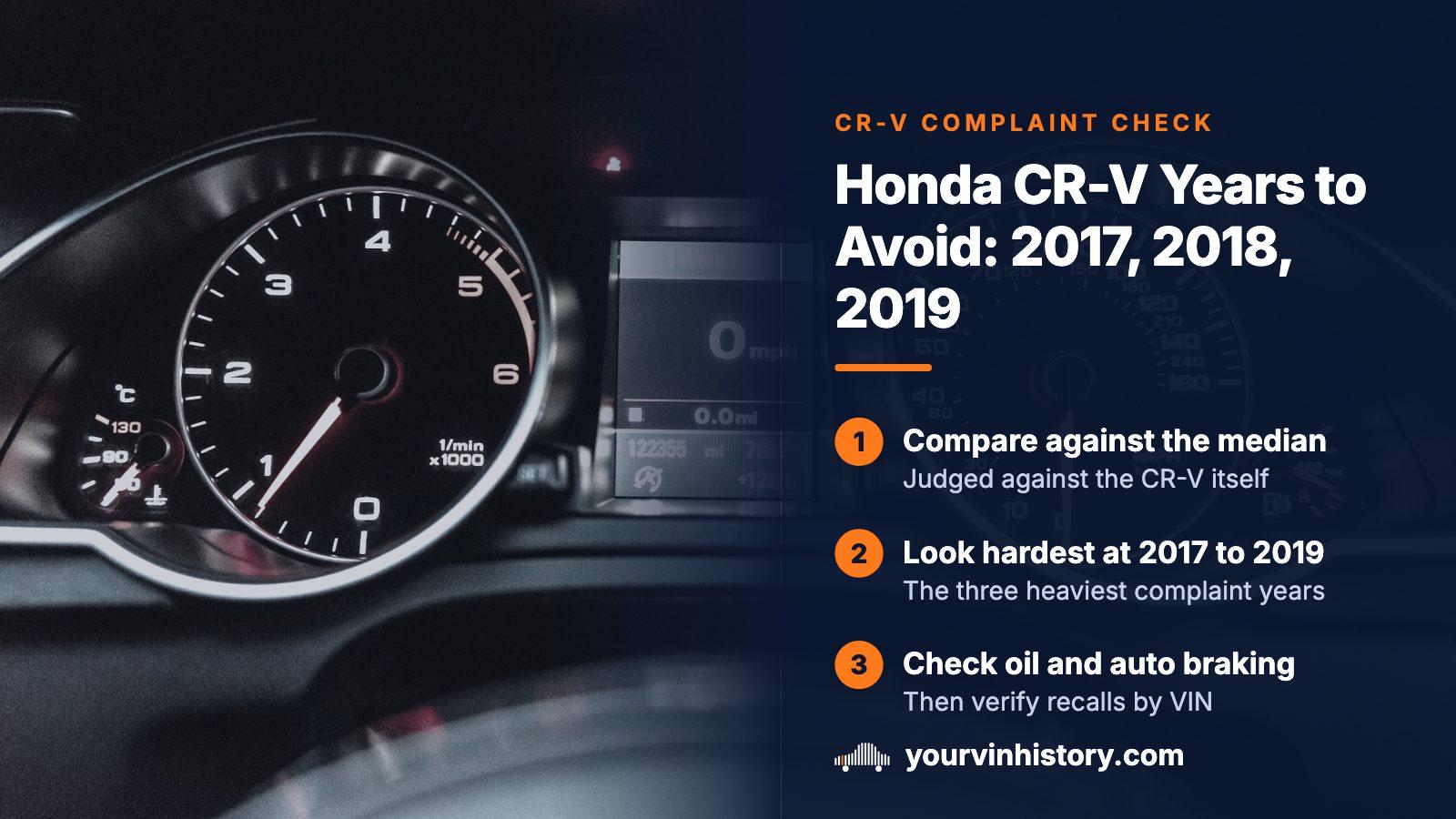
The 2018, 2017 and 2019 Honda CR-Vs draw the most NHTSA complaints against the CR-V's own median of 480 a year, led by 2018 at 2,112. The 2008 and 2015 years also run above it. No year sits clearly below the rest, and engine is the largest complaint category at 1,996 reports. Complaints are unverified owner accounts, not failure rates, so a flagged year is a reason to inspect harder.
- Complaints on record
- 10,899 across 2008 to 2022
- Median year
- 480 complaints
- Heaviest year
- 2018, with 2,112 complaints
- Largest category
- Engine, 1,996 reports
Scoring each CR-V year against its own median
NHTSA keeps every consumer complaint filed against a vehicle. For the CR-V that archive holds 10,899 reports across 15 model years, 2008 through 2022, once duplicates are removed by ODI complaint number. The pull happened on 16 August 2026, so later filings are missing. The middle year lands at 480 complaints, and every other year is expressed as a multiple of that figure.
Raw counts mostly measure sales and time on the road. A bestseller collects more reports than a rare car of identical quality, and an older year has had longer to collect them. Dividing by the nameplate's own middle year cancels most of the sales effect. What remains is still unverified owner accounts, so none of it is a failure rate or a reliability score.
All fifteen model years side by side
In the standing column, far above means at least double the median, above is a smaller lift, and near covers years close to 480 on either side. The 2022 row is marked newest for a reason covered below.
| Model year | Complaints | Multiple of median | Recalls | Standing |
|---|---|---|---|---|
| 2008 | 960 | 2× | 11 | Far above |
| 2009 | 386 | 0.8× | 12 | Near |
| 2010 | 480 | 1× | 15 | On the median |
| 2011 | 551 | 1.15× | 13 | Near |
| 2012 | 400 | 0.83× | 3 | Near |
| 2013 | 381 | 0.79× | 2 | Near |
| 2014 | 585 | 1.22× | 1 | Near, a little high |
| 2015 | 668 | 1.39× | 3 | Above |
| 2016 | 389 | 0.81× | 3 | Near |
| 2017 | 1,752 | 3.65× | 7 | Far above |
| 2018 | 2,112 | 4.4× | 5 | Far above |
| 2019 | 1,078 | 2.25× | 8 | Far above |
| 2020 | 417 | 0.87× | 7 | Near |
| 2021 | 418 | 0.87× | 4 | Near |
| 2022 | 322 | 0.67× | 3 | Near, newest year |
| Median year | 480 | 1× | n/a | Benchmark |
Ten of the fifteen years land near the median, so the heavy years are the exception. They do not form one block, either. 2008 stands alone at the old end, 2015 shows a milder lift, and the real weight sits in 2017 through 2019, three consecutive years running from 2.25 to 4.4 times the median.
The jump from 389 complaints to 1,752
The 2016 CR-V has 389 complaints, a little under the median. The 2017 has 1,752, which is 3.65 times the median. A step that sharp rarely comes from slow drift. It usually lines up with a redesign or a major mechanical change, though complaint data cannot say which.
The tenth character of the VIN encodes the model year, so you can confirm which side of the line a car sits on without trusting a listing headline. The 2017 year carries 7 recalls and lists engine as its most-reported area. This site also keeps a record page for the 2017 CR-V covering its recall campaigns and complaint components.
2018, 2017 and 2019: the three heaviest years
These three years carry a large share of the total. Their figures, in order of volume:
- 2018: 2,112 complaints, 4.4 times the median, 5 recalls; engine and forward collision avoidance stand out
- 2017: 1,752 complaints, 3.65 times the median, 7 recalls; engine leads
- 2019: 1,078 complaints, 2.25 times the median, 8 recalls; forward collision avoidance leads
NHTSA's public narratives fill in what those category names mean. Many of the engine reports for 2017 and 2018 mention oil alongside a gasoline smell, or an oil level that keeps climbing on the dipstick, which owners describe as fuel getting into the oil. Most forward collision avoidance reports for 2018 and 2019 concern braking, and a good share describe the car braking hard with nothing ahead of it, sometimes at highway speed. These are owners' own words, not findings of fact.
2008 and 2015: the older years above the pack
The 2008 CR-V has 960 complaints, exactly double the median, and 11 recalls. Air bags is its leading area, and the narratives behind that label lean heavily on air bag recall notices, including owners who were told replacement parts had not arrived yet. NHTSA's recall records for that year list inflator campaigns for both the driver and passenger sides.
The 2015 year is a smaller case. It has 668 complaints, 1.39 times the median, with only 3 recalls and engine as the leading area. The engine reports here read differently from the 2017 and 2018 ones: most describe vibration or shaking, often at idle, and some mention stalling.
Looking for a clean year: no clear winner
None of the settled years stands well clear of the others on the low side. The lowest multiples belong to 2022 at 0.67 times (322 complaints), then 2013 at 0.79 (381), 2009 at 0.8 (386), 2016 at 0.81 (389) and 2012 at 0.83 (400). Those gaps under the median are tiny next to the gaps above it, where 2018 reaches 4.4 times.
Why 2022 is not named the cleanest
A young model year has had little time on the road, so it looks quiet without having earned the label. The 2022 CR-V has the lowest count in the table, and it is left out of any cleanest ranking for exactly that reason.
With the years packed this tightly, the year on the title decides little. A 2013 with no service paperwork is a bigger unknown than a 2020 with a thick folder of invoices.
Recalls and complaints tell different stories
The two columns do not move together. The 2010 CR-V has the most recalls at 15, followed by 13 for 2011, 12 for 2009 and 11 for 2008, yet 2009 through 2011 sit near the median on complaints. In the other direction, 2014 has a single recall and 585 complaints, 1.22 times the median, while 2013 has just 2 recalls.
A recall is a defect the manufacturer has acknowledged, and dealers repair it at no charge, but only within federal limits. Under 49 U.S.C. 30120(g), that obligation can lapse 15 years after a vehicle's first sale, and the oldest model years in this range are the ones most likely to hit it. Many recalls beside modest complaints can simply mean problems were found and fixed through the maker's program. Recalls also attach to production ranges, not whole model years, so a year's tally cannot say whether one car had its repairs done.
Where owners say the CR-V goes wrong
NHTSA files each report under a component category. Across all fifteen years, six categories lead:
| Component category | Reports, all years |
|---|---|
| Engine | 1,996 |
| Electrical system | 1,663 |
| Forward collision avoidance | 1,210 |
| Air bags | 1,064 |
| Unknown or other | 980 |
| Fuel / propulsion system | 908 |
The category names are broad. Engine covers any engine fault, and electrical system takes in batteries, wiring, lighting and control modules, so these figures work as an upper bound for any single part, never a count of one failure. Engine at 1,996 is still the entry that tells a mechanic where to start, since it is the leading area in 2015, 2017 and 2018.
What to check on a CR-V from a flagged year
A flagged year calls for a harder look and a sharper price, not a refusal. These checks follow what the narratives for each year describe.
- Confirm the model year from the tenth VIN character, then run the full VIN through NHTSA's recall lookup, which is free and lists open campaigns for that exact car.
- On a 2017 or 2018, pull the dipstick on level ground with the engine off. Note whether the oil sits above the full mark or smells of gasoline, and ask for invoices covering oil changes and any dealer engine work.
- On a 2018 or 2019, drive a stretch of highway and watch for automatic braking with nothing ahead, plus any driver-assist warnings on the dash.
- On a 2008, confirm that every air bag recall, inflator campaigns included, shows as completed, and that the air bag light comes on at start-up and then goes out.
- On a 2015, let the engine idle once warm and feel for vibration through the steering wheel and floor.
- Whatever the year, pay an independent mechanic for a pre-purchase inspection with the car on a lift.
NHTSA's records for the 2017 CR-V include a fuel supply pipe campaign and, for 2017 and 2018 cars, a power steering torque sensor campaign. Each covers only certain production ranges, so only a VIN check shows whether a given car is included.
Why only the VIN can settle the purchase
A model year is a group of cars. What settles a purchase belongs to one of them: which recalls cover its production range and whether they were done, what its title record says, whether its odometer readings climb in a believable sequence, and what a mechanic finds underneath.
Three checks cover the basics. NHTSA's lookup handles open recalls. The NICB's VINCheck screens a VIN for theft and total-loss records at no charge. The National Motor Vehicle Title Information System, run under the Justice Department's Bureau of Justice Assistance, exists to protect buyers from fraud and unsafe vehicles and to keep stolen vehicles from being resold.
A yourvinhistory report adds accident records with a damage map, odometer readings and title brands to that picture, and a preview comes first, before any purchase. Its NMVTIS title records come from ClearVin LLC, an approved NMVTIS data provider.
Where this information comes from
- NHTSA: Vehicle safety and complaints — The federal complaint database behind the owner-report counts, where drivers file defect and crash concerns.
- NHTSA: Recalls — Recall campaigns by vehicle, plus the VIN lookup that shows which repairs are still open on one car.
- Bureau of Justice Assistance: NMVTIS vehicle history — The national title database program, for the title side of a used-car check that model-year tables leave out.
- NICB: VINCheck — A no-cost screen of one VIN for reported theft and total-loss records.
Sources and photos: Facts checked against the sources above in October 2026. Photo by Ambitious Studio* | Rick Barrett on Unsplash; diagrams by YourVINHistory.
Keep reading
- 2017 Honda CR-V: 7 recalls, 1,752 complaints and a 5-star crash recordOne of the three heaviest years, with its recall campaigns and complaint areas laid out.
- Honda recallsHow to look up open Honda recalls by VIN before you agree on a price.
- Honda Pilot years to avoid: 2016, 2017 and 2019 lead NHTSA complaintsHonda's larger SUV, scored against its own median in the same way.
- Buying a car with an open recallWhat to do when the lookup turns up a campaign nobody has repaired.
Frequently asked questions
Is the Honda CR-V a reliable SUV?
Complaint data cannot grade reliability, because each report is one owner's unverified account and counts rise with sales and age. It does show that ten of the 15 model years sit near the CR-V's own median of 480, with four far above and one above. For a single car, service records and an inspection say more.
Which Honda CR-V year has the fewest problems?
No year stands clearly below the rest. The 2022 model has the lowest count at 322, but it is the newest year and has had little time to collect reports. Among settled years, 2013, 2009, 2016 and 2012 sit lowest, each only modestly under the 480 median. With gaps that small, condition and maintenance records should break the tie.
Should I buy a 2017 Honda CR-V?
The 2017 model has 1,752 complaints, 3.65 times the median, with engine the leading area, so it earns a closer look than most years. That is a population signal, not a verdict on one car. Run the VIN through NHTSA's recall lookup, check the dipstick, and read the service invoices before you settle on a price.
Does a high recall count make a CR-V a bad buy?
Not by itself. A recall means the maker has acknowledged a defect and dealers fix it at no charge, within federal limits. The 2010 CR-V carries the most at 15 recalls yet sits right on the median for complaints. What matters is whether the campaigns covering your car were completed.
How do I check a used Honda CR-V before buying?
Start with the VIN, and make sure the dash, door jamb and title all show the same one. Look up open recalls with NHTSA, screen theft and total-loss records with the NICB's VINCheck, and pull a title-based history report. Then compare the odometer reading with the records, ask for service invoices, and book an independent inspection.
Now check the car itself
The guide explains what to look for. The report shows what this VIN has on record.