THE SHORT ANSWER
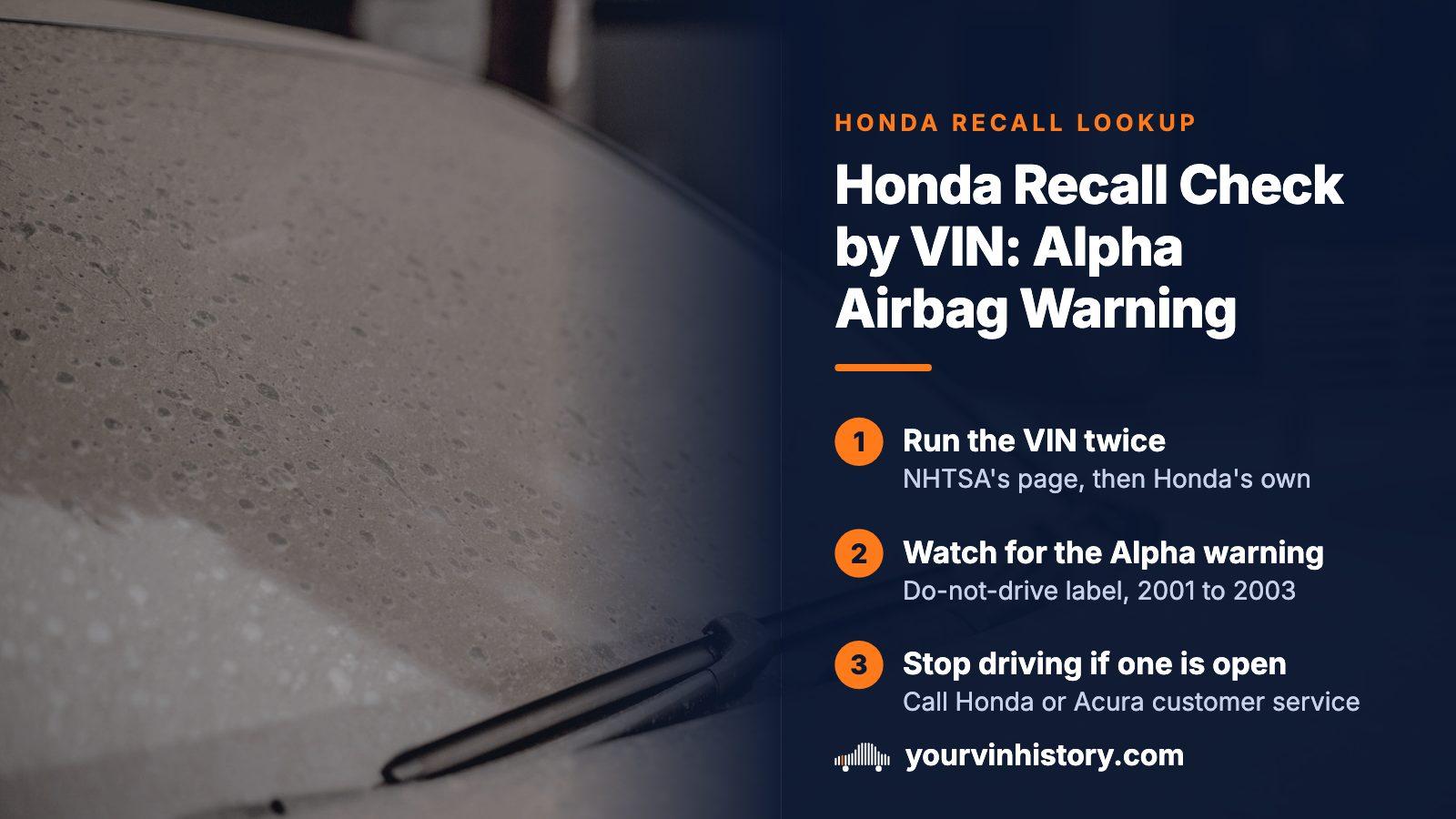
Put the VIN into NHTSA's recall lookup and into Honda's own recall page; together they show the open safety recalls on that exact car. Most are routine dealer visits. The exception is the Takata Alpha air bag: seven Honda and Acura models from 2001 to 2003 carry a do-not-drive warning. If your VIN shows one still open, stop driving the car and call Honda or Acura customer service.
- Alpha failure rate
- 50%, according to NHTSA
- Do-not-drive models
- Seven Honda and Acura models, 2001 to 2003
- NHTSA lookup gap
- Leaves out safety recalls more than 15 years old unless the maker offers more coverage
- Honda and Acura customer service
- 888-234-2138
Pull the VIN off the car, then run it twice
Start with the number on the car, not the number in the ad. NHTSA points owners to the lower left corner of the windshield for the 17-character VIN, and the same number is printed on the registration card and may also appear on the insurance card. If the windshield, the title and the listing disagree, resolve that before you run anything else.
Then search twice. NHTSA's lookup accepts a VIN or a license plate and answers one narrow question: does this specific vehicle have a recall that nobody has repaired yet. A clean result reads as zero unrepaired recalls for that VIN. Honda keeps its own recall page too, and the second search earns its minute because the two sources draw their boundaries differently, as the next section shows.
What NHTSA's lookup leaves out
NHTSA lists the blind spots of its own VIN and plate search, and several of them matter on a used Honda.
- Recalls that were already repaired. That is expected, but it also means a clean result cannot say what was fixed or when.
- Recent recalls where the manufacturer has not yet reported every affected VIN. NHTSA adds them continuously and asks people to check back.
- Safety recalls more than 15 years old, except where the manufacturer offers more coverage.
- Recalls from small manufacturers, vehicles built for other countries, and customer-service campaigns that are not safety recalls.
The 15-year gap is the one that bites on an early-2000s Accord, Civic or Odyssey. On a car that old, an empty NHTSA result is a starting point rather than a verdict. Phone Honda or Acura customer service with the VIN and ask whether any Takata campaign is open on it.
Why one Honda recall carries a do-not-drive label
NHTSA says tens of millions of vehicles carry recalled Takata air bags, but it does not treat them as a single risk. It calls the Alpha inflators some of the oldest under recall, and it gives them a 50% failure rate.
The consequence is specific. If an Alpha inflator ruptures, metal fragments are thrown toward the driver's face, and NHTSA says that can kill a driver or leave devastating, life-altering injuries. A minor crash that fires the bag is enough to carry that risk. That is why Honda moved from an ordinary recall notice to an instruction not to drive unrepaired cars.
NHTSA's alert estimated that about 8,200 Honda and Acura vehicles with these air bags were still being driven, and said that more than 99% of Alpha inflators had been replaced or otherwise accounted for by Honda. Read both numbers as a snapshot from the date of that alert, not as a live count of the cars affected today.
The Hondas and Acuras NHTSA names on the Alpha list
NHTSA names seven vehicles, all from the 2001 to 2003 model years. A match on make, model and year raises the stakes, but it does not make your car dangerous by itself. The warning is aimed at cars on which the Takata recall is still unrepaired.
| Make | Models | Model years |
|---|---|---|
| Honda | Accord and Civic | 2001-2002 |
| Honda | CR-V and Odyssey | 2002 |
| Honda | Pilot | 2003 |
| Acura | 3.2 TL | 2002-2003 |
| Acura | 3.2CL | 2003 |
Plenty of these cars were fixed years ago and are fine. Only the VIN can separate a repaired Accord from an open one, because the dashboard looks the same either way.
Heat, humidity and the clock on an inflator
Takata's problem is chemistry rather than one bad batch. NHTSA explains that the propellant breaks down after long exposure to high temperature swings and humidity. Degraded propellant can burn too fast and build more pressure than the inflator can hold, and in extreme cases the inflator explodes and throws shrapnel toward the occupants.
That explains why NHTSA phased the wider recall by climate zone and vehicle age instead of treating every car alike. Its hot-and-humid zone covered states including Alabama, Florida, Louisiana and Texas, while the least hot and humid group took in places like Maine and Wyoming.
For a buyer, the lesson runs against instinct. A car that has driven for two decades without trouble has not proven its inflator sound. Where the car lived is a fair question to put to the seller, but the VIN lookup is what answers the question that matters.
If the lookup shows an open Takata recall on your Honda
Treat an open Takata result as a same-day task, and work through it in this order.
- Compare your car with the table above. If it matches, treat the do-not-drive warning as yours and stop driving it.
- Call Honda and Acura customer service at 888-234-2138, or a dealer, and say the VIN has an open Takata recall.
- Ask for towing or mobile repair so the car never has to make the trip under its own power. NHTSA's alert lists both, along with loaner or rental vehicles where needed.
- Ask about parts. NHTSA says replacement parts for this recall are available now, so a long wait should not be accepted without a reason.
- Keep the repair order, then rerun the VIN to confirm the recall no longer shows as open.
Open Takata recall, car not on the list
NHTSA still wants it repaired, but the do-not-drive wording in its Honda alert is specific to the Alpha models above. Ask customer service whether any warning applies to your VIN before you decide how to use the car.
Takata recalls outside the Alpha group, and the Acura overlap
Alpha is the sharpest edge of a much larger campaign. A Takata recall on a later Honda is a routine appointment by comparison: check the VIN, call the dealer and sign up for alerts, which is NHTSA's advice to every owner. An open Takata recall on your VIN does not mean you own an Alpha car, only that an air bag on it is waiting for a repair.
Acura shares the recall with Honda. NHTSA's vehicle list shows Acura (Honda) and Honda as separate entries, and the Alpha models run across both badges: the Accord and Civic sit on the same list as the 3.2 TL and 3.2CL. A search by make alone can miss the other badge. A search by VIN covers either one, because the number belongs to the car.
The no-charge repair rule and its 15-year line
Federal law generally makes the manufacturer remedy a recalled vehicle without charge, but the requirement has an edge. It does not apply when the first purchaser bought the vehicle more than 15 calendar years before the manufacturer's recall notice or the government's order, whichever came earlier. The clock runs from that first purchase to the notice, not to today and not to your own purchase date.
Two things follow. The date that counts is fixed by the car's original sale, so a Honda resold several times keeps the date it started with. And an old car cannot simply be assumed to qualify. For the Alpha campaign, NHTSA's alert says the parts, the repair, towing or mobile repair and loaner or rental vehicles cost the owner nothing. That statement belongs to that campaign, not to every recall on every old Honda.
On any other recall for a car well past the line, ask customer service two things before booking: whether the campaign falls inside the 15-year window and, if it does not, whether Honda is covering it anyway. Get the answer before the car goes on the lift.
Buying a used Honda: settle recalls before you pay
Put the recall on the table before money changes hands. A seller can schedule the repair as easily as you can, and a promise to handle it later is how a car ends up unrepaired for two decades.
- Run the VIN yourself, from the windshield, on the day you buy. A printout the seller brings is only as current as the day it was made.
- On an Alpha-list model, ask for the repair record. A completed repair is good news. An open one means the car should be towed from the lot, not driven off it.
- On any other Honda with an open recall, ask the seller to finish the repair before closing, or write the cost and timing into the bill of sale.
- After purchase, update the registration with your current address and sign up for NHTSA's email alerts, which the agency calls a good backup plan for used buyers.
What a clean Honda recall result still does not settle
A recall search answers one question and no others. It does not read crash history, title brands, odometer accuracy or liens. A Honda with a spotless recall result can still have a salvage brand, a rolled-back odometer or a lender's claim on it.
NICB's VINCheck is free to use and screens for theft and total-loss reports from participating insurers. Federal title data sits in NMVTIS, reached through approved providers. A yourvinhistory report gathers open recalls with title brands, accident entries and a damage map, odometer readings, and salvage and auction records with photos, starting with a free preview.
Where this information comes from
- NHTSA: Honda upgrades Takata Alpha recall to do-not-drive — Backs the Alpha failure rate, the seven named models, the remedies on offer and the customer service number.
- NHTSA: Takata air bag recall spotlight — Explains how propellant breaks down with heat and humidity, why the recall was phased by climate zone, and what alerts to sign up for.
- NHTSA: Check for recalls — Describes what the VIN and plate search shows and, just as useful, the recalls it does not display.
Sources and photos: Facts checked against the sources above in October 2026. Photo by Cole Keister on Unsplash; diagrams by YourVINHistory.
Keep reading
- HondaReads the rest of a Honda VIN, including the Takata screening and chassis codes.
- AcuraCovers the Acura side of the Alpha list and where Honda parts cross over.
- Recall check by VINShows why a search by VIN and a search by model answer different questions.
- Buying a car with an open recallSets out what you can ask a seller to do when a recall is still open.
Frequently asked questions
Where do I look up open recalls on a Honda using its VIN?
Enter the VIN in NHTSA's recall lookup, or use the license plate and state if the VIN is not handy. Then repeat the search on Honda's own recall page, since NHTSA leaves out customer-service campaigns and safety recalls older than 15 years. Save a screenshot of each result with the date, which helps if the seller or a dealer later disputes the status.
Does a Honda recall check cost anything?
NHTSA's VIN and plate lookup is a free federal tool, and its SaferCar alert app is free too. Looking up a recall costs nothing. Who pays for the repair is a separate question that depends on the 15-year rule described above and on what Honda chooses to cover for that campaign, so ask before you book.
Can I drive my Honda to the dealer for an Alpha recall?
For an unrepaired Alpha model the instruction is not to drive it at all. That is the reason towing and mobile repair exist for this recall: a technician or tow truck comes to the car. Phone Honda or Acura customer service on 888-234-2138 and ask them to arrange one, rather than risking a short drive.
Why does my old Honda show no recalls on NHTSA?
NHTSA says its VIN search omits safety recalls more than 15 years old unless the manufacturer offers more coverage. An older Accord, Civic or Odyssey can therefore look clean on the federal tool and still have work waiting. Call Honda or Acura customer service with the VIN and ask them to check their own records.
How often should I recheck my Honda for recalls?
NHTSA suggests checking at least twice a year, and signing up for email alerts or the SaferCar app so new recalls reach you without a search. Confirm that your registration carries your current mailing address too, because manufacturers send recall notices by mail to the registered owner.
Now check the car itself
The guide explains what to look for. The report shows what this VIN has on record.