THE SHORT ANSWER
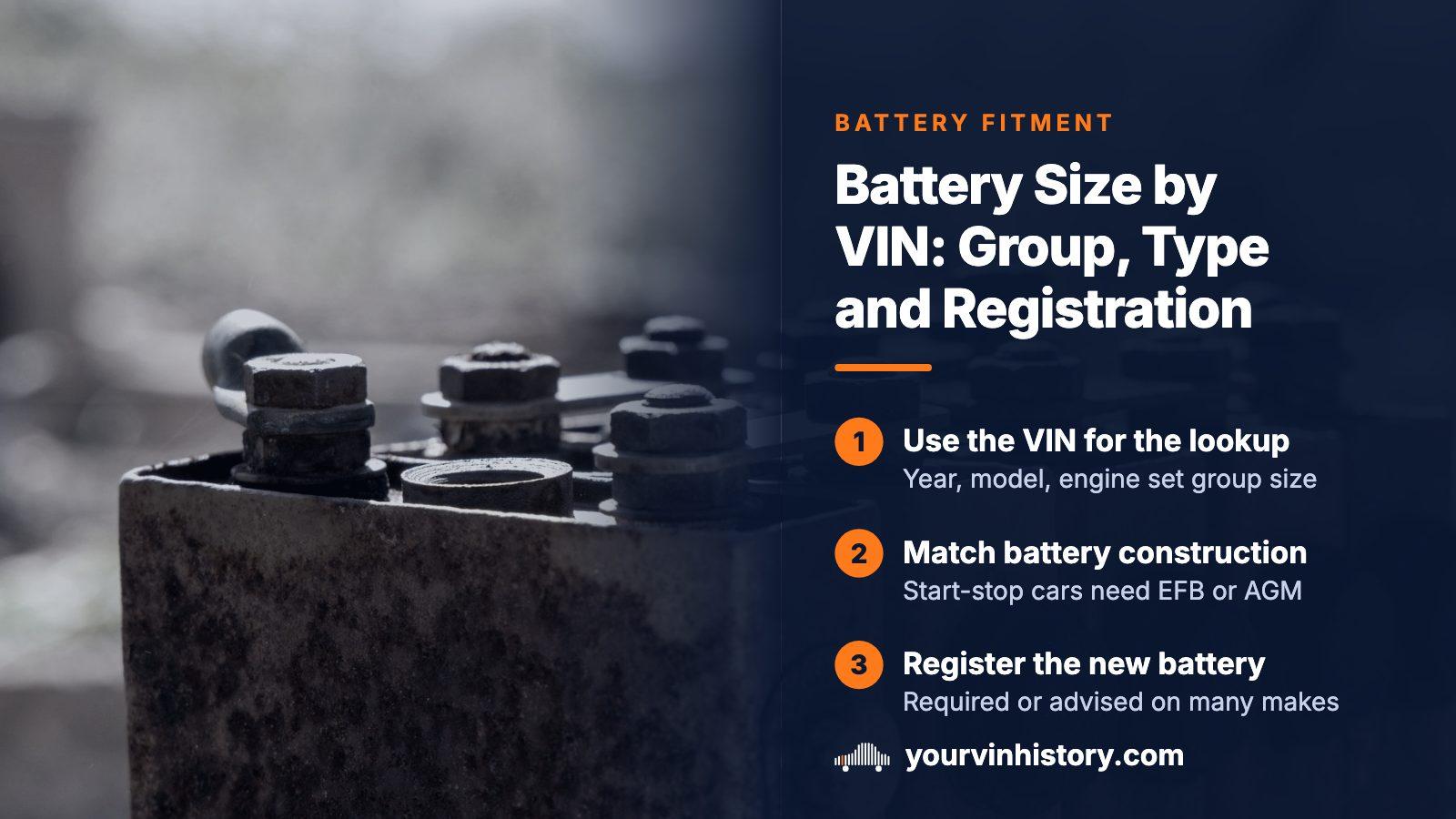
You cannot read a battery size straight from a VIN, but the VIN pins down the year, model and engine that a parts lookup runs on, and that settles the case and terminal layout. Then check construction, because start-stop cars call for EFB or AGM and a standard flooded battery tends to wear out early. Last, confirm in the owner's manual whether the new battery must be registered with the car's management system.
- Group size
- Set by the year, make, model and engine
- Start-stop cars
- Need EFB or AGM, not plain flooded
- Registration
- Required or advised on many makes
- Cold cranking amps
- A floor to meet, not a score to chase
What the VIN contributes to a battery lookup
A VIN does not store a battery. Run one through the federal decoder and you get back what the factory built: the make and model, the year, the body class, engine displacement, cylinder count and fuel type. No parts catalog sits behind it, and no battery group appears anywhere in the result.
That record still earns its place, because every battery lookup begins with the same inputs, and the badge on the trunk lid is an unreliable way to get them. A trim name can hide a different engine, and the engine is what determines the battery the factory installed.
There is a second reason to decode first. Whether a car has start-stop can differ between trims of a single model year. Settling the exact build before you shop is what separates the right battery from one that only happens to fit the tray.
Group size answers one question: will it fit?
The group number describes the case, not what is inside it. Retail lookups resolve it well from year, make, model and engine, which makes it the least risky part of the whole job.
| What the group fixes | What goes wrong if it is off |
|---|---|
| Case length, width and height | The battery will not seat in the tray, or an over-tall one touches a hood liner or brace. |
| Which end the positive post sits on | The cables fall short, or reach only under strain. |
| Terminal style: top post, side post or stud | Adapters exist, but they are a weak stand-in for the correct terminal. |
| Hold-down provision | If the case sits in the tray but the clamp cannot grip it, it shifts around, and vibration shortens its life. |
Chemistry is missing from that table. Batteries sharing one group number can be built in very different ways, and the next sections are about that gap.
Flooded, EFB and AGM are different tools
Most groups are sold in three constructions. They are engineering choices made for particular vehicles, not rungs on a quality ladder that you can climb or descend at will.
| Type | How it is built | Where it belongs |
|---|---|---|
| Conventional flooded | Lead-acid cells with free liquid electrolyte | Cars without start-stop and without heavy electrical demand |
| EFB (enhanced flooded) | A reinforced flooded design; VARTA says it handles twice the charging cycles of a conventional starter battery | Simple start-stop systems, or demanding urban driving without one |
| AGM (absorbent glass mat) | Electrolyte soaked into a glass mat instead of sitting as free liquid | Start-stop with braking energy recovery, and premium cars with many accessories |
If the factory called for AGM, the charging and electrical design assumed it from the start. Treating it as an optional upgrade misses that the rest of the system expects it.
What stop-start driving does to a battery
In a conventional car the battery starts the engine once per trip and the alternator carries the load after that. With start-stop the engine cuts out at the red light and restarts when you lift off the brake, and in between, the battery alone runs the fan, lights and infotainment. Midtronics puts the added burden at hundreds of extra charge and discharge cycles every day.
A standard flooded battery was not designed for repeated deep partial discharge and quick recharge. Midtronics says it fails early in this service, sometimes within months, and its FAQ gives a range of six to eighteen months.
The fault arrives late
Nothing looks wrong on installation day. The engine starts, the lights work, and the invoice looks fine. Months later the battery will not hold a charge, and by then nobody ties the problem to the part that was chosen. On a start-stop car, construction is a poor place to economize.
Registration: telling the car a new battery is in
Many start-stop cars use a battery management system, with a sensor that watches the battery and adjusts charging as it ages. Banner explains that the system has to learn the traits of a replacement. Without that step it can keep working from the old battery's record.
Consequences differ by make. Banner reports that on a Porsche, start-stop does not work until the new battery is registered, that BMW warns of overcharging without it, and that Mini warns of a mis-set charging current that can end the battery early. Audi, Porsche, SEAT, Škoda and VW brands are listed as recommending or requiring it. Elsewhere the result is milder: error messages or limited comfort functions that settle within a few days.
Registration is usually done with a scan tool, sometimes under names such as battery adaptation or a BMS reset. On closed systems Banner says the process typically relies on a code that aftermarket batteries do not carry, so the procedure varies. That is why a driveway battery swap is less simple than it once was.
Which replacements are safe, and which go backward
Substitution runs in one direction. The guidance below comes from battery makers, not from a regulator, and manufacturers differ in the details.
- A car that came with AGM should get AGM again. VARTA states that only an AGM may replace it.
- A car that came with EFB can take another EFB. VARTA says a stronger AGM is a fair choice for heavy city traffic or a long list of electrical consumers.
- Stepping down, from AGM to EFB or to flooded, is the swap to avoid, since the car was engineered around the construction that left.
- A car without start-stop does not need AGM. Buying one anyway is a question of budget, not of correctness.
- If the carmaker has issued its own instructions, those take precedence.
Cold cranking amps: a floor, not a score
CCA is the figure shoppers fuss over most and the one that deserves least of the attention. It states how much current a battery can deliver in the cold for a short spell, which is a measure of turning over a chilly engine.
The manufacturer sets a minimum suited to the engine and the climate the car was designed for. Meeting that number, or going modestly above it in a cold region, is sensible. Hunting for the largest number on the shelf is not, because a high rating cannot make up for the wrong construction and does nothing for a battery facing a duty cycle it was never built for.
The order of priority is construction first, then group size, then an adequate CCA.
Four places to read the requirement, ranked
- The owner's manual. It states the construction the car needs and whether registration is expected, and it outranks the battery label if the two disagree.
- The manufacturer's published guidance. It has the final word on substitutions and registration for that make.
- A parts counter given the full 17-character VIN. It is dependable for group size. Ask directly whether the car needs AGM or EFB rather than accepting whatever the screen defaults to.
- The battery already under the hood. Its label shows the group, usually the construction and the CCA, but only if the last person fitted the right one.
Do not copy the fitted battery blindly
If a previous owner installed the wrong construction, matching it repeats the mistake and passes the early failure to you. Compare the label with the manual instead of trusting the label alone.
Signs of a mismatched or unregistered battery
These problems build slowly and get blamed on other things, so they are worth listing.
- Start-stop quits or works only now and then. Midtronics notes that the management system switches it off when it sees the battery's health slipping.
- A start-stop light or a check battery message on the dash.
- A fresh battery that struggles inside its first year.
- Charging or electrical warnings that appear soon after the battery is swapped.
- A car driven every week that keeps going flat.
- A battery that tests acceptable yet behaves badly, which can point at the charging strategy instead of the battery.
The first item is the one people ignore, since many drivers are happy when the engine stops cutting out. Treat it as the car reporting a problem.
Reading the battery when you inspect a used car
Lift the hood and read the label. On a start-stop car, a conventional flooded battery counts as a finding: it is either failing or about to, and it hints that maintenance was done to a price instead of to the specification. Many batteries also carry a date code that gives a rough age.
None of this should decide a purchase by itself. It is one more line in the picture that a pre-purchase inspection and a pass through the usual red flags are meant to build.
Before you go, decode the VIN so you know the engine and trim, and whether the car was built with start-stop at all. A yourvinhistory report lists factory specifications and open recalls for that VIN, after a free preview. NHTSA also runs its own recall lookup by VIN at no cost, worth using while the number is in hand.
Where this information comes from
- VARTA: EFB and AGM differences — Which battery type suits which vehicle, and which replacements are acceptable when a car came with EFB or AGM.
- Banner: registering a replacement start-stop battery — Why a battery management system has to learn a new battery, and how the consequences of skipping it differ by make.
- Midtronics: battery issues in start-stop vehicles — How start-stop duty cycles punish a standard flooded battery and what warning signs show up first.
- NHTSA: recalls — The federal lookup for open safety recalls on a specific VIN.
Sources and photos: Facts checked against the sources above in October 2026. Photo by Stephen Mabbs on Unsplash; diagrams by YourVINHistory.
Keep reading
- Engine size by VINThe engine is the input the battery requirement follows from, so confirm it first.
- Trim level by VINStart-stop can differ between trims of one model year.
- Parts by VINSee why a parts catalog wants the full VIN and what it does with it.
- Used car red flagsA mismatched battery is one small clue among several to look for.
Frequently asked questions
Can I find my battery group size from my VIN?
Not directly. The decode lists make, model, year and engine, not a battery group, because the federal record has no parts fields. Those details are what a parts counter needs, though, and it will return the group. Give the counter the full VIN and ask whether the car needs AGM or EFB, since the group alone does not answer that.
Will a regular battery work in a start-stop car?
It will bolt in and start the engine, so nothing seems wrong at first. The trouble is the duty cycle. Midtronics calls EFB the minimum specification for lighter-duty start-stop use. A plain flooded battery tends to lose its charge early, and the car may switch start-stop off to protect it.
Do I need to register a new car battery?
It depends on the make and on whether the car's system is open or closed. Your manual and the maker's guidance settle it. Banner says a registered battery usually reaches a stable state within a few days, with learning that can take anywhere from a couple of operating hours to several days. Ask the shop before the work begins.
Can I put an AGM battery in a car that came with an EFB?
Usually yes. VARTA says a powerful AGM can be chosen for heavy urban traffic or when many electrical consumers raise demand. The reverse is the move to avoid, so an AGM car should never drop to EFB or flooded. Because makers differ, check your manufacturer's guidance, and ask whether the new battery needs registering afterward.
How do I know whether my car has start-stop?
The federal decode returns build fields such as engine, body class and fuel type, and cannot be counted on to say whether start-stop is fitted. Watch whether the engine shuts off at red lights, and read the manual. The feature can vary by trim and engine within a model year, so confirm the decoded trim before you trust any battery lookup.
Now check the car itself
The guide explains what to look for. The report shows what this VIN has on record.