THE SHORT ANSWER
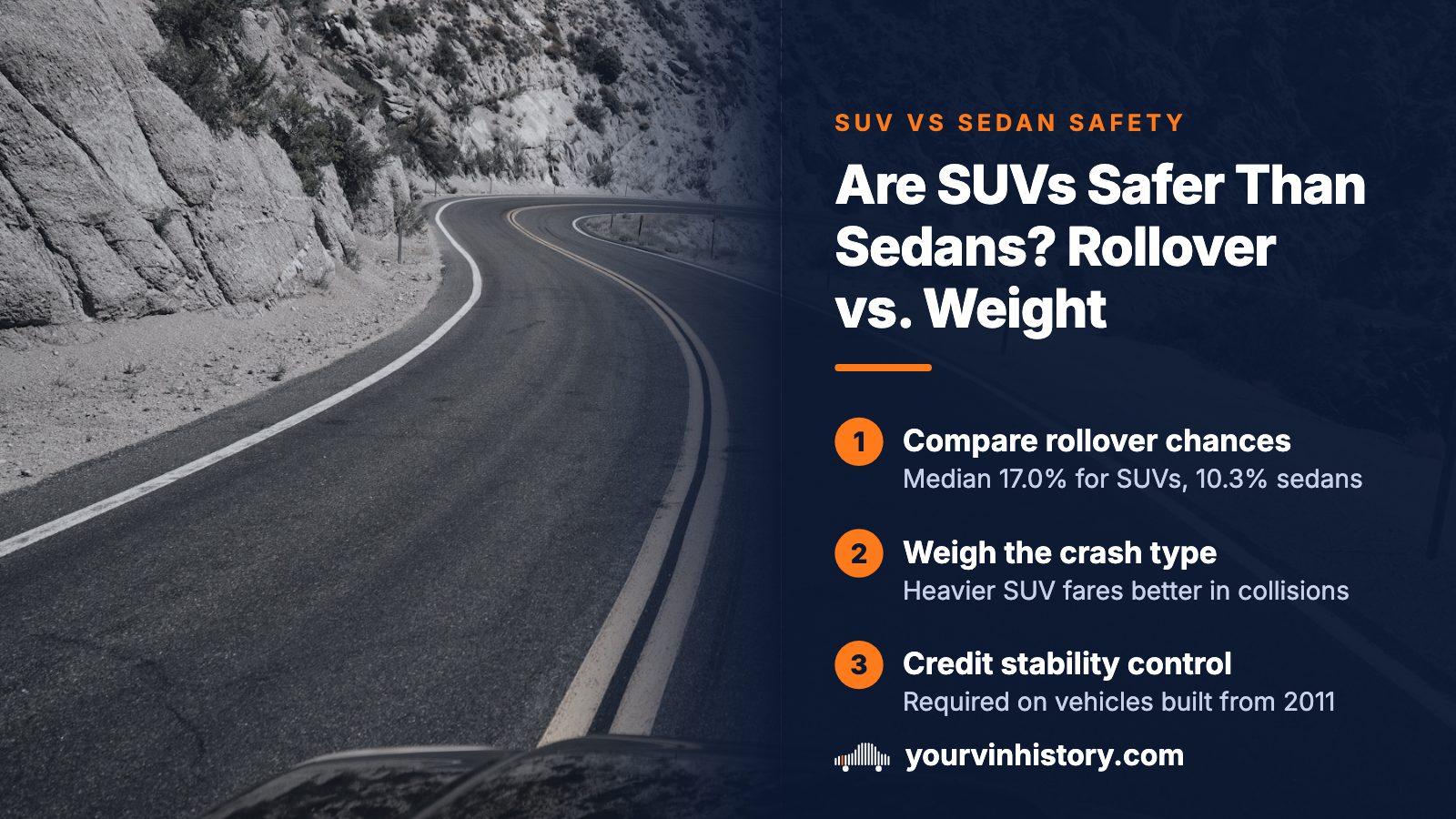
It depends on the crash. When a driver loses control and the vehicle leaves the road alone, sedans score better: across 111 NHTSA-rated configurations, the median rollover chance is 17.0% for SUVs and 10.3% for sedans. In a collision with a lighter vehicle, the heavier SUV protects its occupants better. Stability control, required on every covered vehicle built from September 1, 2011, narrows the rollover gap but does not close it.
- Median SUV rollover chance
- 17.0%, across 56 rated configurations
- Median sedan rollover chance
- 10.3%, across 27 rated configurations
- Sun-visor rollover label
- Utility vehicles with no more than 110 inches between the axles
- Stability control
- Required on every covered vehicle built on or after September 1, 2011
Three crashes hide inside this one question
People who argue about SUVs and sedans are rarely arguing about the same collision. One side pictures a driver who swerves, slides off the shoulder and tips over. The other pictures a family sedan struck by a pickup at an intersection. A third group thinks about the people in whatever the vehicle hits.
Each of those events favors a different body style, and each rests on different evidence. For the first, a federal rating prints a probability for every vehicle it tests. For the other two, the evidence is real but more contested, and it shifts with the traffic around you. The sections below take them one at a time.
Where the heavier vehicle comes out ahead
Start with the SUV's best argument, because it holds up. When two vehicles of unequal weight collide, the heavier one pushes the lighter one around, and the people inside the heavier one are shielded better. Comparisons of car-versus-SUV crashes have long shown worse outcomes for the occupants of the smaller vehicle, and the physics behind that is not in dispute.
Two limits apply. The advantage exists only in a collision with another vehicle, which is a different event from sliding off the road alone. And it is relative: it depends on what you hit, and it shrinks as the vehicles around you get heavier too.
The rollover figure NHTSA publishes for each vehicle
NHTSA's star ratings carry a rollover result, reported two ways: as a star count and as a percentage. The percentage is the likelihood that the vehicle rolls over in a crash involving no other vehicle. Most other safety ratings hand you stars and nothing more.
The number follows the hunch most buyers already have about tall vehicles. When the center of gravity sits high compared with the distance between the wheels, a vehicle tips more readily, and the percentage turns that hunch into something you can set side by side for two specific cars. Enter a year, make and model on NHTSA's ratings page to find it.
Median rollover chance, body type by body type
To see the pattern, take 111 rated configurations from NHTSA's published 5-Star data and group them by body type. Any body type with fewer than 5 rated rows is left out, since a median over one or two vehicles proves nothing.
| Body type | Median rollover chance | Range | Rated configurations | Rollover stars |
|---|---|---|---|---|
| Sedan | 10.3% | 6.6% to 11.8% | 27 | 4 and 5 |
| Minivan | 14.0% | 11.6% to 16.4% | 5 | 4 |
| SUV | 17.0% | 13.5% to 27.9% | 56 | 3 and 4 |
| Pickup | 19.8% | 14.7% to 29.2% | 13 | 3 and 4 |
The SUV median sits about 65 percent above the sedan median. The ranges do not overlap: the SUV with the lowest figure, 13.5%, still rolls more often than the sedan with the highest, 11.8%. Sedans in the set reach five stars for rollover; no SUV does, and some stop at three. Minivans land in between, and pickups come out highest.
A summary, not an official statistic
NHTSA publishes the individual ratings. The medians and ranges above are a summary of 111 of them, not a figure the agency reports, and a different mix of model years would move them. Use them for the pattern, then use NHTSA's page for any car you are actually considering.
What these medians do not prove
A tidy table invites more trust than it has earned, so here is what it leaves out.
- It is not a fatality rate. The percentage covers rolling over in a crash with no other vehicle involved, which is only one kind of crash.
- It is not a national sample. The rows lean toward mainstream cars and trucks from about the past twenty years.
- It does not speak to trim levels. NHTSA rates by body configuration, so a model may occupy several rows, and a particular car may sit above or below the median for its body type.
- It says nothing about two-vehicle collisions, which is where the weight argument lives.
- Compact, coupe, hatchback and wagon rows were too few to summarize, so they are absent rather than guessed at.
- Unrated vehicles do not appear. An older car with no rating has not been shown safe or unsafe; nobody tested it.
On rollover alone, the tall vehicles in this set score worse. The table supports nothing broader than that.
Stability control narrows the gap, with a date attached
Electronic stability control works on the moment before many rollovers, when a driver loses directional control. Federal Motor Vehicle Safety Standard 126 states that aim plainly: fewer deaths and injuries from crashes where control is lost, rollovers included. It reaches cars, multipurpose passenger vehicles, trucks and buses with a gross rating of 10,000 pounds or under.
Used-car shoppers should care about the schedule, because the requirement phased in. At least 55 percent of a maker's relevant production had to comply for vehicles built from September 1, 2008, at least 75 percent from September 1, 2009, a higher share again the following year, and every covered vehicle built on or after September 1, 2011. A tall vehicle built partway through that phase-in could go either way, so confirm the system on the car in front of you instead of inferring it from the model year.
Stability control mitigates; it does not change the shape of the vehicle. The standard also requires a malfunction lamp that lights only when the system has a fault, so a lamp that stays on after start-up is worth a question.
The warning printed on the sun visor
Federal rules go further than a database entry. Under 49 CFR 575.105, a utility vehicle must carry a rollover warning label at the driver's seating position, normally on the sun visor. The heading area is yellow with black text and an alert symbol, and the message area is white. A manufacturer may instead mount it at the lower rear corner of the driver's side window, and if it cannot be seen with the visor stowed, a separate Flip Visor Over alert must be visible.
The definition is narrow. A utility vehicle here is a multipurpose passenger vehicle that is not a passenger-car derivative, has special features for occasional off-road use, and measures no more than 110 inches between the axles. A longer vehicle falls outside it, so a missing label on a large crossover is not a defect. On a short-wheelbase off-road SUV, though, a missing or painted-over label deserves a question about how the vehicle was treated.
Matching the choice to the miles you drive
Because the two risks come from different crashes, your own driving decides which one weighs more.
- Mostly rural roads, higher speeds, little lighting: running off the road alone makes up a larger share of your exposure. Weigh the published rollover figure heavily and treat stability control as a requirement.
- Mostly dense, slower city traffic: collisions with other vehicles dominate, so the weight argument counts for more, as do visibility and crash-avoidance equipment, which have nothing to do with body style.
- A bit of both: compare the specific cars you can actually buy. Some SUVs rate well and some sedans rate poorly, and arguing about categories will not sort them for you.
None of this makes an SUV a bad choice or a sedan a safe one. It means the category label is a weak guide next to a vehicle's own ratings and equipment.
Checking the exact car instead of the category
- Look up the rollover rating for the exact year, make and model on NHTSA's ratings page. The rating attaches to a body configuration, not to a nameplate across all years.
- Confirm stability control is fitted, especially on anything built near the 2008 to 2011 phase-in, and watch the dashboard lamp at start-up.
- Search NHTSA's complaint records for that model year. Owner reports of a misbehaving stability system matter, since a faulty one mitigates nothing.
- On a short-wheelbase utility vehicle, open the driver's door and look for the rollover label on the visor or on the driver's window.
- Run the VIN through NHTSA's recall lookup, since restraint and stability systems turn up in recalls fairly often.
- Treat an unrated older vehicle as unknown: not reassuring, not alarming.
Recall repairs are generally made at no charge to the owner, but the federal free-repair rule has an age limit, so a very old vehicle can fall outside it. Ask the manufacturer or a franchised dealer to confirm before you count on it.
What body-style averages cannot say about one car
A median describes a model family. It says nothing about what has already happened to the particular vehicle you are about to buy. A car with an accident or a damage brand on its record is a different purchase from the same model without one, whether it is an SUV or a sedan.
That is where a history report by VIN helps. A yourvinhistory report shows title brands, accidents with a damage map, salvage and auction records with photos, and open recalls for the exact vehicle. A preview comes first, then a one-time purchase. It does not replace a hands-on inspection, but it tells you where to point one.
Where this information comes from
- NHTSA: 5-Star Safety Ratings — Where the rollover result, as stars and as a percentage, is published for each year, make and model.
- eCFR: 49 CFR 575.105, vehicle rollover consumer information — Supports the sun-visor label, its colors and alternate window placement, and the definition of a utility vehicle.
- GovInfo: 49 CFR 571.126, electronic stability control — Supports the stated purpose, the 10,000-pound scope, the phase-in dates and the malfunction lamp rule.
- NHTSA: Recalls lookup by VIN — The no-cost tool for finding open recall campaigns on a specific vehicle.
- NHTSA: Datasets and APIs — Where the agency's published ratings and complaint records can be pulled in bulk.
Sources and photos: Facts checked against the sources above in October 2026. Photo by Will Truettner on Unsplash; diagrams by YourVINHistory.
Keep reading
- Safety features by VINBuild date decides which safety equipment, stability control included, the law required on a given car.
- Body style by VINConfirm what body style the VIN says you are really looking at before you compare ratings.
- Recall check by VINThe next step for any SUV or sedan: search open recalls by VIN, not by model name.
- VIN accident checkBody-style averages ignore a car's own crash past, which accident records can show.
Frequently asked questions
Are SUVs safer than sedans in a crash?
Neither wins across the board. In a collision with a lighter vehicle, the heavier SUV protects its occupants better. When a driver loses control and leaves the road alone, sedans in the rated set roll over less often. Which crash is likelier for you depends on where and how you drive, so compare the two specific vehicles you are choosing between, not their body styles.
How do I find the rollover rating for a used car?
Enter the model year, make and model on NHTSA's 5-Star ratings page and read the rollover result, which appears as stars and as a percentage. The rating attaches to a body configuration, so check that the one listed matches your car. If an older vehicle has no rating, nobody tested it; treat it as unknown rather than as safe.
Does every SUV carry a rollover warning label?
No. The federal requirement covers utility vehicles as the regulation defines them, and a vehicle outside that definition need not carry one. Where it applies, look at the driver's sun visor first, then at the lower rear corner of the driver's side window, which is the permitted alternative location.
Does stability control make an SUV as safe as a sedan?
It helps with the specific problem of losing control before a rollover, but it cannot change where the vehicle's weight sits, so the gap narrows rather than vanishes. Every covered vehicle built on or after September 1, 2011 must have it. For anything older, confirm the system is fitted and that its dashboard lamp behaves normally.
How can I check a used SUV for safety recalls?
Use NHTSA's recall lookup with the 17-character VIN. It lists open campaigns for that exact vehicle, which is a different question from searching by model name. If one is open, the manufacturer or a franchised dealer handles the repair. Repairs are generally at no cost to the owner, but very old vehicles can fall outside the federal free-repair rule, so confirm before you buy.
Now check the car itself
The guide explains what to look for. The report shows what this VIN has on record.