THE SHORT ANSWER
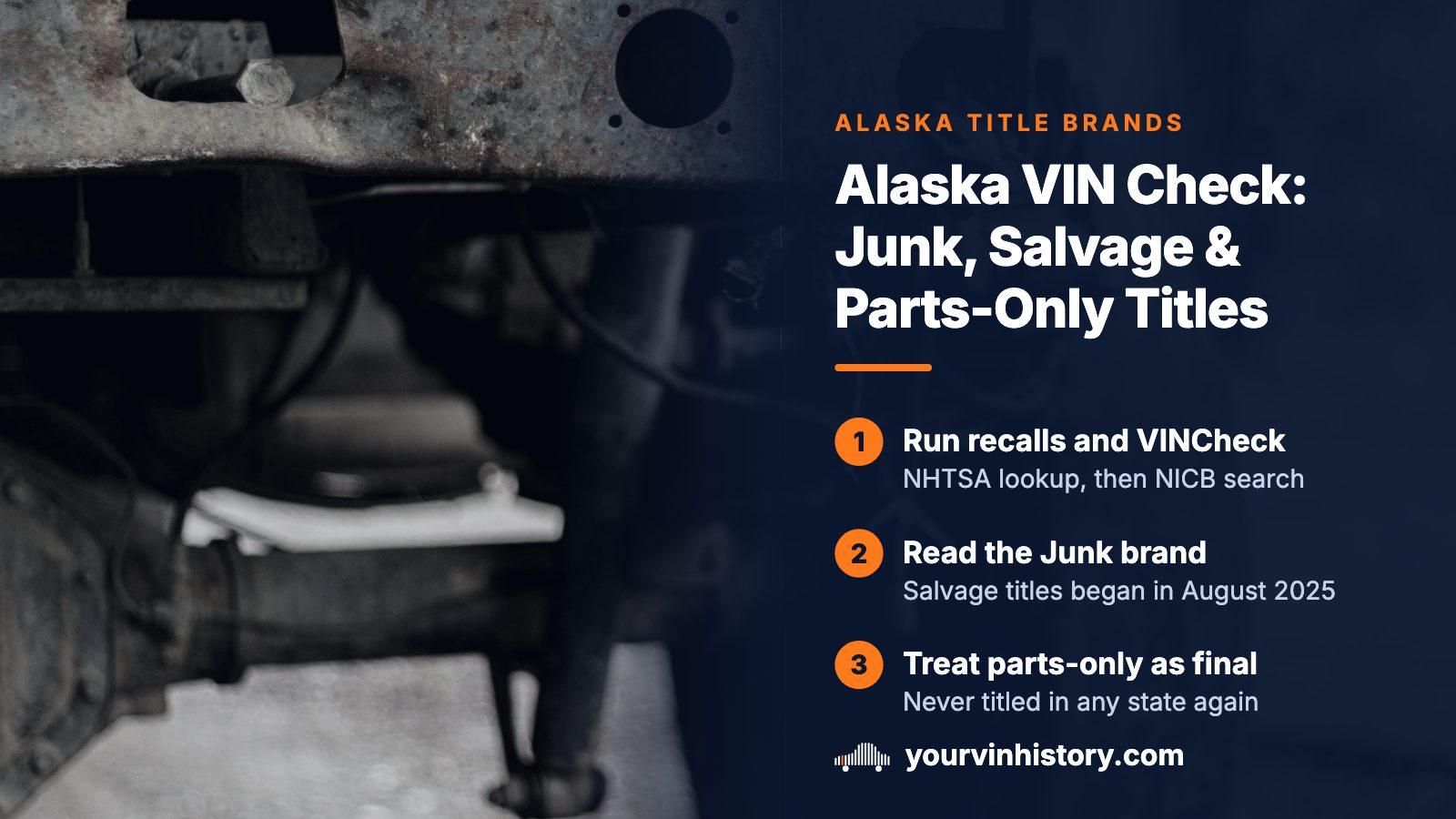
Before buying a used Alaska car, decode its VIN, search NHTSA's free recall lookup and NICB's VINCheck, then read the title brand in the state's own terms. A Junk brand does not automatically mean scrap, and since August 1, 2025 such a vehicle can get a salvage title, which proves ownership but does not make the car legal to drive. Parts-only is final.
- Rule change
- Salvage titles for Junk-branded vehicles began August 1, 2025
- Application
- Form 857 and a $15 fee
- Rebuild paperwork
- Notarized affidavit signed by whoever did the work
- Parts-only
- Never titled or registered again in any state
Four words that do the work on an Alaska title
Most of what an Alaska VIN check turns up comes down to vocabulary. The state attaches four terms to damaged or rebuilt vehicles, and each one marks a different stage. Hearing junk and picturing a crusher is one common mistake. Hearing salvage and assuming the car is nearly ready to register is the other.
| Term | What the state's wording says about it |
|---|---|
| Junk | A brand the DMV can leave on a vehicle that has not been rebuilt yet |
| Salvage | A title that gives such a vehicle stronger proof of ownership, not clearance to drive |
| Reconstructed | A vehicle with new chassis, body or engine work, backed by a sworn affidavit and a VIN inspection |
| Parts-only (non-repairable) | A final designation: no U.S. title or registration, ever |
The state's pages describe each term by what it allows, not by how much damage sits behind it. That is why the brand alone cannot tell you the repair bill.
What a Junk brand tells you and what it hides
The Alaska DMV pages on titles and salvage never give Junk a standalone definition. The word appears only in context: a vehicle carrying a Junk brand that has yet to be reconstructed can now be issued a salvage title. That phrasing treats rebuilding as something that may still happen, which is the opposite of what the word suggests in casual speech.
The reading cuts both ways. A Junk brand does not prove a car is only fit for scrap, so waving it off may mean walking away from a repairable vehicle. It also says nothing about how severe the damage was, who assessed it or what was done afterward. A low price on a Junk-branded car is a question to answer, not a bargain to grab.
Read the document, not the dictionary
Treat every brand name on an Alaska title as a defined term. Match each word to the DMV's description of it, then ask the seller for insurer paperwork, damage photos and repair invoices that explain the gap.
The salvage title Alaska began issuing on August 1, 2025
Before that date, a Junk-branded vehicle still waiting for reconstruction had no salvage title available to it. A change to the state's regulations opened that door, and the DMV now issues one on request. The application is Form 857, the fee is $15, and the applicant has to show ownership.
Acceptable evidence includes an Alaska title or manufacturer's certificate of origin, an earlier salvage or junk title, or proof of ownership from a state that does not issue titles. Without any of those, the DMV asks for a surety bond. Someone who was the latest owner of an Alaska-titled vehicle can rely on the completed application alone, as long as the identity details match state records.
The date has a practical use. Any article or document written before August 2025 predates this option and will not mention it, so do not expect older descriptions of Alaska titling to be complete.
A salvage title proves who owns the car, not that it can drive
The DMV states the purpose openly: a more substantial ownership document. Owners use it to surrender a vehicle to an insurer, pass it to a salvage company, pull it out of impound, or otherwise prove it is theirs. Nothing on that list involves putting the car back on the road.
The title is marked to prevent confusion. It prints the word SALVAGE near the top, carries the model code SVG, and has a remarks line saying the vehicle is incomplete, not for roadway use, and needs a reconstructed title before it can be registered. For a buyer, that translates into three points.
- A salvage-titled car is a project or a parts source until someone reconstructs it and obtains a new title.
- Sellers who call a salvage title almost there have the purpose backwards.
- An incomplete vehicle is not required to get a salvage title and may change hands on a bill of sale, so a missing one tells you little either way.
What Alaska counts as a reconstructed vehicle
Alaska defines a reconstructed vehicle as one materially altered from its original build by removing, adding or swapping essential parts, and it names three: the chassis, the body and the engine. Replacing only the engine does not qualify. A car with a fresh engine is still an ordinary car in the state's eyes, while one wearing a body from a different vehicle is not.
Titling a reconstructed vehicle requires a paper trail, and that trail doubles as a list of documents a buyer can ask to see.
- Titles for any vehicle that supplied the chassis or frame VIN, if not already surrendered
- Bills of sale and invoices for the major parts used
- A VIN inspection by a law enforcement officer or a DMV representative
- Lien releases for any liens recorded on the vehicle
- The notarized Reconstructed Vehicle Affidavit, filed with a title and registration application
The affidavit puts one name on the rebuild
The affidavit must be notarized, and the builder of the vehicle has to sign it personally. That makes it unusually specific: a sworn statement from an identifiable person about work that person did. When a seller says a shop took care of everything, asking whose name appears on the affidavit turns a vague claim into one you can check against the invoices.
Keep the inspection in proportion. The officer or DMV representative is confirming the vehicle's VIN and identity, and the state says the check costs nothing at a DMV office. It is not a mechanical sign-off on the quality of the repairs. For that, hire a mechanic who has no stake in the sale.
Parts-only: the one designation with no way back
A non-repairable or parts-only title means the vehicle can never be titled or registered again anywhere in the country. The state reserves it for vehicles damaged, wrecked or burned so badly that parts and scrap metal are all that remain of their value, and it frames the rule as consumer protection against heavily damaged total losses returning to the road.
The DMV's own example is flooding. Wiring and electronics may be compromised, and short of replacing every electrical component and wire there is no safe repair. That work would cost more than the vehicle justifies, which is why the state closes the door instead of leaving it to the market.
Not a negotiating position
Do not plan a project around a parts-only title, and do not pay on a promise that it can be re-registered later. The rule has no rebuild route in Alaska or in any other state.
Cars from outside Alaska arrive with another state's vocabulary
A used vehicle that came north from another state carries brands issued under that state's rules, and the same word can mean something different there. That mismatch is where a national record helps. NMVTIS is the federal title information system, built to protect consumers from fraud and unsafe vehicles and to keep stolen vehicles from being resold.
The Alaska DMV itself suggests an NMVTIS title search when you buy a used vehicle, and it says the salvage titles it issues are reported there. A yourvinhistory report includes NMVTIS title records supplied by ClearVin LLC, an approved NMVTIS data provider, next to accident, salvage and auction records, so a brand from any reporting state can be compared with the seller's story. The preview is free and the report is paid.
A buying sequence for an Alaska used car
Run these in order. The inexpensive steps come first, so a bad car usually fails before you have spent real money.
- Decode the VIN and compare the year, make and engine with the car in front of you.
- Search NHTSA's free recall lookup, then the NICB VINCheck for theft and salvage flags.
- Read the title brand with Alaska's definitions, and note how the issue date falls against August 2025.
- For a reconstructed vehicle, ask for the affidavit and the donor-vehicle titles, and match the names to the invoices.
- Pull a title history based on NMVTIS to catch brands from other states.
- Pay an independent mechanic to inspect it, with a close look underneath for corrosion, especially if the car lived near salt water.
Where this information comes from
- Alaska DMV: Salvage Vehicle Titles — Source for the August 2025 start date, Form 857, the fee, the ownership evidence list and what the salvage title is meant to do.
- Alaska DMV: Reconstructed or Homebuilt Vehicles — Defines a reconstructed vehicle, lists the paperwork and inspection, and explains the parts-only designation.
- Alaska DMV: Titles — Basic titling rules, plus the state's own advice to run an NMVTIS title search on a used vehicle.
- NMVTIS: National Motor Vehicle Title Information System — The federal system that brings title records from reporting states together, and its stated consumer-protection purpose.
Sources and photos: Facts checked against the sources above in October 2026. Photo by Zoshua Colah on Unsplash; diagrams by YourVINHistory.
Keep reading
- What is a branded title?Every kind of brand, so you can place Alaska's four terms beside the rest.
- NMVTIS reportWhat the federal title record contains and how a buyer can read it.
- Rebuilt title inspectionWhat a rebuild inspection confirms, and what it leaves unjudged.
- Alaska platesThe other Alaska paperwork question: what happens to the plates.
Frequently asked questions
Does a Junk brand mean an Alaska car is scrap?
Not by the state's own wording. The DMV describes Junk as a brand on a vehicle that has not been reconstructed yet, and it lets owners of such vehicles apply for a salvage title. The brand also reveals nothing about severity, so request photos, insurer paperwork and repair records. Scrap-only status belongs to the parts-only designation.
How much is an Alaska salvage title, and which form do I use?
Use Form 857, the application for a salvage vehicle title, and pay the $15 fee. Attach evidence of ownership; if you cannot, expect the DMV to ask for a surety bond. An incomplete vehicle does not have to receive a salvage title, so some damaged Alaska cars will change hands on a bill of sale alone.
Can a parts-only vehicle ever be registered in Alaska?
No. A non-repairable or parts-only title bars the vehicle from being titled or registered anywhere in the country, and no rebuild, inspection or affidavit changes that. If a seller offers to get one back on the road, treat the offer as a red flag and walk away. Parts and scrap metal are all that car is good for.
Who has to sign a reconstructed vehicle affidavit in Alaska?
Whoever did the building or rebuilding signs it, in front of a notary. It goes to the DMV with the inspection record, donor-vehicle titles, bills of sale and a title and registration application. A buyer can ask the seller whose name is on it and whether the invoices for the major parts carry the same name.
What should I check on an Alaska used car besides the title?
Check liens too. The DMV requires lien releases before it will title a reconstructed vehicle, which shows liens are recorded on state files. Add NHTSA's recall lookup, the NICB theft and salvage search, and an independent mechanic's inspection. A brand is only as reliable as the record behind it, so verify it against a second source.
Now check the car itself
The guide explains what to look for. The report shows what this VIN has on record.