THE SHORT ANSWER
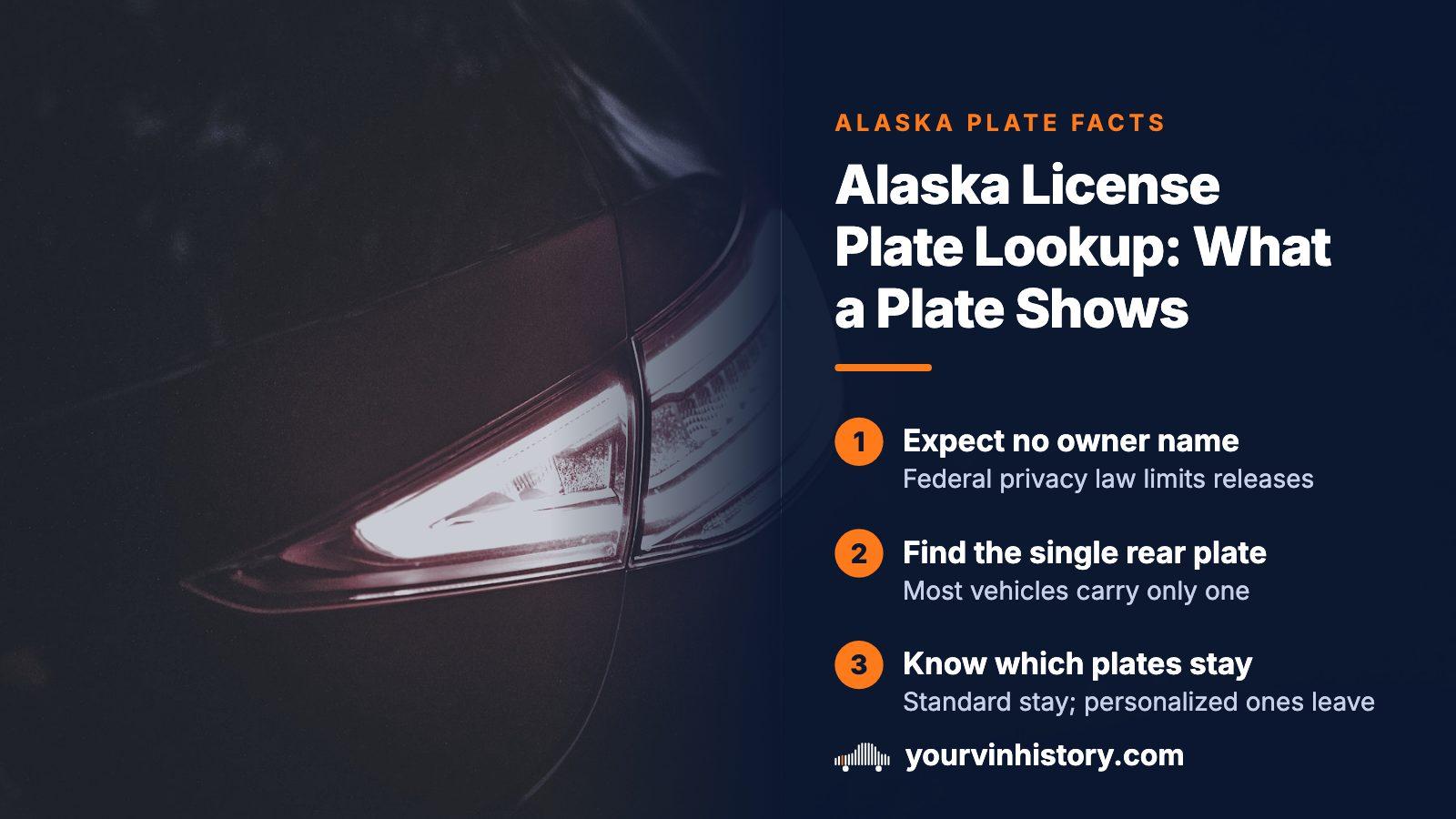
A private buyer has no way to pull the owner behind an Alaska plate. The federal Driver's Privacy Protection Act limits motor vehicle record releases to listed permitted uses. Standard plates stay with the vehicle, personalized and specialty plates come off at a sale, and most vehicles carry a single plate on the rear. Skip the plate search, read the VIN off the car, and check it against the title and the free NHTSA recall lookup.
- Plates displayed
- One, on the rear of most vehicles
- Standard plates
- Not transferable to another vehicle
- Seller's notice
- Sent to the DMV as soon as possible
- Inspections
- No statewide safety check for private vehicles
Why an Alaska plate will not give you a name
The state does not keep an open directory of plate holders, and a federal statute explains why. The Driver's Privacy Protection Act bars motor vehicle agencies from releasing personal information from their records except for a list of permitted uses. Those uses cover things like insurers working a claim, parties to a lawsuit, employers checking commercial drivers and licensed investigators acting within the law. Curiosity about a seller, a neighbor or a driver who cut you off is not on the list.
Websites that sell plate searches run into the same wall. None of them can point to a lawful owner feed from the Alaska DMV, so what they return is thin, recycled or built to collect your card number. A site promising a name for a small fee is the warning.
Three reasons people want a plate checked, and the proper door for each
Most plate searches come from one of three situations, and each has a proper channel that works without any website at all.
- A crash or hit-and-run: give the plate number to the police and to your insurer. Both can request records under the permitted uses, and you do not have to.
- A dispute that is heading to court: a lawsuit is itself a permitted use, so the attorney handling the case is the person to ask, not an online search.
- A purchase: the VIN, not the plate, carries the history that matters, and the seller can show you the title on request.
Turning the plate into a VIN check
For a purchase, the plate is only a pointer. Title brands, theft entries, recall status and odometer readings are filed against the 17-character VIN, and a personalized plate can end up on a different vehicle later. Work in this order.
- Read the VIN from the car itself, at the base of the windshield on the driver's side or on the door-frame label, and compare it with the number printed on the title.
- Run it through the NHTSA recall lookup, a free federal tool, to see which safety recalls are still open.
- Search NICB's VINCheck, also free, for theft and salvage entries, keeping in mind that it has gaps.
- Pull a history report that includes the national title record, because a car brought up from another state can carry a brand issued somewhere else.
Alaska puts a single plate on the back of the car
Buyers used to the Lower 48 sometimes expect a front plate and read its absence as a missing piece. The DMV states that most vehicles display one plate, on the rear, along with a current month and year tab. Commercial vehicles above a set weight are the stated exception and carry theirs on the front. A bare front bumper on a private car tells you nothing.
The tab deserves a look instead. Because a current tab is part of the display rule, an old or missing one on a car offered for sale is a fair question for the seller. There may be an innocent answer: the DMV says it will not renew a registration while a title transfer is pending. Ask which one applies.
Which plates stay and which ones leave at the sale
Alaska's rule is simpler than most states'. The DMV says standard issue plates are not transferable, so a standard plate belongs with the vehicle it was issued for. Personalized and specialty plates are handled differently: sellers are told to remove them when the vehicle sells, and the buyer is issued a new set at no additional charge.
| On the car | What it is | At the sale |
|---|---|---|
| Standard design, such as Gold or Grizzly Bear | Standard issue plate, included in the registration fee at first registration | Belongs to the vehicle it was issued for, and no one can shift it to a different car |
| Owner-chosen letters and numbers | Personalized plate | Seller removes it, and the buyer receives a new set at no additional charge |
| Cause or university design | Support-based or school plate, made individually on request | Falls among specialty plates, so expect it to come off |
| Military, veteran or club design | Issued only after proof of service or membership | Ask the seller; the DMV's sale guidance names personalized and specialty plates only |
| Historic vehicle plate | Meant for older vehicles driven to historical exhibitions | Ask how the car was actually used before you accept the story |
If a personalized plate is still bolted on when you arrive, ask when the seller plans to take it off.
The seller's notice of sale and why a buyer wants it filed
Because standard plates stay mounted, the seller's protection comes from the Notice of Vehicle Sale for Transfer, a section attached to the bottom of the original title. The DMV asks sellers to send or deliver it as soon as possible. A seller can also email the DMV or record the sale online.
A buyer has a stake in this too. The notice puts a date on the handover, so a parking ticket or a crash that comes afterward lands on the right person. The DMV also holds off renewing the registration until the transfer takes place, which means an unfiled notice can leave a car tied to the old owner's name.
Ask for the filing while you are both there
The DMV's selling page gives no day count. It says only as soon as possible, so a seller who insists there is plenty of time is guessing. Have it completed at the handover.
What you should be holding at the handover
- The original title with the seller's assignment filled in. Federal law stops the DMV from transferring a title when the assignment, odometer statement included, has blank spaces.
- Signatures that fit the title's wording. An AND between owner names means every owner signs; OR means one signature releases it.
- A bill of sale showing the vehicle's serial number and description, both printed names, the date and both signatures. The DMV says it does not transfer ownership, but it proves when the car changed hands.
- A plan for a missing title. When the title is lost, the owner shown in DMV records must apply for a duplicate before ownership can move, and a title issued by another state means applying to that state.
- A transfer into your own name, completed through the DMV.
A title that is lost, still in the mail or in someone else's hands is a reason to wait. It is not a reason to hand over cash on a promise.
No inspection stands behind an Alaska plate
Alaska runs no statewide safety inspection program for private vehicles. The emissions testing that Anchorage and Fairbanks once operated was discontinued more than a decade ago. However a car looks on the road, no inspector has signed off on it as a condition of keeping its plate.
In practice, the only professional who will look at the brakes, ball joints and fuel lines before you buy is the one you hire. Book a pre-purchase inspection at a shop you picked yourself, and ask the seller for service receipts, which are the nearest thing to a maintenance record these cars have.
What the Alaska climate leaves on a used car
With no inspection stickers to read, the wear is the record. Most of it shows from a crouch beside the wheel.
- Block-heater cords: nearly every car has one running through or near the grille. Inspect the cord for cracks, trace the wiring back from the plug, and ask how cold the car sat overnight.
- Studded tires: studs chip paint and pit glass. Rocker-panel rash and a pitted windshield point to winters spent on studs, whatever the tread says.
- Coastal salt: cars from Southeast and Southcentral can have corroded seams and fasteners, so look hard at the underbody.
- Frost heaves: broken pavement punishes suspension parts year-round, so listen for clunks and check bushings.
Cars that came up from the Lower 48
Plenty of Alaska used cars started out in another state and arrived by ferry, barge or highway. They bring the risks of their earlier homes, such as flood exposure or years of road salt. A brand issued by an earlier state shows up in the national title record, which collects title brands from reporting states and keys them to the VIN.
The Alaska plate says only where the car is registered now. Ask the seller where it lived before, then compare that story with the title history rather than trusting either one alone, and note any unexplained gap in where it was registered.
Where a vehicle history report fits
A yourvinhistory report starts with a free preview, then lists title brands, accident records with a damage map, odometer readings, salvage and auction records, liens, theft entries and open recalls. Its title records come from ClearVin LLC, an approved NMVTIS data provider. It cannot show who owns a car and does not replace a mechanic's inspection, so treat it as the paper half of a two-part check, with the lift time as the other half. Use it before you pay for the inspection, since a brand or an open lien can end the deal early and save the shop fee.
Where this information comes from
- Alaska DMV: Selling a vehicle in Alaska — Backs the seller's notice of sale, the title signature and AND/OR rules, the bill of sale advice, the duplicate title steps and the instruction to remove personalized or specialty plates.
- Alaska DMV: License plates — Backs the one-rear-plate rule, the month and year tab, the plate categories and the statement that standard issue plates are not transferable.
- U.S. Code: 18 U.S.C. 2721, Driver's Privacy Protection Act — The federal limit on releasing personal information from motor vehicle records, with its list of permitted uses.
- U.S. Department of Justice: NMVTIS — The national title information system behind multi-state title records, relevant for cars that arrived in Alaska from elsewhere.
Sources and photos: Facts checked against the sources above in October 2026. Photo by Maurice Sahl on Unsplash; diagrams by YourVINHistory.
Keep reading
- License plate lookupThe national rules on who may request plate records and how plate-search scams work.
- Alaska VIN checkHow to read the state's own title terms once you have the VIN.
- Where is the VIN number?Where to read the VIN yourself before running any check.
- Release of liabilityWhat a seller's notice of sale does and what it leaves untouched.
Frequently asked questions
Can I find out who owns an Alaska license plate?
Not as a private person acting on curiosity. The Driver's Privacy Protection Act restricts the DMV's owner data to permitted uses. If the plate matters because of a crash, a hit-and-run or a lawsuit, give the number to the police, your insurer or your attorney, and let them request records through the proper channel.
Do Alaska license plates stay with the car after a sale?
Standard plates do, because the DMV says they are not transferable. Personalized and specialty plates are removed by the seller, and the buyer is issued a new set at no additional charge. The seller should also send the notice of sale promptly, since the DMV will not renew the registration until the transfer is complete.
Does Alaska require a front license plate?
For most vehicles, no. The DMV requires one plate on the rear, plus a current month and year tab. Heavier commercial vehicles are the exception and mount it on the front. So a car with a bare front bumper is normal here, while a faded or out-of-date rear tab is the detail worth asking about.
Does Alaska require a safety inspection or emissions test?
Not for private vehicles. The state has no safety inspection program, and the emissions programs in Anchorage and Fairbanks have ended. A valid registration therefore says nothing about brakes or suspension. Pay for a pre-purchase inspection, and ask the seller for repair receipts, especially for cold-weather equipment such as the heater cord, battery and starter.
Can a license plate number show a car's accident or title history?
Not reliably. Accident, title brand, theft and odometer records are filed against the VIN, and a personalized plate can move to another vehicle. Copy the 17-character VIN from the car and compare it with the title before running any check. A mismatch between the two is a reason to stop the deal.
Now check the car itself
The guide explains what to look for. The report shows what this VIN has on record.