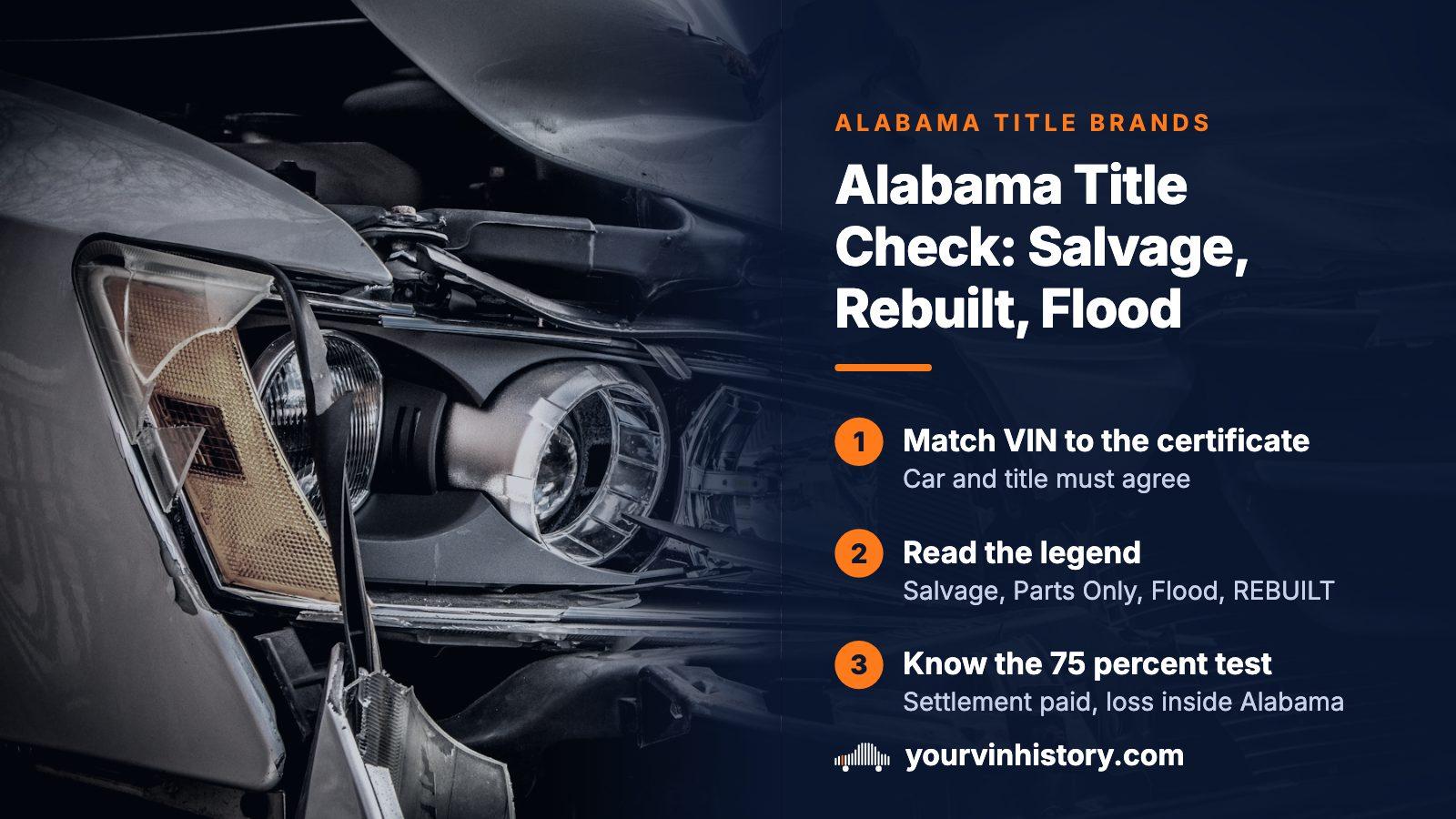
THE SHORT ANSWER
Compare the VIN on the vehicle with the VIN on the certificate, then read the legend: salvage, Parts Only – Non-Rebuildable, Flood Vehicle or REBUILT. Alabama treats a car as a total loss when a settlement is paid on damage of at least 75 percent of its pre-damage retail value, and only if the loss happened in Alabama. Damage from other states needs a national NMVTIS record to surface.
- Total-loss test
- Settlement paid, damage at 75 percent or more of pre-damage retail value
- Where the loss happened
- Must be in Alabama for an Alabama salvage certificate
- Rebuilt inspection fee
- $90 total: $75 application, $15 title
- Flood Vehicle legend
- Repeats on every later title, rebuilt or not
Check that the vehicle's VIN agrees with its title
Do this before you read a single legend. When someone files for an Alabama salvage certificate, the rules make them verify the VIN against two things: the current title certificate and the actual car being reported. If the numbers disagree, the owner named on the title has to get a corrected certificate first, and the salvage application waits until that is done.
Nobody enforces that process for you in a driveway, so build the habit yourself. Read the VIN off the vehicle, read it off the paper, and compare every character, not just the first few. A mismatch might be a clerical slip or something worse, such as a swapped identity. Either way, hold the deal until the seller hands over a corrected document.
The four legends an Alabama title can carry
Each of these wordings comes from the Department of Revenue's rules, and each one answers a different question about the car's past.
| Wording | Why it appears | What it tells you |
|---|---|---|
| Salvage certificate of title | A total loss that happened in Alabama and was reported to the department | The car was written off and has not yet been through a rebuilt inspection |
| Parts Only – Non-Rebuildable | The filer disclosed the vehicle as junk or sold for parts only | It cannot be rebuilt, and no later title will be issued |
| Flood Vehicle | The filer disclosed that water damage was part of the total loss | The wording repeats on every later title |
| REBUILT | An approved application plus a department inspection | Restored in Alabama, with an inspection decal on the car |
How Alabama decides a damaged car is a total loss
The trigger has two parts, and both must be present. A monetary settlement has to be paid on the damaged vehicle, and the damage has to reach 75 percent or more of the car's fair retail value as it stood just before the damage. Only then does the rule call the car a total loss.
The value side comes from a published guide rather than an adjuster's preference. The rule points to a current, nationally recognized compilation of retail values, automated databases included, and names two examples: National Market Reports, and the NADA Used Car Guide in its Southeastern Edition. Whatever source is used must give a fair, representative retail figure for that vehicle within Alabama.
Notice what the wording leaves out. Because the test begins with a settlement, a car that was damaged and repaired with no claim paid does not run through this trigger, so the title may have nothing to report about it. A clean Alabama title is weaker evidence than it looks.
Alabama brands only the losses that happen in Alabama
The department's rule is plain on location. For an Alabama salvage certificate to be issued, the total loss has to take place inside the state. When the damage occurs in a different state, or any other jurisdiction, that place's own salvage laws decide what gets issued.
Picture a sedan totaled in Tennessee and later sold to a lot in Mobile. Alabama's salvage process never touched that loss. The Alabama paperwork on such a car reflects only what Alabama recorded, so the earlier wreck has to be found through a record that covers more than one state.
The same boundary shows up on the rebuilding side. Alabama will issue a rebuilt title only after the vehicle is restored in the state, which means two of the steps that matter most to a buyer both depend on geography.
Parts Only – Non-Rebuildable is a one-way door
At the salvage stage the applicant has to state whether the vehicle is junk or is to be sold for parts only. The applicant is the owner when the owner is uninsured or self-insured, or an authorized insurance company representative when an insurer declared the loss and paid the owner. The same filing asks for:
- Which city and state the total loss took place in
- Whether water damage was part of the reason for the total loss
- For insurer filings, whether the company is applying for the salvage certificate or the owner is keeping the vehicle
A parts-only disclosure is final. The vehicle cannot be rebuilt, no further title will be issued, and the salvage certificate is stamped with Parts Only – Non-Rebuildable. If you see that wording on a car being sold as a driver, walk away.
Scrap is handled separately. Dismantlers and scrap processors who recycle a total loss into metal for remelting do not need a salvage certificate and report the vehicle as junk through a department portal.
The Flood Vehicle legend stays on every later title
Water damage gets its own line on the salvage application. When the filer reports that the total loss was due even partly to water, the salvage certificate carries a Flood Vehicle legend.
What sets this legend apart is how long it lasts. Under the department's rule, once it has been issued on any Alabama title, it appears on every certificate that follows, whether the vehicle is later rebuilt in Alabama or in another state. A REBUILT title can therefore also read Flood Vehicle. A buyer who sees both should picture a flooded car that was repaired, not one that was cleaned up and forgiven.
Alabama has Gulf coastline, and water damage is among the harder defects to spot by eye. That is a good reason to read the legend line on the paper and ask the seller directly whether water was ever involved.
From salvage to REBUILT: what the department asks for
A rebuilt title is available once the vehicle has been restored in Alabama to the condition it was in before the event that produced the salvage certificate. According to the Department of Revenue, an owner who held the vehicle before it was salvaged applies by mail with:
- The application for a rebuilt inspection
- The salvage certificate of title
- Bills of sale for every component part that was replaced
- A registration receipt showing who owned the vehicle before the salvage
- The $90 inspection fee, paid by cashier's check or money order
That $90 breaks down as a $75 application fee and a $15 title fee. After the application is processed, a Motor Vehicle Inspector schedules the inspection, and the department puts the wait for the inspector's call at 1 to 2 weeks.
Someone who did not own the car before the salvage must hold a master dealer regulatory license. The rule also lets an owner who received the salvage title from the insurer in settlement of a claim submit prior registration or other ownership proof in place of a rebuilder's license.
The inspection decal is a second number to check
Once the department approves the package and inspects the vehicle, it attaches an inspection decal that carries a unique identifying number and issues a title with the REBUILT legend. That decal number is separate from the VIN, so a rebuilt Alabama car answers to two identifiers.
Put that to work when you shop. On a car titled REBUILT, ask where the decal is and photograph it. Ask for the paperwork behind the rebuilt application, including the bills of sale for replaced parts, since the department asks for those. A missing decal proves nothing by itself, but it is an open question to settle before any money moves.
REBUILT is a status, not a grade
The rules describe paperwork, a fee and a decal. They do not promise anything about workmanship. Pay an independent shop to look at the structure, airbags and wiring before you commit.
What to add when Alabama's paperwork stops at the border
State paperwork explains state events. To see past them you need a record that crosses state lines. NMVTIS, the national title brand and total loss database, is reached through the approved providers listed on the federal NMVTIS site.
Two no-cost lookups from other organizations fit alongside it. NHTSA's recall page searches by VIN and reports recalls that are still unrepaired, though it leaves out some very old campaigns. The NICB's VINCheck screens a VIN for theft and salvage records. Neither one reads Alabama's title, so neither replaces the steps above.
A yourvinhistory report draws its NMVTIS title records from ClearVin LLC, an approved NMVTIS data provider, and begins with a preview before you decide to buy.
A pre-purchase sequence for an Alabama title
Run the pieces in this order, so the cheap checks come first and the payment comes last.
- Compare the VIN on the vehicle with the VIN on the certificate, character by character.
- Read every legend. Parts Only – Non-Rebuildable ends the conversation.
- Ask where the loss happened and whether water was part of it.
- On a REBUILT title, locate the decal and request the rebuilt-application paperwork.
- Run the NHTSA recall search and NICB VINCheck, then pull a national NMVTIS record.
- Have an independent mechanic look the car over before you pay.
If any step turns up something the seller cannot explain, either the price should reflect it or the deal should end there. Keep copies of the title, the decal photo and whatever the seller hands over.
Where this information comes from
- Alabama Administrative Code: Rule 810-5-75-.57, salvage certificate application — Covers the in-state loss requirement, VIN verification, parts-only and flood disclosures, the settlement test and the valuation guides.
- Alabama Administrative Code: Rule 810-5-75-.28, title to a rebuilt vehicle — Covers restoration in Alabama, the owner alternative to a rebuilder's license, the fee split, the decal and the REBUILT legend.
- Alabama Department of Revenue: Salvage and Rebuilt Vehicles — Lists the documents for a rebuilt inspection, the payment method, the inspector's timing and the license needed by non-prior owners.
- NMVTIS: Vehicle History — Explains the national title brand record and points to the approved providers that sell NMVTIS reports.
- NHTSA: Check for Recalls — Shows the VIN search for unrepaired recalls and what that search leaves out.
Sources and photos: Facts checked against the sources above in October 2026. Photo by Clark Van Der Beken on Unsplash; diagrams by YourVINHistory.
Keep reading
- Total loss threshold by stateSee how Alabama's 75 percent settlement test compares with other states.
- What is a rebuilt title?Learn what a REBUILT car is worth and how lenders and insurers treat it.
- Flood-damaged carsFind the signs of water damage that a title legend can miss.
- NMVTIS reportRead what the national record adds when a loss happened outside Alabama.
Frequently asked questions
How can I tell if an Alabama car has a salvage title?
Ask to see the paper certificate and read the legend line, since a salvage, Parts Only or REBUILT wording would be printed there. Then confirm it against a national NMVTIS record, because Alabama brands only losses that happened inside the state. A car wrecked elsewhere may show nothing on an Alabama certificate.
How much does an Alabama rebuilt title cost?
The department's fee is $90, made up of $75 on the application and $15 on the title, paid by cashier's check or money order when the application is mailed. That covers the inspection and paperwork only. Repairs, replacement parts and any bills of sale for them sit outside that figure and are the owner's expense.
Can a Parts Only car ever be titled for the road again?
Under Alabama's rule, no. A vehicle disclosed as junk or sold for parts only cannot be rebuilt, and the department will not issue a later certificate for it. If a seller shows you that legend and still calls the car drivable, treat the listing as a serious warning and ask for an explanation in writing.
What should I do if the VIN on the title does not match the car?
Stop and ask for a corrected certificate before paying. Alabama requires the same fix before it accepts a salvage application: the person named on the title must obtain a corrected title first. Also check the VIN in any other places it appears on the vehicle, because a seller's typo is easier to prove than to assume.
Which Alabama agency handles salvage and rebuilt titles?
The Alabama Department of Revenue. It cites the Code of Alabama section 32-8-87 as the salvage title law, and its Motor Vehicle Inspector schedules rebuilt inspections. The rules themselves sit in the department's chapter of the Alabama Administrative Code, so check those texts when a seller describes how a title was handled.
Now check the car itself
The guide explains what to look for. The report shows what this VIN has on record.