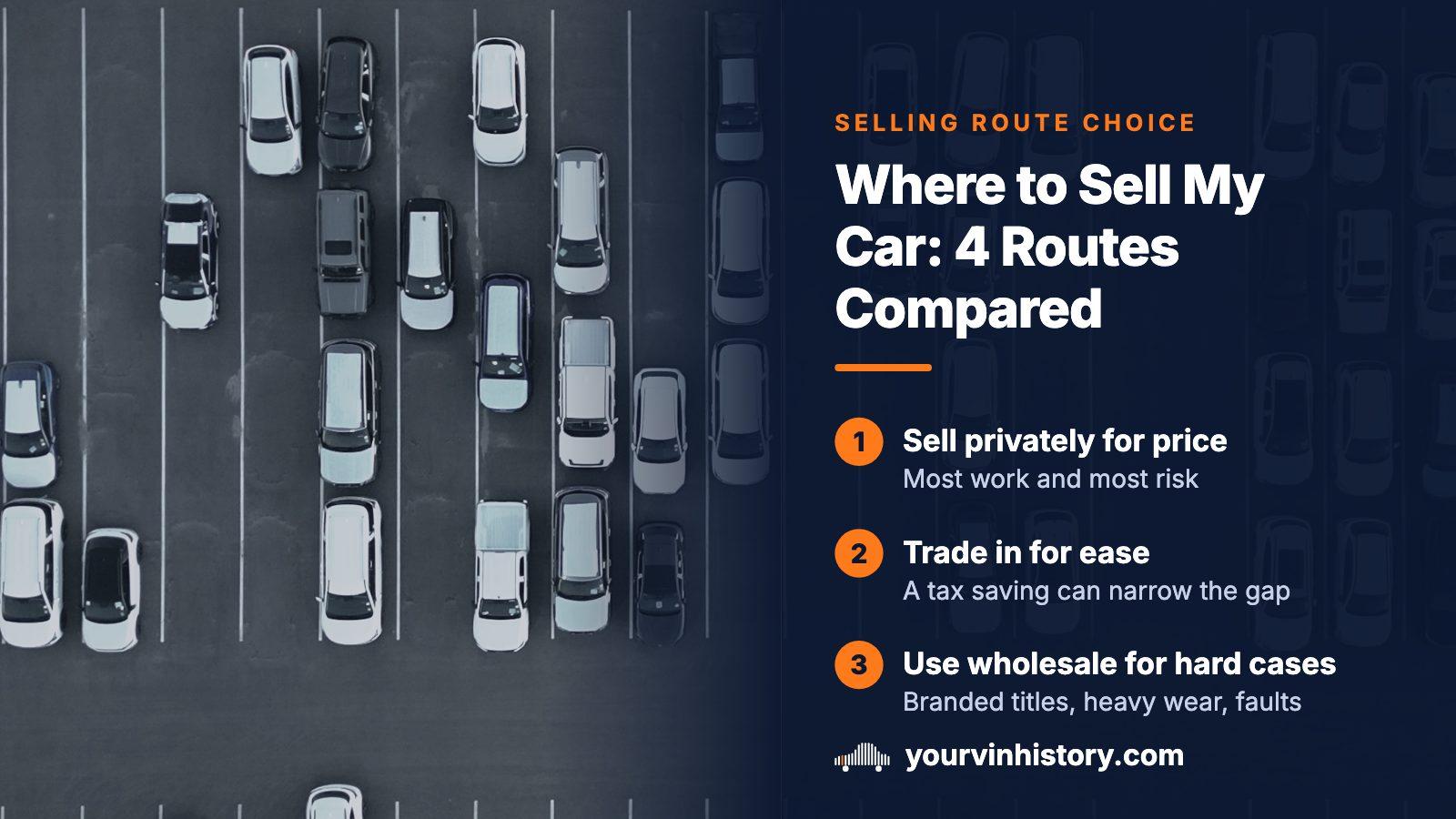
THE SHORT ANSWER
Sell privately when you want the highest price and can spare the time. Trade in when you are buying another car from a dealer, because a sales tax saving can close much of the price gap. Take an instant online offer for a clean, late-model, common car when speed matters. Use a wholesale buyer or auction for cars with a branded title, heavy wear or expensive faults. Collect at least one firm offer before deciding.
- Highest price
- Private sale, with the most work and risk
- Easiest handoff
- Dealer trade-in, one visit and one signature
- Tax angle
- Where a state taxes car sales, most tax only the price left after the trade-in allowance
- Floor price
- Wholesale or auction, fast and firm
Start from the car, then pick the route
People ask which channel pays best as if a single answer covered every vehicle. It does not. A clean sedan a few years old is what instant-offer companies and franchised dealers want, so they will bid against each other for it. A worn-out truck with a salvage brand on its title has a far smaller audience, mostly resellers working backward from a low wholesale figure.
- Recent, common, clean record: collect instant offers, then judge whether a private sale is worth the extra work.
- Popular model, fully paid off: a private sale rewards patience.
- Buying your next car from a dealer: price the trade-in together with its tax effect before dismissing it.
- Branded title, heavy wear or costly faults: wholesale and auction buyers are built for exactly this.
- Loan still open: any route works, but the payoff and lien release shape the paperwork.
Private sale: the best price for the most effort
Selling to the next driver removes the reseller, so no margin sits between your price and what the buyer pays. That is the entire reason the headline number runs higher. In exchange, you take on every job a dealership would: photos, a listing, replies, test drives with strangers, a bill of sale and the title work.
The costs that never show on a price tag add up. Insurance, registration and any loan payments keep running while the car sits unsold, and hours lost to no-shows are unpaid. Payment is where private sales actually go wrong: a buyer's check or transfer remains your problem until the bank confirms it is final.
Instant online offers: a firm-looking number with conditions
You enter the VIN or plate, the mileage and your own account of the condition, and a buyer replies with a figure within minutes. Most of these offers depend on an inspection, so the number reflects what you typed, not what the inspector will see. Describe the car generously and expect the figure to move.
These buyers do best with late-model, popular cars and worst with anything unusual. Requesting a quote costs nothing, so it makes sense even when you intend to sell privately: it sets a floor you can refuse to go beneath. If the final number differs from the first, ask what changed. A specific, itemized reason is normal. A vague one is a warning.
Dealer trade-in: lowest sticker, simplest transaction
A trade-in is one appointment. The dealer appraises the car, deals with the lender if there is a payoff, takes the title and applies the allowance to your next purchase. You skip the listing, the strangers and the payment risk. What you give up is price, because the dealer has to recondition the car and resell it at a profit.
The allowance is also one piece of a larger negotiation. A generous trade figure can be paid for with a higher price on the car you are buying. Settle the purchase price first, then the trade, so you can tell which number moved.
The sales tax offset that can flip the result
Where a state taxes car purchases, the tax usually applies to the price after the trade-in allowance comes off. Trading in therefore trims the bill on your next car, and the saving arrives in the same transaction. A few states refuse the reduction and some cap it, so the rule has to come from your own state.
- Find your state's rule on its revenue or motor vehicle department website.
- Take the trade-in offer and add the tax you would avoid on the next car.
- Set that total beside the private-sale price you can realistically expect, not the price you hope for.
- Deduct your time, carrying costs and risk from the private figure before declaring a winner.
Sellers who run this sum often find the trade-in closer than it looked, and sometimes ahead. Read the state's own page, because tables published elsewhere go stale.
Wholesale and auction buyers: the floor for hard cases
Some cars resist retail: very high mileage, a brand on the title, a failed transmission, a flood or collision past. Ordinary buyers walk away from these or discount them so heavily that a private listing turns into months of haggling. Wholesale buyers, auctions and salvage buyers price such cars daily and close quickly.
Expect the lowest number of any route, along with certainty: a fixed price, a fast pickup and no later complaint from a private buyer who found a problem. Be accurate about the title status and condition, because a buyer who discovers an omitted brand will cut the offer or cancel.
The four routes side by side
| Route | Price | Your effort | Main risk | Best for |
|---|---|---|---|---|
| Private sale | Highest | Most: listing, viewings, paperwork | Payment fails to clear, or liability lingers | Popular, clean, easy-to-describe cars |
| Instant online offer | Moderate | Low | Number shifts after inspection | Late-model common cars sold quickly |
| Dealer trade-in | Lower, softened by a tax offset in most states | Lowest | Trade figure tangled with the new-car price | Sellers buying from the same dealer |
| Wholesale or auction | Lowest | Low | Selling cheaply when a retail buyer existed | Branded, worn or faulty cars |
Price and effort pull in opposite directions, so the decision comes down to what an hour of your time and a measure of risk are worth to you.
What every buyer looks up before making an offer
A buyer, whether a dealership or a stranger answering your listing, starts with the VIN. Four things come back fast, and the record outranks your description when the two disagree.
- Factory build: the NHTSA VIN decoder shows what the manufacturer reported, which ends any argument about trim or engine.
- Title record: the federal NMVTIS system exists to curb title fraud, and a brand found in a title record narrows who will pay and how much.
- Odometer history: readings logged at sales and inspections get compared, and a gap between your figure and the record draws questions.
- Open recalls: NHTSA's lookup takes the VIN and costs nothing to use.
A yourvinhistory report gathers title brands, accident records and odometer readings in one place, which lets you see roughly what a buyer's report will show before you set a price.
Open recalls: look before the buyer does
Enter the VIN on NHTSA's recall page and any unrepaired safety recall on the car will appear. An open recall hands a buyer a documented reason to lower the offer. The repair is the manufacturer's responsibility for vehicles inside the federal rule, but very old vehicles fall outside that rule, so ask a franchised dealer for the brand about your car's eligibility before assuming the work will cost you nothing.
On the legal side, the federal limit on selling with an unrepaired recall is written around new vehicles in dealer hands and around rental fleets. An ordinary private sale of a used car sits outside it. That is no reason to leave the defect open. A buyer who learns about it mid-negotiation will use it.
Selling a car you still owe money on
A loan does not block a sale. The lender holds a lien and usually the title until the balance clears, so the lender is paid from the sale money before you see any. Ask for a payoff quote, not the balance on your latest statement. The quote includes interest through a stated date and is the figure that actually closes the account.
- Get the payoff quote in writing and note the date it is good through.
- Gather real offers from at least two sources, since a valuation guide only estimates.
- Subtract the payoff from the best offer. A positive result is yours; a negative one is negative equity.
- Decide how to cover any shortfall. Cash settles it, while rolling it into a new loan adds interest to your next car's financing.
A trade-in lets the dealer handle the lender paperwork. A private sale needs a plan for the payoff and lien release, so ask the lender how it releases the title and how long that takes before listing.
Paperwork and payment on handoff day
- Title: in your name, with any lien formally released, and signed over where your state's form requires.
- Odometer statement: federal rules put the mileage on the title when ownership changes, and it should match the dashboard. Photograph the reading.
- Bill of sale: a dated record of the price, both parties and any as-is wording.
- Payment: release the title only after the money is final. Cash counted at a bank, or a transfer your bank confirms as complete, beats a check you cannot verify.
- Release of liability: file it with your state promptly so tickets and tolls after the sale are not traced to you.
- Plates, keys and records: handle plates as your state directs, and pass along both keys and any service records.
Signals to slow down
Be wary of a buyer who wants your signature before the lender's payoff quote arrives, anyone proposing a payment that clears after you have handed over the title, or any offer that depends on you not checking something. An honest buyer does not need you uninformed.
Where this information comes from
- NHTSA: Recalls — The federal lookup where a VIN shows any unrepaired safety recall on your car before you ask for offers.
- NHTSA: vPIC VIN decoder — Decodes a VIN into the build details the manufacturer reported, which is what a buyer will trust over a listing.
- U.S. Department of Justice: NMVTIS — Explains the national title information system built to deter title fraud and stop stolen vehicles from being resold.
Sources and photos: Facts checked against the sources above in October 2026. Photo by Erik Mclean on Unsplash; diagrams by YourVINHistory.
Keep reading
- Value my car by VINEstimates and real offers differ, and this explains how to read each.
- Vehicle lien checkConfirm whether a lien is still attached before a buyer finds it for you.
- Bill of sale for a carLearn what the paper proves and where the mileage statement belongs.
- Release of liabilityThe filing that logs your sale with the state after the car is gone.
Frequently asked questions
Where can I sell my car fast?
An instant online offer or a dealer trade-in is usually quickest, because the buyer handles the inspection, payoff and paperwork in one visit. Auctions and wholesale buyers also move fast for cars others will not touch. A private sale is the slowest, since it depends on finding a person who agrees on price. Speed costs money, so compare at least two offers.
Should I fix problems before selling my car?
Fix what is cheap and obvious, such as a dead bulb or an open recall, since buyers tend to discount small flaws heavily. Skip major repairs on a car headed to auction or a wholesale buyer, because those bidders already allow for repairs in their price. For anything large, get a written estimate first.
Can I sell a car with a salvage or rebuilt title?
Yes, but the pool of buyers shrinks and the price drops by a share of the car's value, not a few hundred dollars. Wholesale and salvage buyers, specialist dealers and some private buyers will bid. Disclose the brand in writing, because hiding it can turn a sale into a dispute, and keep any brand paperwork with the title.
Do I need the title to sell my car?
You generally need the title, or in some states the lender's electronic record of it, to transfer ownership. If you lost yours, ask your state's motor vehicle agency for a duplicate before listing the car. A bill of sale alone does not move ownership. A dealer can often take a car while a lender still holds the title, because the dealer pays the lender directly.
Does the time of year change what my car sells for?
It can. Demand for some body styles follows the weather, and prices differ from one region to another. A convertible and an all-wheel-drive wagon do not draw the same interest in the same month. Check recent listings near you for your exact model, then confirm with a real offer.
Now check the car itself
The guide explains what to look for. The report shows what this VIN has on record.