THE SHORT ANSWER
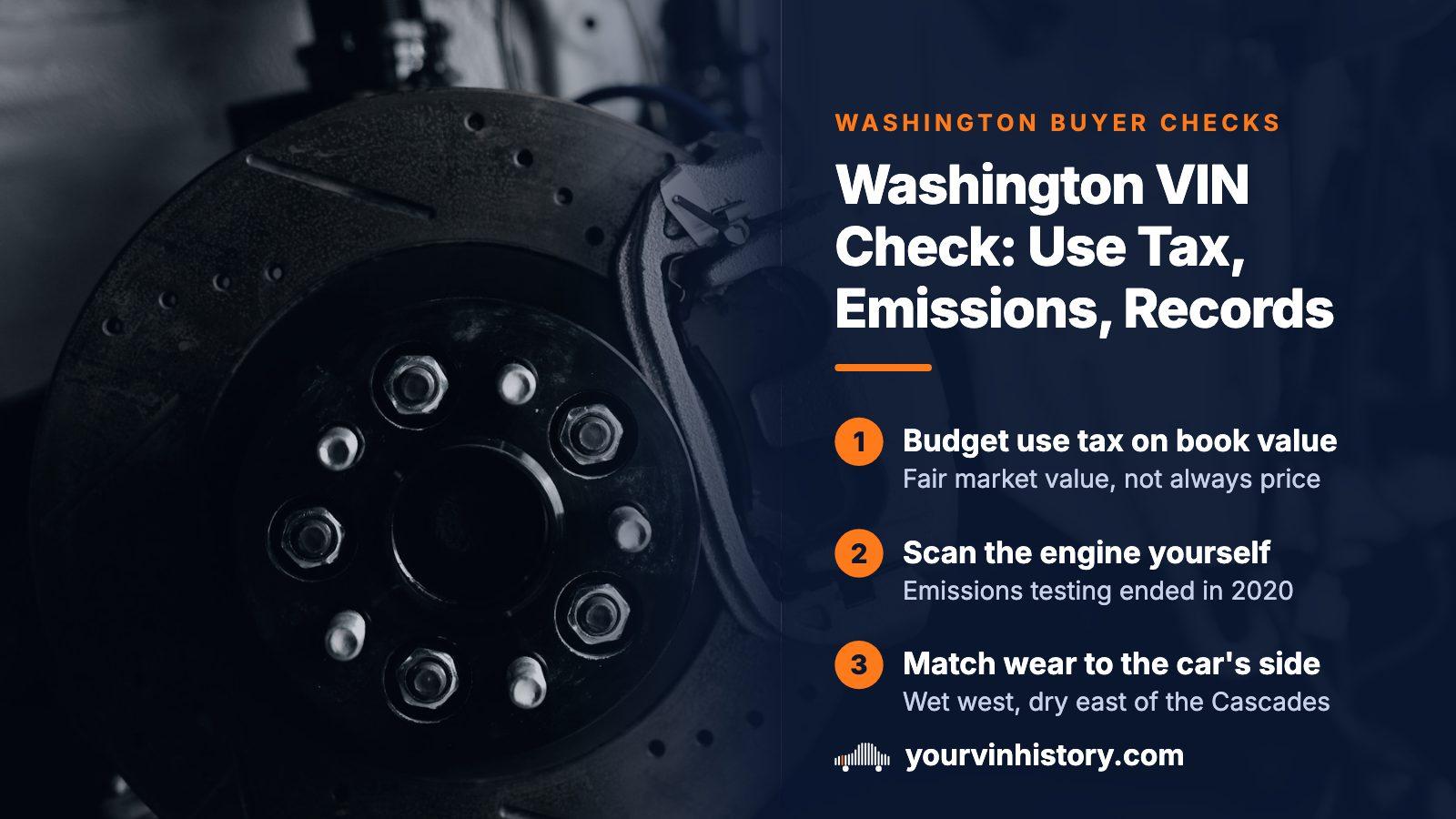
Decode the VIN, look up open recalls with NHTSA, search NICB for theft and salvage reports, and pull an NMVTIS title record from an approved provider. Then handle Washington's own quirks: budget use tax on the car's fair market value rather than only your price, scan the engine yourself because emissions testing stopped in 2020, and inspect for wear that fits the car's side of the state. A plate will not give a private buyer an owner, so ask for the VIN.
- Use tax basis
- Fair market value, not always your price
- Emissions testing
- Ended statewide at the start of 2020
- Climate split
- Wet west, dry east of the Cascades
- Plate lookups
- Restricted by the federal DPPA
Start with records that follow the VIN across state lines
Nothing in the first round of checks depends on Washington. Each one runs on the 17-character VIN alone, so you can finish them from the listing page before you drive anywhere.
- VIN decode: confirms that the model year, body and engine match the ad. A mismatch is the first thing to raise with the seller.
- NHTSA recall lookup: shows open safety recalls for that exact VIN at no charge. Repairs for an open recall are generally done at no cost, though a very old vehicle can fall outside the federal free-repair rule.
- NICB VINCheck: a no-charge search of theft and salvage records supplied by participating insurers.
- NMVTIS title record: brands reported by any state, sold through approved providers.
A report from this site draws its NMVTIS title records from ClearVin LLC, an approved NMVTIS data provider, and sets accident, odometer and salvage entries beside them when they exist.
Why the state taxes the book price, not the handshake price
When a privately purchased vehicle is registered in Washington, the buyer owes use tax. The state works that tax out from the vehicle's average fair market value, and the price on your bill of sale is not automatically the starting point. Buyers who negotiated hard sometimes reach a licensing office and learn that the clerk and the seller disagree about what the car was worth.
That gap is the Washington surprise. If your price lands near market value, nothing unusual happens. If you found a real bargain, plan for a tax bill built on a higher figure than the one you paid, and count the difference as part of the car's cost when you decide what to offer.
Matching your paperwork to your price
How much friction the valuation causes depends on why the price was low. Treat this as a rough guide only, since the licensing office decides each purchase on its own facts.
| Why the price was what it was | What to expect | What to bring |
|---|---|---|
| Close to market value | Little friction at the counter | A complete bill of sale |
| Visible damage | A valuation above your price unless the damage is shown | Dated photos and a written repair estimate |
| A fault found during inspection | A general book figure knows nothing about this particular car | A shop's written diagnosis with the cost to fix it |
| Seller wanted a fast sale | Hardest to prove, because motive leaves little paper | Listing history and messages, though inspection evidence carries more weight |
Ask the licensing office how it handles a declared value and which documents it accepts. The state does let a buyer challenge a valuation with supporting documents, and that goes more smoothly when the paperwork was gathered before the sale closed.
A bill of sale that holds up under a valuation
The bill of sale is the first document anyone asks for, so write it carefully. Include the full VIN, the price actually paid, the date, and the names of both parties, and have both sign. Photograph the odometer and the VIN plate on the day money changes hands.
Staple to it whatever explains the price: inspection notes, estimates, pictures taken before you bought. A thick file lets a valuation conversation start from your evidence instead of from the state's default.
Do not shrink the number
Understating the price on paper is fraud, however common the habit. Valuing by market figures exists in part because of it. If the low price is real, prove it with documents and let the process weigh them.
No emissions test since 2020, and what that does to a used-car history
Washington's emission check program came to an end at the start of 2020. No periodic test remains anywhere in the state. That simplifies registration, and it quietly removes a filter that used to catch some failing cars before they reached the used market.
- A car with a fault that a smog check elsewhere would flag can now register here without any test.
- An older listing that boasts a passing result is quoting the years before the program ended. A car with no test record on file is simply normal now, not suspicious.
- Tampering is still illegal under federal law. A deleted diesel remains unlawful, hurts resale, and would fail a test in any state that still runs one.
Using a scan tool in the test's place
Since no state inspector looks at the exhaust any more, a basic OBD scan before purchase fills that gap. Plug a reader into the port under the dash and look at two things: stored fault codes, and whether the emissions monitors have finished their self-checks.
Unfinished monitors on a car that has supposedly run fine for months suggest that codes were cleared or the battery was disconnected recently. That is worth a direct question. The check-engine light is the one dashboard signal left, so treat a lit lamp as a bargaining point and a dark lamp with unfinished monitors as a puzzle to solve before you pay.
Which Washington did the car live in?
The Cascades split the state into two car environments. West of the mountains the air is mild and wet, which is gentle on bare metal and hard on seals, drains and electrical connectors. East of them the climate is dry, with hot summers and cold winters, and cars age there much as they do across the border in Idaho.
Neither side salts roads the way Midwestern states do, although the mountain passes see de-icer, so a car that commuted over one deserves a look underneath. On the dry side, check for baked dashboards, cracked hoses and rubber, faded paint and a tired battery. The practical result is that a Spokane car and a Seattle car need different inspections, and the title history gives a good hint of which one you are looking at.
A wet-side checklist, from the inside out
- Sunroof, door and cowl drains: a blocked drain lets a car flood itself from the inside.
- Carpets and trunk floor: lift the mats, and treat dampness or a mildew smell in the footwells as the tell.
- Door and window seals: cracked or flattened rubber means moisture has had years to find a way in.
- Electrical faults that appear only in the rain: often water tracking into a connector.
- Moss in the trim seams: the car lived outdoors, so look harder at everything else.
- Brake rotors: surface rust on a parked car is normal, but pitting is not.
Frame rust is rarely the story on this side. The pattern is a run of small failures in seals, drains, connectors and upholstery. Each is cheap alone, but together they change what the car is worth, and they help your negotiation only if you find them before you pay. Salvage and auction entries on a history report can also show whether water damage was ever recorded against the VIN.
Where the Department of Licensing fits, and why plates lead nowhere
The Department of Licensing is the state agency behind vehicle titles. You deal with it day to day through county auditors and licensing offices, which also handle registration and the use-tax assessment. It does not vouch for a car's history in other states, so the brand check has to come from the national NMVTIS record.
Plate searches hit a different wall. Motor vehicle records fall under the federal Driver's Privacy Protection Act, which allows personal details out only for listed permitted uses, and a private buyer sizing up a stranger's car is not on the list. Ask the seller for the VIN instead. Every check above runs on it.
The order to work in before money moves
- From the listing page, decode the VIN, check NHTSA for open recalls and search NICB records. These take minutes, and any one of them can end the deal.
- Pull the NMVTIS title record through an approved provider, for brands reported by any state.
- Plug in an OBD scanner, since the state no longer runs a test.
- Inspect for wear that matches the car's side of the state: drains, seals and carpets in the west, heat and winter damage in the east.
- Estimate the use tax from the car's market value, and gather proof if your price is genuinely below it.
- Match the seller's name to the name on the title letter for letter, then finish the transfer at a licensing office.
Where this information comes from
- Washington State Department of Licensing — The agency that handles titles, registration and the use-tax assessment on a purchase in the state.
- NMVTIS: National Motor Vehicle Title Information System — The federal program behind the national title record, and the route to an approved provider.
- NICB: VINCheck — A no-charge theft and salvage search to run before any deposit.
- NHTSA: Recalls — The federal open-recall lookup by VIN.
Sources and photos: Facts checked against the sources above in October 2026. Photo by ün LIU on Unsplash; diagrams by YourVINHistory.
Keep reading
- Oregon VIN checkThe neighbor to the south brands some damage that never involved an insurance claim.
- Maryland VIN checkAnother state where the tax follows book value, with a narrow exception.
- Bill of sale for a carWhat that document proves and what belongs on the title instead.
- Smog check historyWhat an emissions test log tells you in states that still keep one.
Frequently asked questions
How do I run a VIN check on a car in Washington?
Read the VIN from the dashboard plate and the door-jamb label, and confirm both match the title. Then decode it, check NHTSA for open recalls, search NICB for theft and salvage flags, and order a title record built on NMVTIS data. The Department of Licensing handles the paperwork side, while history from other states arrives through the national system.
Why is my Washington use tax higher than the price I paid?
The state bases use tax on a private purchase on the car's fair market value, and a bill of sale is evidence rather than the final word. If the price was low for a documented reason, bring that proof to the licensing office and ask about the valuation process. Collect it while the seller and the car are still in front of you.
Does Washington require an emissions test to register a car?
No. Washington stopped requiring the test when its program closed on January 1, 2020, so nothing is needed to register or renew. Federal law still forbids removing or defeating emissions equipment, which means a deleted diesel stays illegal and hard to resell, and it can cause trouble if the vehicle later moves to a state that tests.
What should I check on a car from western Washington?
Look for moisture damage rather than salt rust. Press the carpet near the pedals, check the spare-tire well for standing water, and test the drains by pouring a little water near each sunroof and cowl opening. Weak door seals, electrical glitches in rain and pitted brake rotors point to a car that sat outdoors for years.
Can I find the owner of a Washington license plate?
Not as a private person. Federal privacy law, the Driver's Privacy Protection Act, releases personal details from motor vehicle records only for specific permitted purposes, and curiosity about another driver is not one of them. The workable route is to ask the seller for the VIN, then compare the name on the title with the seller's photo ID.
Now check the car itself
The guide explains what to look for. The report shows what this VIN has on record.