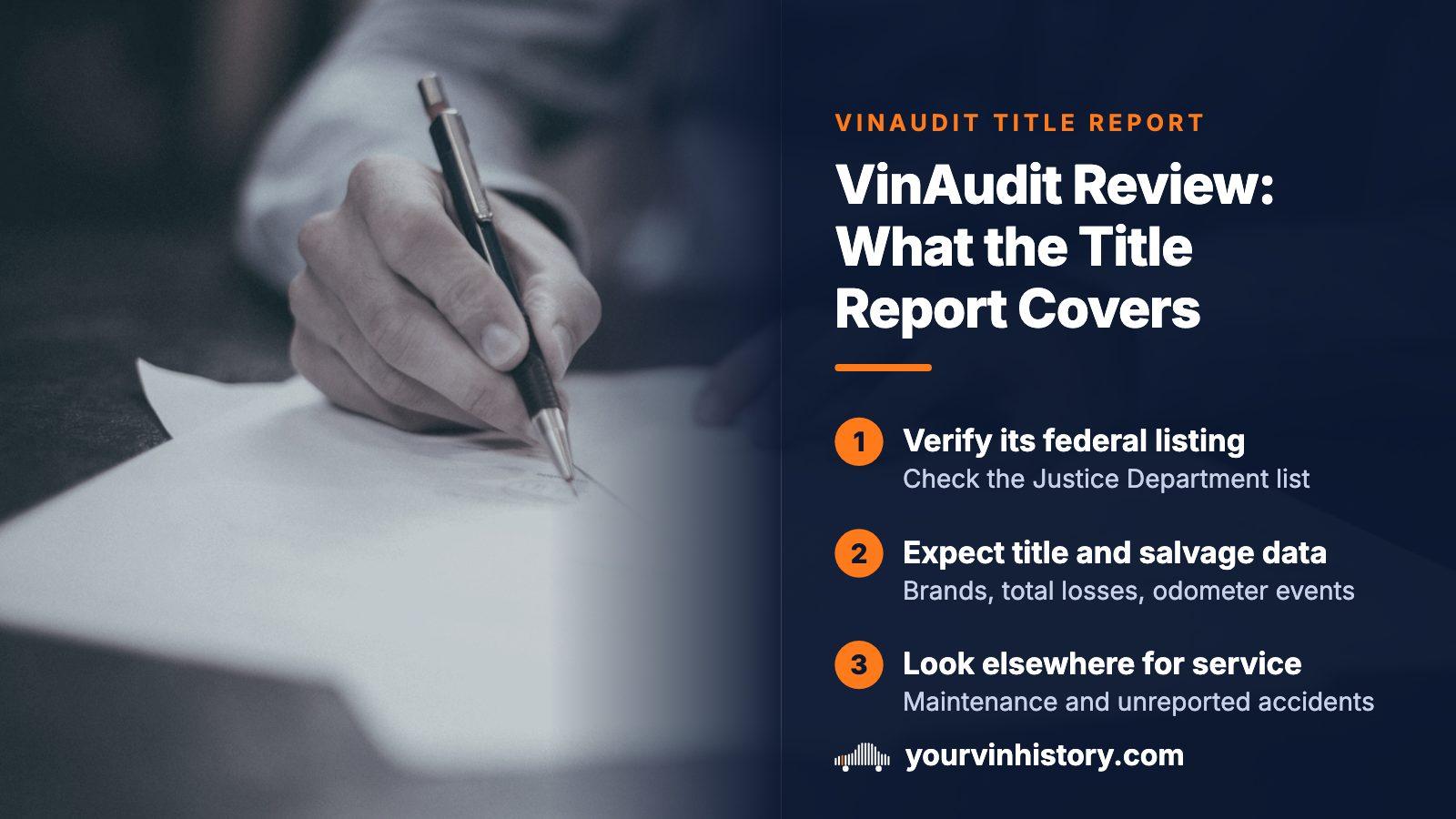
THE SHORT ANSWER
VinAudit appears on the Justice Department's list of approved NMVTIS data providers, in the group open to consumers, and anyone can verify that in a browser. Expect title brands, salvage and total-loss entries, odometer readings tied to title events and a value estimate. Do not expect a maintenance narrative, or accidents that never reached an insurer, a police report or a title office.
- Federal status
- Listed for public and commercial customers
- Affiliated site
- VinCheck.Info, listed under its entry
- Core product
- NMVTIS title data plus a value estimate
- Not its focus
- Dealer and shop service history
What the federal provider list says about VinAudit
The Justice Department keeps a public page of businesses approved to sell NMVTIS vehicle history reports. It sorts them into two groups: providers that sell to anyone, and providers that serve commercial customers only. Vinaudit.com sits in the first group, the one open to consumers, dealerships and lenders alike.
Beneath that entry the page names a second site, VinCheck.Info, and describes it as a business owned by the approved provider and authorized to sell NMVTIS reports. The page also states that businesses are listed alphabetically with no preference indicated. So the list tells you who may sell the data. It does not grade anyone on price, support, speed or how clearly a report reads.
What the approval proves and what it leaves open
Approval is the one credential in this market that a buyer can check without taking a seller's word for it. A company on the list has been cleared under the federal program to resell title records to the public, which means those records come out of the federal system itself.
What approval cannot tell you is how a particular company handles refunds, how its report is laid out, or whether its customer support answers the phone. Those answers sit on the company's own pages and in its sample report. Read them before you pay anyone, VinAudit included, and treat the federal listing as the floor rather than the whole picture.
Confirming the listing yourself in a few minutes
- Open the Justice Department's approved NMVTIS providers page, linked in the sources below.
- Find the group labeled for both commercial and public customers, then look for Vinaudit.com.
- Read the note under the entry that names additional websites owned by the provider.
- Compare the web address you are about to pay with the address on the list, character by character.
The last step applies to every provider on the page. A look-alike address is a poor place to type a VIN and a card number, and the government list gives you a fixed point of comparison that costs nothing to use.
Two storefronts sharing one approval
VinCheck.Info shows up on the federal page only as an affiliate of Vinaudit.com, never as a provider in its own right. For a buyer who likes to run two cheap services and compare the output, that detail changes the exercise. Two reports from one approved provider cannot confirm each other, because both rest on the same provider's access to the same federal record.
The arrangement is not unusual. Several other providers on the list carry affiliated websites as well, so the lesson reaches well beyond this one company. Before treating matching results as proof, find out which approval sits behind each brand name.
A second opinion needs a second source
Pair an NMVTIS title report with checks drawn from different systems: the NHTSA recall lookup for open safety recalls, and the NICB's VINCheck, a free theft screen. Three separate systems tell you more than three brands of one.
What a VinAudit report is described as containing
The report is built mainly on NMVTIS data, with a pricing figure and factory details added. The table lists the parts a buyer can expect. Confirm the exact layout against the sample on the company's own site before you buy, since formats change.
| Report part | What it tells you |
|---|---|
| NMVTIS title history | Brands recorded by state titling agencies, such as salvage or junk |
| Salvage and junk entries | Reports sent in by insurance carriers and salvage operators |
| Total-loss records | Cars an insurer wrote off, including some that never earned a state brand |
| Odometer readings | Mileage recorded at title events, which helps expose a rollback |
| Market value estimate | A price figure drawn from comparable sales |
| Specifications | Factory build details decoded from the VIN |
What any NMVTIS-based report is built to cover
The Justice Department says an NMVTIS report is meant to cover five indicators: the current state of the title and its last date, brand history, the odometer reading, total-loss history and salvage history. Insurance carriers, auto recyclers, junk yards and salvage yards must report into the system under federal law, and state titling agencies supply title data too.
The same federal page adds that private providers sell information never intended to live in NMVTIS, such as repair histories, recall information and maintenance data. When a title-focused report says nothing about repairs or recalls, that silence reflects how the product is designed. It is a boundary of the data, and it applies to every provider selling the same record.
A consumer report beside a business data service
VinAudit also supplies vehicle data and valuation to businesses through an API, the kind of feed that dealers, marketplaces and software companies plug into their own tools. A retail buyer sees only the storefront side of that arrangement, and nothing about it changes what the consumer report contains.
For you, the practical question is the value estimate. A figure derived from comparable sales is an algorithm's opinion. Use it to open a negotiation or to sanity-check an asking price, then compare local listings and judge the car in front of you, because a number built from a VIN has never seen the paint, the tires or the wear on the driver's seat.
Where a title-focused report runs out
- No service narrative: dealer and shop maintenance records are not what this product is designed to deliver.
- No view of accidents that triggered no insurer write-off, left no police report and caused no title event. That gap exists across the whole industry.
- A clean result means no records were found. It does not prove the car has no past.
- Layout matters if you plan to show the document to a seller or a lender, so look at the sample first and decide whether it serves that purpose.
- The value figure is an estimate, as covered above.
None of these limits is unique to VinAudit. They come from what the federal record holds, so any other provider selling the same record meets the same walls.
The case for a cheap title check on every finalist
Title washing is the scenario that justifies the exercise. A car carries a salvage brand in one state, gets retitled in another, and turns up with a paper title that looks clean. The federal database exists to catch that kind of movement, so a low-priced query against it works as a filter for any car you would seriously consider.
VinAudit is known for low pricing, generally single-digit dollars for one report, with bundles cheaper per report. Prices change, so confirm the current figure on its site. Running a cheap check on each finalist and saving a pricier, more detailed report for the one car you intend to buy is a sensible way to spend.
Who it suits, and who may want more depth
It fits a buyer screening a shortlist, a private-party sale where a premium report would take a noticeable bite out of the price, and anyone who has finished the no-cost federal lookups and wants the title record next.
It fits less well when you are buying an expensive late-model car and want documented service history. Buyers who want accident, salvage and auction records in the same report have other options, including this site's, which takes its NMVTIS title records from ClearVIN LLC, a separate approved provider.
No report replaces a mechanic. The Justice Department's buying tips strongly encourage an independent inspection of any car, whatever history you have purchased.
A sensible order of checks around any cheap report
- Compare the VIN on the car with the VIN in the listing and on the paperwork.
- Run NHTSA's recall lookup, which costs nothing, to see open safety recalls.
- Try NICB's VINCheck for a theft flag.
- Buy the NMVTIS title report for each finalist, from VinAudit or another approved provider.
- Ask the seller for maintenance records, and speak with the previous owner if you can reach one.
- Pay a mechanic to inspect the car, then test drive it on hills, highways and in stop-and-go traffic.
Each step uses a different source, which is the point. Agreement between unrelated systems carries weight that repeated lookups from one provider do not.
Where this information comes from
- U.S. Department of Justice: Approved NMVTIS Data Providers — Where the Vinaudit.com entry, the VinCheck.Info affiliate note and the alphabetical, no-preference statement were read.
- Bureau of Justice Assistance: NMVTIS program overview — Describes NMVTIS as a system that exchanges title, brand and theft data to curb vehicle theft and fraud.
- NICB: VINCheck — A free lookup run by an insurance-industry nonprofit, separate from NMVTIS, so it works as a true cross-check.
- NHTSA: Recalls — The federal lookup for open safety recalls by VIN, information a title-focused report is not built to carry.
Sources and photos: Facts checked against the sources above in October 2026. Photo by Scott Graham on Unsplash; diagrams by YourVINHistory.
Keep reading
- NMVTIS reportWhat the federal title record contains, laid out in plain terms.
- EpicVIN reviewAnother approved provider that sells on price, read the same way.
- Carfax alternativesWhere a free tool, a cheap report and a paid one each fit.
- Title washingHow a brand can vanish when a car crosses a state line.
Frequently asked questions
Is VinAudit legit?
Vinaudit.com is named on the Justice Department's published list of approved NMVTIS providers, in the group open to public customers, and you can open that page yourself. The listing confirms authorization to sell the federal title data. Refund terms and support quality are separate matters, so read the company's own policies before paying.
Is VinCheck.Info the same as VinAudit?
The federal list shows VinCheck.Info as an extra site owned by Vinaudit.com, the approved provider, and authorized to sell NMVTIS reports. The two storefronts share one approval. Running a report on each would not give you an independent second opinion on the car's title history.
How much does VinAudit cost?
It is known for low pricing, generally single-digit dollars for one report, with bundles bringing the per-report cost down. Prices change and this guide cannot show the current figure, so check the company's site before you buy. Weigh that against what you would also spend on a deeper report for your final pick.
Does VinAudit show accident history?
Only the parts that reach its sources. Total-loss and salvage entries, brands and title-event odometer readings can reflect serious crashes. A minor collision that triggered no write-off, left no police report and caused no title event leaves nothing in the data, and commercial providers generally share that limit.
VinAudit or Carfax: which should I use?
They answer different questions. VinAudit is a low-priced route to federally sourced title records. Carfax is known for service and accident detail, and the Justice Department's list puts it among commercial-only NMVTIS providers. Many buyers run a title check on every candidate, then add a deeper report on the finalist.
Now check the car itself
The guide explains what to look for. The report shows what this VIN has on record.