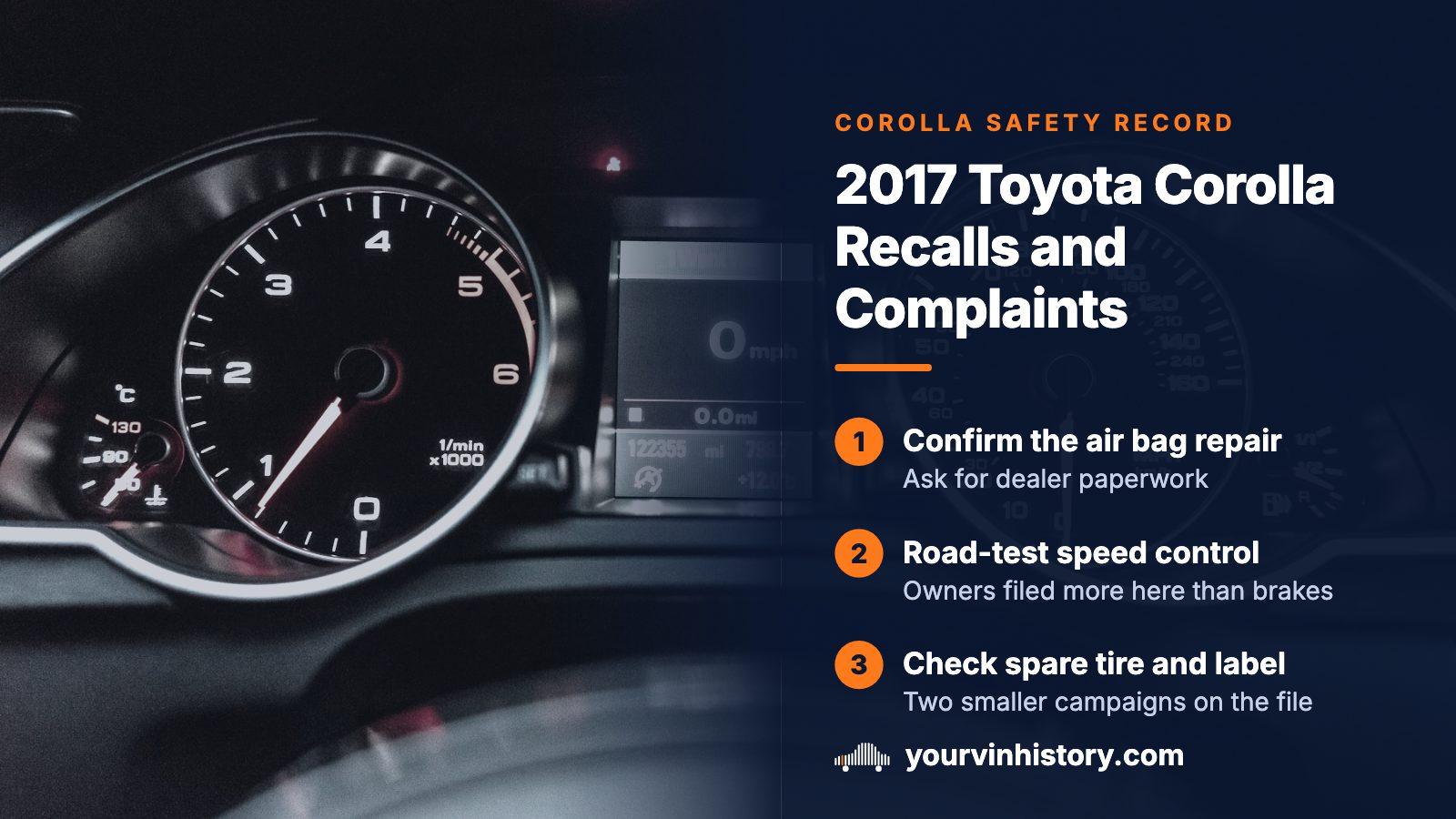
THE SHORT ANSWER
The 2017 Toyota Corolla has 3 recall campaigns on file with NHTSA: an air bag control unit that can malfunction in a crash, a load capacity label that may be wrong, and a spare tire filled to the wrong pressure. Owners filed 188 complaints, led by air bags at 57. The federal crash test gave the sedan 5 of 5 stars overall. Recalls follow VIN ranges, so check the specific car before you pay anything.
- Recall campaigns
- 3 on file with NHTSA
- Owner complaints
- 188, with 57 naming air bags
- NHTSA overall rating
- 5 of 5 stars
- Against other Corolla years
- 12th heaviest of 14, at 0.77 times the median
What the federal file holds on this Corolla
Two NHTSA datasets describe a model year, and they answer different questions. A recall campaign is a defect the manufacturer has acknowledged and agreed to repair, and this Corolla has 3 of them. A complaint is an owner's unverified account, and 2017 has 188. The first tells you what Toyota admitted; the second tells you what owners believed happened, with nobody checking.
Some filings carry flags worth reading in full. Owners described a crash in 47 of them, an injury in 44 and a fire in 1. Those flags reflect the filer's own wording, one event can produce several reports, and no investigator confirmed any of it. NHTSA also lists 2 investigations touching this model year, which are early signals rather than findings. The counts here come from a pull dated August 15, 2026, so live totals can run a little higher.
Three campaigns at a glance
Each campaign is its own NHTSA record. Listed here by the year it was issued, they come from three different Toyota entities, and none involves the engine or the drivetrain.
| NHTSA number | Issued by | What it addresses | Toyota's own reference |
|---|---|---|---|
| 17V295000 | Gulf States Toyota | Spare tire filled to the wrong pressure | 17R2 |
| 19V503000 | Southeast Toyota Distributors | Load capacity label that may be incorrect | SET19A |
| 20V024000 | Toyota Motor Engineering & Manufacturing | Air bag control unit that may malfunction in a crash | 20TB03, 20TA03, 20TA05 |
On safety grounds the air bag unit is the serious one. The spare tire matters only on the day the spare is needed, and the label concerns loading information.
The air bag control unit recall, 20V024000
Toyota recalled Corollas from model years 2011 through 2019, plus certain Matrix and Avalon cars, because the air bag electronic control unit could malfunction during some crashes. If it does, the air bags and the seat belt pretensioners might not deploy, and NHTSA says that raises the risk of injury.
The remedy is modest. Dealers inspect the unit and, where needed, fit a noise filter between the control module and its wiring harness, at no charge to the owner. Letters about the safety risk began reaching owners on March 2, 2020, and a second letter announcing the remedy was mailed between March 16 and June 27 of that year. A 2017 car inside the affected range has therefore been eligible for this work for years. A seller who cannot say whether it was done should produce dealer paperwork, or the VIN should be run through the recall lookup.
The spare tire and the load label
Gulf States Toyota recalled the 2017 Corolla alongside many other 2017 Toyota models because the spare tire had not been set to the pressure printed on the tire pressure label. An under-filled spare may not perform as intended, which raises crash risk. Dealers inspect the spare and adjust it as needed at no charge. That campaign began on June 15, 2017.
The label campaign came later. Southeast Toyota Distributors reported that the load carrying capacity label on certain 2017 through 2019 cars might be wrong, so the vehicles fell short of the federal tire selection and rims standard. Owners get a corrected label to place over the old one, and the risk NHTSA names is accidental overloading. Neither job is a major repair, so an unfinished one on a used car reads as an errand to schedule, not a reason to walk away.
Where the 188 complaints cluster
NHTSA files each complaint under the component the owner blamed. The spread says more than the total does: filings scattered across many systems mean something different from one system drawing a large share.
| Reports | Component | Share of 188 |
|---|---|---|
| 57 | Air bags | 30% |
| 33 | Unknown or other | 18% |
| 30 | Vehicle speed control | 16% |
| 26 | Service brakes | 14% |
| 21 | Electrical system | 11% |
| 16 | Power train | 9% |
| 13 | Engine | 7% |
| 13 | Steering | 7% |
| 13 | Seat belts | 7% |
| 10 | Structure | 5% |
Ten smaller categories hold the remainder, from forward collision avoidance at 9 down to back over prevention and visibility at 2 each. The air bag label does not say which fault an owner described, so it may or may not track the control unit recall. Brake and speed control entries are likewise owner descriptions, and the notes behind them are on NHTSA's site, not in this table.
When owners filed, and where 2017 sits among Corolla years
Filings for this model year peaked in 2020, the same year Toyota began mailing the air bag unit notices. The record does not connect the two, so treat the overlap as a calendar coincidence until you read the individual filings.
Measured against the Corolla's own run from 2008 to 2021, 2017 is the 12th heaviest of 14 model years. Its complaint volume is 0.77 times the median year, a little under the middle of the pack.
| Marker | Model year | Multiple of the median |
|---|---|---|
| Heaviest on record | 2009 | 6.31 |
| This car | 2017 | 0.77 |
| Lightest settled year | 2018 | 0.58 |
A lighter year helps, but it is a count of filings and not a failure rate, and it says nothing about how one owner maintained one car.
How old the car was when each system acted up
Each complaint carries the date the owner says the trouble happened, and the gap from the 2017 model year gives the car's age at that moment. The age summary covers eight categories. Brakes and electrical show one report fewer than the category table, which suggests a filing without a usable date.
| System | Median age in years | Dated reports | Share inside three years |
|---|---|---|---|
| Air bags | 3.3 | 57 | 42% |
| Unknown or other | 2.2 | 33 | 64% |
| Vehicle speed control | 1.2 | 30 | 83% |
| Service brakes | 1.8 | 25 | 68% |
| Electrical system | 3.1 | 20 | 50% |
| Power train | 1 | 16 | 81% |
| Engine | 1.8 | 13 | 54% |
| Seat belts | 3.2 | 13 | 38% |
Speed control and power train reports came early, with 83% and 81% of their reports inside the first three years, so a well-kept example probably had that attention from the first owner and the dealer. Ask for the paperwork instead of assuming. Air bags, electrical and seat belts arrive later, at medians of 3.3, 3.1 and 3.2 years, so they are the systems a later owner is more likely to have met.
These medians are not predictions
They summarize unverified owner reports and show when people who complained say something went wrong. They do not measure how likely any part is to fail. A neglected car can beat every age in the table, and a documented one can pass them all without trouble.
Crash-test results and driver aids
NHTSA's New Car Assessment Program rated the 2017 Corolla in its four-door, front-wheel-drive configuration. Stars describe how that configuration did in standardized tests. A sedan that was wrecked and poorly repaired is no longer the one that earned them.
| Result | Test |
|---|---|
| 5 of 5 | Side crash |
| 5 of 5 | Overall |
| 4 of 5 | Rollover |
| 4 of 5 | Frontal crash |
| 11.8% | Rollover probability |
On driver aids, NHTSA's entry for that configuration lists forward collision warning as not offered, while lane departure warning is marked standard. Because 9 complaints fall under forward collision avoidance, the equipment fields may not describe every trim. Read the window sticker or decode the VIN to see what the actual car carries.
Confirming recalls on the exact car
Recalls attach to production ranges, so two 2017 Corollas can carry different open campaigns and a third can carry none. Enter the VIN in NHTSA's recall lookup to see what is open on that car, then confirm that any repair listed as done was actually performed and not just mailed about.
Federal law requires the maker to cover a recall remedy without charge, with a limit. Under 49 U.S.C. 30120, the duty falls away when the first retail purchase came more than 15 calendar years before the owner notice or a government order. The three campaigns here date from 2017, 2019 and 2020, well inside that window for a car first sold near its model year. That limit is why a recall repair should never be described as free at any age.
What to inspect and what to ask the seller
Use the complaint pattern to aim the inspection, then add the wear checks any sedan this age needs, such as bushings, the trunk floor and spare well, and ride height at each corner.
- Air bag warning light: it should light at start-up and then go out
- Speed control and throttle response on a road test, since 30 filings sit in that category
- Brake pedal feel, with 26 filings naming the service brakes
- Lights, windows and dashboard warnings, given 21 electrical filings
- Spare tire pressure, and whether a corrected label sits over the old load label
- Engine bay wiring for heat damage or amateur splices, because 1 fire report exists
- Were all 3 campaigns repaired, and is there dealer paperwork?
- Has the air bag system ever been serviced or replaced?
- Who maintained the car, and do you have the service records?
- Has it ever been in a collision, and was an insurance claim paid?
- May my own mechanic look at it before we settle on a price?
A yourvinhistory report covers what this file leaves out: title brands, accident records, odometer readings and salvage history, plus open recalls for the VIN.
Where this information comes from
- NHTSA: recalls lookup — Where a VIN is entered to see open campaigns; the three campaign records discussed here are drawn from the same agency data.
- NHTSA: vehicle safety and consumer complaints — Entry point to the owner filings behind the 188 total, the category counts and the crash, fire and injury flags.
- 49 U.S.C. 30120: remedy without charge — Statute text for the no-charge recall remedy and the 15 calendar year limit counted from first retail sale.
- NHTSA: 5-Star Safety Ratings — The federal crash-test program behind the overall, frontal, side and rollover results shown above.
- NMVTIS: national title information system — Federal source for title brands and history, which a safety record does not include.
Sources and photos: Facts checked against the sources above in October 2026. Photo by CHUTTERSNAP on Unsplash; diagrams by YourVINHistory.
Keep reading
- Toyota Corolla years to avoid: 2009 to 2011 lead the complaintsRanks every Corolla model year by complaints, so you can see how 2017 compares.
- Toyota recallsWalks through checking any Toyota by VIN for open campaigns.
- Buying a car with an open recallCovers what to do when the lookup shows a repair was never made.
- Toyota Corolla brake replacement cost, and the model years to checkSeparates routine brake wear from the years with real brake defects.
Frequently asked questions
How many recall campaigns cover a 2017 Toyota Corolla?
The model year carries 3 recall campaigns at NHTSA: 17V295000, 19V503000 and 20V024000. Campaigns cover VIN ranges, so one car can fall inside all three, only some, or none. The reliable way to know is to enter its VIN in NHTSA's recall lookup, which also shows whether a repair is still open.
What do 2017 Corolla owners complain about most?
Air bags lead with 57 of the 188 complaints. The unknown or other bucket follows at 33, then vehicle speed control at 30 and service brakes at 26. These are unverified owner accounts, so use them to decide where to look on a test drive, not as proof that a given car will fail.
Is a 2017 Corolla safe to buy used?
In NHTSA's crash tests it earned 5 of 5 stars overall and for side crash, with 4 stars each for frontal crash and rollover, and a rollover probability of 11.8%. Those results describe the tested sedan as built. They cannot reveal earlier damage or sloppy repairs on the car you are considering, which an inspection and a history check can.
Does Toyota fix the 2017 Corolla air bag recall at no charge?
Dealers perform the 20V024000 repair at no charge under the federal rule, which counts 15 calendar years from the first retail sale to the owner notice. Notices went out in 2020, so a 2017 car sits well inside that window. Call a Toyota dealer with the VIN to confirm the work is still open before you book.
Does a clean recall record mean the Corolla has a clean history?
No. Recalls and complaints describe safety defects, not what happened to one car. They omit title brands, accident claims, odometer readings and salvage or auction records. A yourvinhistory report gathers those by VIN and starts with a preview before any purchase, so you can see what exists first.
Now check the car itself
The guide explains what to look for. The report shows what this VIN has on record.