THE SHORT ANSWER
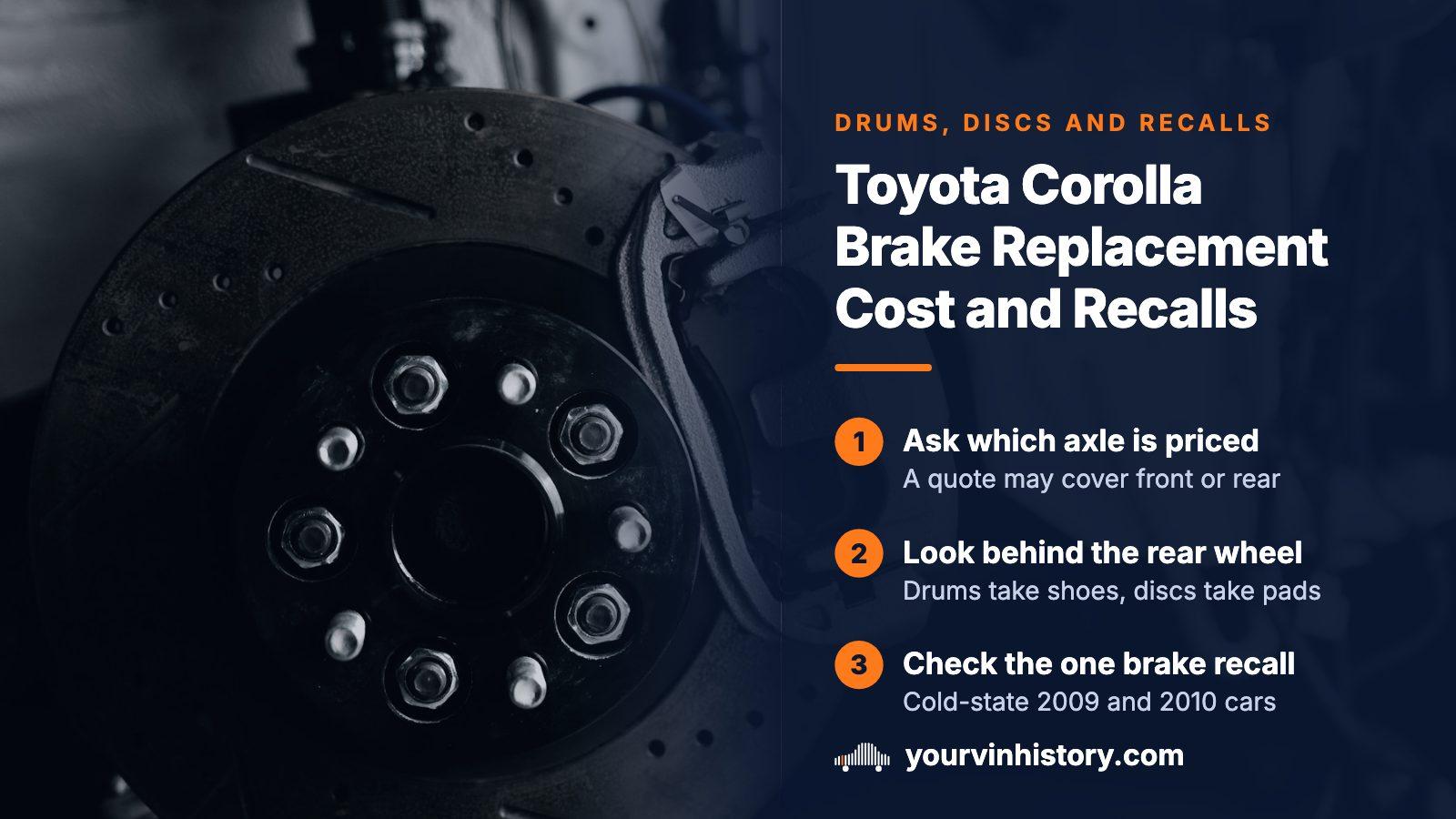
RepairPal's published Corolla estimates are $297 to $355 for a pad replacement and $257 to $335 for rear shoes, taxes and fees excluded. Which one applies turns on the rear axle: drums take shoes, discs take pads. NHTSA lists a single brake recall for 2008 to 2021: 09V338000, covering 2009 and 2010 cars with the 1.8-liter engine in cold-weather states. Rotors and fluid cost extra.
- RepairPal pads
- $297 to $355, before tax
- RepairPal rear shoes
- $257 to $335, before tax
- Brake recalls, 2008 to 2021
- One: 09V338000
- 2009 and 2010 share
- 296 of at least 446 counted brake reports
The two price ranges on record, and who published them
RepairPal publishes the most detailed Corolla figures, split into parts and labor. Both of its pages show a September 3, 2026 update date, leave out taxes and fees, and ignore your location.
| RepairPal job | Labor | Parts | Total |
|---|---|---|---|
| Pad replacement | $122 to $179 | $175 to $176 | $297 to $355 |
| Shoe replacement, the rear job on drum cars | $164 to $240 | $94 to $95 | $257 to $335 |
Kelley Blue Book lists Corolla brake prices too, varying by ZIP code and covering the front or the rear, never both. That explains many quotes that look double a published number: the shop priced two axles. This site sells history reports, not repairs, and prints no brake price of its own.
Drums or discs behind the rear wheels set the line item
Every Corolla from 2008 through 2021 has disc brakes up front. The rear differs, and RepairPal prices the two jobs separately for that reason.
| Model year | Rear axle | Basis |
|---|---|---|
| 2009 to 2013 | Drums | Toyota bulletin T-SB-0235-12 |
| 2011 | Nine-inch drums, every grade | Toyota press release |
| 2014 | S grade gets discs, other grades keep nine-inch drums | Toyota press release |
| 2015 | Four-wheel discs offered with 17-inch wheels | Toyota press release |
| 2016 to 2019 | Varies by trim; parts catalogs disagree on LE and SE | Inspect the car |
| 2020 and 2021 | Four-wheel discs on L, SE and XLE | Third-party spec listings |
The press-release rows were readable only as search excerpts, and the 2020 row rests on a spec site. To check one car, peer between the rear spokes: a flat disc with a caliper around its edge means pads, a closed round housing means shoes.
Brake complaints describe defects, not worn pads
Pads, shoes and rotors are consumables, and nobody files a federal complaint because a set reached its wear limit. NHTSA's service brakes category holds owners' reports of brakes misbehaving: a pedal that sank or turned hard, ABS warning lights, grinding on a young car, a vehicle that kept rolling with the pedal pressed.
So the record cannot say how long Corolla pads last. It can point to model years with odd brake trouble, and to any recall or bulletin that followed. Across 6,096 owner complaints on 2008 to 2021 Corollas, where each year keeps only its five most-reported components, brakes make the top five in 8 of 14 years: 2008 through 2011, then 2013, 2016, 2017 and 2020. Those years hold at least 446 reports. Brakes never rank first, and the best showing is second place in 2016. In the other six (2012, 2014, 2015, 2018, 2019 and 2021) they fall below the fifth-place line, which is not the same as zero.
Two model years hold most of the brake reports
Of the counted reports, 296 belong to 2009 and 2010, about 66%. The 2010 total of 172 is roughly 6 times the largest figure in any later year, 29 for 2016. Brakes rank only fourth in both years, trailing air bags, steering and speed control.
The complaint text explains part of that weight. Most were filed during calendar 2010, with Toyota's pedal and floor-mat recalls in the headlines, and many are co-filed with speed control by drivers who say the car refused to stop or sped up under braking. A complaint count is not a failure rate, and this one partly measures a news cycle.
Recall 09V338000, the only brake campaign in the range
Searching NHTSA's recall data for each model year from 2008 through 2021 turns up mostly airbag campaigns and exactly one brake campaign: 09V338000, filed by Toyota in August 2009 with repairs starting September 21, 2009.
It covers 2009 and 2010 Corolla and Corolla Matrix models plus 2008 and 2009 Scion xD cars, all with the 1.8-liter engine and all originally sold in or now registered in 19 cold-weather states, Alaska, Maine and Wyoming among them. In extreme cold, condensation from the crankcase ventilation can freeze and plug the intake-manifold port that supplies vacuum to the brake booster, which NHTSA says could lengthen stopping distance. Dealers fitted a newly designed intake air connector that moves the port, at no charge.
Check this before booking pads
On a 1.8-liter Corolla from 2009 or 2010 that lived in a cold state, a stiff pedal and long stops in freezing weather belong in a recall conversation first. Run the VIN through NHTSA's recall lookup, then ask a dealer whether the repair is still available under the federal rule's limits.
Smart Stop and the surging petition on 2009 and 2010 cars
A petition filed with NHTSA in September 2014 sought an investigation of low-speed surging in 2006 to 2010 Corollas, alleging that the brakes failed to stop the car. NHTSA logged it as DP14-003 and denied it in April 2015, concluding that more digging was unlikely to uncover a safety defect.
Smart Stop Technology came out of Toyota's 2013 settlement of economic-loss claims over unintended acceleration. It is a software change to the engine computer that trims output when both pedals are pressed at once. Toyota's campaign memo counts roughly 843,300 Corollas from 2009 and 2010, and a September 2016 update turned it into special service campaign BST with no end date. It is not a brake part; a dealer can say whether it was installed.
Toyota bulletins that explain odd brake symptoms
A bulletin is not a recall: it tells dealers how to treat a known complaint, usually inside the factory warranty, which every Corolla here has outlived. It still names the symptom and the part that cured it.
| Model years | Bulletin | Symptom and instruction |
|---|---|---|
| 2009 to 2013 | T-SB-0235-12 | Pedal travel creeps upward; improved rear drum adjusters, 1.4 hours |
| 2014 to 2017 | T-TT-0409-16 | Shudder under braking below 10,000 miles; dealers to call Toyota, not disassemble |
| 2015 to 2018 | T-SB-0313-17 | Vibration from wrongly torqued lug nuts; not a warranty repair |
| Through 2021 | T-TT-0636-20 | Squeal or groan with Toyota Complete Maintenance Care pads; Toyota supplied an installation guide |
| 2020 to 2022 | T-TT-0732-23 | Rattle from the pedal bracket on bumpy roads |
The drum bulletin matters most on an older car: it replaces the rear brake strut kit on cars assembled in Japan through 2013 and in North America through 2011, each ahead of a production-change VIN. A long, low pedal with healthy front pads may call for that kit or a drum adjustment, not new pads.
Shaking under braking: check the lug nuts first
Toyota's T-SB-0313-17 says a single lug nut tightened too much or too little can cause brake vibration. A 2015 to 2018 car that began shaking after a tire change should have its wheels re-torqued in a star pattern before anyone quotes rotors. Outside 2009 and 2010 the high brake years look like a blend, not one repeated fault: 2016 holds second place with 29 reports and 2013 third with 24.
In 2020 and 2021, an electric parking brake can change the rear job
Brakes re-enter the top five in 2020 at 22 reports, and several owners of 2020 and 2021 cars mention an electric parking brake. Toyota's T-SB-0078-21 handles a Parking Brake Malfunction message, code C059746, on the 2021 and 2022 Corolla, hatchback included; its second revision dropped 2020. The fix is a skid control computer reprogram, 0.8 hours under the basic warranty of 36 months or 36,000 miles.
For pad work the point is mechanical: motors drive the rear caliper pistons, and most such systems need a service mode, set through a scan tool or a documented procedure, before the pistons retract. Ask whether the shop can do that. Which 2020 and 2021 trims have the electric brake is unverified here, so check the console for a switch instead of a lever.
What a Corolla brake quote should spell out
- Which axle is priced; a published figure may cover only front or rear
- Pads or shoes at the rear, matched to what is on the car
- Measured pad or lining thickness at each corner, not a bare 'needs brakes'
- Rotors replaced or resurfaced, with measured rotor thickness
- Pad brand (OEM, Toyota's Complete Maintenance Care line or aftermarket) and its warranty
- Fluid flush included or not, and the fluid specified
- For a 2020 or 2021 car with an electric parking brake, how the shop will retract it
Three patterns deserve a second question: rotors added to every pad job without a measurement, rear pads quoted for a car with rear drums, and a vibration quote on a 2015 to 2018 car that never mentions lug torque.
If you are buying the Corolla instead of repairing it
Worn pads are a small bargaining point; faults a pad job cannot cure matter more, and they follow the model year. On a 2009 or 2010 car from a cold state, ask whether the vacuum-port recall was done and the Smart Stop update installed. On a 2009 to 2013 car, a low pedal alongside healthy front pads suggests the rear drums. On a 2020 or 2021 car, the parking brake should apply and release with no warning message.
Weak charging on 2009 and 2010 cars can trigger an ABS light, since braking and steering electronics share one 12-volt supply. ToyotaCare will not help: Toyota describes it as covering scheduled servicing for the first 2 years or 25,000 miles, and every 2008 to 2021 Corolla is well past that.
A yourvinhistory report lists open recalls and factory specs for a VIN, which answers the recall and trim questions above. A mechanic's pre-purchase inspection, with the brakes measured, answers the rest.
Where this information comes from
- RepairPal: Toyota Corolla brake pad replacement estimate — Where the $297 to $355 pad range and its labor and parts split come from; its brake shoe page gives the $257 to $335 rear range.
- NHTSA: recalls for the 2009 Toyota Corolla — The record for recall 09V338000, the cold-weather vacuum-port campaign on 2009 and 2010 cars with the 1.8-liter engine.
- NHTSA: investigations for the 2010 Toyota Corolla — Lists defect petition DP14-003 on low-speed surging, opened in 2014 and denied in 2015.
- Toyota T-SB-0235-12 Rev2, copy on NHTSA's site — Confirms drums at the rear of 2009 to 2013 Corollas and describes the improved adjusters for creeping pedal travel.
- Toyota T-SB-0313-17, copy on NHTSA's site — Says a single wrongly torqued lug nut can cause brake vibration on 2015 to 2018 Corollas.
- Toyota T-SB-0078-21 Rev2, copy on NHTSA's site — Covers the Parking Brake Malfunction message and the skid control computer reprogram on 2021 and 2022 cars.
Sources and photos: Facts checked against the sources above in October 2026. Photo by Erik Mclean on Unsplash; diagrams by YourVINHistory.
Keep reading
- Toyota Corolla years to avoid: 2009 to 2011 lead the complaintsThe same model years scored on the whole complaint record, not only the brakes.
- Toyota Corolla alternator replacement cost and the 2009-2010 bulletinThe charging fault behind some ABS and steering warnings on 2009 and 2010 cars.
- Toyota recallsHow to check a specific car for 09V338000 or any other campaign left unrepaired.
- Brake fluid by VINWhich fluid a car specifies, which matters on any job that opens the hydraulics.
Frequently asked questions
What should a Corolla brake job cost?
Treat RepairPal's $297 to $355 for pads and $257 to $335 for rear shoes as a yardstick for one axle, excluding taxes and fees. A quote near double either figure often covers two axles. Rotors and calipers come extra.
Has Toyota ever recalled Corolla brakes?
Once in the 2008 to 2021 model years: recall 09V338000, for 1.8-liter cars from 2009 and 2010 in 19 cold-weather states, where frozen condensation could block the brake vacuum port. Enter the VIN in NHTSA's lookup to see whether the repair was done. Every other campaign in that span covers different parts.
What do brakes cost on a 2020 Toyota Corolla?
Begin with RepairPal's general pad range of $297 to $355. Spec sites show discs at all four wheels on the 2020 sedans they list, so the rear job is pads, not shoes. Owners of some 2020 and 2021 cars describe an electric parking brake, which needs a service mode before the pistons retract.
Do all four Corolla brakes need replacing together?
Not by default. Brakes are done in axle pairs, but the two axles wear on separate schedules. The front axle handles most of the stopping and usually goes first, while rear drum shoes can outlast several front sets. Ask for thickness at each corner and do the rear only when the measurement calls for it.
How many miles do Corolla brake pads last?
No fixed mileage applies, and federal complaint data cannot supply one, since owners report defects, not normal wear. Stop-and-go city driving uses pads far faster than highway cruising. Have pad thickness checked at each tire rotation, with shoe lining on drum cars, and replace parts once the shop can show you the number.
Now check the car itself
The guide explains what to look for. The report shows what this VIN has on record.