THE SHORT ANSWER
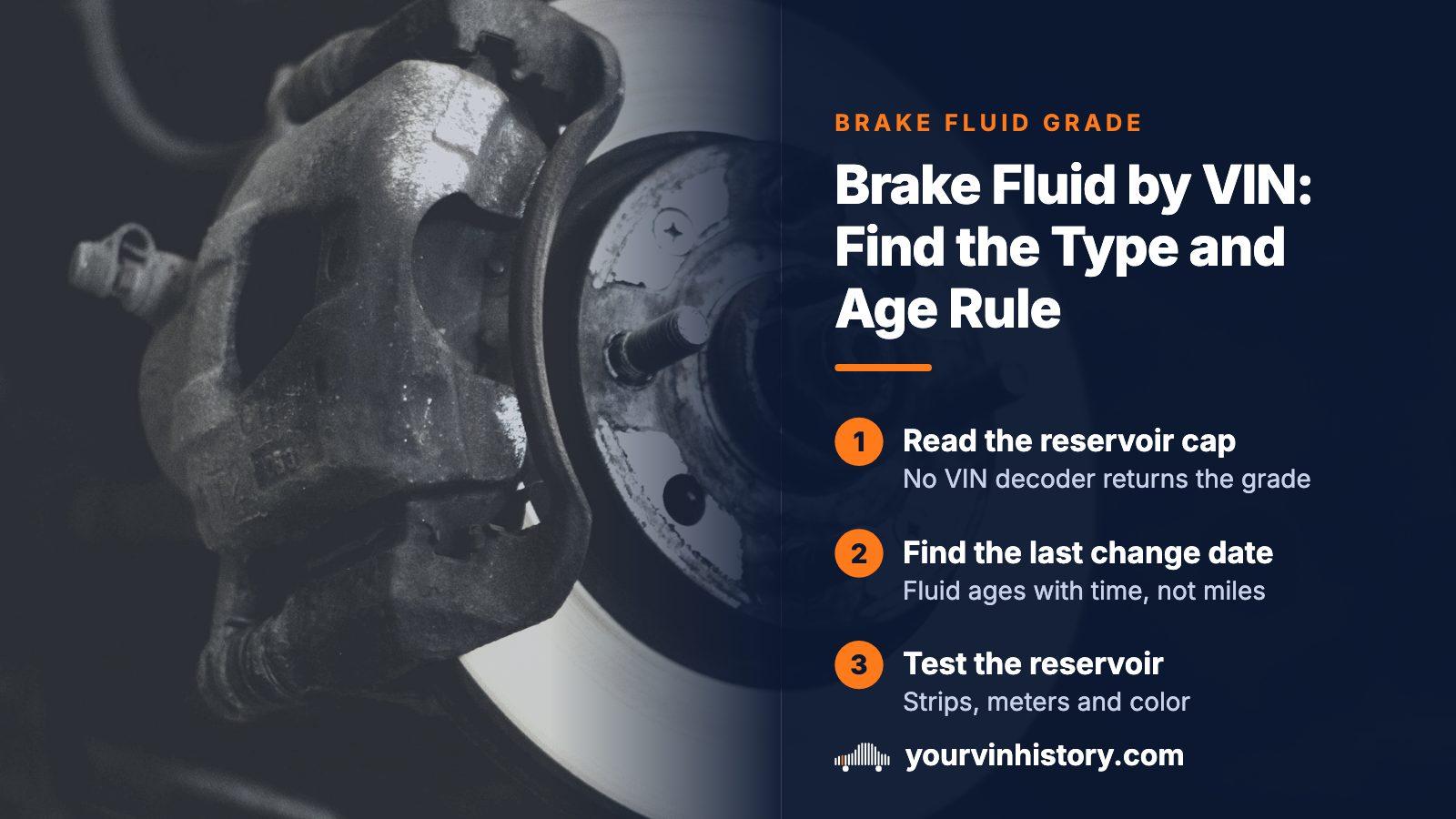
No VIN decoder returns a brake fluid grade, because the fluid requirement is not a registration fact. Read the grade off the reservoir cap, confirm it in the owner's manual, and use the VIN only to be sure which trim you are dealing with. Then find the date of the last change. Federal rules give every grade a lower boiling point once it has absorbed water, and that happens with time, even in a car that sits.
- Grade in the VIN
- None; read the cap and manual
- Wet boiling minimums
- 140, 155 and 180 °C for DOT 3, 4 and 5
- What ages the fluid
- Calendar time, not odometer miles
- DOT 5 base
- Silicone, not a stronger DOT 4
What a VIN decode holds, and what it skips for brake fluid
A federal decoder reads the VIN and reports what the car was built as: manufacturer, model, year, body type, engine size, cylinders and fuel. Brake fluid is missing from that list, and from every decoder that draws on it. Which fluid a car takes is an engineering choice the manufacturer publishes, and the 17 characters never carry it.
What the VIN does give you is certainty about the car. Braking hardware can differ between trims of one model, and a dealer service desk needs the right trim before it can pull the requirement. A vehicle history report built on the same VIN adds factory specifications and open recalls, which helps confirm you are researching the right car.
Three places that name the grade, in order of trust
Few fluid specifications are stamped on the component itself, and brake fluid is one of them, so the answer is often a quick look under the hood.
- The reservoir cap. On most cars the grade the maker requires is molded or printed into it, and it sits on the exact car you are checking.
- The owner's manual. This is the authority, and it also holds the replacement interval. If the two sources conflict, the manual wins.
- A dealer parts or service desk. Hand over the VIN when the manual is missing and the cap has worn smooth. The staff can match the number to a trim and pull the specification from the factory's own data.
Whichever route you take, write down the date the fluid was last changed. The next decision depends on that date, and nothing on the odometer can stand in for it.
DOT 3, DOT 4, DOT 5 and DOT 5.1 side by side
FMVSS 116, the federal brake fluid rule, sets a minimum boiling point for every grade twice: once for fluid fresh from the factory, and again at a lower figure after it has absorbed water. The table shows the three grades whose figures appear in the boiling-point sections of the regulation.
| Grade | Base fluid | Minimum dry boiling point | Minimum wet boiling point | Drop |
|---|---|---|---|---|
| DOT 3 | Glycol | 205 °C | 140 °C | 65 degrees |
| DOT 4 | Glycol | 230 °C | 155 °C | 75 degrees |
| DOT 5 | Silicone | 260 °C | 180 °C | 80 degrees |
DOT 5 is the grade that trips people up. The number suggests a step above DOT 4, yet the regulation defines a silicone base fluid as one made of at least 70 percent diorgano polysiloxane by weight. That is a separate chemistry, not a stronger version of the same product. DOT 5.1 confuses things from the other side: despite the 5 in its name it is a non-silicone fluid, and the labeling rules print it as DOT 5.1 NON-SILICONE BASE. Those boiling-point sections give no figures for it, so none are quoted here.
Why a federal standard prints a wet boiling point
The standard tests each fluid twice. The dry test uses fluid as made. The wet test first conditions a sample in a humid chamber beside a reference fluid until the reference reaches a set water content, then measures the boiling point of the result. Regulators do not write a procedure like that for a rare accident. They write it because water uptake is simply what brake fluid does in a car.
Look at the drops in the table above: 65 degrees for DOT 3, 75 for DOT 4 and 80 for DOT 5. Those gaps come from the floors the standard sets, so the margin in any particular car depends on how much water its fluid holds. Fresh fluid starts well above the wet figure, while fluid that has gone years without service can sit much closer to it.
The bottles on a store shelf carry the same split. The rule requires each container to state its grade and its minimum wet boiling point, and to warn the buyer to keep the container tightly closed so the fluid does not absorb moisture.
How water gets into a closed brake system
Nobody pours water into a brake circuit, and the circuit is sealed, yet the fluid still gains water. Glycol-based brake fluid is hygroscopic, meaning it pulls moisture from the surrounding air and holds on to it. Vapor works through flexible hoses and past seals, and the reservoir trades air with the outside whenever the cap comes off or the level falls as pads wear.
Seen from the fluid's side, this is a design trade and not a defect. Water that stays dispersed in the fluid is not pooling inside a caliper, where it would rust the metal from within. The cost is that the whole volume loses boiling margin bit by bit, with no leak to point at.
Why a parked car can hold the oldest fluid
Almost every maintenance item is counted in miles, so brake fluid tends to get filed next to engine oil and forgotten on a car that rarely moves. Water uptake follows exposure, not use. A pickup driven only on weekends takes on moisture at roughly the same pace as a commuter car that racks up many times the distance.
That flips a common assumption. A low-mileage car can have worse fluid than a high-mileage car of the same age, and the one that sat in a garage through several winters is the clearest case. It collected moisture every month, with no service visit to interrupt the process and no mileage to prompt one. The odometer counts distance; the fluid counts months.
What boiling fluid does to the pedal
Brakes work hydraulically, and liquid is nearly impossible to squeeze. Your foot pushes fluid, and the fluid pushes the caliper pistons. If a pocket of that fluid boils, it becomes vapor, which compresses easily, so pedal travel gets spent crushing bubbles instead of clamping the pads.
Drivers describe a pedal that sinks toward the floor or feels long and soft, with stopping power that returns once the brakes cool. The cruel part is the timing. Fluid boils under the conditions that ask the most of the system: a long downhill grade, a string of hard stops, a heavy load, a trailer on the hitch. Wetter fluid boils at a lower temperature, so it gives out sooner.
Topping off and mixing without making things worse
A bottle on the shelf answers a different question from the one the car is asking. These rules keep the two matched.
- Use the grade the manual and cap call for. That is the requirement, not a starting point to improve on.
- DOT 3 and DOT 4 share a glycol base, and adding DOT 4 to a DOT 3 system is commonly accepted where the manufacturer allows it. Check the manual first.
- Do not stretch that to DOT 5. Silicone fluid is a different chemistry, and the standard assigns it a purple color while the glycol grades run from colorless to amber, so purple in a reservoir points to silicone.
- Treat an opened bottle as aging stock. It keeps drawing moisture from the air, which is why the label tells you to keep the cap tight.
- Buy a small bottle, use it up, and do not keep the remainder on a shelf for years.
Testing the reservoir: strips, meters and color
Brake fluid condition can be measured, which sets it apart from most fluid questions. A shop can dip a strip that changes with moisture content, or hold a meter to the reservoir that estimates the boiling point. Each has limits. Fluid down at the calipers runs hotter and is often in worse shape than fluid at the top, so a reservoir reading can flatter the system. Both still beat guessing.
Color is a weak guide. Fresh glycol fluid is typically light and clear, and it darkens as it ages and picks up contamination, so dark or murky fluid is a reason to look closer. The reverse does not hold. Water has no color, which means a fluid can carry a damaging amount of moisture and still look acceptable.
A reservoir check for a used car you are about to buy
This is one of the cheapest items on a pre-purchase list, and it needs no tools.
- Open the hood, find the brake fluid reservoir, and read the grade on the cap. Compare it with the manual.
- Look at the fluid and the cap rim. Dark, cloudy fluid with no paperwork to explain it is a finding, and so is crusty residue around the cap.
- Ask when the fluid was last changed, and ask to see paper or a shop record if one exists.
- Treat the phrase 'it has low mileage' as a non-answer. For this item, low mileage protects nothing.
- Run the VIN through NHTSA's recall lookup, a no-cost tool, since braking parts turn up in recalls often.
When nobody can say when it was changed
Schedule a fluid change soon after you buy. The job is inexpensive, and it swaps an unknown for a known date. Odometer readings recorded over the years in a history report can also reveal long stretches when the car barely moved, and that is where old fluid tends to hide.
Where this information comes from
- 49 CFR 571.116: FMVSS 116, motor vehicle brake fluids — Where the dry and wet boiling-point minimums, the silicone base definition, the fluid color rule and the container labeling requirements come from.
- NHTSA: Federal Motor Vehicle Safety Standards — Shows the numbered series of federal standards that the brake fluid rule belongs to.
- NHTSA: Recalls — NHTSA's lookup for open safety recalls by VIN, useful because braking components turn up in recalls often.
Sources and photos: Facts checked against the sources above in October 2026. Photo by Benjamin Brunner on Unsplash; diagrams by YourVINHistory.
Keep reading
- Coolant type by VINAnother under-hood fluid where a matching color proves nothing and mixing can cause trouble.
- Oil type by VINEngine oil has the same gap: the VIN identifies the engine but never prints the grade.
- How many miles is too many?Explains why the odometer is only one measure of how worn a used car really is.
- Vehicle maintenance reportFluid change dates are rarely on record, and this covers where service data does exist.
Frequently asked questions
How often should brake fluid be changed?
Follow the interval in the owner's manual, and count it in calendar time as well as miles. Water uptake continues while a car is parked, so the date of the last change matters more than the odometer. If a used car comes with no record of one, a fluid test, or a fresh change early in ownership, removes the guesswork.
Can you mix DOT 3 and DOT 4 brake fluid?
Both are glycol-based, and adding DOT 4 to a DOT 3 system is commonly accepted where the manufacturer permits it, so check the manual first. DOT 5 is the exception. It is a silicone fluid, so it should never be poured in as a stronger substitute for either glycol grade.
Is DOT 5.1 the same as DOT 5?
No. Despite the similar number, DOT 5.1 is a non-silicone fluid, and the federal labeling rules print it as DOT 5.1 NON-SILICONE BASE. DOT 5 is the silicone fluid, defined by its polysiloxane content and colored purple. Match the grade your cap and manual name, not the apparent rank of the number.
Does a VIN show which brake fluid a car needs?
Not directly, because decoders report build details and carry no fluid field. What the VIN does is pin down the model and trim that the manufacturer's specification is written against. From there, read the cap, then the manual. A dealer parts desk can look the requirement up from the VIN when neither is available.
Is it safe to drive on old brake fluid?
In everyday driving the brakes may feel normal, because trouble appears when heat builds: a long descent, repeated hard stops, towing. A car with aged fluid can feel fine in town and fade on a mountain road. If you suspect the fluid is old, have it tested before a trip instead of waiting for a soft pedal to tell you.
Now check the car itself
The guide explains what to look for. The report shows what this VIN has on record.