THE SHORT ANSWER
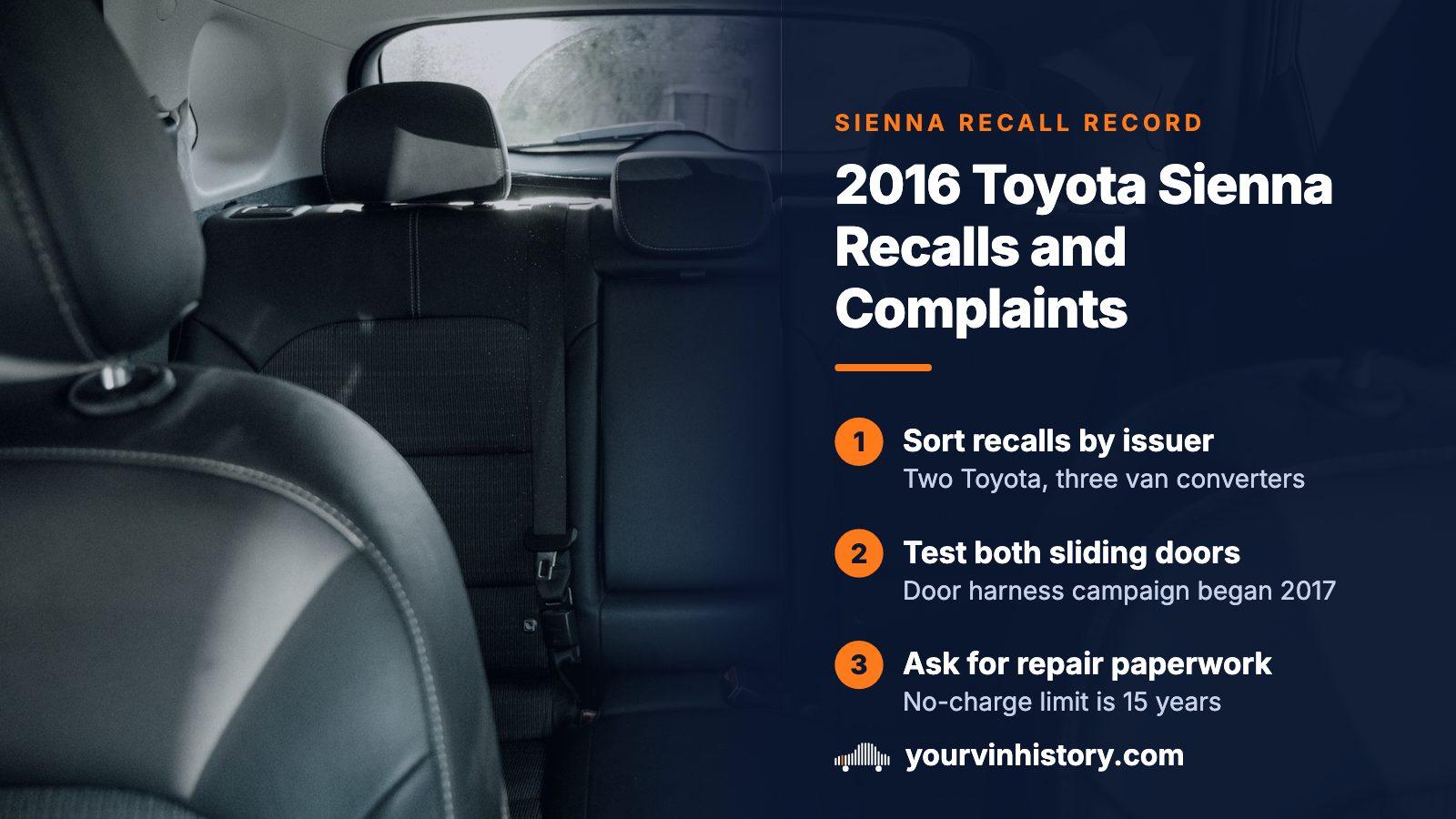
The 2016 Toyota Sienna has 5 recall campaigns on file with NHTSA: a sliding door wiring repair, a seat belt height adjuster swap for a short production window, and three issued by wheelchair-van converters for brake lines, brake hoses and wheelchair restraints. Owners filed 75 complaints, 35% of them under structure. NHTSA rated the van 5 of 5 stars overall. Recalls follow VIN ranges, so each van needs its own lookup.
- Recall campaigns
- 5 on file with NHTSA
- Owner complaints
- 75, with 35% under structure
- NHTSA overall rating
- 5 of 5 stars
- Against other Sienna years
- 10th heaviest of 15, at 0.46 times the median
What the recall file and the complaint file each tell you
NHTSA keeps two separate records for every model year, and they answer different questions. A recall campaign is a defect that a vehicle maker or equipment maker has accepted responsibility for, with a repair attached. A complaint is one owner's account, sent to the government and never ruled on, so a stack of them shows where owners pointed their frustration rather than what failed.
The 2016 Sienna stack holds 75 complaints. Owners described 7 as involving a crash, 1 a fire and 6 an injury. Those flags rest on the owner's own wording, and one incident can spawn several filings, so read them as pointers worth a closer look rather than findings.
Five campaigns, sorted by who built the part
Three of the five do not come from Toyota. They were issued by companies that convert minivans into wheelchair-accessible vans, so a standard passenger Sienna is unlikely to appear on those lists. Only a VIN lookup settles that.
| Campaign | Issued by | Range it names | The fault |
|---|---|---|---|
| 16V858000 | Toyota | 2011-2016 Siennas built January 4, 2010 to August 12, 2016 | Power sliding door can open by itself after refusing a command |
| 16V197000 | Toyota | 2016 Siennas built February 15 to 19, 2016 | Wrong front seat belt height adjusters |
| 19V410000 | Braun Corporation | 2014-2019 Sienna mobility conversions | Brake lines fitted with incorrect tube nuts |
| 19V553000 | Vantage Mobility International | 2012-2018 AMS Genesis vans on a Sienna | Rear brake hoses cut too short |
| 25V876000 | Rollx Vans | 2016-2017 Sienna, among many models | Wheelchair restraint retractors may not lock |
16V858000: the sliding door that can swing open on its own
Toyota's door campaign reaches Siennas of model years 2011 through 2016 built in the stated window. A power sliding door gets a command to open and cannot, for example because it is frozen shut. Later the door may open unexpectedly, including while the van is moving, which raises the risk of injury to anyone inside.
The remedy replaces the junction block and the rear sliding door wire harnesses and adds two sub wire harnesses, all at no charge from a dealer. The campaign began July 28, 2017, and Toyota tracks it as G04. Ask for the dealer work order showing this job, then cycle each sliding door repeatedly from the key fob, the dash switch and the handle.
16V197000: a seat belt part fitted wrong over a few days of production
This one is narrow. Toyota recalled only 2016 Siennas built from February 15 to 19, 2016, because the wrong front seat belt height adjusters may have gone in. In a crash, the incorrect part could touch the B-pillar and tear or separate, leaving the occupant poorly restrained.
Dealers replace the front height adjusters at no charge. The campaign began April 29, 2016, and Toyota's own code is G0H. With a window this short, most 2016 vans fall outside it. On any van, check that both front belts latch and retract cleanly and that the height adjuster slides and locks.
Three wheelchair-van campaigns and how to tell if they apply
- 19V410000, Braun Corporation: brake lines on some mobility conversions may carry incorrect tube nut fittings, letting pressure drop and risking a loss of rear braking power. Dealers install an adaptor. The recall began June 25, 2019.
- 19V553000, Vantage Mobility International: rubber rear brake hoses on AMS Genesis wheelchair vans may be too short and rub the rear axle trailing arm. A failed hose could cost braking and control. Dealers fit hoses with proper clearance. The recall began December 16, 2019.
- 25V876000, Rollx Vans: vans with QRT-Deluxe or QRT-Max wheelchair restraints may have retractors that fail to lock, so a wheelchair is not secured. The report reached NHTSA December 18, 2025, and the remedy is an inspection and replacement of retractors as needed.
Signs of a conversion include a ramp or lift, a lowered floor and tie-down hardware. If you see any, ask the seller for the converter's name and paperwork, because those campaigns are tracked under the converter rather than Toyota.
Where the 75 complaints land by component
Owners choose the component label when they file, and the labels are broad. The twelve largest groups are below.
| Share of the 75 | Reports | Component label |
|---|---|---|
| 35% | 26 | Structure |
| 19% | 14 | Unknown or other |
| 12% | 9 | Electrical system |
| 8% | 6 | Seat belts |
| 7% | 5 | Wheels |
| 7% | 5 | Air bags |
| 5% | 4 | Latches, locks and linkages |
| 5% | 4 | Engine |
| 5% | 4 | Steering |
| 5% | 4 | Exterior lighting |
| 4% | 3 | Power train |
| 4% | 3 | Visibility and wipers |
Structure runs well ahead of every other label. The sliding door campaign is filed under structure in NHTSA's component list, though the complaint file cannot link a given report to a campaign. The electrical label is a catch-all too, covering batteries, wiring, lighting and control modules.
When the complaints arrived and how old the vans were
Filings for this model year peaked in 2017. A peak that close to launch usually points to early faults absorbed by warranty work, while reports that pile up years later point to wear still waiting for the next owner. Each complaint carries the date the owner says the problem happened, which gives the van's age then.
| System | Reports | Median age at failure | Share inside three years |
|---|---|---|---|
| Structure | 26 | 1 year | 81% |
| Unknown or other | 14 | 1.4 years | 71% |
| Electrical system | 9 | 1.3 years | 89% |
Most reports in all three groups landed early, so a well-kept van may already have had the work done. Ask for the paperwork instead of assuming.
A median is not a prediction
These figures come from unverified owner reports. They say when the people who complained say the problem showed up, not how likely any van is to have one. A well-kept example can outlast every age above.
Where 2016 sits among the other Sienna model years
Raw complaint totals follow sales, so the useful comparison sets each year against the Sienna's own median year. That strips out most of the volume effect. It is still a count of owner reports, never a failure rate or a reliability score.
| Yardstick | Where the Sienna stands |
|---|---|
| Rank by volume among model years | 10th heaviest out of 15, covering 2008 through 2022 |
| 2016 versus the median year | 0.46 times |
| Worst year in the run | 2011, 3.77 times the median year |
| Quietest year | 2022, 0.08 times, counted as settled |
At 0.46 times the median, 2016 sits well below a typical Sienna year. That does not clear any individual van, but it puts the model year in the calmer half of the run.
Crash-test stars and the driver-assist gap
| Test | Result |
|---|---|
| Overall | 5 of 5 stars |
| Side crash | 5 of 5 stars |
| Frontal crash | 4 of 5 stars |
| Rollover | 4 of 5 stars |
| Rollover probability | 14.0% |
NHTSA scored two configurations separately, the front-wheel-drive and all-wheel-drive vans, and both earned 5 overall with 4 for rollover. The program tests a representative new van, so treat the stars as a ceiling for the model year. Repair quality after a collision is the one thing the ratings cannot see.
Driver-assistance gear varies. Forward collision warning was optional on this model year, so some vans have it and some do not. Lane departure warning was not offered.
How long a recall repair stays at no charge
Federal law, 49 U.S.C. §30120, lets a manufacturer decline the no-charge remedy when the first purchaser bought the vehicle more than 15 calendar years before the recall notice. The count starts at the first sale, so a second or third owner does not restart it. A Sienna sold new in 2016 is inside that window today, though the margin narrows each year.
Take the two Toyota campaigns to a Toyota dealer. The converter campaigns run through the converter, with dealers named in the Braun and Vantage fixes. Whatever the lookup shows as open, ask for written proof of any repair marked done.
What to put in front of a mechanic
- Structure and body: panel gaps, door fit and any trace of collision repair, since this label draws the most reports.
- Electrical system: scan the modules for stored codes and test lighting, power doors and the power hatch.
- Sliding doors: tracks, rollers and motors, the priciest routine failure on a minivan.
- Hatch struts and the tailgate seal, plus the latches and folding mechanisms on the second and third rows.
- Transmission behavior under load, because vans spend their lives carrying weight.
- Engine bay and wiring: a fire report exists for this model year, so look for heat damage and amateur electrical work.
Questions for the seller, then the VIN lookup
- Is this a factory minivan or a wheelchair-accessible conversion, and who did the conversion?
- Which of the five campaigns apply to this VIN, and where is the dealer paperwork for each?
- Was a sliding door or any structural part ever repaired or swapped?
- Which shop has serviced it, and do the records show what was done?
- Was there a collision, and did an insurer cover the repair?
- Will you let my own mechanic inspect it before we discuss price?
Everything above describes the model year, and the van on the lot has its own story. Run its VIN through NHTSA's recall lookup for open campaigns. For title brands, accidents with a damage map, odometer readings and liens, the yourvinhistory preview costs nothing and the full report is a one-time purchase.
Where this information comes from
- NHTSA: recalls lookup — Where a VIN is entered to see unrepaired campaigns; the five campaign summaries on this page come from the same agency records.
- NHTSA: vehicle safety and complaints — Entry point to the owner filings behind the 75 total, the component counts and the crash, fire and injury flags.
- 49 U.S.C. §30120: remedy without charge — Statute text for the no-charge remedy and the 15 calendar year limit counted from the first sale.
- NHTSA: 5-Star Safety Ratings — The federal crash-test program behind the overall, frontal, side and rollover results above.
- NMVTIS: national title information system — Federal source for title brands and history, which a safety record does not include.
Sources and photos: Facts checked against the sources above in October 2026. Photo by THLT LCX on Unsplash; diagrams by YourVINHistory.
Keep reading
- Toyota Sienna years to avoid, ranked by NHTSA complaintsRanks every Sienna model year by complaints, so you can see how 2016 compares with the heavier ones.
- Toyota recallsShows how to check any Toyota by VIN for open campaigns.
- Buying a car with an open recallCovers what to do when the lookup shows a repair that was never made.
- 2016 Toyota Highlander: 3 recalls, 115 complaints, 5-star ratingAnother Toyota family hauler from the same model year, with its own recall and complaint record.
Frequently asked questions
Does my 2016 Toyota Sienna have an open recall?
Five campaigns are on file for the model year, but each covers a defined build range or a converter's vans, so some may not apply. Enter the 17-character VIN in NHTSA's recall lookup, which shows what remains unrepaired on that exact van. A converted wheelchair van also needs the conversion maker's campaigns checked.
What are the most common problems with a 2016 Toyota Sienna?
By owner reports, structure leads with 26 of 75, followed by the unknown or other bucket at 14 and the electrical system at 9. These are unverified filings, not confirmed defects. The sliding door campaign sits under the structure heading in NHTSA's component list, which makes the doors a sensible first test.
Is the 2016 Toyota Sienna a safe minivan?
NHTSA's tests gave it 5 of 5 stars overall and for side crash, 4 for frontal crash and 4 for rollover, with a rollover probability of 14.0%. Those results describe a representative new van. Past collision repair or a missed recall can change how a used one performs, so inspect the car as well as the stars.
Who pays for a recall repair on a 2016 Sienna?
For the Toyota campaigns, a dealer does the work at no charge, provided the van is inside the federal limit of 15 calendar years from the first sale. Each converter campaign names its own no-cost remedy. A later owner is covered too, because the clock runs from the first purchase, not the current one.
Will an NHTSA check show if a Sienna was in an accident?
No. NHTSA's file covers recalls, owner complaints and crash-test results for the model, not the history of one van. Accident, salvage and title records sit in other databases, and NMVTIS supplies title brands. A yourvinhistory report gathers those histories by VIN, and the preview shows what exists before you buy.
Now check the car itself
The guide explains what to look for. The report shows what this VIN has on record.