THE SHORT ANSWER
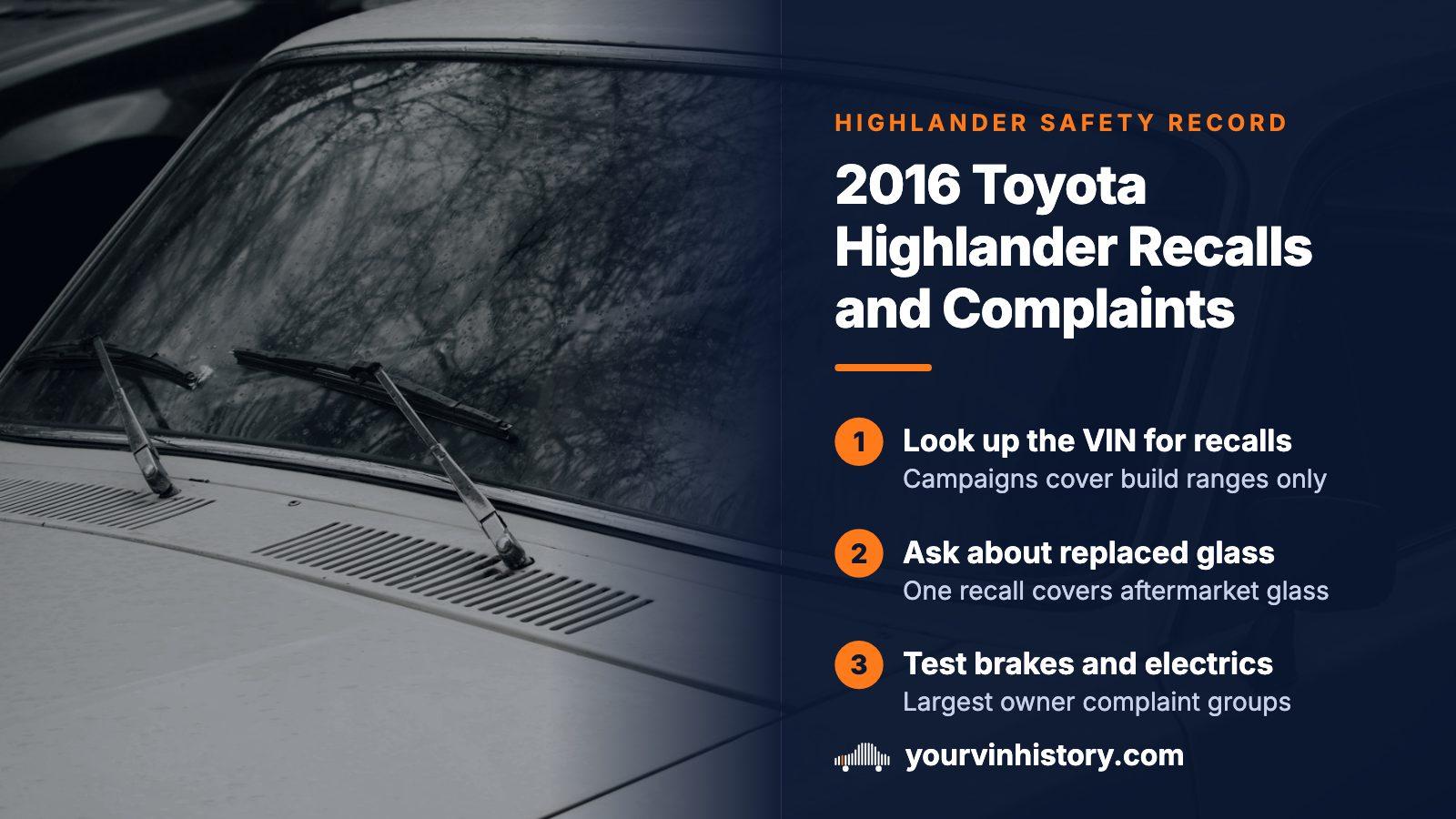
The 2016 Toyota Highlander has 3 recall campaigns on file with NHTSA: 16V775000 for a brake fluid sensor connection, 16V420000 for load labels and 18E107000 for aftermarket replacement windshields. Owners filed 115 complaints, led by service brakes and unknown or other at 22 apiece. NHTSA rated the SUV 5 of 5 overall, with 4 stars in the frontal and rollover tests. Campaigns follow build ranges and parts, so a VIN lookup shows which ones apply.
- Recall campaigns
- 3 on file with NHTSA
- Owner complaints
- 115, with brakes and unknown or other at 22 each
- NHTSA crash rating
- 5 of 5 overall, 18.5% rollover probability
- Against other Highlander years
- Lightest of 15, at 0.49 times the median
What the 3 recalls and 115 complaints each tell you
NHTSA keeps two kinds of record on a model year, and they carry different weight. A recall is a defect the manufacturer has accepted responsibility for, with a repair attached; the 2016 Highlander has 3 of them. A complaint is a single owner's account, filed with the agency and never tested in a hearing; this model year has 115.
Within the complaint pile, 14 reports mention a crash, 1 a fire and 11 an injury. Those are claims made at the time of filing, not findings by investigators, and one incident can generate more than one report. They are still the entries worth reading in full before you buy.
The three campaigns side by side
Copy the campaign numbers before you call a dealer or open the NHTSA lookup, because that is how both sides find the paperwork.
| Campaign | Started | Issued by | The problem | The remedy |
|---|---|---|---|---|
| 16V420000 | July 14, 2016 | Southeast Toyota Distributors | Load-capacity labels that could understate the weight of fitted accessories | A corrected label placed over the wrong one |
| 16V775000 | November 14, 2016 | Toyota | A brake fluid level sensor possibly left unconnected on cars built May 26 to September 16, 2016 | Dealer inspection and reconnection where needed |
| 18E107000 | January 29, 2019 | Fujian Wanda Automobile Glass Industry | Aftermarket replacement windshields with a wire harness that water can reach | New windshield plus an engine computer check |
The label campaign came from a regional Toyota distributor and also names Camry, Tundra, Scion FR-S and tC models. A wrong weight figure could lead an owner to overload the vehicle, which touches a federal tire and rim standard, number 110.
16V775000: a brake fluid sensor that may be unconnected
Toyota recalled 2016 Highlanders built between May 26 and September 16, 2016, because the brake fluid level sensor might never have been joined to its wiring. With no signal, the car cannot warn the driver that fluid is low, and NHTSA's summary says braking could suffer as a result, raising crash risk. The condition also put those vehicles out of step with Federal Motor Vehicle Safety Standard 135, which governs light vehicle brake systems.
The remedy is an inspection, with the harness connected to the sensor wherever it was found loose, done by a dealer at no charge within the federal limits. The build window is only a few months wide. A Highlander made outside it is not part of the campaign, and one made inside it may already have been fixed. Neither answer is visible from the driver's seat, which is why the VIN lookup earns its keep here.
18E107000: a recall that follows the glass, not the car
This campaign comes from the glass maker, not Toyota. Fujian Wanda Automobile Glass Industry recalled certain aftermarket windshields sold for 2014 to 2018 Highlanders. The glass has a wire harness attached, and water that gets into it can reach the engine control module. Damage there could stall the engine, which is why NHTSA treats it as a crash risk. Wanda said service centers would swap the windshields, inspect the module and replace it if damaged.
For a buyer the useful question is simple: has this Highlander ever had a new windshield? A car still wearing its original glass is not the subject of the campaign. One with replacement glass should come with an invoice naming the brand, and a call to the glass shop is worth making if the paperwork is thin.
Where the 115 complaints cluster
Total complaints mostly reflect how many cars were sold, so the useful part is the spread. Owners pick the component when they file. These are the largest groups for the model year.
| Share | Reports | Component category |
|---|---|---|
| 19% | 22 | Unknown or other |
| 19% | 22 | Service brakes |
| 12% | 14 | Electrical system |
| 9% | 10 | Air bags |
| 8% | 9 | Engine |
| 7% | 8 | Exterior lighting |
| 6% | 7 | Steering |
| 6% | 7 | Tires |
| 6% | 7 | Visibility and wiper |
Two groups tie at the top. Unknown or other is a catch-all, but the service brakes tie deserves a closer look. That category holds owners reporting a brake defect, not ordinary pad and rotor wear, so a routine brake job on a used example proves nothing either way. No single category pulls away from the rest, so the file does not point to one recurring fault.
How old the car was when owners say each system failed
Each complaint carries the date the owner says the trouble happened, and the gap from the 2016 model year gives the car's age at that moment. The table shows the median for the six largest groups, plus the share of reports that landed inside the first three years.
| System | Median age | Dated reports | Within 3 years |
|---|---|---|---|
| Air bags | 1.7 years | 9 | 56% |
| Service brakes | 2.8 years | 21 | 52% |
| Exterior lighting | 2.9 years | 8 | 50% |
| Unknown or other | 3 years | 22 | 50% |
| Engine | 3.9 years | 9 | 33% |
| Electrical system | 4 years | 14 | 36% |
Half or more of the air bag, brake, lighting and unknown reports arrived within three years of the model year, so a cared-for car may have had those repairs done under its original coverage; request the work orders rather than guess. Electrical reports came latest, at a median of 4 years, which makes that the group an older car's buyer should budget for. Treat the figures as the middle point of unverified owner reports, not as odds of failure. A Highlander with full service records can outlast every number in the table.
Where 2016 falls among Highlander model years
The nameplate's own median year gives a fair yardstick, because it softens the effect of sales volume. Measured that way, 2016 comes in at 0.49 times the median, the lightest of the 15 model years from 2008 through 2022. The heaviest year on record is 2008, at 2.55 times the median. Filings for the 2016 cars peaked in 2019, and a peak that arrives years after sale usually points to parts that age with the car rather than a launch flaw already fixed under warranty.
A low ranking is not a clean bill
The comparison counts owner reports and nothing else. It cannot see collision repairs, odometer history or deferred maintenance, and a low total can partly reflect how many owners bothered to file. Use it to worry less about the model year, then let the individual car earn its price.
Crash-test results and the driver-assist caveat
NHTSA's New Car Assessment Program gave the 2016 Highlander 5 of 5 stars overall and 5 for side crash protection. The frontal crash and rollover tests each earned 4 stars, and the agency's rollover probability figure is 18.5%.
Two configurations were scored, front-wheel drive and all-wheel drive, and both finished at 5 stars overall with 4 for rollover, so the drivetrain does not change the headline result. The ratings describe a new test vehicle. They cannot see a past collision or how well it was repaired.
Driver-assist gear was not uniform. Forward collision warning was optional and lane departure warning was an option to confirm, so check the specific car's equipment.
What to check on a used 2016 Highlander
The federal file points to places to look; it does not diagnose anything. Start with the groups that showed up in this model year's complaints.
- Brakes: ask whether the brake fluid warning has ever lit or been ignored, confirm the sensor campaign was done, and test pedal feel on a firm stop.
- Electrical: run every light, window, lock and screen, then look under the hood for wiring that someone added or spliced. One fire report exists for the model year, so look for heat marks.
- Air bags: confirm the warning light goes out after starting, and ask about any air bag repair, since 10 owners filed in that category.
- Windshield: look for replacement glass and ask for the invoice, because campaign 18E107000 concerns aftermarket glass.
- All-wheel drive: have a mechanic check the transfer case and couplings, which hide trouble on a short drive.
- Water paths: inspect the tailgate seals, the spare-tire well, the floor under any third-row seats and the roof-rail mounts for damp or rust.
Confirming open recalls, and where the limits sit
Only a VIN answers the open-recall question. Enter the 17-character number into NHTSA's recall lookup and it returns the campaigns still unrepaired on that car, which can be none even though the model year has 3 on file.
Dealers repair recalls at no charge, but the federal rule has limits. Under 49 U.S.C. §30120, the duty to remedy without charge does not apply once the first purchaser bought the vehicle more than 15 calendar years before the manufacturer's notice or NHTSA's order, whichever came first. Ask the dealer or maker to confirm eligibility for a given campaign rather than assume it.
NHTSA's records say nothing about title brands, accident history, odometer readings or liens. A vehicle history report on the VIN, this site's included, covers those, and NMVTIS is the federal source behind the title data. Ask the seller for proof that all 3 campaigns were completed and whether the windshield was ever replaced.
Where this information comes from
- NHTSA: recalls by vehicle — Where a 17-character VIN is entered to see unrepaired campaigns, and the agency record behind the three campaign summaries here.
- NHTSA: vehicle safety and owner complaints — Entry point to the owner filings behind the 115 total, the category counts and the crash, fire and injury mentions.
- 49 U.S.C. §30120: remedy without charge — Statute text for the no-charge repair and the 15 calendar year cutoff counted from the first sale.
- NHTSA: 5-Star Safety Ratings — The federal crash-test program that produced the overall, frontal, side and rollover results.
- NMVTIS: national title information system — Federal source for title brands and history, which a safety record leaves out.
Sources and photos: Facts checked against the sources above in October 2026. Photo by Tigran Shishmanyan on Unsplash; diagrams by YourVINHistory.
Keep reading
- Toyota Highlander years to avoid: 2008, 2019 and 2021 stand outRanks every Highlander year against the nameplate's median, so you can see where 2016 sits.
- Toyota recallsWalks through checking any Toyota by VIN for open campaigns.
- Buying a car with an open recallCovers what to do when the lookup shows a repair was never made.
- NMVTIS reportExplains the title record that a federal safety file does not include.
Frequently asked questions
Does a clean recall lookup mean a 2016 Highlander is fine to buy?
No. The lookup answers one narrow question, whether campaigns are open on that VIN. It says nothing about brake wear, electrical faults, collision repair, title brands or the odometer. After a clean result, still book a mechanic's inspection and run a history report on the same VIN.
Did the 2016 Highlander do well in crash tests?
NHTSA gave it 5 of 5 stars overall and 5 for side impact, with 4 each for frontal and rollover. The all-wheel-drive and front-wheel-drive versions scored alike. Stars come from a new test vehicle, so a used one with collision repairs can behave differently, and driver-assist features such as forward collision warning were optional equipment.
What do owners complain about most on a 2016 Highlander?
Service brakes and unknown or other each account for 22 of the 115 complaints, about 19% apiece. Electrical system follows with 14 and air bags with 10. The reports are unverified and spread across many categories, so use them as a prompt for what to test on a drive, not as proof of a recurring defect.
Will a dealer fix a 2016 Highlander recall at no charge?
Within the statutory limits, yes. The federal rule excuses the no-charge remedy when the first purchaser bought the vehicle more than 15 calendar years before the notice or NHTSA order. The windshield campaign is run by Wanda, the glass maker, which said service centers would do the work, so contact the maker for that one.
Does a replaced windshield put a 2016 Highlander in the Wanda recall?
Only if the glass is one of the aftermarket windshields the campaign names, sold for 2014 through 2018 Highlanders. A car on original glass is outside it. If a shop fitted new glass, ask for the invoice and check the maker and part against the campaign notice on NHTSA's recall pages.
Now check the car itself
The guide explains what to look for. The report shows what this VIN has on record.