THE SHORT ANSWER
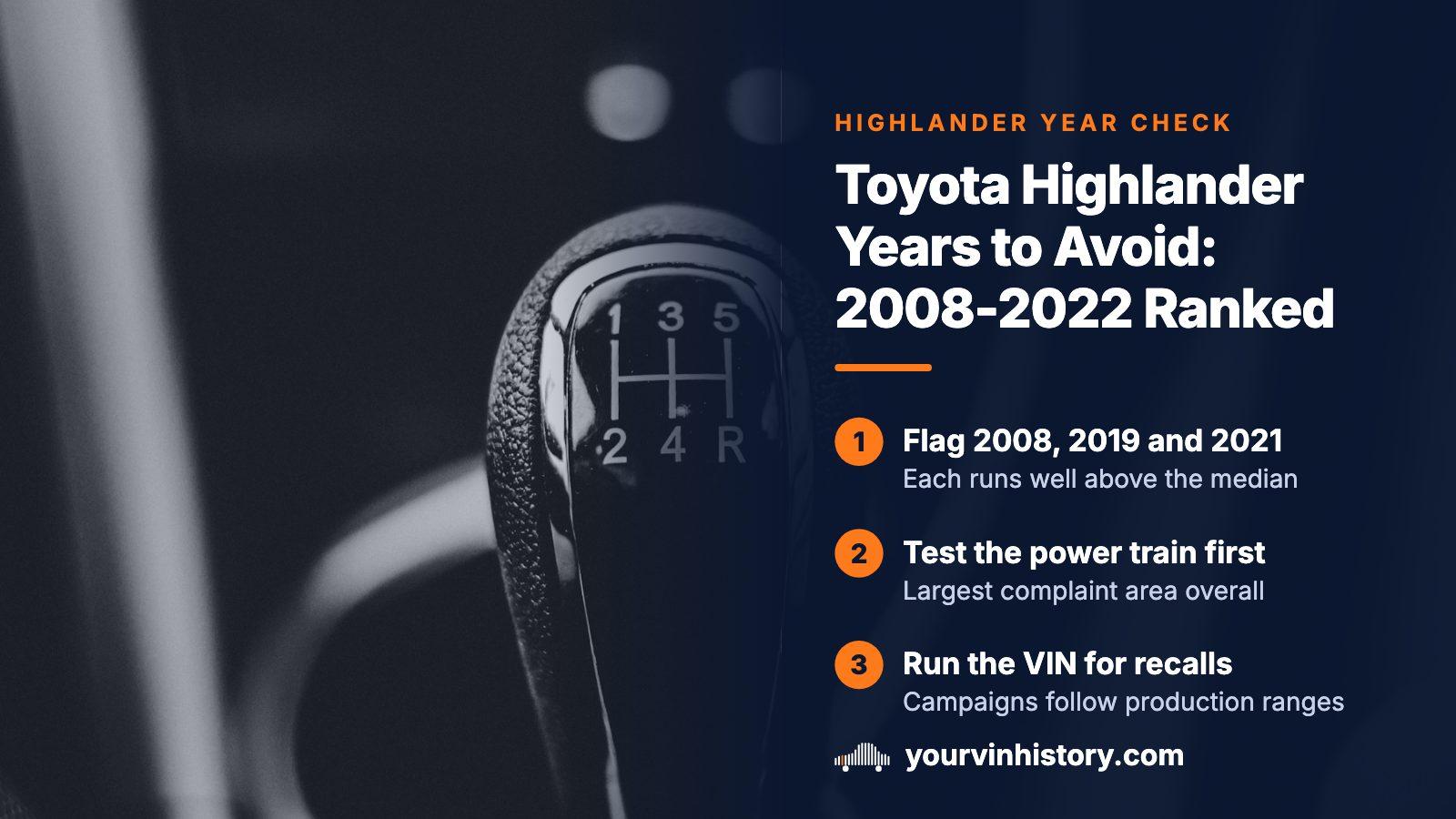
On NHTSA complaint volume, the 2008, 2021 and 2019 Toyota Highlander years stand out, at 600, 503 and 477 reports against a yearly median of 235. The 2016 year is the lightest at 115. Power train is the biggest complaint area, with 691 reports, ahead of service brakes at 554. A complaint is an unverified owner account, not a failure rate, so a flagged year means inspect harder, not walk away.
- Complaints on record
- 4,097 across 2008 to 2022
- Median year
- 235 complaints
- Heaviest year
- 2008, with 600 complaints
- Top complaint area
- Power train, 691 reports
What each year's score is measured against
A raw complaint total mostly follows how many SUVs were sold and how long they have been on the road. A popular year piles up reports that a scarce year never gets the chance to collect. To strip some of that out, this page sets each model year against the Highlander's own typical year: the median across the 15 model years from 2008 to 2022, which is 235 complaints.
A year at 1 times the median is ordinary, and a year at 2 times has drawn about twice the usual volume. The pool holds 4,097 NHTSA consumer complaints, with duplicates removed by each report's ODI number and the data pulled on August 15, 2026. Recall counts sit beside the complaints because they measure something different, and a later section explains how.
All fifteen Highlander years in one table
Standing uses plain words for the bands in the source data. Judging by the rows, the line for the top label falls between 1.33 and 2.03 times the median, and the line for the bottom label between 0.49 and 0.58.
| Model year | Standing | Times the median | Complaints | Recalls |
|---|---|---|---|---|
| 2008 | Well above | 2.55× | 600 | 13 |
| 2009 | Near median | 0.74× | 174 | 9 |
| 2010 | Near median | 1.01× | 238 | 10 |
| 2011 | Near median | 0.79× | 186 | 5 |
| 2012 | Near median | 0.81× | 190 | 2 |
| 2013 | Near median | 0.89× | 210 | 3 |
| 2014 | Near median | 0.58× | 136 | 5 |
| 2015 | Near median | 0.82× | 193 | 2 |
| 2016 | Below | 0.49× | 115 | 3 |
| 2017 | Near median | 1.12× | 264 | 4 |
| 2018 | Near median | 1.12× | 263 | 5 |
| 2019 | Well above | 2.03× | 477 | 3 |
| 2020 | Near median | 1.33× | 313 | 4 |
| 2021 | Well above | 2.14× | 503 | 4 |
| 2022 | Near median | 1× | 235 | 5 |
| Median year | Benchmark | 1× | 235 | n/a |
The 2022 row is the median itself. With fifteen years in the pool, the median is the eighth value counted from either end, and 235 is where 2022 lands.
2008: the loudest year, with brakes and wiring in the mix
The first model year in the run is also the heaviest: 600 complaints, 2.55 times the median and well clear of the runner-up, 2021, at 503. It also lists 13 recalls, the most of any Highlander year, so Toyota ran repair campaigns for defects it acknowledged as well as owners filing reports.
Two component areas stand out in the 2008 record. Service brakes is its most-reported area, and the electrical system is also prominent. The data holds counts, not owner narratives, so what exactly went wrong stays unknown. The counts point a mechanic toward an area, not toward a particular part.
2019 and 2021: a late climb after a long calm
Complaints jump from 263 for the 2018 model year to 477 for 2019, which is 2.03 times the median. A step that size can mark a redesign or a major mechanical change, not a slow drift, though this data cannot say which happened here. If you are weighing a 2018 against a 2019, ask what changed between them.
The 2021 year climbs higher, at 503 complaints or 2.14 times the median, and power train is the most-reported area for both 2021 and 2019. Their recall tallies are modest, 3 for 2019 and 4 for 2021, so the recall column offers no explanation for the volume.
Between them sits 2020, with 313 complaints. Its label reads near the median at 1.33 times, yet the count tops every year from 2009 through 2018. The 2022 year drops back to 235. These are the youngest rows, and a younger SUV has had less time to collect reports, so treat their counts as a record still forming.
2009 to 2018: the settled middle and the lightest year
Eight years, 2009 through 2016, land between 115 and 238 complaints. The 2017 and 2018 years follow at 264 and 263, both 1.12 times the median. Nothing in that stretch earns a flag, and the 2010 year sits only one complaint above the median, at 1.01 times.
The lightest record in the whole table belongs to 2016: 115 complaints, 0.49 times the median, with 3 recalls. It is the only year with the below-median label, and 2014 comes next at 136. The cleanest list leaves out the most recent three model years, because young cars always look quiet, but that exclusion changes nothing here since 2016 is also the lowest row in the full table.
On recalls, 2012 and 2015 list only 2 apiece, the fewest in the run. This site has a separate record page for the 2016 Highlander.
What the recall column adds, and where it stops
A recall is a defect the maker has acknowledged and must repair without charge to the owner. A complaint is one person's unverified account. The two can disagree: 2008 pairs the most complaints with 13 recalls, while 2019 and 2021 pair heavy complaint volume with only 3 and 4.
The no-charge promise has an expiry date. Under 49 U.S.C. §30120(g), the duty to repair at no cost ends for a vehicle first bought more than 15 calendar years before the recall notice. A new campaign on a 2008 or 2009 Highlander can therefore fall outside coverage. Confirm the cost with a dealer using the VIN.
Campaigns also follow production ranges, not whole model years, so a recall count for a year says little about the one SUV in front of you. Only the VIN answers that.
Where the complaints land: power train, brakes, wiring
NHTSA files each complaint under a component bucket. Across all fifteen years, the six largest rank like this.
| Component bucket | Reports, 2008 to 2022 | What the bucket covers |
|---|---|---|
| Power train | 691 | Transmission and other drive parts |
| Service brakes | 554 | Brake defects owners reported, not routine wear |
| Electrical system | 463 | Battery, wiring, lighting and modules |
| Unknown or other | 454 | Reports with no clear component |
| Engine | 320 | Engine faults of any kind |
| Structure | 253 | Body and frame |
Power train tops the list overall and is the leading area in two of the three flagged years. The buckets are broad, so a count marks where to look, not a failed part or a number of affected SUVs.
Five ways a complaint ranking can mislead
The table already corrects for some of these, but the rest stay with the reader.
- Sales volume: a bestselling year gathers more filings than a scarce one of equal quality, hence the comparison with the Highlander's own median.
- Time on the road: older SUVs have had longer to collect reports, which flatters the newest rows.
- Unverified accounts: each complaint is one owner's belief about what went wrong, valuable in the aggregate and shaky taken alone.
- Recalls point the other way: they are acknowledged defects with a repair attached, so a long list is not automatically bad news.
- Not a rate: a complaint count is neither a failure rate nor a reliability score.
A flag is a bargaining position
Every year in the table includes SUVs serviced on schedule and SUVs that were neglected. A high multiple means look closer and bargain harder. It does not mean skip a vehicle nobody has inspected yet.
Inspecting a Highlander from a flagged year
The complaint areas show a mechanic where to start. On a 2008, 2019 or 2021 example, work through these in order.
- Enter the 17-character VIN in NHTSA's recall lookup first. It shows which campaigns apply to that SUV and whether the repair was done.
- Ask for the service file. On an SUV this age, documented upkeep outweighs any model-year statistic, and gaps in it are a fair reason to ask for a lower price.
- Look for transmission and drivetrain service records, then test drive for hesitation, harsh or late shifts and odd noises, since power train is the largest area.
- On a 2008, check pedal firmness, pulling and vibration under braking, and ask for invoices covering pads, rotors and fluid.
- Run every electrical function: windows, locks, lights and the dash warning lamps at start-up. Have a shop scan for stored codes before you commit.
From a model year to the SUV in front of you
With room in the budget, 2009 through 2018 is the calmer hunting ground, and 2016 is the lightest of it. Price can still pull you toward a flagged year. That can work, if the recalls are complete and the paperwork is thick: a documented 2008 can beat a 2016 with no history at all.
Once the year is settled, everything that matters belongs to one vehicle. NHTSA's recall lookup lists open campaigns by VIN. NICB's VINCheck, a no-cost tool, screens for reported theft and total-loss records, and the federal NMVTIS site explains national title records. For a fuller history of that SUV, this site offers a free preview from the VIN and a one-time paid report with title brands, accident records and a damage map, odometer readings, and salvage or auction records. Compare the results with what the seller says.
Where this information comes from
- NHTSA: Vehicle safety — The federal home of the owner complaint records counted in every row of this ranking.
- NHTSA: Recalls — Where the recall totals by model year come from, and the VIN search that shows campaigns open on one SUV.
- Bureau of Justice Assistance: NMVTIS — A federal overview of national title records, which cover the title history of a single vehicle.
- NICB: VINCheck — A no-cost lookup for theft and total-loss reports on an individual VIN.
Sources and photos: Facts checked against the sources above in October 2026. Photo by Alok Sharma on Unsplash; diagrams by YourVINHistory.
Keep reading
- 2016 Toyota Highlander: 3 recalls, 115 complaints, 5-star ratingThe single-year record for the lightest Highlander in this ranking, with its recall campaigns and complaint areas.
- Toyota recallsHow to find open Toyota recalls by VIN, the first check on any Highlander.
- Toyota Highlander Hybrid battery replacement cost by model yearWhat the hybrid battery costs, worth reading if a Highlander Hybrid is on your list.
- Honda Pilot years to avoid: 2016, 2017 and 2019 lead NHTSA complaintsThe same year-by-year ranking for a rival SUV, for a like-for-like comparison.
Frequently asked questions
Which Toyota Highlander years should I avoid?
By complaint volume, the 2008, 2021 and 2019 years stand out, at 600, 503 and 477 reports against a median of 235. Avoid is a strong word, though. A flagged year is a cue to ask for recall proof and service records and to price in inspection work, since sound Highlanders turn up in every year on the list.
Which Toyota Highlander year has the fewest complaints?
The 2016 year, with 115 complaints, 0.49 times the median and 3 recalls. The 2014 year follows at 136. Complaint volume cannot crown a most reliable year, because it ignores mileage and upkeep, but both years sit in the settled stretch where the record has had time to form.
What problem do Toyota Highlander owners report most?
Power train leads with 691 reports, then service brakes at 554 and electrical system at 463. Another 454 reports carry no clear component. The categories are broad and unverified, so they suggest where an inspector should begin with any Highlander, not which part is failing or how many SUVs are affected.
Is a 2008 Toyota Highlander too old to buy?
Age alone does not rule it out, but the 2008 has the heaviest record at 600 complaints and the most recalls at 13. A new recall on an SUV that old may fall outside the 15-year no-charge limit in 49 U.S.C. §30120(g). Demand documented brake, drivetrain and electrical history, and run the VIN through NHTSA's recall lookup.
Are the 2020 to 2022 Highlanders free of these problems?
Not necessarily. The 2020 year has 313 complaints and 2021 has 503, or 2.14 times the median, while 2022 sits at the median of 235. Newer SUVs have had less time to collect reports, so a quiet year may only be young. Check the VIN for open recalls and read the service file.
Now check the car itself
The guide explains what to look for. The report shows what this VIN has on record.