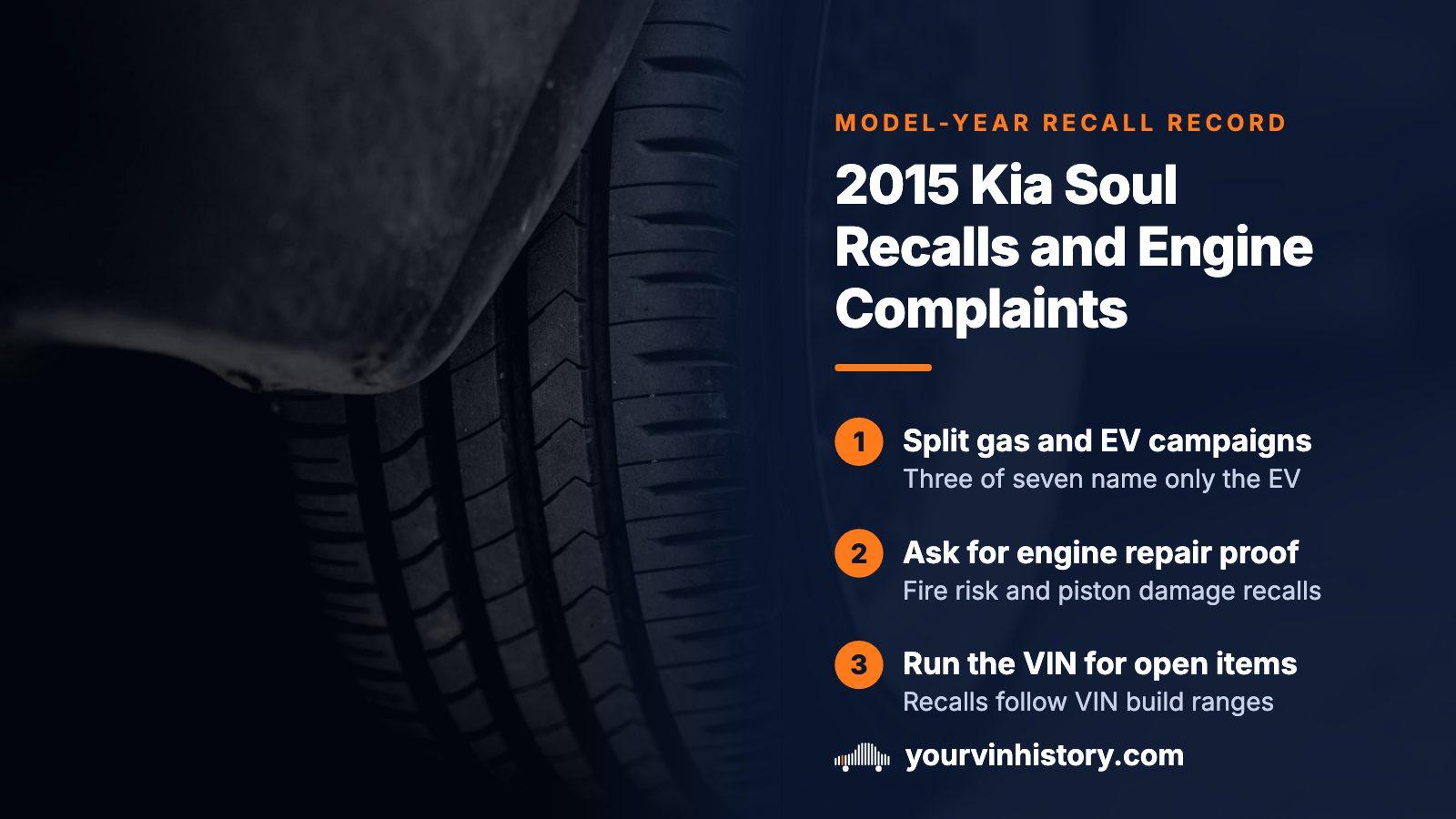
THE SHORT ANSWER
NHTSA lists 7 recall campaigns for the 2015 Kia Soul. Four reach the regular car: an engine fire risk, piston damage, a steering pinion plug and an accelerator pedal. Three name only the Soul EV. Owners filed 902 complaints, 628 about the engine, and NHTSA rates the crash tests 5 of 5 overall. Recalls follow VIN ranges, so each car needs its own lookup.
- Recall campaigns
- 7 in NHTSA's records, 3 naming only the Soul EV
- Owner complaints
- 902, with 70% under engine
- NHTSA crash rating
- 5 of 5 overall, 4 of 5 rollover
- Against other Soul years
- 3.13 times the median, heaviest of 13
What three kinds of federal entry say about this Soul
NHTSA keeps separate files on every model year, and they do not carry equal weight. A recall is a defect the maker has accepted and must fix. A complaint is one owner's unverified account. An investigation is the agency looking into a possible pattern, which can end in a recall or in nothing. For the 2015 Kia Soul the totals are 7 recall campaigns, 902 complaints and 5 investigations, open or closed.
Some owners also describe what happened when they filed: 36 mention a crash, 82 a fire and 32 an injury. NHTSA has not confirmed those labels, and one incident can produce several reports. They are still worth reading in full before you buy.
Seven campaigns, sorted by which Soul they name
NHTSA files campaigns by component, which hides the most useful fact: not every campaign reaches every Soul. This table groups them by who they name. The first two digits of a campaign number are the year it opened.
| Who it names | Campaign | NHTSA component |
|---|---|---|
| 2014 and 2015 Soul, shared with other Kia models | 20V750000 | Engine |
| Soul with the 1.6L GDI engine | 19V120000 | Engine |
| Soul and Soul EV | 17V608000 | Steering |
| Soul and Soul electric built in a set window | 15V123000 | Vehicle speed control, accelerator pedal |
| Soul EV only | 20V389000 | Power train, gear position indication |
| Soul EV only | 23V724000 | Power train, gear position indication |
| Soul EV with the E400 battery | 23V218000 | Electrical system, traction battery |
Read the first four rows as the ones a gasoline Soul can carry and the last three as electric-only. Within a group, build ranges still differ, so two Souls on one lot can too.
Engine campaigns: a fire risk and piston damage
Campaign 20V750000 covers an engine compartment fire that can start while the car is moving. It names 2014 and 2015 Soul cars along with several other Kia models. Dealers look for fuel or oil leaks, run an engine test and repair what they find, up to a replacement engine, then update the software for the Knock Sensor Detection System.
Campaign 19V120000 reaches 2012 through 2016 Souls with the 1.6L gasoline direct injection engine. Hot exhaust can damage the catalytic converter, which upsets combustion and can wreck a piston or break a connecting rod. A rod that breaks may punch through the block and let oil reach the exhaust, adding a fire risk to a stalled engine. Dealers reprogram the engine computer to stop the overheating, replace a damaged converter and, where damage went further, replace the engine. It began on April 17, 2019.
The steering pinion plug and the accelerator pedal
Campaign 17V608000 covers 2014 through 2016 Soul and Soul EV cars. A pinion plug can let the pinion gear come loose from the steering gear assembly, and a separated gear means lost steering. Dealers inspect and secure the plug, or replace the whole steering gear when needed. The campaign began on November 16, 2017, and it supersedes 14V-332 and 15V-736, so cars fixed under those older numbers were called back again. A receipt for the earlier numbers does not close this one.
Campaign 15V123000 is the narrowest. It applies to 2014 and 2015 Soul and Soul electric cars built between July 21, 2013 and January 8, 2015. A pedal that bends or fractures can make it hard to accelerate, so the dealer fits a supporting rubber piece beneath the pedal stopper. Dealers have offered the work since March 24, 2015.
Three campaigns that name only the electric Soul
Campaigns 20V389000, 23V724000 and 23V218000 are about the Soul EV, not the gasoline car, so they are background for a gasoline listing. The first two concern a parking mechanism that can be damaged by shifting into Park before the car has fully stopped, letting it move with the parking brake off. The remedy is a control unit software update. NHTSA's record for 23V724000 says it widens and replaces 20V389000 and covers 2015 through 2019 Soul EVs, so a repair under the older number does not finish the job.
Campaign 23V218000 concerns the E400 battery in the same 2015 through 2019 range. The high-voltage pack can short-circuit while the car is driven, which raises fire risk. Dealers update or replace the battery management system and its software, and the battery is replaced if abnormal voltage shows up.
When recall work costs the owner nothing
A dealer does recall repairs at no charge to the owner, but the statute behind that promise has an edge. Under 49 U.S.C. section 30120, a maker need not remedy a vehicle at no charge when the first purchaser bought it more than 15 years before the maker's notice or NHTSA's order, whichever came first. The clock starts at the first sale, so a used buyer cannot restart it.
Run the VIN before you run the numbers
NHTSA's recall lookup takes the 17-character VIN and lists open campaigns for that car at no cost. Recalls follow production ranges, so a Soul can be clear of 19V120000 and still owe 17V608000. If an item is open, a Kia dealer can book the work, and Kia customer service takes calls at 1-800-333-4542.
Where the 902 complaints land
NHTSA files each complaint under the part the owner blamed, so the table shows belief, not shop findings. The shape matters more than the total: when one category draws most of the reports, that points to a single weak area instead of ordinary wear.
| Share of 902 | Complaints | Component |
|---|---|---|
| 70% | 628 | Engine |
| 12% | 108 | Unknown or other |
| 8% | 76 | Electrical system |
| 8% | 76 | Fuel or propulsion system |
| 7% | 62 | Power train |
| 6% | 58 | Engine and engine cooling |
| 5% | 44 | Steering |
| 4% | 36 | Exterior lighting |
| 4% | 34 | Service brakes |
| 3% | 31 | Vehicle speed control |
| 2% | 20 | Air bags |
| 2% | 16 | Structure |
Engine and engine cooling is a separate bucket of 58, apart from the 628, so engine talk is split across two categories. Steering (44) and vehicle speed control (31) touch the same subjects as the pinion plug and pedal campaigns, though NHTSA does not tie a complaint to a campaign.
How old the car was when owners reported trouble
Each complaint carries the date the owner says the problem occurred. Measure from the 2015 model year to that date and you have the car's age at the time. Engine reports center on 6.2 years, with only 1% inside the first three, so most of that repair bill landed after the original warranty would have run out.
| System | Median age in years | Inside first three years |
|---|---|---|
| Engine | 6.2 | 1% |
| Unknown or other | 6.5 | 8% |
| Electrical system | 5.6 | 21% |
| Fuel or propulsion system | 6.2 | 8% |
| Power train | 5.9 | 8% |
| Engine and engine cooling | 7.6 | 3% |
| Steering | 4.9 | 39% |
| Exterior lighting | 5.5 | 8% |
Steering is the early outlier at 39%, and electrical follows at 21%. Engine and engine cooling arrives latest, at 7.6 years. Filings overall peaked in 2020. These are medians of unverified reports, not odds of failure: a Soul with full service records can beat every figure here, and a neglected one can fall short of them.
Where 2015 ranks among Soul model years
Comparing each model year's complaint count with the Soul's own median year removes much of the effect of sales volume. By that measure 2015 is the heaviest of the 13 model years on record, 2010 to 2022, at 3.13 times the median. The lightest settled year is 2022, at 0.31 times the median. Settled years leave out the newest model years, which have had less time to collect complaints. A complaint count is not a failure rate or a reliability score, but a gap that wide is a reason to compare similarly priced Souls by model year before you choose between listings.
Crash ratings and driver-assist equipment
These ratings come from NHTSA's New Car Assessment Program.
| Stars awarded | Where NHTSA tested |
|---|---|
| 5 | Overall score |
| 5 | Head-on frontal test |
| 5 | Side impact |
| 4 | Rollover resistance |
NHTSA puts rollover probability at 14.7% for the tested car, a front-wheel-drive 2015 Kia Soul. For driver aids, forward collision warning was not offered on this model year and lane departure warning was not available, so do not expect either on a 2015 listing. Stars describe a lab result for a car in factory condition. A Soul that has been in a collision and repaired badly is a different car from the one that earned them.
Inspection points and seller questions for a used 2015 Soul
- Engine: oil or fuel seepage, oil condition, knocking, and any past repair or replacement.
- Engine bay: heat damage and amateur wiring, since 82 complaints describe a fire.
- Steering: play or noise at the wheel, plus proof that 17V608000 was done.
- Electrical system: lights, warnings and switches, a category with 76 complaints.
- Tailgate: hinges, struts and the wiring running into the hatch.
- Body: rear wheel arch seams, where salt collects, and the load floor for damp.
- Suspension: worn bushes all round.
- Do you have dealer paperwork for each recall that was completed?
- Who serviced the car, and may I see the records?
- Has the engine been repaired or replaced?
- Has the car been in a collision, and did an insurer pay for the repair?
- Is the title in your name, with no lien on it?
- May my own mechanic inspect it before we settle on a price?
NHTSA's records say nothing about title brands, prior wrecks or odometer history. A yourvinhistory report fills that gap for the exact VIN, and it begins with a preview that costs nothing.
Where this information comes from
- NHTSA: Recalls — Where to enter a VIN and see open campaigns for one car; the campaign records discussed here come from NHTSA.
- NHTSA: Vehicle safety — Entry point to the consumer complaint database behind the 902 owner reports and the component totals.
- U.S. Code: 49 U.S.C. section 30120 — The statute that sets the no-charge remedy and its 15-year limit.
- NHTSA: 5-Star Safety Ratings — The federal crash-test program behind the star ratings and rollover figures.
- BJA: NMVTIS — The national title record, which covers brands and history that safety data leaves out.
Sources and photos: Facts checked against the sources above in October 2026. Photo by engin akyurt on Unsplash; diagrams by YourVINHistory.
Keep reading
- Kia Soul years to avoid: 2010-2022 ranked by owner complaintsLines up every Soul model year against the nameplate's own median, so you can place 2015 among them.
- Kia engine warrantyThe natural next read when most of a car's complaints sit under the engine.
- Recall check by VINThe steps for running any VIN through a federal recall lookup.
- Buying a car with an open recallWhat to do when the lookup shows an unfinished campaign on the car you want.
Frequently asked questions
Does a 2015 Kia Soul recall repair cost anything?
Dealers do recall work at no charge to the owner, within the federal 15-year limit counted from the first purchase. Bring the VIN and the campaign number to a Kia dealer, or ring the Kia customer line on 1-800-333-4542. Keep the repair order as proof for resale.
Why do so many 2015 Soul owners complain about the engine?
NHTSA does not say why. The 628 engine reports are unverified, and their median age is 6.2 years, so they arrive late in the car's life. Campaigns 20V750000 and 19V120000 address a fire risk and piston damage, yet a complaint count is not a failure rate. Ask for service records.
Does five-star crash testing make a used Soul safe to buy?
NHTSA gave 5 of 5 overall, 5 in the frontal and side tests, and 4 in rollover, with a rollover probability of 14.7%. Those stars describe the model, not your car, and cannot show whether it was repaired well after a crash.
Can I trust a seller who says the recalls were done?
Ask for dealer paperwork, then check it yourself. NHTSA's lookup by VIN shows whether a campaign is open for that car. Some campaigns replace earlier ones, as 17V608000 and 23V724000 do, so an old receipt may not cover the newer number. Match every receipt to the campaign numbers the lookup returns.
Does a recall lookup show accidents or a salvage title?
No. NHTSA's recall lookup covers safety campaigns only. Title brands, accidents, odometer readings and liens come from title and insurance records, with NMVTIS as the federal title database. A yourvinhistory report gathers those records by VIN, and its preview is free while the full report is a one-time purchase.
Now check the car itself
The guide explains what to look for. The report shows what this VIN has on record.