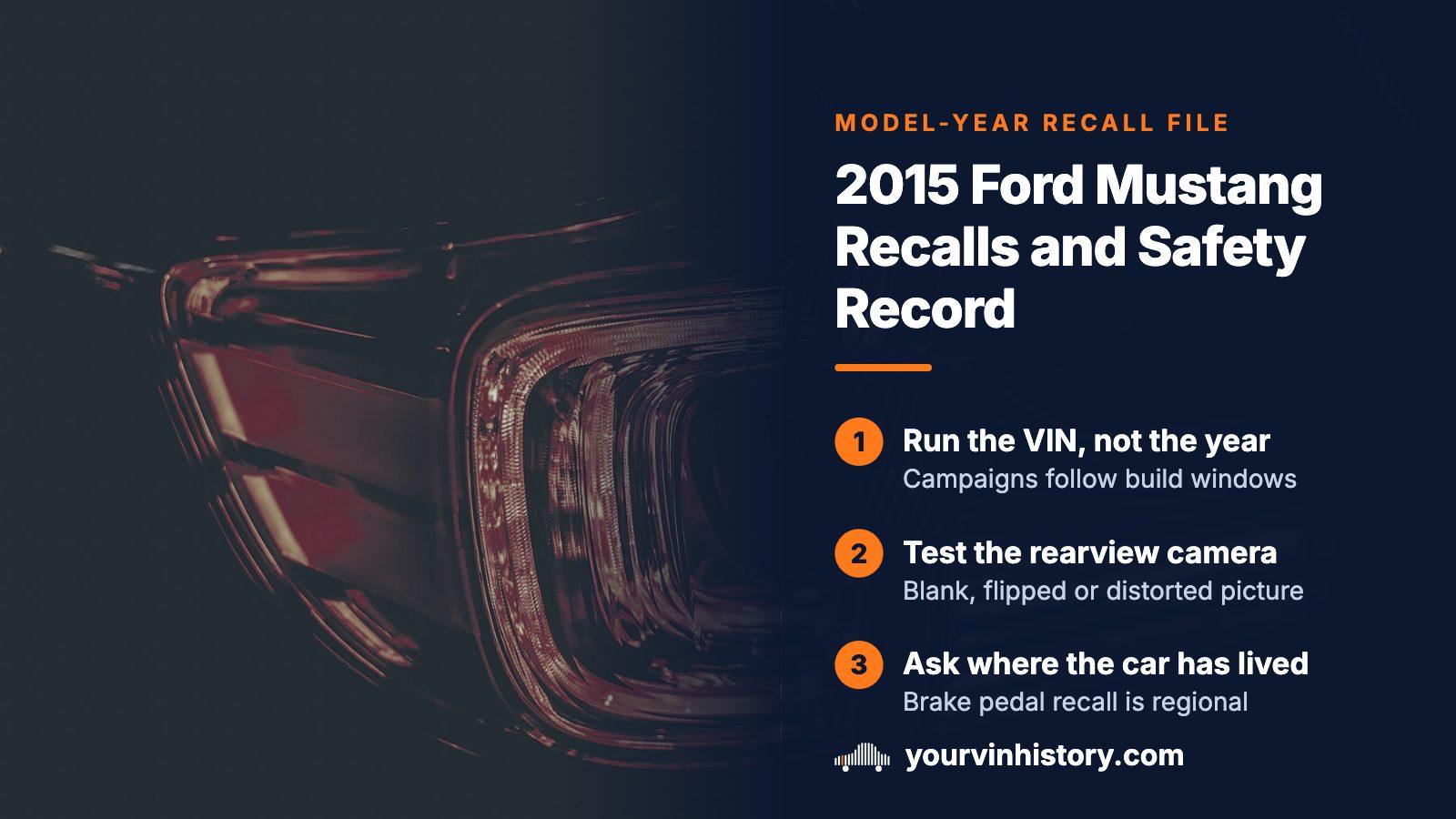
THE SHORT ANSWER
The 2015 Ford Mustang has 11 recall campaigns on file with NHTSA, covering an oil cooler hose, fuel leaks, seat belt and air bag sensing, brake parts, door latches and the rearview camera. Owners filed 436 complaints, led by unknown or other (75) and the electrical system (66). The 2 DR RWD listing scored 5 of 5 stars overall; the C RWD listing has no overall score. Recalls follow VIN ranges, so look up each car.
- Recall campaigns
- 11 on file with NHTSA
- Owner complaints
- 436, led by unknown or other at 17%
- NHTSA crash rating
- 5 of 5 overall on the 2 DR RWD listing
- Against other Mustang years
- 1.61 times the median, 3rd heaviest of 15
What the federal file holds on a 2015 Mustang
A model year collects three kinds of entry at NHTSA. A recall is a defect the manufacturer has accepted and must repair. A complaint is one owner's unchecked account. An investigation is the agency looking for a pattern, and it can end in a recall or in nothing. The 2015 Mustang has 11 recall campaigns, 436 complaints and 3 investigations.
Some filers also say what happened: 26 describe a crash, 7 a fire and 19 an injury. Those tags are the owner's wording, not NHTSA findings, and one incident can produce several reports.
The eleven campaigns, grouped by what they fix
NHTSA labels each campaign by component, which reads like a parts catalog. Sorted by problem, the 11 fall into six groups. The first two digits of a campaign number are the year NHTSA opened it.
| Problem | Campaigns | Who is covered |
|---|---|---|
| Engine oil leak | 16V779000 | Builds from February 2015 to August 2016 |
| Fuel leak | 14V774000, 15V339000 | Autumn 2014 builds; 2.3L cars built 2014 to early 2015 |
| Seat belts | 14V649000, 25V614000 | Builds from August to October 2014; 2015 to 2017 Mustangs |
| Brake hardware | 15V832000, 22V011000 | Roush Stage 3 GT; cars from certain humid or coastal states |
| Door latches | 16V643000, 20V331000 | Shared with other Ford and Lincoln models |
| Rearview camera | 22V082000, 25V572000 | 2015 to 2017 and 2015 to 2019 Mustangs |
Each campaign applies only inside its own build window, engine or sales region, so one Mustang can sit in four rows while another sits in none.
Oil and fuel: three campaigns about leaks
All three name fire as a possible outcome.
- 16V779000: a hose can come off the engine oil cooler tube assembly, and a sudden loss of oil can wreck the engine. Dealers fit a new assembly; the campaign began March 23, 2017. It reaches 2015 to 2017 Mustangs built February 24, 2015 to August 30, 2016, so an earlier 2015 build is outside it.
- 14V774000: cars built September 25 to October 9, 2014 may have a fuel pressure sensor seated poorly on the jumper line, which can leak. Dealers replace the line; the campaign began December 17, 2014.
- 15V339000: on 2.3L cars built February 14, 2014 to February 10, 2015, underbody heat can degrade the fuel tank, vapor lines and parking brake cable seals. Dealers replace the tank shield and add thermal patches and wraps; it began July 9, 2015.
Belts, air bags and brakes
- 14V649000: in Mustangs built August 18 to October 2, 2014, the passenger belt sensor can misjudge the occupant's size, rating a child as an adult or the reverse, so the air bag may deploy wrongly. That breaches Federal Motor Vehicle Safety Standard No. 208. Dealers replace the belt buckle.
- 25V614000: on 2015 to 2017 Mustangs, water and road salt can corrode the front belt pretensioner cables, and a broken cable means the belt may not restrain an occupant properly. NHTSA's summary lists the final remedy as expected in December 2026, so ask a dealer what is possible today.
- 15V832000: a Roush campaign, not Ford's, for Mustang GT Roush Stage 3 cars built April 1 to October 31, 2015 with Roush Extreme Duty half shafts. A rear caliper guide pin may be under-tightened and work loose, reducing rear braking. A Mustang without those Roush parts is outside it.
- 22V011000: heat, humidity and salt air can corrode the brake pedal bumper until it falls off, which can leave the brake lights on and, on an automatic, let the driver leave Park without pressing the pedal. It covers cars sold or ever registered in Gulf and Southeast states from Texas to Virginia, plus Hawaii.
Door latches and the rearview camera
Campaigns 16V643000 and 20V331000 cover a part inside the door latch that can break, leaving a door that will not latch or looks closed when it is not. The 2020 campaign is a second pass: Ford says the earlier repair on those cars may not have been done correctly, so dealers check latch date codes and replace side door latches as needed. A receipt for the first job does not close the file.
Campaign 22V082000 blames loose or damaged wiring at the trunk lid; dealers repair the harness or replace the camera. Campaign 25V572000, opened in 2025, covers a camera that can show a distorted, inverted or blank picture in reverse, and reaches Mustangs from 2015 through 2019 and many other models. Either fault cuts the driver's view behind the car.
Where the 436 complaints cluster
The category is the owner's pick at filing, so the table shows what people believed had failed. The catch-all leads at 17% and no system runs away, which looks like scattered complaints rather than one dominant fault.
| Category | Reports |
|---|---|
| Unknown or other | 75 |
| Electrical system | 66 |
| Engine | 51 |
| Service brakes | 51 |
| Structure | 45 |
| Power train | 42 |
| Exterior lighting | 42 |
| Back over prevention | 41 |
| Fuel and propulsion system | 28 |
| Air bags | 23 |
| Latches, locks and linkages | 21 |
| Steering | 17 |
Some categories sit beside recall entries: back over prevention beside the camera campaigns, service brakes beside the brake entries, latches beside the door entries. That overlap shows where owners and the recall file both point, not a proven common fault.
How old the car was when owners say it failed
Each complaint carries the date the owner gives for the failure, so the gap from the 2015 model year is the car's age then. Filings peaked in 2019.
| System | Median age in years | Filed within 3 years |
|---|---|---|
| Unknown or other | 5.4 | 23% |
| Electrical system | 5.3 | 29% |
| Engine | 4.4 | 45% |
| Service brakes | 6.8 | 33% |
| Structure | 5.2 | 38% |
| Power train | 4.2 | 43% |
| Exterior lighting | 5.6 | 5% |
| Back over prevention | 8 | 7% |
Engine and power train reports skew earliest. Service brakes sit near 6.8 years and back over prevention near 8, the latest of the group and the system to budget for on a car this old.
Medians, not failure rates
These are middle ages from unverified reports. They say when owners who complained say something broke, not the odds that a given part will fail. Complete service records can carry a car past every figure here.
Where 2015 sits among Mustang model years
Raw complaint counts track sales volume, so this site's year-by-year pages set each year against the Mustang's own median year. The result is a multiple, where one would be a typical year.
On that scale the 2015 Mustang is 3rd heaviest among 15 model years in the record, spanning 2008 to 2022, at 1.61 times the median. The heaviest is 2012 at 1.73 times and the lightest settled year is 2020 at 0.43 times. A complaint count is not a failure rate or reliability score; 2015 is a year to inspect with care, not rule out.
Crash ratings: two NHTSA listings, two answers
NHTSA scores the 2015 Mustang under two configurations, labeled 2 DR RWD and C RWD, with different results. The C label does not spell out its body style, so match the listing to your car.
| Test | 2 DR RWD | C RWD |
|---|---|---|
| Overall | 5 of 5 | Not rated |
| Frontal crash | 5 of 5 | Not rated |
| Side crash | 5 of 5 | Not rated |
| Rollover rating | 5 of 5 | 5 of 5 |
| Rollover probability | 8.1% | 8.1% |
On the 2 DR RWD listing the passenger side scored 4 in the side test and every other score was 5. Stability control is standard, forward collision warning was optional and lane departure warning was not offered. Stars describe the design as built, not a car repaired after a collision.
A walk-around plan built from the file
- Check the front of the engine for oil seepage along the cooler lines.
- Sniff for fuel near the rear; on a 2.3L car, look for the tank shield and heat wraps.
- Select reverse and watch the camera for a blank, flickering, inverted or distorted picture.
- Confirm the brake pedal has its rubber bumper and the brake lights go out on release.
- Close each door repeatedly and watch the dash door warning for a latch that sometimes fails to register.
- Feel the front footwell carpet for dampness, and confirm the belt and air bag lights go out after start-up.
- Scan the engine bay and trunk for scorched insulation, taped splices or aftermarket wiring, since 7 reports describe a fire.
- Listen for clunks from worn bushings, check under the trunk mat for standing water or repair seams, and compare ride height at all four corners.
Settling it with the VIN and the seller
Take the 17-character VIN to NHTSA's recall lookup. It lists the campaigns still open on that exact car, and any marked complete should have dealer paperwork behind it. Federal law, 49 U.S.C. 30120, requires repairs at no charge only when the first sale was no more than 15 calendar years before the manufacturer's notice, so ask about cost before booking.
- Which campaigns were completed, and where is the paperwork?
- Has the car ever been registered along the Gulf Coast, the Southeast coast or in Hawaii?
- Which shop did the maintenance, and can I read the invoices?
- Has insurance paid for a collision repair, and may my mechanic inspect the car before we agree on a price?
NHTSA's file leaves out accidents, title brands, odometer readings and liens. A vehicle history report on the VIN covers them; this site starts with a preview and sells the full report separately.
Where this information comes from
- NHTSA: recalls by vehicle — The VIN lookup that shows which campaigns are open on one car, and the campaign records summarized above.
- NHTSA: vehicle safety and consumer complaints — Entry point to the public complaint database behind the category counts and filing dates.
- NHTSA: New Car Assessment Program ratings — The federal crash-test program behind the star ratings and the driver-assistance listings.
- NMVTIS: national title record — The national title system, which holds the brands and history that a safety file leaves out.
Sources and photos: Facts checked against the sources above in October 2026. Photo by A n v e s h on Unsplash; diagrams by YourVINHistory.
Keep reading
- Ford Mustang years to avoid: 2008 to 2022 ranked by owner complaintsRanks every Mustang model year against the nameplate's median to show where 2015 stands.
- Ford recallsWalks through checking any Ford for open campaigns once you have the VIN.
- Buying a car with an open recallExplains your options when the lookup turns up a repair nobody performed.
- MustangReads the engine and body codes, which decide which campaigns can apply to a car.
Frequently asked questions
How many recall campaigns apply to a 2015 Mustang?
NHTSA lists 11, but no single car faces all of them. Build windows, engines, a Roush-only modification and a list of sales states each narrow who is covered, and two of the 11 revisit or expand earlier campaigns. A VIN lookup shows which are open on a specific car.
Is the 2015 Mustang reliable?
NHTSA data cannot answer that, because complaint counts are not failure rates. The record shows a year with 1.61 times the typical Mustang year's complaints, spread across about a dozen systems. Service history and a pre-purchase inspection are worth more than the model year alone.
Did the 2015 Mustang pass its crash tests?
The 2 DR RWD listing scored 5 of 5 stars overall, with 5 in the front and side tests and 5 for rollover. The C RWD listing has no overall, frontal or side score, only a 5 of 5 rollover rating. Both show an 8.1% rollover probability. Ask how any past collision was repaired.
Are 2015 Mustang recalls repaired at no charge?
Dealers do the work at no charge within the federal limit, which is 15 calendar years between first sale and the manufacturer's notice. Give the dealer the VIN and campaign number, and ask about cost before booking. Parts can lag: NHTSA lists the final remedy for campaign 25V614000 as expected in December 2026.
Does the recall record show accidents or a salvage title?
No. NHTSA's file holds recalls, complaints, investigations and crash tests. Title brands come from the national title system, while accidents, odometer readings, liens and auction records come from other sources. A vehicle history report on the VIN gathers those records so you can compare them with the seller's story.
Now check the car itself
The guide explains what to look for. The report shows what this VIN has on record.