THE SHORT ANSWER
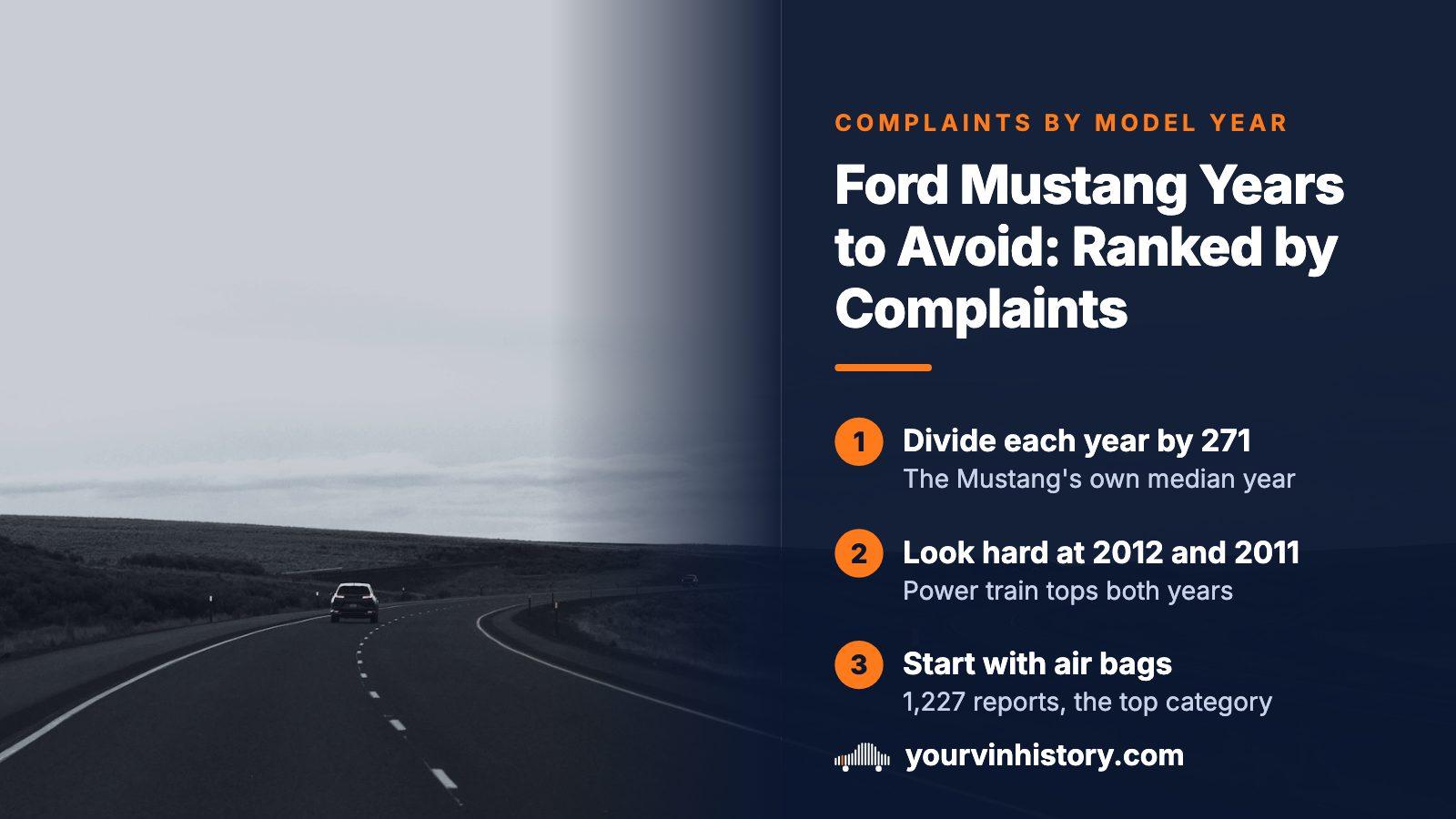
Judged by NHTSA complaint volume, the Mustang years to approach most carefully are 2012, 2011 and 2015, with 2021 and 2016 also running above the pack. The lightest record belongs to 2020, at 117 complaints versus a median year's 271. Air bags draw the most reports across the whole run. A high count is a cue to inspect harder and bargain, not proof that one car is faulty.
- Complaints on record
- 4,441 across 2008 to 2022
- Median year
- 271 complaints
- Heaviest year
- 2012, with 469 complaints
- Top complaint area
- Air bags, 1,227 reports
The yardstick: every year against the Mustang's own median
Raw complaint totals mostly follow sales. A model year that sold in huge numbers collects more owner reports than a rare one even when the cars are equally sound, and a year that has been on the road longest has had the most time to attract them. To blunt the sales effect, this ranking takes the Mustang's median year, 271 complaints, and divides every other year by it. A year at 1.73× has 1.73 times the median year's filings; a year at 0.43× has well under half.
The correction is partial. The figures come from NHTSA's consumer complaint database, where each entry is one owner's unverified account. Read a count as a pointer to where reports pile up, never as a failure rate or a reliability score. Duplicate filings were removed using each ODI complaint number, and the data was pulled on 2026-08-15.
All fifteen model years, 2008 through 2022
The last column sorts each year into three plain bands: elevated, mid-pack or light. In this data the line between mid-pack and elevated falls between 1.32× and 1.37×, and 2020 is the only year in the light band.
| Model year | Recalls | Complaints | Times the median | Band |
|---|---|---|---|---|
| 2008 | 8 | 347 | 1.28× | Mid-pack |
| 2009 | 6 | 181 | 0.67× | Mid-pack |
| 2010 | 6 | 260 | 0.96× | Mid-pack |
| 2011 | 5 | 466 | 1.72× | Elevated |
| 2012 | 7 | 469 | 1.73× | Elevated |
| 2013 | 6 | 271 | 1× | Mid-pack |
| 2014 | 4 | 359 | 1.32× | Mid-pack |
| 2015 | 11 | 436 | 1.61× | Elevated |
| 2016 | 5 | 371 | 1.37× | Elevated |
| 2017 | 6 | 264 | 0.97× | Mid-pack |
| 2018 | 4 | 186 | 0.69× | Mid-pack |
| 2019 | 6 | 142 | 0.52× | Mid-pack |
| 2020 | 8 | 117 | 0.43× | Light |
| 2021 | 6 | 395 | 1.46× | Elevated |
| 2022 | 9 | 177 | 0.65× | Mid-pack |
The two counts do not track each other closely. 2020 has the lightest complaint record yet carries 8 recalls, while 2011 has 466 complaints and only 5 recalls.
2012 and 2011: the pair at the top
The two heaviest years sit side by side. 2012 has 469 complaints, 1.73× the median, and 2011 has 466, or 1.72×. Power train is the most-reported category for both. In 2012 air bags also stand out, so a car from that year draws attention on two fronts.
Power train is a wide bucket in NHTSA's coding. It takes in the transmission and the rest of the drive line, so the count cannot say which part upset owners. What it does tell a buyer is where a test drive should concentrate on these two years: shifting, drive-line noise and how the car pulls away from a stop. Recalls for the pair are modest, 5 for 2011 and 7 for 2012, which leaves most of the weight on the complaint side.
2015 and 2016: the busiest recall year and its follower
2015 posts 436 complaints, 1.61× the median, and 11 recalls, more than any other year in the run. Its leading category is the catch-all labeled unknown or other, so NHTSA's coding does not point to one system. 2016 follows with 371 complaints, 1.37×, 5 recalls, and engine at the head of its list.
With that many campaigns on one model year, the question for a 2015 car is whether the ones that apply to its build range were carried out. Campaigns attach to production ranges, so two 2015 Mustangs on the same lot can differ. A separate page on this site covers the 2015 Mustang, names its open campaigns and splits its complaints by component.
2021: a leap from 117 to 395
The sharpest move in the run comes between 2020 and 2021. Complaints climb from 117 to 395 in a single model year, taking the multiple from 0.43× to 1.46×. Electrical system is the leading category for 2021, which logged 6 recalls against 8 the year before.
A step like this is often tied to a design or mechanical change, though these figures cannot say what changed on the Mustang. The practical point is narrower: 2020 and 2021 are neighbors in age and far apart on paper, so the model year on the title matters more here than in a stretch where the counts slide down gradually. Electrical is a broad category too, which makes service records more useful than hunting for one suspect part.
The lighter years: 2020, 2019 and the quiet ones near them
Only 2020 lands in the light band, with 117 complaints at 0.43×. 2019 is next at 142 (0.52×), and 2018 at 186 (0.69×) follows the same downward slope. Further back, 2009 is quiet too, at 181 complaints and 0.67×. 2022 shows 177 at 0.65×, but it is the newest year in the run, and young cars have had less time to collect reports. The ranking keeps the newest years off its cleanest list for that reason, so read 2022 as provisional.
A quiet complaint record is not a clean one. 2020 carries 8 recalls and 2022 carries 9, among the higher counts in the table, so each of these years still needs its campaigns checked against the VIN.
Where Mustang complaints cluster by component
Added up across every model year, air bags lead by a wide margin. This is how NHTSA's leading categories stack up for the Mustang:
| Component | Reports, 2008 to 2022 | Where it shows up |
|---|---|---|
| Air bags | 1,227 | Largest overall; also prominent in 2012 |
| Power train | 717 | Tops the list for 2011 and 2012 |
| Electrical system | 541 | Tops the list for 2021 |
| Engine | 365 | Tops the list for 2016 |
| Unknown or other | 324 | Tops the list for 2015 |
| Structure | 171 | Smallest of the six shown |
The 1,227 air bag figure is the one to act on, since it applies to any year, and it sits well ahead of power train at 717. The data behind this page does not break out what owners say inside each category, so use the table as a map of where reports sit, not as a diagnosis. On a Mustang of any year, an air bag warning light or a repaired front end deserves an explanation before the sale.
Why recall counts and complaint counts differ
A complaint is an owner's unverified account. A recall is a defect the manufacturer has acknowledged and must remedy. The repair comes at no charge, but only within a limit: under 49 U.S.C. §30120(g), the duty to fix without charge lapses for a car more than 15 years past its first sale, with the clock running from that sale to the date the recall notification begins.
A Mustang with many recalls is therefore not automatically a worse buy. A year can show plenty of campaigns and few complaints, which can mean problems were found early and repaired. What matters is whether the campaigns covering the specific car were performed, and NHTSA's recall lookup answers that from the VIN at no cost.
What to check on a Mustang from a flagged year
The counts point at where to look. A sensible order for a 2011, 2012, 2015, 2016 or 2021 car:
- Run the VIN through NHTSA's recall lookup, then ask for paperwork on any campaign marked complete.
- Read the service records, watching for drive-line work on a 2011 or 2012 and electrical repairs on a 2021.
- Watch the dash at start-up. The air bag light should come on briefly and then go out.
- Drive long enough to include a cold start, shifts through the gears and some stop-and-go.
- Put the car on a lift, where a mechanic can spot repaired structure, leaks and worn mounts.
From model year to this particular Mustang
Everything above describes a population. The car in the driveway has its own history: which recalls were done, what the title says, whether the odometer readings climb sensibly, and what a mechanic finds underneath. A model-year table contains none of that.
The federal NMVTIS holds title and brand records on individual vehicles, and NICB's VINCheck screens a VIN for theft and total-loss entries at no cost. A yourvinhistory check opens with a preview at no cost; the full report is a one-time purchase covering accident damage, odometer readings, salvage and auction photos, liens and open recalls.
A multiple is a prompt for questions
Each year in the table includes cars that were looked after and cars that were not. Let a high number shape your inspection and your offer, not your decision to skip a car you have never seen.
Where this information comes from
- NHTSA: Vehicle safety — The agency whose complaint filings supply every yearly count in the ranking above.
- NHTSA: Recalls — Where the per-year recall counts come from, plus the VIN lookup for open campaigns on one car.
- Bureau of Justice Assistance: NMVTIS — The federal title information system, which covers the individual car's records that a model-year table cannot.
- NICB: VINCheck — A no-cost theft and total-loss screen for a single VIN.
Sources and photos: Facts checked against the sources above in October 2026. Photo by John Kakuk on Unsplash; diagrams by YourVINHistory.
Keep reading
- 2015 Ford Mustang recalls: 11 campaigns, 436 complaints, what to checkThe recall-heavy 2015 year on its own page, with campaigns and complaints split by component.
- Ford recallsHow to find open Ford recalls from a VIN, the first check on any Mustang.
- MustangReading a Mustang's VIN to confirm the year and build behind a listing.
- Airbag deployed checkAir bags lead the complaint list, so see what a deployment check can and cannot show.
Frequently asked questions
Which Ford Mustang years should I avoid?
Start with 2012, 2011 and 2015, which have the three highest complaint counts, then look at 2021 and 2016. For 2015, add a recall check, since it has 11 campaigns on record. None of these years is an automatic no: a well-kept 2012 with documented drive-line service can be a better buy than a neglected 2013, which sits right on the 271 median.
What is the most reliable Ford Mustang year?
No complaint count measures reliability, but the counts do show which years drew the fewest reports. 2020 is lightest at 117, then 2019 at 142, 2022 at 177, 2009 at 181 and 2018 at 186. Treat 2022 as provisional because it is the newest year, and remember that 2020 still has 8 recalls to verify.
Which problem do Mustang owners report most often?
Air bags, by NHTSA's component coding, with 1,227 reports across the run. Power train follows at 717, then electrical system at 541 and engine at 365. These are categories, not diagnoses, so one entry can describe many different faults. Use the ranking to decide what a mechanic should examine first, not to predict what will fail.
Do recalls on a used Mustang cost anything to fix?
Dealers perform recall remedies at no charge, within a federal limit: the duty ends for cars more than 15 years past first sale, measured to the start of the recall notice. An older Mustang may fall outside that window for a recent campaign. Ask the dealer to confirm coverage by VIN before you count on it.
How do I check the history of one specific Mustang?
Use the VIN. NHTSA's recall lookup shows open campaigns, NICB's VINCheck screens for theft and total-loss records, and NMVTIS holds title and brand records. A model-year table cannot stand in for any of them. Also compare the tenth character of the VIN with the model year on the listing; if they disagree, ask why.
Now check the car itself
The guide explains what to look for. The report shows what this VIN has on record.