THE SHORT ANSWER
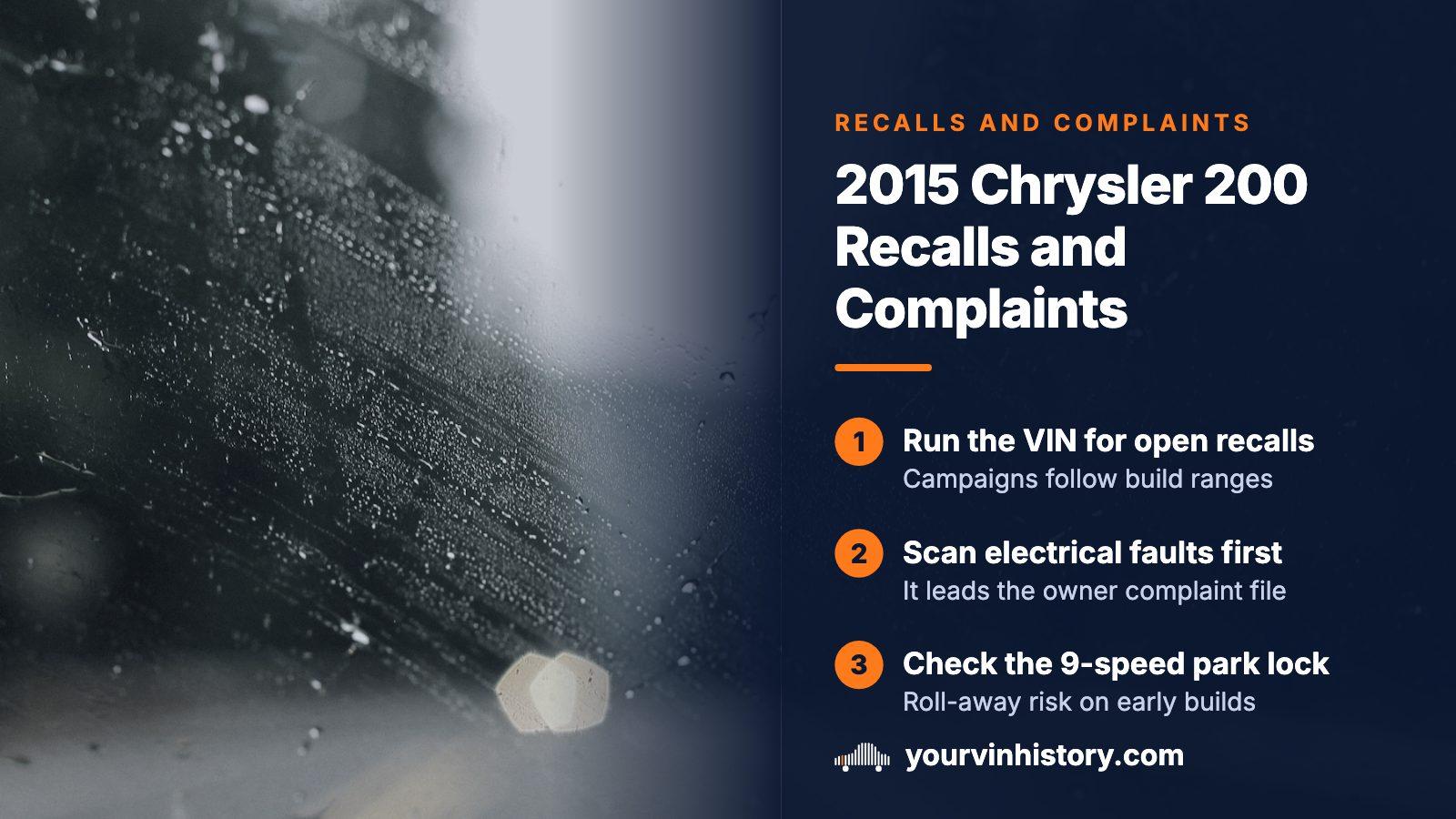
The 2015 Chrysler 200 has 8 recall campaigns with NHTSA, filed under wiring, automatic transmissions, a passenger air bag sensor, a radio and a rear shock absorber. Owners filed 1,983 complaints, 750 of them about the electrical system. The front-wheel-drive sedan earned 5 of 5 stars overall and 4 of 5 for rollover. Recalls follow VIN ranges, so only a VIN lookup shows what is open on one car.
- Recall campaigns
- 8 on file with NHTSA
- Owner complaints
- 1,983, led by the electrical system at 38%
- Among 200 model years
- Heaviest of 7, at 5.8 times the median year
- Crash ratings
- 5 of 5 overall for front-wheel drive; rollover 4 of 5
Two records, one model year: what each can tell you
NHTSA keeps two separate files on this car, and they carry different weight. A recall campaign is a defect that Chrysler (FCA US LLC) has acknowledged and promised to repair; the 2015 200 has 8 of them. A complaint is an owner's report that nobody has verified, and the agency holds 1,983 for this model year. Neither describes the particular sedan on a seller's lot, but together they show where a buyer should look hardest.
Some complaints describe worse outcomes: 99 mention a crash, 24 a fire and 58 an injury. Those tags come from the person filing, not from an investigator, and one incident can produce several reports. NHTSA also lists 1 investigation touching this model year. An investigation can end in a recall or in nothing, so it is an early signal and not a conclusion.
The eight campaigns in one table
Dealers and NHTSA both work from campaign numbers, so write them down. This page describes four of the eight in full. The other four are known here only by the system they touch, and they also cover other models, as industry-wide actions often do.
| Campaign | System it is filed under | Described below |
|---|---|---|
| 15V470000 | Electrical system | Yes |
| 14V480000 | Electrical system, wiring | Yes |
| 18V332000 | Electrical system, wiring | System only |
| 15V090000 | Power train, automatic transmission | Yes |
| 16V529000 | Power train, automatic transmission | System only |
| 16V114000 | Air bags, occupant classification sensor | Yes |
| 15V461000 | Electrical equipment, radio and similar | System only |
| 14V392000 | Suspension, rear shock absorber | System only |
The wiring recalls: a stalling risk and a door harness fire risk
Campaign 15V470000 applies to 2015 200s built between January 7, 2014, and September 23, 2014. A connector in the Power Distribution Center can make power to some components drop out on and off, and Chrysler warns the car could stall without notice. The repair depends on the engine: on 3.6L cars, dealers replace the C4 connector with a 12-wire split kit, and on 2.4L cars they replace the transmission wiring harness. The recall began October 21, 2015, as Chrysler code R24.
Campaign 14V480000 is narrower: cars built from May 19 to June 21, 2014. The driver-side door harness used wire too thin for its load, so heat can melt the insulation, cause a short and start a fire. Dealers swap the harness. It began October 3, 2014, as code P43.
The park pawl recall and the passenger seat sensor recall
Campaign 15V090000 involves the 9-speed automatic on cars built March 9 to December 15, 2014. The parking pawl can pick up contamination, or the park rod can work loose or break. The display may then read Park while the lock has not engaged, and the car can roll away. Dealers inspect the transmission and replace any unit showing a fault. It began April 9, 2015 (code R08).
Campaign 16V114000 is a repair-history problem rather than a factory one. On cars built April 7, 2014, to August 3, 2015, the front passenger seat's Occupant Classification Module or its cushion foam may have been replaced alone during service, although the two form a calibrated pair. A mismatched set can make the passenger air bag deploy improperly in a crash. Dealers fit an OCM-SCF service kit. It began May 27, 2016 (code S09).
Where the 1,983 complaints land
NHTSA files each complaint under the component the owner blames. This is how the model year's reports spread, with every share measured against all 1,983.
| Component | Share of all complaints | Reports |
|---|---|---|
| Electrical system | 38% | 750 |
| Power train | 35% | 693 |
| Engine | 31% | 605 |
| Air bags | 16% | 326 |
| Unknown or other | 14% | 275 |
| Vehicle speed control | 8% | 159 |
| Service brakes | 6% | 113 |
| Electronic stability control | 5% | 108 |
| Steering | 4% | 86 |
| Suspension | 3% | 60 |
| Fuel and propulsion | 3% | 54 |
| Wheels | 2% | 33 |
The shares add up to well over 100% because one report can name more than one component. The shape matters more than the total: three components draw the bulk of the file, which points at specific weak spots instead of ordinary wear. These are things owners believed had happened, so test them against the actual car.
How old the car was when owners say trouble began
Each complaint carries the date the owner says the problem happened, so the gap from the 2015 model year gives the car's age at that moment. Filings peaked in 2019. The table covers the eight largest components.
| Component | Median age in years | Dated reports | Within three years |
|---|---|---|---|
| Electrical system | 3.3 | 747 | 48% |
| Power train | 2.7 | 689 | 54% |
| Engine | 3.7 | 604 | 42% |
| Air bags | 3.4 | 326 | 42% |
| Unknown or other | 3.6 | 275 | 40% |
| Vehicle speed control | 3.2 | 158 | 49% |
| Service brakes | 2.6 | 113 | 55% |
| Electronic stability control | 3.5 | 108 | 38% |
Power train and service brake reports came early, with more than half inside the first three years, so a car that was looked after may have had those repairs made years ago. Ask to see the invoices. Engine reports arrive latest, at a median of 3.7 years. These are medians of unverified reports, not failure rates: they say when complainers say it broke, not how likely any one car is to break.
Where 2015 sits among Chrysler 200 model years
NHTSA's record for this nameplate spans 7 model years, 2011 through 2017. Measuring each year against the nameplate's own median year strips out much of the effect of sales volume. By that yardstick the 2015 is the heaviest of the run for complaints, at 5.8 times the median. The lightest settled year is 2017, at 0.13 times the median.
A multiple like that is a screening tool, not a verdict on any one car. When two 200 listings sit at similar prices, it is a fair reason to press harder on the 2015 for service records and recall paperwork.
Crash-test results and the two tested configurations
NHTSA's New Car Assessment Program tested this model year. The figures below belong to the four-door front-wheel-drive version.
| Test | Result |
|---|---|
| Overall | 5 of 5 stars |
| Frontal crash | 5 of 5 stars |
| Side crash | 5 of 5 stars |
| Rollover | 4 of 5 stars |
| Rollover probability | 10.7% |
The agency rated two configurations separately. The front-wheel-drive sedan has the 5-star overall result. The all-wheel-drive sedan shows no overall rating, although its rollover result is also 4 of 5, so the headline score does not carry over to it on paper. Forward collision warning was optional on this model year, and lane departure warning was an option to confirm, so check the equipment on the car itself. Stars describe a tested design, not a repaired one.
No-charge repairs and the 15-year limit
Federal law, 49 U.S.C. 30120, requires a manufacturer to remedy a recalled defect at no charge to the owner. The same section ends that duty when the first purchaser bought the vehicle more than 15 calendar years before the manufacturer's notice or the government's order, whichever came earlier. So the car's age counts on the day a recall is announced, not the day you reach the service desk. The four campaigns described above began between October 2014 and May 2016, while the car was young.
To see what is open on one car, enter its VIN in NHTSA's recall lookup. Build ranges decide who is covered: a 200 assembled in 2015 falls outside the build windows of three of the four campaigns described here.
What to inspect on a used 2015 200
Let the complaint pattern decide where a mechanic looks first.
- Electrical system, 750 complaints: scan for stored fault codes and operate every power function, including the door-mounted ones.
- Power train, 693 complaints: shift cold and warm, and on a 9-speed car in the 15V090000 build range, ask whether the park pawl inspection was done.
- Engine, 605 complaints: listen on a cold start and ask for oil change records.
- Wiring and engine bay: owners filed fire complaints, so look for heat damage, melted insulation and amateur add-ons.
- Passenger seat: ask whether the seat module or cushion was ever replaced, and watch the air bag warning light at start-up.
- Recall paperwork: a dealer work order that closes each campaign for this VIN.
A sedan this age also needs the ordinary checks no federal file covers: worn suspension bushings, standing water in the trunk well, and uneven ride height at the corners, which can hint at an unreported collision.
Questions for the seller, and what the federal file leaves out
- Were all 8 campaigns completed, and is there paperwork to prove it?
- Has the electrical system been repaired or replaced, and by whom?
- Which shop handled the maintenance, and do you have the invoices?
- Has the sedan ever been in a crash that an insurer paid to fix?
- Will you let my own mechanic look it over before we talk price?
- Do you hold the title outright, with no lender listed?
Recall and complaint data say nothing about branded titles, collision history, odometer readings or liens. For those, run the VIN through a history report. A yourvinhistory report starts with a preview and then offers a one-time purchase, with title brand records supplied by ClearVin, an approved NMVTIS data provider, alongside accident, odometer, salvage and auction entries.
Where this information comes from
- NHTSA: Recalls — Where a VIN returns the campaigns that apply to one car, and the source for the eight campaign numbers used here.
- NHTSA: Vehicle safety and owner complaints — Entry point to the complaint database behind the totals and component categories in this record.
- 49 U.S.C. §30120: Remedies for defects and noncompliance — The statute that requires a no-charge remedy and sets the 15-calendar-year limit counted from first purchase.
- NHTSA: New Car Assessment Program ratings — The federal crash-test program behind the star results, rollover figures and driver-aid listings.
- NMVTIS: National title record — The federal title database, which holds brand and history data that recall files do not.
Sources and photos: Facts checked against the sources above in October 2026. Photo by Cole Keister on Unsplash; diagrams by YourVINHistory.
Keep reading
- Chrysler 200 years to avoid, ranked from NHTSA complaint dataEvery Chrysler 200 model year ranked against the nameplate's own median.
- Recall check by VINThe step-by-step way to learn which campaigns are open on one VIN.
- Buying a car with an open recallWhat to do if the lookup shows a repair still outstanding.
- What is a branded title?The title brands that matter more than any complaint pattern.
Frequently asked questions
Is the 2015 Chrysler 200 reliable?
NHTSA data cannot settle that, because complaint counts are not failure rates. What the file does show is that this model year has the highest complaint volume of the 7 Chrysler 200 years on record, led by electrical, power train and engine reports. One car with full service records and completed recalls tells you more than the model-year totals do.
How do I check a 2015 Chrysler 200 for open recalls?
Enter the 17-character VIN in NHTSA's recall lookup. It lists the campaigns that apply to that number and whether the repair is still open. The VIN is on a plate at the base of the windshield on the driver's side and on the door jamb sticker, and both should match the title.
Will a dealer fix a recall on a 2015 200 at no charge?
Within the federal limit, yes: the remedy costs the owner nothing. That limit counts 15 calendar years from the first purchase to the manufacturer's notice. Bring the VIN and the campaign number, and ask for a work order that names the campaign, so the repair is documented for the next buyer.
Does the 2015 Chrysler 200 have a transmission recall?
Two campaigns are filed under power train, automatic transmission: 15V090000 and 16V529000. The first concerns the parking pawl and park rod in the 9-speed, on cars built March 9 to December 15, 2014. This page has no detail on the second, so read its notice on NHTSA's site for the build range and remedy.
Does a clean recall result mean the car has a clean history?
No. Recall data covers manufacturer defects only. A car can show no open campaigns and still carry a salvage brand, an unreported collision, a rolled-back odometer or a lien. Title brand records come from NMVTIS, the federal title database, so a vehicle history report built on them is worth running before you hand over money.
Now check the car itself
The guide explains what to look for. The report shows what this VIN has on record.