THE SHORT ANSWER
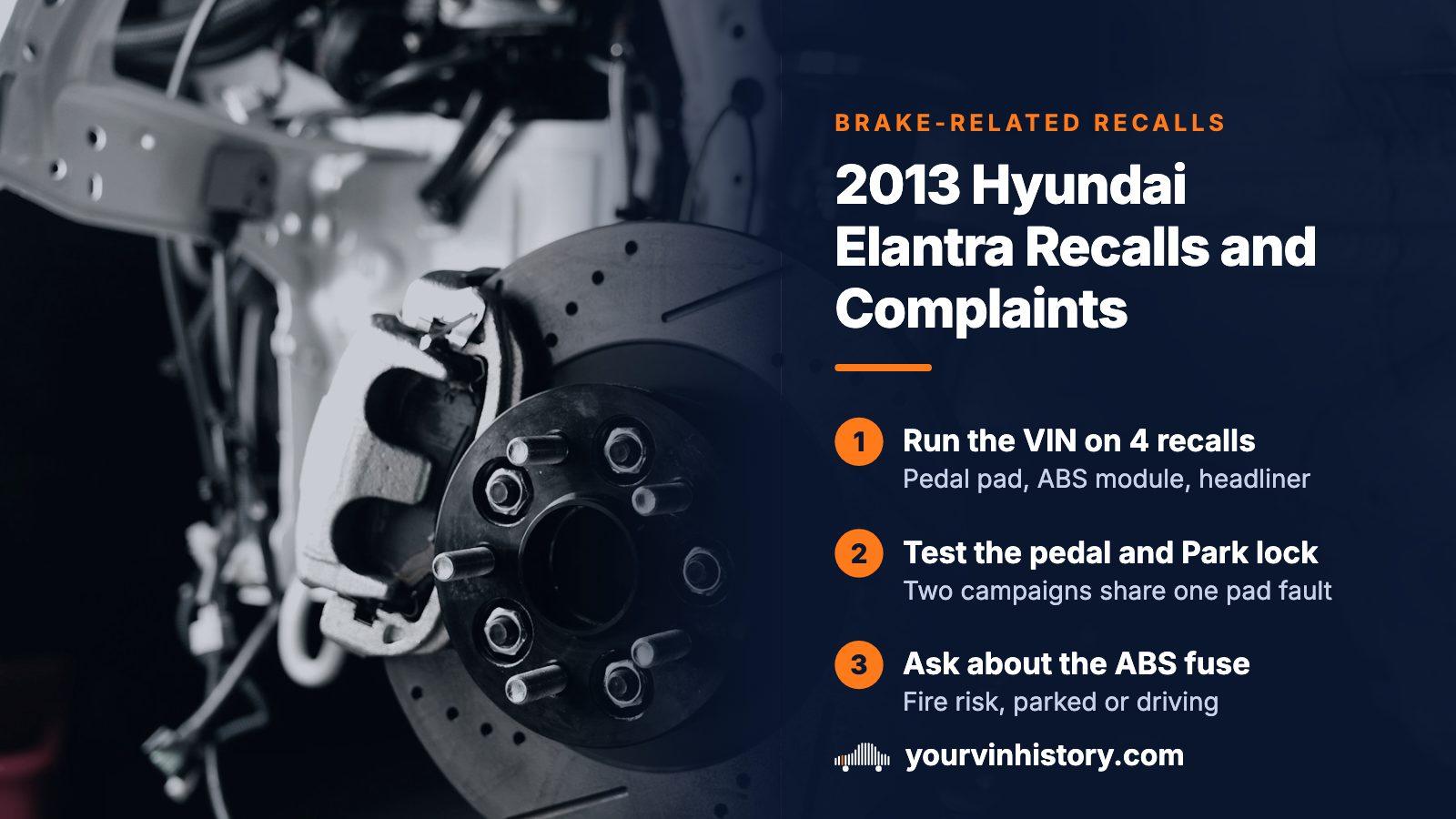
The 2013 Hyundai Elantra has 4 recall campaigns on file with NHTSA and 1,331 owner complaints, led by service brakes at 21%. The 4-door sedan earned 5 of 5 stars overall, while the 2-door version carries no rating. Recalls follow build ranges, not model years, so the car's own VIN decides which campaigns apply and whether each repair was made.
- Recall campaigns
- 4 on file with NHTSA
- Owner complaints
- 1,331, with 21% under service brakes
- Complaint volume
- Heaviest of 15 Elantra model years
- NHTSA overall rating
- 5 of 5 for the 4-door; 2-door not rated
What NHTSA keeps on file for this model year
The agency holds two kinds of record on the 2013 Elantra, and they carry different weight. A recall is a defect the manufacturer has acknowledged and promised to repair, and this model year has 4. A complaint is one owner's account, filed with the government and never tested by an investigator, and there are 1,331. One is a commitment from the maker; the other is a pattern that owners reported.
Some filings describe a crash (95), a fire (30) or an injury (68). Those flags reflect the owner's wording, and one incident can produce several reports, so read them as entries worth opening, not as findings. NHTSA also lists 4 investigations touching the model year. An investigation can end in a recall or in nothing, which makes it an early warning and not a verdict.
The four recall campaigns, side by side
Every campaign attaches to a build range, so two Elantras parked side by side can have different open repairs.
| Campaign | The fault | Cars named | Dealer repair |
|---|---|---|---|
| 16V574000 | Deteriorating pedal stopper pad leaves the brake light switch plunger extended | 2013 Elantras built December 1, 2012 to April 30, 2013 | Improved pad |
| 17V769000 | Same pedal pad fault, wider group of cars | Elantra sedans, coupes and GTs, model years 2013 and 2014 | Replace the pad |
| 13V115000 | Headliner bracket can slip during a side-curtain air bag deployment | 2011-2013 Elantras built November 12, 2010 through March 5, 2013 | Adhesive strips on the headliner |
| 23V651000 | ABS module can leak fluid internally, short out and start an engine compartment fire | Elantras from 2011 to 2015, among many other Hyundai models | Replace the ABS fuse |
Two campaigns, one pedal pad
The two pedal campaigns describe a single part. When the stopper pad behind the brake pedal wears out, the plunger on the brake light switch can stay pushed out after the driver lifts off. The brake lights then stay lit, and the drivers behind get no signal about whether the car is slowing. Both notices add that the shift lever can leave Park without the pedal being pressed, and they say either condition raises crash risk.
The first repair, 16V574000, was scheduled to start on September 30, 2016. The expansion, 17V769000, was set to begin in February 2018 and reaches the 2013 and 2014 cars. A car built outside the first window can therefore still be open on the second. Ask the seller which campaign covered the pad, and have a mechanic confirm the lever stays in Park until the pedal is pressed.
The ABS fire recall and the headliner bracket
Campaign 23V651000 is the one to take most seriously. Hyundai reported that the anti-lock brake module can leak fluid inside itself and cause an electrical short, which can lead to a fire in the engine compartment whether the car is parked or moving. Until the repair is done, owners were advised to park outside and away from buildings. Owner letters were mailed between April 10, 2024 and October 11, 2024, so a car sold around then could have had its letter go to the previous owner.
The air bag campaign, 13V115000, concerns a support bracket on the headliner that can come loose in a side-curtain deployment and, if it touches a passenger, cause a laceration. That repair began in April 2013, which makes it the oldest of the four and the one most likely to be done already. Confirm it anyway.
Where the 1,331 complaints land
Owners file each complaint under the part they blame. Raw volume mostly follows sales, so the more useful read is the spread. These are the ten largest categories.
| Share | Complaints | System named by owners |
|---|---|---|
| 21% | 284 | Service brakes |
| 20% | 272 | Steering |
| 18% | 236 | Engine |
| 13% | 170 | Air bags |
| 12% | 155 | Electrical system |
| 10% | 127 | Unknown or other |
| 9% | 115 | Hydraulic |
| 7% | 99 | Suspension |
| 6% | 81 | Wheels |
| 5% | 73 | Exterior lighting |
The shares add up to well over 100% because one filing can name several components. The Hydraulic row is the back half of NHTSA's service brakes, hydraulic label, which also classifies two of the recall campaigns, so read it beside the Service brakes row. No single category dwarfs the rest: brakes, steering and engine lead a spread of ordinary complaints, not one dominant failure.
When owners filed and how old the car was
Filings for this model year peaked in 2024, more than a decade after the cars were built. A late peak points to parts that wear out on schedule, still ahead for the next owner. Filings bunched near launch usually mean a flaw fixed under warranty. The ABS owner letters also went out in 2024, though nothing in the data says the two are linked.
| System | Median age at failure | Dated reports | Within first 3 years |
|---|---|---|---|
| Service brakes | 10.7 years | 282 | 17% |
| Steering | 6.5 years | 271 | 27% |
| Engine | 6.1 years | 236 | 17% |
| Air bags | 6.5 years | 169 | 15% |
| Electrical system | 5.8 years | 154 | 28% |
| Hydraulic | 10.8 years | 115 | 3% |
| Suspension | 1.7 years | 99 | 73% |
Suspension is the outlier: nearly three quarters of its reports arrived inside the first three years, so a well-kept car may already have had the work done under warranty, and the paperwork will say. The brake rows sit at the late end, which makes brake hydraulics the likely budget item on a car this old. These are medians of unverified reports, not failure rates.
How this year compares with other Elantras
Across the 15 Elantra model years on record, 2008 through 2022, the 2013 is the heaviest for complaints. Measured against the median Elantra year it runs at 4.23 times the volume, while the lightest settled year, 2022, sits at 0.48 times.
Older cars have had longer to collect complaints, so a high multiple does not make a 2013 a bad buy on its own. It does mean this year deserves more checking than a typical Elantra year. The Elantra years-to-avoid guide on this site ranks every model year on the same measure.
Crash-test stars depend on the door count
NHTSA rated two versions of this model year on their own, and the results differ. The 4-door front-wheel-drive Elantra earned 5 of 5 stars overall and 4 of 5 for rollover, with 4 stars in the frontal test and 5 in the side test. The 2-door entry has no rating, which is why some summaries call the car unrated.
| Configuration | Overall | Rollover |
|---|---|---|
| 2-door, front-wheel drive | Not rated | Not rated |
| 4-door, front-wheel drive | 5 of 5 | 4 of 5 |
Driver-assistance equipment is thin: NHTSA records forward collision warning as not offered and lane departure warning as not available. Stars describe a new test vehicle, not the one on the lot, and they cannot see how well a past collision was repaired.
Recall repairs at no charge and the 15-year limit
A manufacturer owes a recall repair at no cost, but the duty has an end. The limit sits in 49 U.S.C. §30120(g): it lapses when the first buyer purchased the vehicle more than 15 calendar years before the manufacturer's notice or NHTSA's order, whichever came first.
The four campaigns here date from 2013 through 2024, inside that window for a car first sold in 2013, so a dealer should perform them at no charge. A campaign announced in some later year will eventually fall outside it. Dealers sometimes repair out-of-window cars anyway, but ask before you assume, and ask before you buy. Run the 17-character VIN through NHTSA's recall lookup to see what is still open on that exact car.
What to inspect on a used 2013 Elantra
The complaint pattern tells a mechanic where to look first. Start with the recall items, then work through the systems owners named most.
- Brakes: pedal feel, brake light operation and any history of a soft or pulsing pedal.
- Steering: play, noise and warning lights, since it is the runner-up system.
- Engine bay: heat damage, fluid seepage and amateur wiring, because fire reports exist for this model year.
- Recall completion: match each of the 4 campaigns to dealer paperwork, not to a seller's memory.
- Suspension corners: uneven ride height can hide a collision repair the paperwork never mentions.
- Bushings and trunk floor: worn subframe bushings, standing water or repair seams.
- Firewall seals and the cabin filter housing, where water tends to reach the footwells.
Questions for the seller, and what a VIN history adds
- Which of the 4 campaigns did a dealer complete, and what do the work orders say?
- Has anything in the brake system been replaced, from the pedal pad to the ABS fuse?
- Who maintained the car, and do receipts exist?
- Was there ever an insurance claim or collision repair?
- Will you let an independent mechanic put it on a lift first?
- Is the title clean and held in your name, without a lender's lien?
NHTSA's file cannot answer the last three. A VIN check on this site begins with a preview, and the full yourvinhistory report is a one-time paid purchase that adds title brands, accident and salvage records, odometer readings and lien status for that VIN.
The VIN is the dividing line
Everything on this page describes the model year. Only the VIN shows which of the four campaigns apply to the car in front of you.
Where this information comes from
- NHTSA: recalls and VIN lookup — Where to enter a VIN and see which campaigns are still open on that particular car.
- NHTSA: vehicle safety and complaints — The federal database holding owner complaints and the component categories they are filed under.
- 49 U.S.C. §30120: remedies for defects — The statute behind repairs at no charge, including the 15-calendar-year cutoff.
- NHTSA: New Car Assessment Program ratings — Star ratings for the frontal, side and rollover tests, listed by configuration.
- NMVTIS: national title record — The federal title-record system, which covers brands and history that the safety file leaves out.
Sources and photos: Facts checked against the sources above in October 2026. Photo by Erik Mclean on Unsplash; diagrams by YourVINHistory.
Keep reading
- Hyundai Elantra years to avoid: 2008 to 2022 ranked by NHTSA complaintsSee how the 2013 ranks against every other Elantra model year on complaints.
- Hyundai recallsLook up Hyundai campaigns by VIN, including the four listed for this year.
- Buying a car with an open recallWhat to do when a campaign is still unrepaired on the car you want.
- NMVTIS reportThe title record that NHTSA's safety file does not include.
Frequently asked questions
How many recall campaigns cover the 2013 Elantra?
Four: 13V115000 for a headliner bracket, 16V574000 and 17V769000 for the brake pedal pad, and 23V651000 for the ABS module. Each is tied to a build range, so one Elantra may be covered by some and not others. NHTSA's lookup answers it for a single VIN, including whether a completed repair was recorded.
What do owners complain about most on the 2013 Elantra?
Service brakes lead with 284 of 1,331 complaints, followed by steering at 272 and engine at 236. These are unverified owner reports, and a filing can name several components, so the categories overlap. They show a mechanic where to look during an inspection, not what will fail on any one car.
Is the 2013 Elantra safe to buy?
The 4-door front-wheel-drive version earned 5 of 5 stars overall from NHTSA, with 4 of 5 for rollover, and the 2-door has no rating. Stars cannot capture age, upkeep or collision repair, so judge the individual car by its condition, its repair paperwork and its recall status.
What should I do if an Elantra's brake lights stay on?
Stuck-on brake lights are the symptom the pedal pad campaigns describe. Following drivers cannot tell when you slow down, and the shift lever may leave Park without the pedal pressed, so have a Hyundai dealer look at it promptly. Check the VIN first to see whether 16V574000 or 17V769000 is still open.
Where do these recall and complaint figures come from?
They come from NHTSA's public records: recall campaigns, owner complaints and crash-test ratings. Counts change as new filings arrive, so use NHTSA's own lookup for the current picture of a specific car. Title brands and ownership history sit outside the safety file, in NMVTIS records.
Now check the car itself
The guide explains what to look for. The report shows what this VIN has on record.